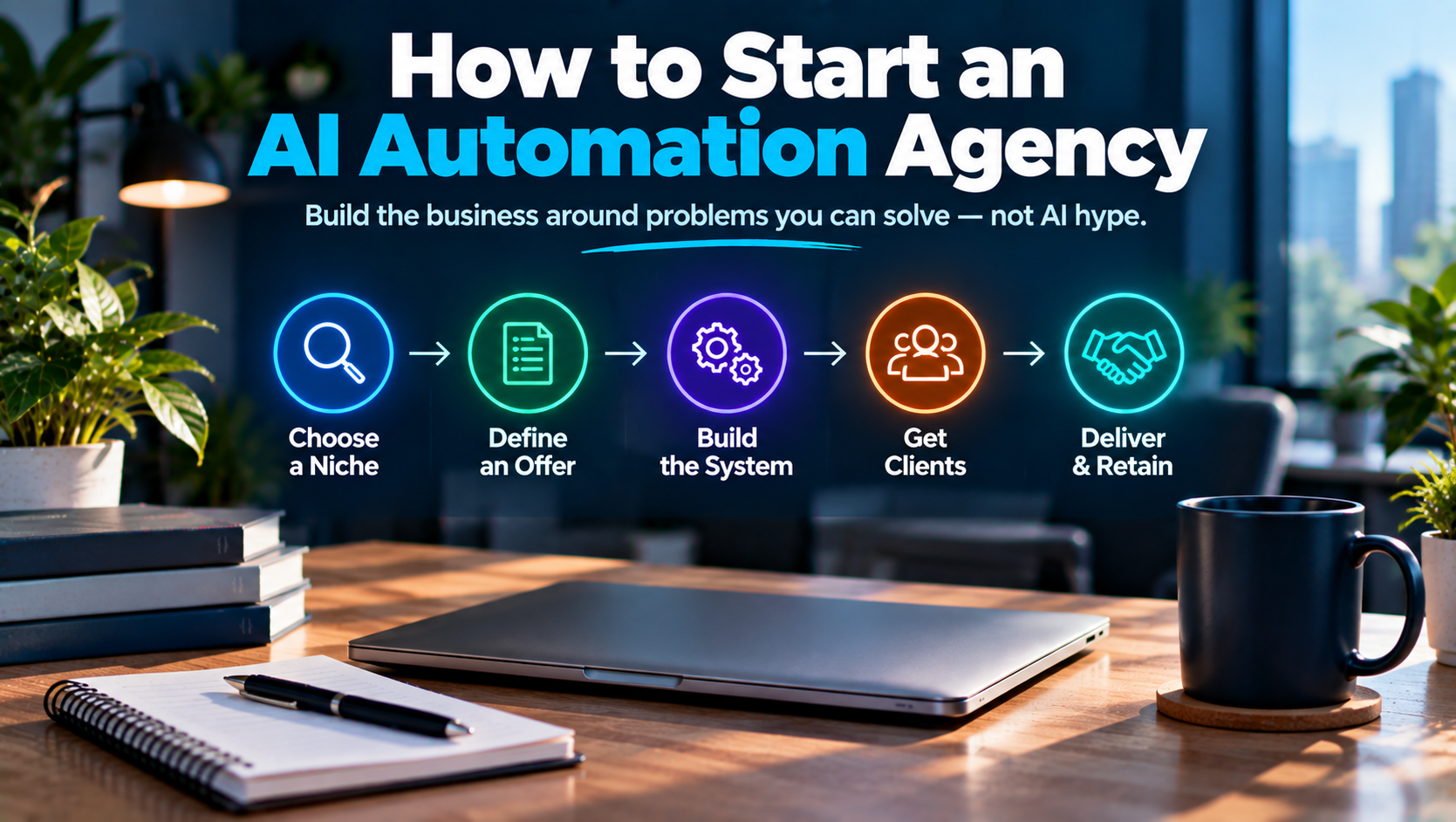
There are two versions of the AI automation agency business floating around the internet right now.
The first one goes something like this:
Learn a few AI tools.
Build a chatbot.
Cold DM 100 businesses.
Charge somebody $5,000 a month.
Repeat until Lamborghini.
I wouldn't build a business around that plan.
The second version is considerably less sexy, which is usually a good sign.
Find problems businesses already have. Learn how AI and automation can help solve some of them. Package the solution into something useful. Sell it. Implement it well. Keep improving it.
That's an actual business.
And if you're considering starting an AI automation agency, that's the version worth understanding.
What is an AI automation agency?
An AI automation agency is a service business that helps other businesses implement AI, automation and connected software systems to improve how work gets done.
That might mean helping a company:
- respond to new leads
- follow up with prospects
- schedule appointments
- handle repetitive customer questions
- organize information
- update a CRM
- automate administrative work
- reactivate old leads
- request customer reviews
- route inquiries
- create internal workflows
- reduce repetitive data entry
The important part isn't the AI.
It's the problem being solved.
That's where I think a lot of the conversation around AI agencies gets backwards.
Business owners generally aren't sitting at their desks thinking:
I really need an AI automation.
They're thinking:
We're missing calls.
Nobody follows up with these leads.
My staff wastes hours doing this manually.
Customers keep asking us the same questions.
Our CRM is a disaster.
We're paying for leads that aren't turning into appointments.
Those are business problems.
AI and automation are tools you may be able to use to solve them, and a collection of practical AI automation ideas can show what that looks like across real business processes.
That distinction sounds simple, but it changes almost everything about how you build the business.
Is an AI automation agency a legitimate business model?
Yes — and if you want the fuller case for whether an AI automation agency is actually profitable, that's covered separately.
But not because attaching "AI" to something automatically makes it valuable.
Companies have paid consultants, agencies, software vendors and implementation specialists for decades to help improve sales, marketing, operations and customer service.
AI creates new ways to solve some of those same problems, and small businesses are increasingly using AI as part of how they operate and grow.
The opportunity is essentially an implementation gap.
Powerful tools exist.
Business owners know AI exists.
But knowing ChatGPT exists and having a reliable system operating inside your company are two very different things.
Someone still needs to determine:
- what problem should be solved
- what should happen
- which technology makes sense
- how the pieces connect
- where humans remain involved
- what happens when something goes wrong
- how the system gets implemented
- how it gets maintained
That creates room for service businesses that can bridge the gap between available technology and practical implementation.
And you don't necessarily need to invent new AI technology to participate.
You can build useful solutions using technology that already exists.
What are you actually selling?
This is probably the most important question in this article.
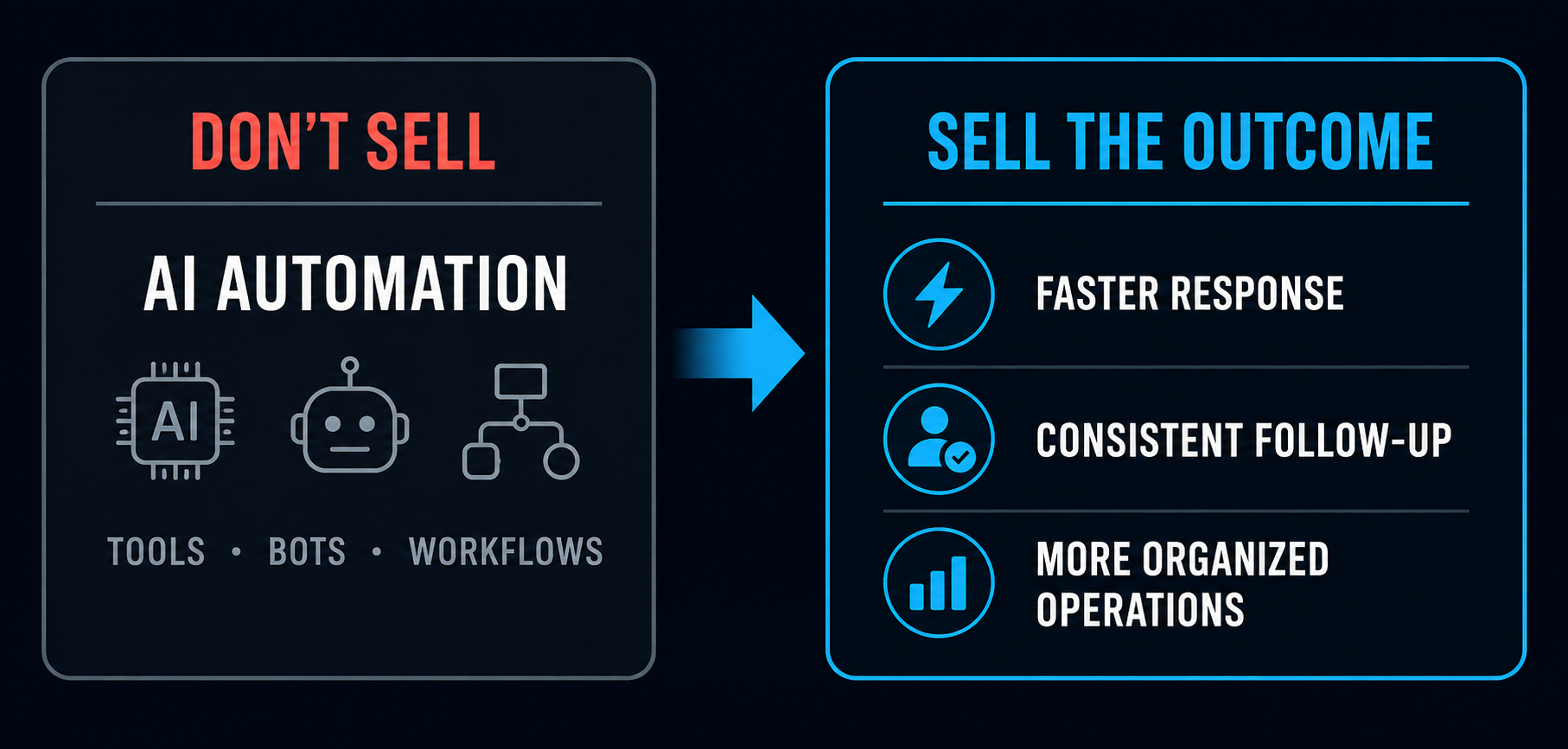
Don't sell:
AI automation.
Sell what the automation helps accomplish.
Consider the difference.
Offer A
We provide cutting-edge AI automation solutions utilizing advanced conversational artificial intelligence.
Cool.
What does that do?
Offer B
We help home-service companies respond to new inquiries, follow up automatically and make it easier for qualified prospects to schedule an estimate.
Now I understand why I might care.
The technology behind Offer B could include:
- AI
- workflow automation
- SMS
- CRM software
- calendars
- forms
- web chat
- phone systems
- integrations
But the client doesn't need a tour of your technology closet before they understand the value.
Lead with the problem.
Then explain the system.
Start with problems businesses already pay to solve
One of the easiest ways to make starting an AI agency unnecessarily difficult is to invent a solution and then wander around looking for somebody who wants it.
Reverse that.
Look at where businesses already spend money.
They pay for:
- employees
- receptionists
- customer service
- marketing
- advertising
- salespeople
- appointment setters
- administrative staff
- software
- lead generation
- reputation management
Now look for repetitive work, communication gaps and inefficient processes inside those areas.
That's where opportunities start appearing.
Example: lead response
A service company generates inquiries through Google Ads, SEO, referrals and its website.
But some calls go unanswered.
Website forms sit in an inbox.
Follow-up depends on whether somebody remembers.
That's not fundamentally an "AI problem."
It's a lead-conversion problem.
A solution might combine automated acknowledgment, CRM organization, follow-up, missed-call text back, scheduling and AI-assisted conversations.
The client isn't buying artificial intelligence.
They're buying a better system for handling opportunities they're already generating.
That's also why I've become increasingly interested in the space from a digital-marketing perspective.
Generating attention and leads is only one side of the equation.
What happens after somebody raises their hand matters too.
What services can an AI automation agency offer?
There are dozens. We've ranked the best AI automation services to sell in a separate guide if you want the full breakdown.
Don't offer dozens.
Especially when you're starting.
A few broad categories include:
Lead response and follow-up systems
Capture inquiries, respond, organize contacts, trigger follow-up and help move prospects toward conversations or appointments.
AI chat and conversational systems
Answer appropriate questions, collect information, qualify inquiries and escalate conversations when human involvement is needed.
AI voice systems
Handle certain inbound or outbound phone workflows, answer common questions, capture information, route calls or assist with appointment scheduling.
CRM and pipeline automation
Create contacts, update opportunities, assign leads, trigger tasks and keep customer activity organized.
Appointment and reminder systems
Connect scheduling with confirmations, reminders, rescheduling and follow-up.
Reputation automation
Trigger review requests at appropriate points in the customer journey and make the process easier to manage consistently.
Customer service automation
Handle repetitive questions, categorize requests, route issues and assist human support teams.
Internal workflow automation
Move information between applications, generate documents, summarize data, trigger tasks or eliminate repetitive administrative steps.
None of these categories automatically makes a good offer.
A good offer needs a specific customer + meaningful problem + useful outcome.
Don't start by trying to automate an entire company
This is another place where beginners can get carried away.
They discover automation software and suddenly want to redesign a client's entire operation.
Don't.
Start narrower.
Find one painful workflow.
Understand it.
Improve it.
Make it reliable.
Then expand.
For example:
Weak starting offer:
Complete AI transformation for small businesses.
That could mean virtually anything.
Stronger starting offer:
We help roofing companies automatically respond to new web leads and continue following up when the prospect doesn't answer the first call.
Now you have something you can actually:
- demonstrate
- explain
- build
- price
- improve
- repeat
Specificity makes businesses easier to build.
Do you need to choose a niche?
Eventually, some specialization can be extremely useful. If you want a deeper framework for evaluating markets, our guide to choosing an AI automation agency niche walks through it in detail.
But I wouldn't let "pick the perfect niche" become another excuse to spend six weeks building spreadsheets instead of talking to businesses.
There are two reasonable approaches.
Niche first
Choose a type of business you understand and find a recurring problem inside that industry.
For example:
Pool contractors → slow lead follow-up
Dentists → appointment reminders and reactivation
Property managers → repetitive tenant communication
Problem first
Choose a problem that appears across several industries.
For example:
Missed calls → lost conversations
Old leads → no reactivation process
Website inquiries → inconsistent follow-up
Repetitive questions → staff time consumed
Then test which industries care enough to pay for the solution.
Either can work.
The important thing is eventually becoming known for solving something.
"We do AI" isn't a market position.
What skills do you actually need?
This is where the "no skills required" crowd loses me.
You don't necessarily need to be a software engineer.
But you're still building a business.
That requires skills.
At minimum, you'll need to develop competence in several areas.
Business-process thinking
Can you look at how a company currently handles something and identify where the friction is?
This may matter more than knowing 97 AI tools.
Automation
You need to understand triggers, actions, conditions, data flow, integrations and what happens when something breaks.
AI implementation
You should understand what AI is reasonably good at, where it is unreliable and when a deterministic automation or human should take over.
Sales
Someone still has to convince a business owner that the problem matters and that you're capable of solving it. Our guide to selling AI automation services covers how to lead with the business problem instead of the technology.
ChatGPT cannot save you from learning how to sell.
Sorry.
Communication
You'll need to explain technical systems in normal human language.
If your explanation requires a 46-box automation diagram before the prospect understands why they should care, you've probably already lost them.
Client management
Businesses will ask questions.
Things will change.
Integrations will break.
Someone will inevitably forget the password to something important. A structured client onboarding process helps you catch those issues before they become problems.
Welcome to services.
You don't need to master every AI tool
This is one of the biggest rabbit holes.
Every week there's another:
MUST-USE AI TOOL THAT CHANGES EVERYTHING
Then three weeks later nobody talks about it.
Learn enough tools to deliver the outcome you're selling.
That's different from collecting software subscriptions like Pokémon cards.
Depending on your offer, your stack may include categories such as:
- CRM
- workflow automation
- AI models
- communication
- scheduling
- forms
- websites
- databases
- integration tools
Platforms such as GoHighLevel can combine several of those functions into one environment, while tools such as Zapier, Make or n8n can connect applications and create more customized workflows. For a full breakdown of the tools an AI automation agency actually needs, we cover that separately.
But don't build your identity around a platform.
Tools change. Problems don't change nearly as quickly.
If your entire pitch is:
I'm a [software name] reseller.
you're making yourself easier to replace.
Build the simplest version that solves the problem
You don't need your first solution to resemble NASA mission control.
Suppose your offer solves missed website leads.
Version one might simply:
- capture the form submission
- create the contact
- send an acknowledgment
- notify the business
- trigger follow-up
- provide an appointment option
- record the activity
That's already useful.
Later you might add:
- AI qualification
- conversational follow-up
- advanced routing
- reactivation
- reporting
- voice AI
- additional channels
But complexity should be earned.
Every extra integration creates another place something can fail.
A boring system that works beats an impressive demo that breaks Tuesday morning.
How should you package the service?
You can sell automation several ways. We cover the full framework for turning capabilities into a clear, sellable offer in how to package AI automation services into an offer.
Project-based
The client pays you to build a specific system.
Good for custom implementation work.
The downside is that you're constantly hunting for the next project.
Setup fee + monthly management
The client pays for implementation and then ongoing management, maintenance, software, optimization or support.
This can create recurring revenue when there is legitimate recurring value.
Productized service
You solve a similar problem for a similar customer using a repeatable delivery process.
This is the model I find especially interesting.
Instead of:
We build anything with AI.
you might sell:
Lead-response and appointment automation for home-service companies.
The underlying system can still be customized.
But your sales message and delivery become much more repeatable.
SaaS or white-label model
Some platforms allow agencies to provide software access under their own brand.
That can create another recurring-revenue component.
But software alone isn't automatically an offer.
If the client logs in and has no idea what to do with it, congratulations—you've created another subscription they'll eventually cancel.
Implementation and business value still matter.
What should you charge?
There isn't a universal AI automation agency price list. For a practical framework on how to price your work, see our guide to pricing AI automation services.
And anybody telling every beginner to immediately charge the same giant monthly retainer is skipping several important variables.
Pricing depends on things such as:
- complexity
- implementation time
- ongoing work
- software costs
- usage costs
- business value
- customization
- support requirements
- risk
- your experience
- market
- scope
A useful structure for many services is:
Implementation / setup fee
plus
Ongoing monthly fee
The setup fee compensates you for designing and implementing the system.
The monthly fee should correspond to something that actually continues:
- software access
- maintenance
- monitoring
- optimization
- support
- usage
- ongoing automation management
Don't manufacture a retainer because recurring revenue sounds nice.
Create recurring value.
How do you get your first client?
You probably don't need a 73-step funnel. We've written a full playbook for getting your first AI automation client if you want the step-by-step process.
You need conversations.
Start with businesses you can reasonably reach.
That might include:
- existing professional relationships
- local businesses
- previous clients
- referrals
- email outreach
- direct outreach
- networking
- industry groups
But change the pitch.
Don't lead with:
Hi, I run an AI automation agency and wanted to show you our revolutionary AI solutions.
Delete.
Instead, find something specific.
For example:
I noticed your website asks people to request an estimate. What happens after somebody submits the form if nobody gets back to them right away?
Now you're discussing the business.
That's where you want the conversation.
A simple way to find opportunities: follow the customer journey
Pick a business.
Pretend you're the customer.
Then walk through the experience.
How do I discover them?
What happens when I visit the website?
How do I contact them?
What happens if they miss my call?
What happens after I submit a form?
How do they follow up?
Can I schedule?
Do I receive reminders?
What happens if I don't buy today?
What happens after I become a customer?
You're looking for friction.
Not every friction point needs AI.
Some need ordinary automation.
Some need better website copy.
Some need a CRM.
Some need an employee to actually pick up the phone.
That's fine.
Your job isn't to force AI into the process.
Your job is to improve the process.
Build a demo around a problem, not a toy
A demo can make an intangible service much easier to understand.
But demonstrate something commercially relevant.
A chatbot that knows 400 facts about Star Wars proves that AI can talk about Star Wars.
Congratulations.
Instead, demonstrate:
New website inquiry → acknowledgment → qualification → appointment option → CRM update
Now a business owner can imagine that operating inside their company.
The best demos create the reaction:
"Wait... this could handle that for us?"
That's much more valuable than showing off how complicated your workflow builder looks.
Your first offer doesn't need to be perfect
This matters.
You're going to learn things after speaking with actual businesses that you will never learn while polishing your website.
Maybe nobody cares about the feature you thought was amazing.
Maybe the thing you considered minor is the part everybody wants.
Maybe your niche hates monthly retainers.
Maybe they love them.
Maybe the owner doesn't care about AI chat but desperately wants missed calls handled.
Good.
That's information.
Treat your first version as something to validate.
Don't spend three months constructing the ultimate agency before discovering whether anybody wants what you're selling.
Where AI agencies get into trouble
There are several predictable traps.
Selling technology instead of value
Business owners don't owe you money because you learned how to connect two APIs.
Automating processes you don't understand
If you don't understand the business workflow, automating it can simply make mistakes happen faster.
Overpromising AI
AI can misunderstand instructions, hallucinate, misclassify information and behave unpredictably.
Build guardrails.
Test.
Monitor.
Know when a human needs to take over.
Ignoring compliance
Text messaging, calling, customer data, industry regulations and privacy requirements aren't magically suspended because your workflow has an AI step in it.
Understand the rules relevant to what you're implementing.
Depending entirely on one platform
Platforms change pricing.
Features disappear.
Policies change.
APIs change.
Build expertise around solving the problem, not clicking buttons inside one tool.
Trying to offer everything
Chatbots.
Voice AI.
SEO.
Ads.
Websites.
CRM.
Content.
Agents.
Automations.
SaaS.
Consulting.
Custom software.
And apparently blockchain because why not.
Pick a lane.
You can expand later.
The recurring-revenue opportunity is real—but earn it
One reason the AI automation agency model is attractive is the potential for recurring revenue.
Systems often require:
- software
- hosting
- communication usage
- maintenance
- monitoring
- optimization
- support
- changes as the business evolves
That can justify ongoing fees.
But here's the standard I'd use:
If you disappeared tomorrow, would the client lose something they genuinely value each month?
If yes, you may have recurring value.
If not, you're probably just trying to turn a one-time project into a subscription.
Create recurring value.
Where GoHighLevel fits
GoHighLevel is one platform that can make this business model easier to operate because it combines many functions an automation provider may need, including CRM, communication, workflows, websites, funnels and scheduling. If you want a fuller picture of what the platform can do, my complete guide to GoHighLevel breaks it down.
It's particularly relevant if your offer revolves around lead management, customer communication and appointment workflows.
But here's the part that matters:
GoHighLevel isn't the business.
Neither is Zapier.
Neither is Make.
Neither is n8n.
Neither is ChatGPT.
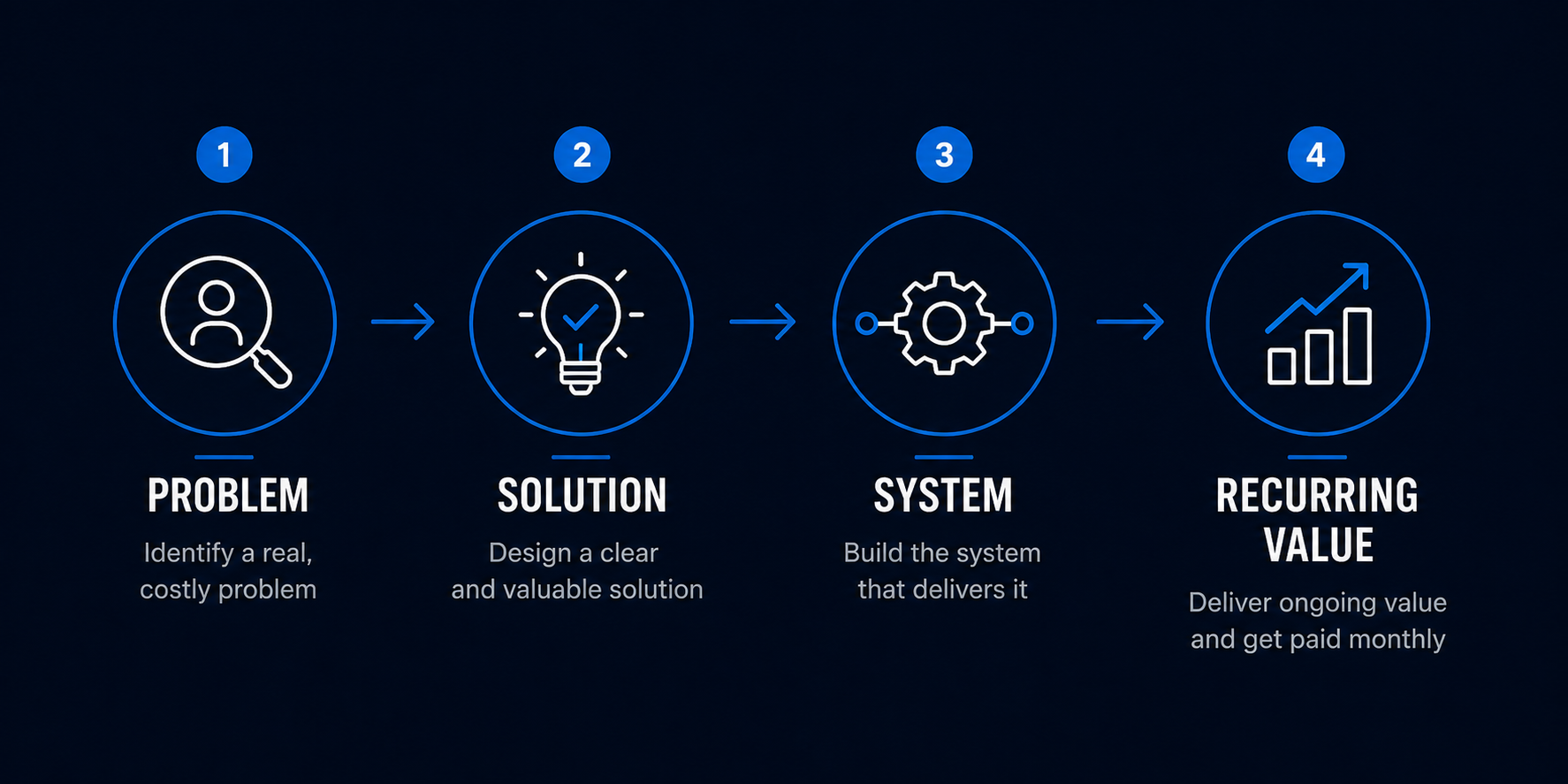
The business is:
Find problem → design solution → implement system → deliver value → maintain relationship.
The tools sit underneath that.
That's why I wouldn't start by asking:
Which AI software should I sell?
I'd start with:
What painful business process can I become unusually good at fixing?
Can you start an AI automation agency as a side hustle?
Potentially, yes.
The model doesn't necessarily require an office, inventory or a large team to begin.
But don't confuse low startup overhead with zero work.
You'll still need time to:
- learn
- build
- test
- prospect
- sell
- onboard
- implement
- support clients
If you're starting alongside a job or another business, narrowness becomes even more important.
One repeatable offer for one type of problem is considerably easier to manage than becoming the world's most exhausted full-service AI conglomerate on Tuesday nights.
A practical path from zero
If I were starting from scratch, I'd keep the first version simple.
1. Learn enough automation to be dangerous—in the useful sense
Understand basic workflows, triggers, actions, CRM concepts, how different software tools connect, and where AI can fit into the process.
You don't need mastery yet.
You need competence.
2. Choose one business problem
Not "AI."
A problem.
Preferably one tied to money, time, customer experience or operational friction.
3. Choose a likely customer
Identify businesses that regularly experience that problem.
4. Build a working example
Create the smallest reliable system that demonstrates the solution. If you're new to the build process itself, our guide on how to build an AI automation for a client walks through it step by step.
5. Talk to businesses
Ask questions.
Learn how they currently handle the problem.
Don't spend the entire conversation presenting.
6. Sell an outcome
Explain what improves.
Then explain how your system helps, and when they're ready, capture the scope, deliverables and pricing in a clear AI automation proposal.
7. Deliver manually where necessary
Your first delivery process doesn't need to be perfectly automated.
Ironically, your automation agency may contain manual work.
You'll survive.
8. Document what repeats
Turn successful delivery steps into templates, checklists and reusable components.
9. Create recurring value
Maintenance, optimization, software, support and ongoing management can turn project work into recurring relationships when justified.
10. Expand after you've earned the complexity
Add services because customers reveal opportunities.
Not because another YouTube thumbnail scared you into thinking you're behind.
The opportunity isn't "AI." It's the gap between technology and implementation.
That's the part I'd keep coming back to.
Businesses don't necessarily need another person telling them AI is changing everything.
They need people who can look at a real process and say:
Here's what's broken.
Here's what we can improve.
Here's what should be automated.
Here's where AI helps.
Here's where a human should stay involved.
And here's how we can actually implement it.
That's a useful skill set.
And useful skill sets can become businesses.
The AI automation agency opportunity is real.
But the sustainable version probably looks less like selling futuristic technology and more like something businesses have paid for forever:
Solving expensive problems well.
Want a More Actionable Starting Point?
If you're serious about exploring this business model, I created the 48-Hour AI Cashflow Stack to help turn the idea into a more concrete starting point.
It walks through how to think about the offer, tools, systems and business opportunity without requiring you to invent everything from scratch.
It's not a promise that you'll make money in 48 hours.
That would be nonsense.
It's a framework for getting out of research mode and beginning to build something real.
Download the 48-Hour AI Cashflow Stack and use it as your starting blueprint.