You have a good discovery call.
The client has a real problem.
You can already picture the automation.
Then comes the dangerous sentence:
“Great. Send me a proposal.”
This is where a surprisingly large number of AI automation projects start becoming vague.
The provider writes three pages about AI agents, integrations, workflows and everything the technology could do.
The client reads it and still isn't entirely sure:
What exactly are you building?
What am I responsible for?
How much does it cost?
What's included after launch?
And what happens if this thing doesn't behave exactly as expected?
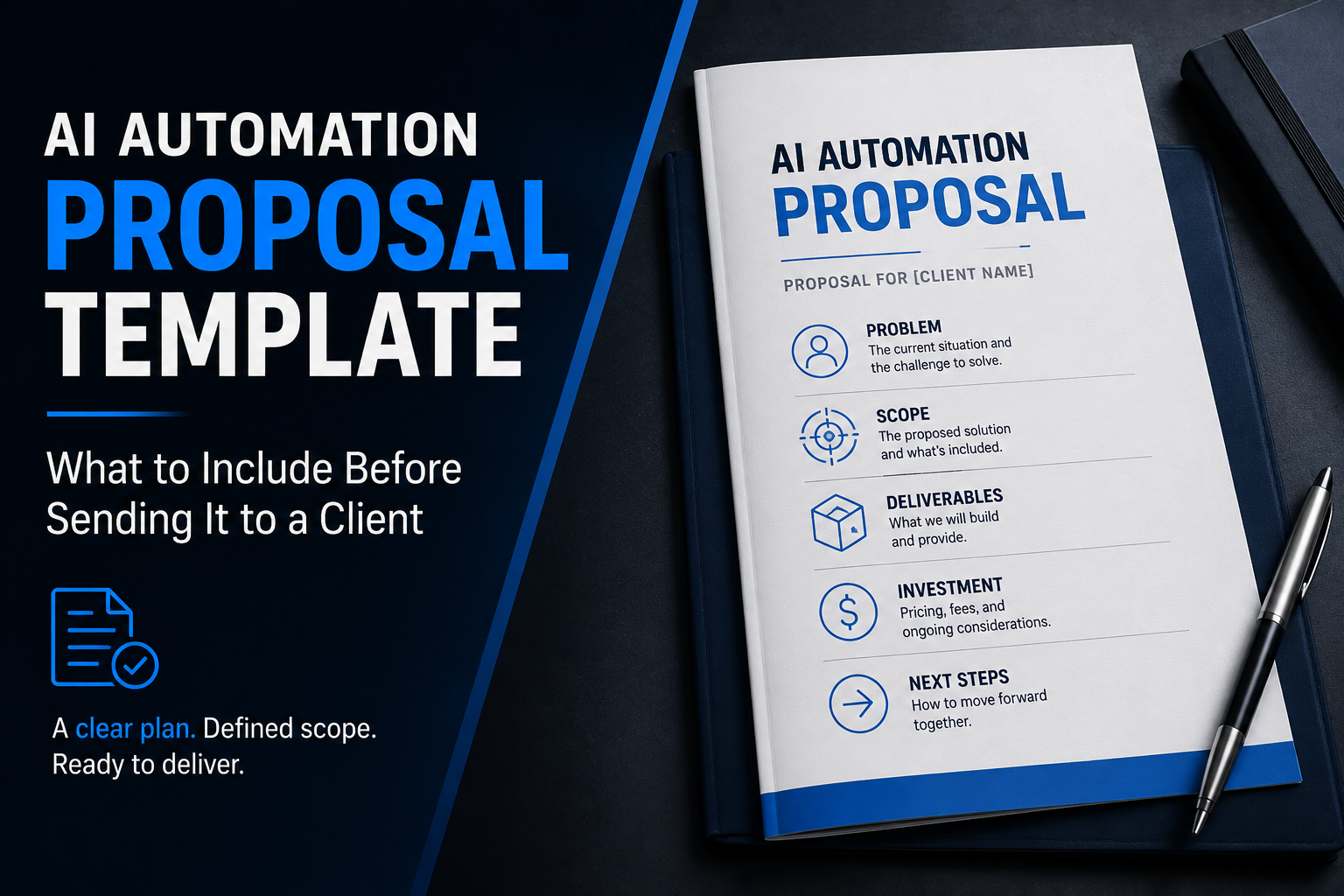
A good AI automation proposal should answer those questions before the project starts.
It doesn't need to be 30 pages long.
It needs to make the engagement clear enough to buy and clear enough to deliver.
What Should an AI Automation Proposal Include?
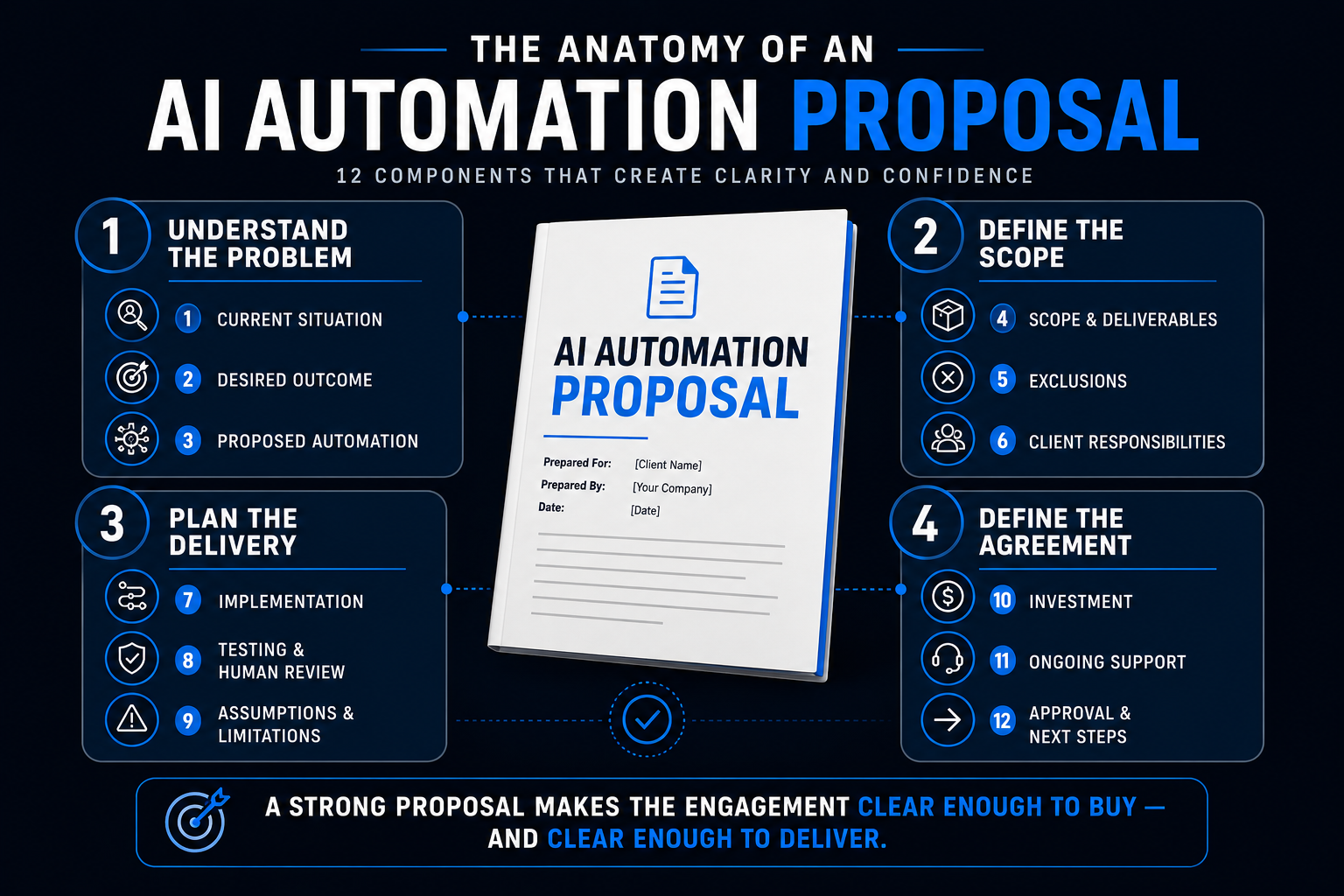
At minimum, a useful AI automation proposal should usually cover:
- the client's current problem
- the desired outcome
- the proposed automation
- the scope and deliverables
- what is not included
- client responsibilities and dependencies
- implementation approach and timeline
- testing and human review
- pricing and ongoing costs
- support or maintenance
- assumptions and limitations
- approval and next steps
That may sound like a lot.
It doesn't have to be.
Some projects can cover all of that in a concise proposal.
The goal isn't document length.
The goal is removing expensive ambiguity before somebody says yes.
Before the Proposal: Discovery Has to Come First
A proposal shouldn't be where you discover what the client needs.
That's backwards.
Before you write one, you should understand enough about the current process to explain:
- what happens today
- where the problem occurs
- who is involved
- what systems are involved
- what information moves between them
- where delays, repetitive work or missed opportunities happen
- what the client would like to improve
- what exceptions could occur
This is one reason selling AI automation services shouldn't begin with a technology demo.
If your discovery consists of:
“Would you like an AI chatbot?”
you don't have enough information to write a meaningful proposal.
You have enough information to sell a chatbot.
Those aren't the same thing.
1. Start With the Client's Problem
Don't open the proposal with:
We are an innovative AI automation agency leveraging cutting-edge artificial intelligence...
The client already knows who sent the proposal.
Start with their situation.
For example:
ABC Plumbing currently receives new inquiries through phone calls, website forms and Facebook messages. When the office is busy or closed, some inquiries are not acknowledged until a team member is available. The proposed system is designed to improve initial response, organize incoming opportunities and help the team move appropriate inquiries toward the next step.
Now the proposal is about a business problem.
Not your technology collection.
If you have reliable numbers from discovery, use them.
If the client tells you their team spends approximately eight hours per week manually transferring information between systems, that's useful.
If you don't know the number, don't invent one because an ROI calculator looks impressive.
Unknown is better than fictional.
2. Define the Desired Outcome
Next, explain what the project is supposed to improve.
Notice the word improve.
Be careful with guarantees such as:
This automation will increase sales by 37%.
Unless you have a defensible basis for that claim, you don't know that.
A better outcome might be:
The goal is to reduce manual handling of new inquiries, acknowledge opportunities faster, centralize conversations in the CRM and create a more consistent process for scheduling and follow-up.
That tells the client what success is supposed to look like without pretending you control every variable in their business.
3. Explain the Proposed Automation in Plain English
Now describe what you're proposing.
This is where technical people often lose the room.
The client usually doesn't need:
Webhook → JSON parser → LLM classification node → conditional router → API endpoint → CRM object mutation.
They need:
When a new website inquiry is submitted, the system will create or update the contact in the CRM, send an initial acknowledgement, notify the appropriate team member and begin the approved follow-up process. If the prospect responds, the conversation can be routed or continued based on the configured workflow.
You may need technical documentation later.
The proposal is primarily a business agreement about what you're going to build.
Explain the workflow before the machinery.
4. Define the Scope and Deliverables
This is one of the most important sections.
“AI automation system” is not a scope.
Spell out the deliverables.
For example:
Included in this project:
- CRM pipeline configuration for the agreed workflow
- website-form integration
- initial SMS and email response workflow
- missed-call text-back workflow
- approved follow-up sequence
- appointment-calendar integration
- internal notifications
- basic AI-assisted conversation logic for agreed use cases
- testing before launch
- initial team handoff or training
That gives both sides something concrete to evaluate.
Your deliverables will vary by project.
The important part is that the client can tell what they are buying.
This is where good AI automation packaging becomes useful. Your offer may be standardized, but the proposal should still make the actual engagement clear.
5. Say What Is Not Included
This may be the least glamorous section in the proposal.
It may also save you the most headaches.
Imagine you agree to automate lead follow-up.
Two weeks later:
“Since you're already in the CRM, can you rebuild our sales pipeline?”
Then:
“Can you connect QuickBooks?”
Then:
“Can the AI answer our phones too?”
Then:
“Can you redo the website while you're in there?”
Congratulations.
Your automation project has eaten the building.
An exclusions section creates a boundary.
For example:
Not included unless added separately:
- website redesign
- paid advertising management
- accounting integrations
- custom mobile application development
- voice AI
- migration of unrelated historical data
- workflows outside the agreed lead-conversion process
- ongoing copywriting or campaign management
The exclusions don't need to sound hostile.
They need to make the boundary visible.
6. Define Client Responsibilities and Dependencies
Some automations cannot be built until the client provides access, decisions or information.
Say that before the project starts.
Client responsibilities might include:
- providing access to required software
- approving message copy
- identifying the appropriate team members
- providing business policies and FAQs
- connecting required accounts
- reviewing test scenarios
- responding to implementation questions
- maintaining valid software subscriptions
- obtaining any legal or compliance advice their business requires
This matters because a two-week project can easily become a six-week project when you're waiting 17 days for somebody's CRM login.
Your timeline should not silently absorb every client delay.
7. Explain the Implementation Process
The proposal doesn't need a technical build manual.
A simple implementation outline is usually enough.
For example:
Phase 1 — Confirm
Validate the workflow, access requirements, messages, routing and success criteria.
Phase 2 — Build
Configure the agreed automations, integrations and CRM components.
Phase 3 — Test
Run realistic scenarios, including expected paths and common exceptions.
Phase 4 — Launch
Activate the approved workflows.
Phase 5 — Monitor
Watch the system after launch and address issues within the agreed support scope.
This creates structure without pretending every project follows the exact same calendar.
The detailed implementation process belongs closer to the work itself. That's what our guide to building AI automation for a client covers.
8. Explain Where Humans Stay Involved
This matters more with AI than with a basic “when this happens, do that” automation.
Not every decision should be handed to AI.
The proposal should clarify where appropriate:
- what the AI can do automatically
- what requires human review
- when the system should escalate
- who receives the escalation
- what happens when the system is uncertain
- which actions the automation should never take independently
For example:
The AI may answer approved general questions and collect preliminary information. Pricing exceptions, complaints, contractual questions and other designated scenarios will be routed to a human rather than resolved automatically.
That's much more useful than promising:
Our AI handles everything 24/7.
Everything?
That's quite a job description.
9. Define How Testing and Approval Work
“It's built” and “it's ready” are not necessarily the same thing.
Your proposal can briefly explain what happens before launch.
For example:
Before activation, the workflow will be tested using agreed scenarios. The client will have an opportunity to review customer-facing messages and key workflow behavior before final launch.
Depending on the project, testing may include:
- normal scenarios
- missing information
- duplicate contacts
- unexpected replies
- failed integrations
- routing exceptions
- scheduling conflicts
- human handoff
- opt-out behavior
- AI uncertainty
You don't need to predict every edge case.
You do need a process for discovering the obvious ones before customers do.
10. Make the Pricing Easy to Understand
Don't make the client hunt for the investment.
Clearly state:
Setup / implementation fee
What they pay for the initial build.
Recurring fee
What they pay monthly, if applicable.
Usage-based costs
Anything that may vary with SMS, phone, email, AI usage, API usage or third-party software.
Additional work
How work outside the agreed scope will be handled.
You don't necessarily need to expose every internal cost.
You do need to make the client's financial commitment understandable.
For a deeper discussion of the strategy behind those numbers, see How to Price AI Automation Services.
11. Explain What Happens After Launch
This is where one-time implementation and recurring service start to separate.
Will you:
- monitor the workflows?
- troubleshoot failures?
- make minor adjustments?
- optimize prompts?
- update integrations?
- add new workflows?
- provide reporting?
- offer a defined support window?
- charge separately for expansion?
Don't hide the answer until after the client signs.
If the project includes ongoing management, explain what that means.
If it doesn't, say that too.
This is also where the business model connects to recurring revenue from AI automation services.
Recurring revenue should come from recurring value.
Not from attaching “$497/month” to a proposal and hoping nobody asks what happens each month.
12. Include Assumptions and Limitations
AI automation proposals need a little humility.
Software changes.
APIs change.
Third-party services go down.
AI outputs can vary.
Client processes change.
Data can be incomplete. Users do unexpected things because users have apparently never read our workflow diagrams.
A reasonable proposal can acknowledge relevant dependencies without becoming a 14-page disclaimer.
Examples might include:
- third-party software availability can affect integrations
- usage charges may change based on volume
- AI-generated outputs may require human review
- performance depends partly on the accuracy of client-provided information
- material scope changes may affect timeline or pricing
- additional integrations may require separate evaluation
The goal isn't to scare the client.
It's to avoid presenting automation as magic.
The AI Automation Proposal Template
Here is a practical structure you can adapt.
AI Automation Proposal
Prepared for: [Client / Company]
Prepared by: [Your Name / Company]
Date: [Date]
1. Current Situation
[Briefly explain the client's current workflow, problem or opportunity based on discovery.]
2. Desired Outcome
[Explain what the proposed project is intended to improve.]
3. Proposed Automation
[Describe the workflow in plain English. Explain what happens, when it happens and what the system is intended to do.]
4. Scope and Deliverables
Included:
- [Deliverable]
- [Deliverable]
- [Deliverable]
- [Deliverable]
5. Exclusions
Not included unless separately approved:
- [Exclusion]
- [Exclusion]
- [Exclusion]
6. Client Responsibilities
The client will provide:
- [Required access]
- [Approvals]
- [Business information]
- [Team contacts]
- [Other dependencies]
7. Implementation
Confirm → Build → Test → Launch → Monitor
[Add project-specific details or estimated timeline.]
8. AI and Human Review
AI may:
- [Approved action]
- [Approved action]
Human review is required for:
- [Scenario]
- [Scenario]
9. Testing and Approval
[Explain how the workflow will be tested and what the client approves before launch.]
10. Investment
Implementation: $[Amount]
Recurring service: $[Amount]/month, if applicable
Usage or third-party costs: [Explain]
Out-of-scope work: [Explain how additional work is approved/priced]
11. Ongoing Support
[Explain support, monitoring, maintenance, optimization or post-launch support.]
12. Assumptions and Limitations
[List relevant third-party dependencies, AI limitations, access requirements or scope assumptions.]
13. Approval and Next Step
[Explain exactly how the client accepts the proposal and what happens immediately afterward.]
That's the template.
But don't make the mistake of turning it into Mad Libs.
A template gives you structure.
Discovery gives you the content.
Should You Include ROI in an AI Automation Proposal?
If you can support it.
Suppose the client tells you:
- three employees each spend five hours per week on a manual process
- you know the relevant labor cost
- the proposed automation is expected to remove a clearly defined portion of that work
You can build a conservative business case from those inputs.
But label estimates as estimates.
And don't turn assumptions into facts.
A proposal that says:
Based on the workflow information provided by the client, the current process requires approximately 15 staff hours per week.
is very different from:
Our AI will save you $74,382 per year.
Where did $74,382 come from?
The sacred ROI spreadsheet?
Precision does not make a guess more true.
If the value is difficult to quantify, describe the operational outcome instead.
Proposal vs. Scope of Work: Are They the Same?
Not necessarily.
The proposal helps the client understand the problem, recommended solution, investment and engagement.
The scope of work defines the work with greater precision.
For a small project, those may live in one document.
For a larger engagement, the proposal may lead to a separate agreement or SOW with more detailed:
- deliverables
- milestones
- acceptance criteria
- responsibilities
- exclusions
- change procedures
The important thing isn't what you call the document.
It's whether both sides understand what was agreed.
What Happens After the Client Says Yes?
Don't immediately start building because somebody replied:
Looks good 👍
Move into a defined AI automation client onboarding process.
That may include:
Approval → payment → agreement → access → kickoff → implementation
The exact sequence depends on your business.
But the proposal should tell the client what happens next.
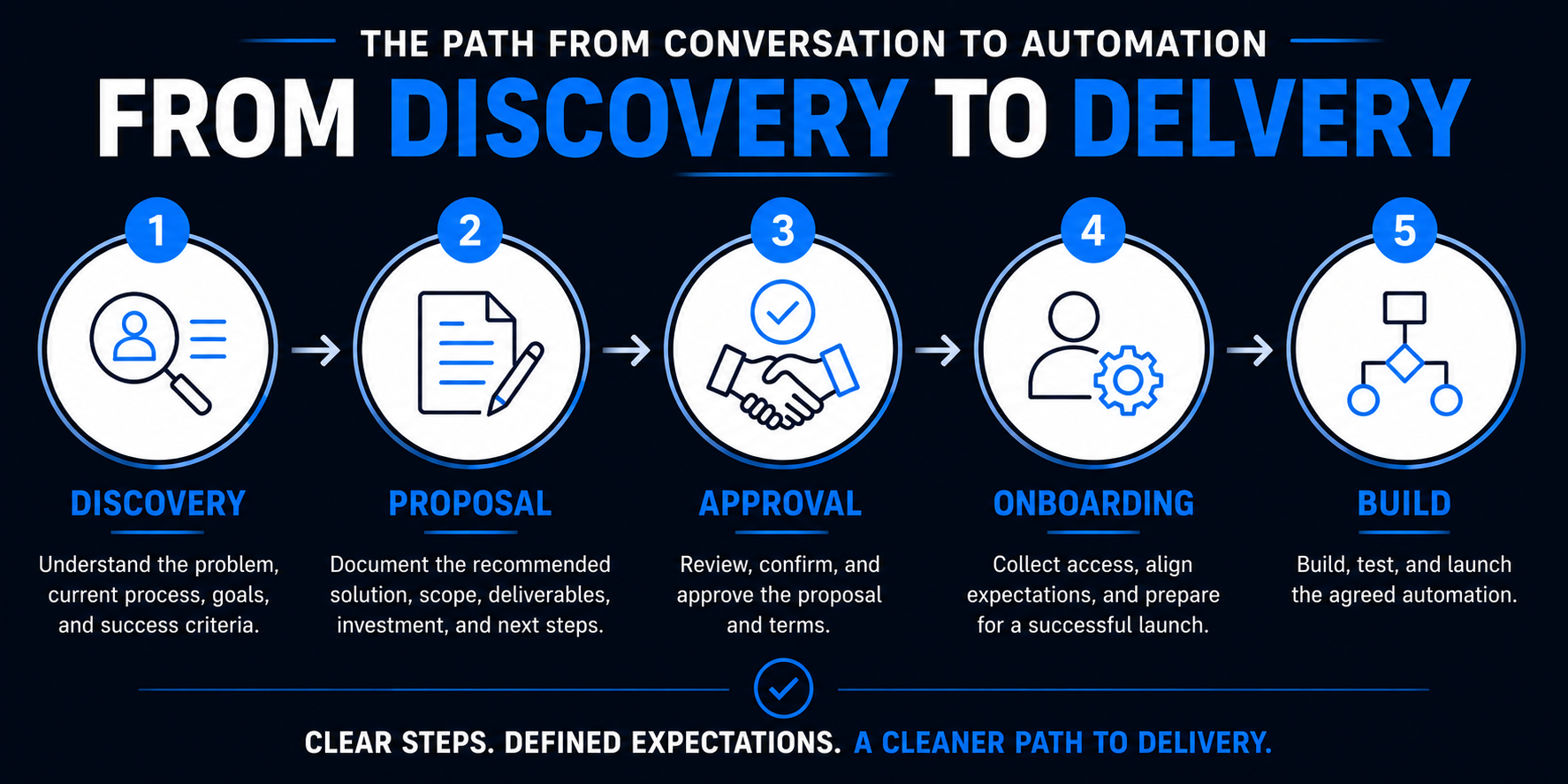
This distinction matters:
Discovery determines what should be proposed.
The proposal defines what is being agreed to.
Onboarding prepares both sides to deliver it.
When those three stages blur together, projects get messy before the automation even exists.
Don't Send a Proposal Just Because Someone Asked for One
This sounds strange.
A prospect says:
Send me a proposal.
Isn't that good?
Maybe.
But if you still don't understand the problem, scope, decision process or basic fit, a proposal may simply become a beautifully formatted substitute for a sales conversation.
You can say:
Absolutely. Before I put it together, I want to make sure I'm proposing the right thing. Can I clarify a few details about how you're handling this today?
That's not resistance.
That's doing discovery.
A proposal should document clarity, not manufacture it.
Your Proposal Should Make the Project Easier to Deliver
Most advice about proposals focuses exclusively on closing the deal.
That's understandable.
No signature, no project.
But there's another test:
If the client signs this proposal today, will the document make tomorrow's project easier or harder?
A vague proposal can close.
Then everybody gets to argue about what “AI-powered lead management” was supposed to mean.
A strong proposal does two jobs:
It helps the client make a buying decision.
And:
It gives the project boundaries before implementation begins.
That's why scope, exclusions, responsibilities, human review and post-launch expectations belong in the proposal.
They're not boring administrative details.
They're part of selling something you can actually deliver.
Want to Build an AI Automation Business Around This?
A proposal is only one piece of building an AI automation business.
You still need to choose useful services, package them, price them, find clients, sell the outcome, onboard the work and deliver something that creates recurring value.
That's the broader system we're building throughout our guide to starting an AI automation agency.
And if you want a faster starting point, the 48-Hour AI Cashflow Stack walks through a practical path for putting the pieces of an AI-powered service business together without trying to sell vague “AI transformation.”