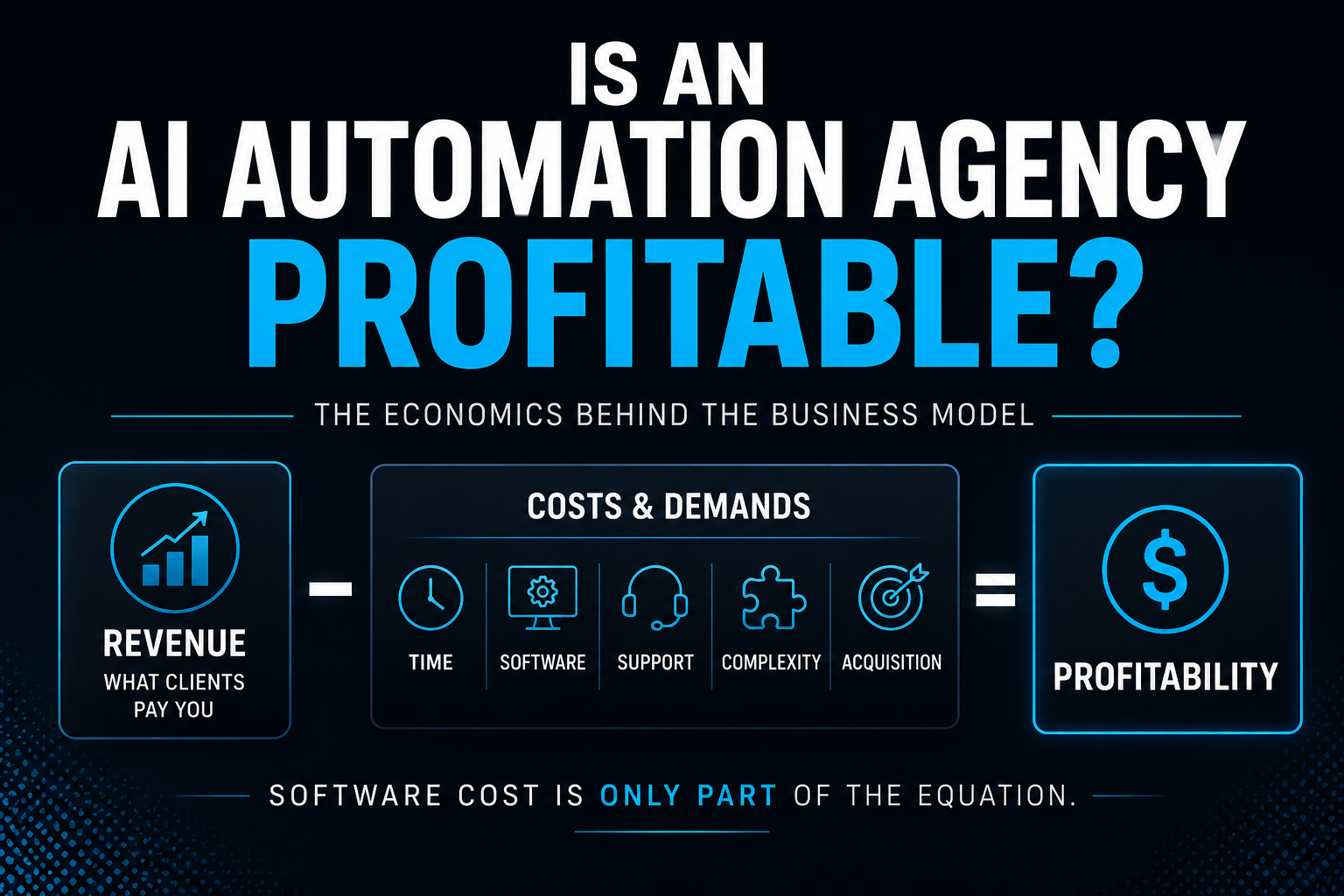
Yes, an AI automation agency can be profitable.
But if you're looking for a universal profit margin like "AI agencies make 80% margins," you're asking the wrong question.
There isn't one.
Two agencies can charge exactly the same amount for what sounds like the same service and have wildly different economics.
One might build a repeatable automation, monitor it occasionally and spend very little time supporting the client.
The other might spend hours every week troubleshooting custom workflows, attending meetings, changing prompts and responding to "Can you just add one more thing?" messages.
Same revenue.
Very different business.
The profitability of an AI automation agency depends less on how impressive the automation looks and more on how much human time, complexity and expense are required to deliver continuing value.
That's the part the screenshots of monthly recurring revenue tend to leave out.
What Makes an AI Automation Agency Profitable?
At the simplest level:
Revenue − Expenses = Profit
Not exactly groundbreaking finance.
The interesting part is what goes into each side of that equation.
For an AI automation agency, profitability is influenced by:
- what you sell
- what you charge
- software and infrastructure costs
- implementation time
- ongoing support
- AI and communication usage
- client acquisition costs
- scope control
- retention
- how much of delivery can be standardized
- how much genuinely needs to remain custom
That last distinction matters.
Automation can reduce labor for your client without necessarily reducing labor for you.
If every automation you sell becomes a never-ending custom software project, you've created a very different business from an agency selling well-defined, repeatable solutions.
How Does an AI Automation Agency Make Money?
There are several legitimate revenue models.
Implementation or Setup Fees
A business pays an upfront fee for discovery, configuration, integrations, workflow development, testing and launch.
This can help compensate the agency for the heavier workload that often happens at the beginning of an engagement.
Monthly Management
The client pays for ongoing monitoring, maintenance, optimization, reporting or support.
The scope matters enormously here.
"Monthly management" could mean occasional system checks and improvements.
Or it could quietly become unlimited technical support.
Those are not economically equivalent.
Recurring Automation Services
The agency provides an ongoing system that continues delivering value.
Examples could include:
- lead response automation
- follow-up systems
- appointment workflows
- review-request automation
- CRM management
- AI-assisted conversations
- reactivation campaigns
This can create recurring revenue without requiring the agency to rebuild the service every month.
We've covered the mechanics more deeply in our guide to AI automation agency recurring revenue.
Productized Services
Instead of selling "anything involving AI," the agency defines a narrower problem, deliverable and scope.
For example:
We install and manage an automated lead-response and follow-up system for home-service businesses.
That's easier to price and operationalize than:
Tell us whatever you want automated and we'll figure it out.
Software or SaaS Components
Some agencies include access to software as part of the offer or charge separately for it.
Platforms such as HighLevel can support this type of model because CRM, automation, communications, calendars and other functionality can live within the same ecosystem.
That doesn't mean you need to become a software reseller.
It simply gives you another possible component of the business model.
Consulting and Custom Implementation
There are also situations where businesses genuinely need custom strategy or implementation.
Custom work isn't bad.
Uncontrolled custom work is.
What Does It Cost to Run an AI Automation Agency?
There isn't one startup-cost number because the required stack depends on what you sell.
A basic agency might need relatively little infrastructure.
A more sophisticated operation involving AI conversations, phone systems, custom integrations, multiple platforms and paid acquisition can have substantially higher expenses.
It helps to separate costs into categories.
Fixed and Semi-Fixed Costs
These may include:
- CRM and automation software
- AI tools
- website and hosting
- scheduling software
- business email
- project-management tools
- accounting software
- documentation tools
Some platforms consolidate several of these.
As of August 2026, for example, HighLevel publicly lists its Starter plan at $97 per month, Unlimited at $297 per month and Agency Pro at $497 per month. The plans include different agency capabilities, and additional services can carry separate charges.
Pricing changes, so always check the current pricing before building your economics around any platform. For a fuller breakdown of those numbers, read my detailed HighLevel pricing guide.
Variable Costs
These change as clients or usage increase.
Examples include:
- AI/API consumption
- text messages
- phone calls
- phone numbers
- email volume
- third-party API usage
- client-specific integrations
- contractors
- fulfillment labor
This distinction becomes important as an agency grows.
Your core platform might cost the same whether you have five clients or fifteen, while communications or AI consumption can increase with actual usage.
Growth Costs
Then there are expenses that aren't directly attached to a workflow but absolutely affect profitability:
- advertising
- prospecting tools
- sales software
- commissions
- contractors
- employees
- customer support
- training
- administrative help
A business can have excellent service-level margins and still produce disappointing net profit if acquiring and supporting customers is expensive.
Usage-Based Costs Deserve Attention
Modern automation stacks increasingly combine subscriptions with consumption-based pricing.
AI is a good example.
API providers may charge according to the model selected and the amount of input and output processed.
Communications work similarly.
SMS costs can depend on message volume, segments, carriers and other fees.
That doesn't mean these costs are necessarily high.
It means they should be understood.
If your client doubles their messaging volume, launches an AI-heavy workflow or starts generating significantly more conversations, your cost structure may change too.
Someone needs to know who absorbs that cost.
Software Cost Is Only Part of the Equation
This is where beginners often get fooled by attractive margin calculations.
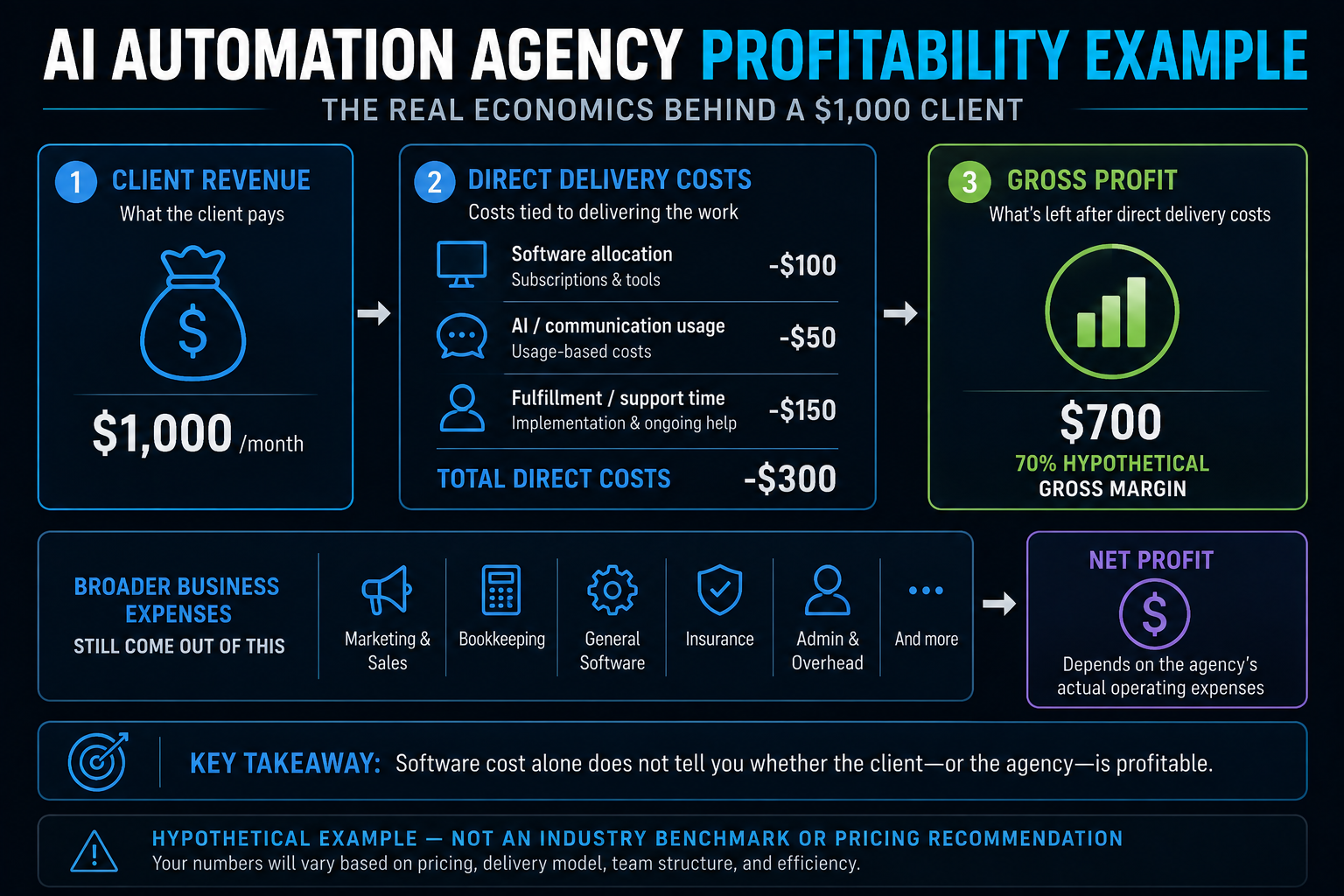
Suppose your software allocation for a client costs $100 per month and the client pays $1,000.
It would be tempting to say:
Sweet. $900 profit. 90% margin.
Not so fast.
Who built the workflows?
Who tested them?
Who handles support?
Who monitors failures?
Who talks to the client?
Who fixes the integration when another platform changes something?
Who updates the system when the client's process changes?
Your software bill isn't your entire cost of delivery.
Human time is a cost even when you're the human and you aren't writing yourself a paycheck yet.
Ignore that and you can build yourself a very impressive job with terrible economics.
Gross Margin vs. Net Profit
These terms often get mixed together.
Gross Margin
Gross margin looks at the revenue remaining after the direct costs required to deliver the service.
A simplified formula is:
Gross Profit = Revenue − Direct Delivery Costs
Gross margin expresses that gross profit as a percentage of revenue.
Net Profit
Net profit goes further.
It accounts for the broader expenses required to operate the business.
That could include:
- marketing
- sales
- administration
- general software
- professional services
- payroll
- office expenses
- insurance
- other overhead
That's why someone saying:
My software costs $100 and I charge $1,000, so I make 90% profit.
is usually oversimplifying the situation.
They're probably describing a rough software spread—not the actual profitability of the business.
A Simple Hypothetical Example
Let's make the math concrete.
This example is hypothetical. It is not an industry benchmark or recommendation.
Suppose a client pays:
$1,000 per month
And suppose the direct monthly delivery costs look like this:
| Item | Hypothetical Monthly Cost |
|---|---|
| Software allocation | $100 |
| AI/communication usage | $50 |
| Fulfillment/support time | $150 |
| Total direct cost | $300 |
That would leave:
$700 in gross profit
or a hypothetical 70% gross margin.
But we're not finished.
The agency still has broader expenses.
Maybe part of its monthly operating costs include:
- marketing
- prospecting software
- bookkeeping
- sales expenses
- general business software
- insurance
- administrative costs
Those expenses affect net profit.
The example isn't intended to show what your margin should be.
It shows why calculating profitability from the software subscription alone is incomplete.
The Real Margin Killer: Fulfillment Complexity
Here's where the business model gets interesting.
Imagine two agencies.
Both charge $1,000 per month.
Agency A
Every new client gets:
- completely custom workflows
- custom integrations
- custom reporting
- frequent strategy calls
- unlimited revisions
- ongoing feature requests
Every client is essentially a new invention.
Agency B
The agency has:
- a defined offer
- a documented onboarding process
- reusable workflow frameworks
- standardized testing procedures
- defined support boundaries
- repeatable reporting
- clear rules for additional work
The client still receives necessary customization.
But the agency isn't rebuilding the entire delivery system every time.
Agency B may have stronger economics because less human effort is required to produce each dollar of revenue.
That's not because templates are magic.
It's because the agency learned what should be repeatable.
A useful operating principle is:
Standardize the repeatable. Customize what actually needs customization.
Productized vs. Highly Custom Agency Models
Neither model is automatically right or wrong.
But they behave differently.
| Area | Highly Custom / Low-Leverage Model | More Productized Model |
|---|---|---|
| Offer | Broad, changes substantially by client | Clearly defined problem and deliverable |
| Implementation | Frequently built from scratch | Repeatable framework with necessary customization |
| Customization | Extensive by default | Applied where it adds meaningful value |
| Support | Often open-ended | Defined boundaries and process |
| Meetings | Frequent and reactive | Purposeful and structured |
| Pricing | Can be difficult to estimate consistently | Easier to align with defined scope |
| Documentation | Often client-specific or informal | Reusable processes and SOPs |
| Recurring workload | Can remain high after launch | May decrease after implementation |
| Expansion | Additional requests easily become free work | Additional scope can be identified and priced |
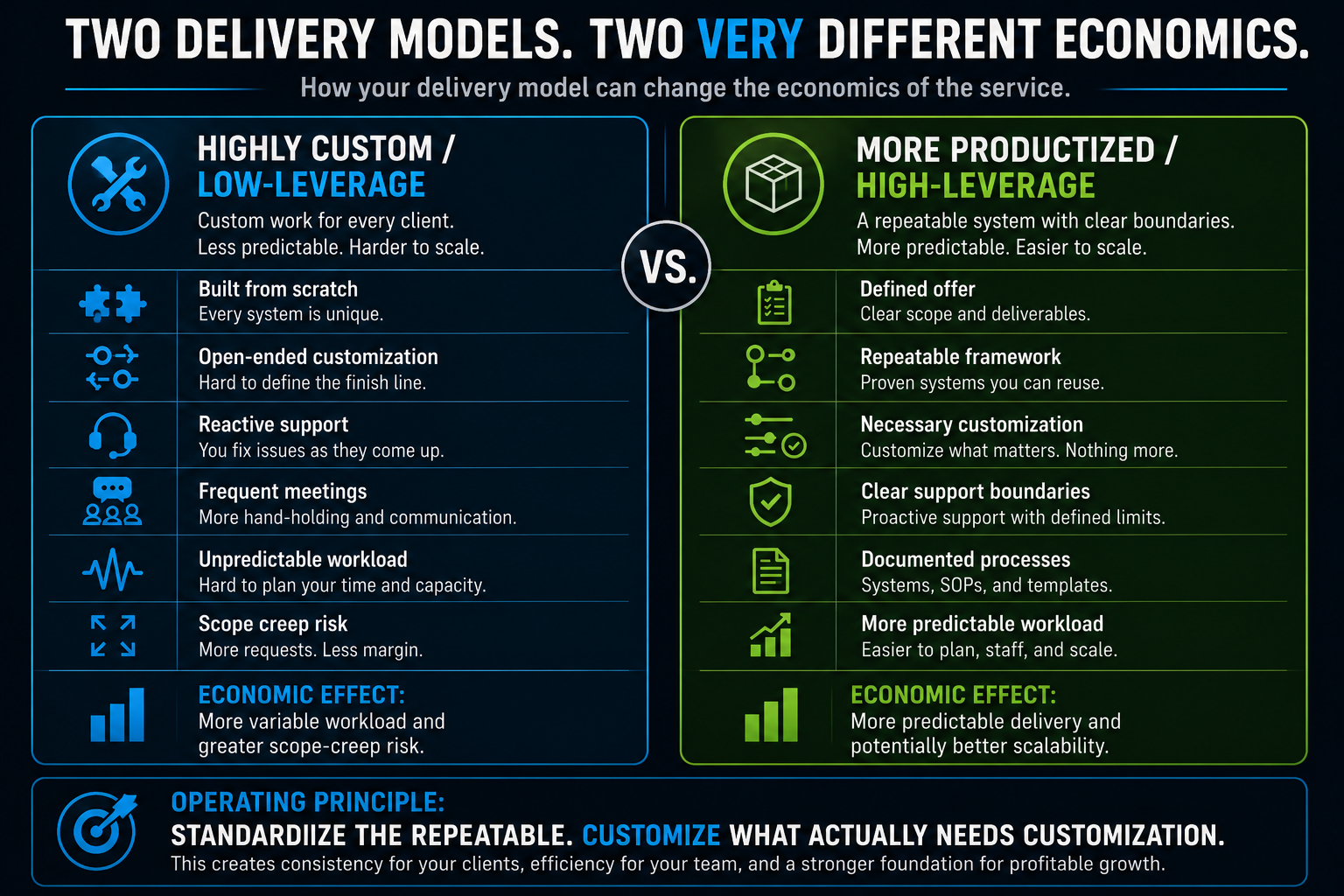
The productized model may improve scalability.
It doesn't eliminate judgment or customization.
Scope Creep Can Destroy an Otherwise Good Offer
This deserves more attention than it gets.
You sell one automation.
Then comes:
Can you just add another workflow?
Then:
Can we connect our other CRM too?
Then:
Can you make a dashboard for the sales manager?
Then:
Can you join our weekly marketing meeting?
Individually, none sounds catastrophic.
Collectively, you've changed the economics of the account.
Common margin killers include:
- unlimited revisions
- additional integrations
- new departments
- extra users
- custom reports
- continual prompt tuning
- unrelated marketing tasks
- frequent meetings
- "small" workflow additions
Scope control doesn't mean being difficult.
It means everyone understands what the client is paying for.
That's one reason packaging AI automation services matters so much.
Price the Service, Not Just the Software
Another common mistake is taking your software cost and adding a markup.
That's not really a pricing strategy.
Your price may need to account for:
- value to the business
- complexity
- implementation effort
- ongoing workload
- responsibility
- support requirements
- infrastructure
- usage
A workflow that costs $20 in software but requires significant strategy, implementation and monitoring isn't a $20 product.
Conversely, expensive software doesn't automatically justify an expensive service if the customer receives little value from it.
We've gone deeper into this in how to price AI automation services.
Client Acquisition Changes the Math
Delivery is only one side of profitability.
You also have to acquire customers.
Suppose you spend substantial money and 20 hours of sales effort acquiring a client who cancels after two months.
Compare that with a client who comes through a referral, stays for two years and expands their account.
Again:
Same monthly price.
Completely different economics.
A few useful concepts:
Customer Acquisition Cost (CAC)
What you spend to acquire a new customer.
Retention
How long customers continue paying for the service.
Payback Period
How long it takes for the profit from a client to recover what you spent acquiring them.
Customer Lifetime Value (LTV)
The economic value a customer generates over the relationship.
You don't need a finance degree to use these ideas.
You just need to stop evaluating the business based solely on monthly revenue screenshots.
If acquisition is the challenge you're working on now, start with how to get AI automation clients and how to sell AI automation services.
Recurring Revenue Doesn't Automatically Mean Recurring Profit
Recurring revenue is attractive for obvious reasons.
You don't start every month at zero.
But a recurring client can still be terrible business.
Imagine a $1,000 monthly account requiring:
- weekly meetings
- constant revisions
- frequent troubleshooting
- several custom integrations
- significant AI usage
- continual new development
That monthly recurring revenue might look nice on a dashboard.
The workload tells another story.
Recurring revenue becomes more attractive when the agency continues creating value without requiring recurring reinvention.
That's the distinction.
Retention Should Come From Continuing Value
One ugly version of recurring revenue is making the client dependent on the agency simply so they can't leave.
That's not the model I'd build.
Clients should stay because the system continues doing something useful.
They should understand:
- what is being managed
- what the system does
- what support is included
- where improvements are being made
- why the service remains valuable
Good retention comes from continuing relevance.
Not captivity.
Beginners May Have Worse Margins at First
There's another reality that doesn't fit nicely into "start an AI agency this weekend" content.
You're probably going to be inefficient at first.
You may:
- take longer to build workflows
- make mistakes
- rebuild things
- spend too much time researching
- over-service early clients
- struggle to estimate scope
- take longer to close sales
- lack reusable templates
- have weak documentation
That's normal for a new service business.
As you learn what repeats, you can build better systems around it.
That may improve margins.
But experience doesn't magically fix a bad offer.
If the underlying service requires enormous amounts of custom labor forever, becoming slightly faster won't suddenly make it scalable.
AI Doesn't Remove the Work of Running the Agency
AI can automate plenty.
It doesn't eliminate:
- discovery
- strategy
- implementation
- testing
- monitoring
- exception handling
- troubleshooting
- client communication
- optimization
And sometimes the most valuable thing you do has nothing to do with AI.
You might discover that the client's real problem is a broken sales process.
Or unclear ownership.
Or terrible follow-up.
Or bad data.
Adding another model won't fix that.
That's why the better AI automation services to sell tend to start with a real business problem rather than an impressive technology demo.
Seven Levers That Can Improve AI Agency Profitability
There isn't one magic margin lever.
There are several.
1. Increase Value and Price Appropriately
Don't race to the bottom because the underlying software is inexpensive.
Price the service in the context of what you're actually responsible for delivering.
2. Reduce Unnecessary Fulfillment Time
If you're performing the same manual task for every client, ask whether the process can be improved.
3. Standardize Repeatable Delivery
Create:
- onboarding procedures
- templates
- testing checklists
- documentation
- reusable workflow structures
Then customize where the client's situation actually requires it.
4. Control Scope
Define what's included.
Define what isn't.
Have a process for additional work.
5. Manage Software and Usage Costs
Understand which expenses are fixed and which grow with usage.
Don't discover your cost structure after the invoice arrives.
6. Improve Retention
Keep delivering something the customer values.
Fix recurring problems instead of hiding them.
7. Improve Acquisition Efficiency
Better positioning, referrals, partnerships, content, outbound processes and sales systems can potentially reduce the effort required to acquire each client.
Profitability isn't just about cutting costs.
It's about improving the entire machine.
What Commonly Destroys AI Agency Margins?
The usual suspects aren't particularly glamorous:
- underpricing
- unlimited customization
- endless support
- unlimited revisions
- too many disconnected tools
- failure to charge for expanded scope
- excessive meetings
- poor onboarding
- bad-fit clients
- high churn
- rebuilding everything from scratch
- building before understanding the client's process
Notice how few of those problems are actually "AI problems."
Most are service-business problems.
A strong AI automation client onboarding process and a disciplined approach to building automation for a client can prevent several of them before they become expensive.
Do You Need Expensive Software to Start?
Not necessarily.
Your software stack should follow the offer.
Not the other way around.
HighLevel is one option we use and discuss because it combines a number of functions an automation agency may otherwise need to assemble separately, including CRM, workflows, forms, calendars and communications.
As of August 2026, its public monthly pricing is:
- Starter — $97
- Unlimited — $297
- Agency Pro — $497
There are also optional add-ons and usage-based services, so those subscription prices should not be interpreted as the complete operating cost of every implementation.
If you're evaluating platforms, HighLevel is one option worth understanding. Disclosure: Boost Local Biz may earn a commission if you sign up through this link, at no additional cost to you.
But don't buy a giant software stack before you know what you're selling.
Tools follow the business model.
So, What Profit Margin Should an AI Automation Agency Have?
There isn't a credible universal number I can give you.
And anyone confidently telling every new AI automation agency that it "should" have a specific margin without knowing the offer, pricing, fulfillment model, labor, acquisition costs and overhead is skipping most of the calculation.
Instead, track your own economics.
For each client, understand:
Revenue
minus
Direct delivery costs
equals
Gross profit
Then account for the broader costs of operating the business to understand net profit.
Do that consistently and you'll know far more about your agency than someone quoting a random industry percentage.
The Question I'd Ask Instead
Forget:
What's the average AI agency margin?
Ask:
Can I deliver meaningful recurring value without requiring recurring reinvention?
That's a much better test of the business model.
If every client requires you to invent a new service every month, scaling becomes difficult.
If the core delivery is repeatable while still allowing the customization that genuinely matters, the economics can become much more attractive.
That's where an AI automation agency starts looking less like freelance technical work and more like an actual business.
Want to Build the Business Model, Not Just Learn the Tools?
Knowing how to connect software is useful.
Knowing what to sell, how to package it and how the pieces fit into a real business is more useful.
That's why we created the 48-Hour AI Cashflow Stack.
It's designed for people who want a practical starting point for building an AI-powered service business around problems companies will actually pay to solve.
No promise that you'll get rich in 48 hours.
That would be ridiculous.
The goal is to help you stop staring at 47 AI tools and start building something you can actually offer.