
Picking a niche sounds simple until you actually have to pick one.
Roofers?
Dentists?
Law firms?
Real estate agents?
Med spas?
Property managers?
E-commerce?
Then you watch three more videos and suddenly somebody is telling you the real opportunity is automating llama farms in Montana.
Now you're back to zero.
Here's the problem:
There probably isn't one objectively "best" niche for an AI automation agency.
There are attractive markets.
There are terrible markets.
And there are niches that could be excellent for one agency and a complete disaster for another.
The better question isn't:
What's the most profitable AI automation niche?
It's:
Which market has valuable problems I can solve, businesses I can realistically reach, enough economic value to pay for the solution, and workflows I can eventually serve repeatedly?
That's a much better foundation for choosing where to build.
What is an AI automation agency niche?
A niche is a specific market or type of customer your agency chooses to focus on.
Instead of:
We provide AI automation for businesses.
you might say:
We help HVAC companies respond to missed calls and new leads faster.
Or:
We help dental practices automate appointment reminders and patient reactivation.
Or:
We help property managers automate repetitive tenant communication.
Notice what's happening.
The niche isn't just making the sentence more specific.
It's helping define:
- who you're talking to
- what problems you need to understand
- which workflows matter
- what your offer might become
- where you find prospects
- what language you use
- what technology you'll need
- what you need to learn
That's why niche selection matters.
But do you actually need a niche?
Eventually, I think specialization becomes extremely valuable.
At the beginning?
I'm less dogmatic.
If you already understand an industry, have relationships in it, or see an obvious problem worth solving, starting with a niche makes sense.
But I wouldn't spend three months choosing between plumbers and electricians while talking to exactly zero plumbers or electricians.
Sometimes your first few conversations or projects reveal the niche.
You might discover:
- one industry responds better to your offer
- a particular workflow keeps appearing
- one type of business is easier for you to understand
- one market has better economics
- you enjoy working with one type of owner more than another
That's useful information.
So yes, specialization is valuable.
But "pick the perfect niche before doing anything" can become another form of procrastination.
A profitable niche needs more than businesses with money
This is where a lot of niche advice gets lazy.
People search for industries with high average customer values and assume:
High-value customers = great automation niche.
Not necessarily.
A niche can have plenty of money and still be miserable for you to serve.
Maybe:
- the sales cycle is extremely long
- compliance is complicated
- workflows vary dramatically between companies
- integrations require advanced technical work
- buyers are difficult to reach
- existing systems are deeply entrenched
- you have zero credibility in the industry
On the other hand, a less glamorous market may have:
- obvious operational problems
- lots of reachable businesses
- relatively simple workflows
- owners who make purchasing decisions directly
- repeatable needs
- easy demonstrations
I'll take boring and sellable over exciting and impossible.
The 7 things I would evaluate before choosing a niche
Instead of starting with a giant list of industries, I'd score potential niches using seven factors.
1. Problem severity
Does this industry have problems painful enough that businesses will actually care about fixing them?
Look for things like:
- missed leads
- unanswered calls
- slow follow-up
- appointment no-shows
- repetitive administrative work
- unworked databases
- repetitive customer questions
- scheduling problems
- manual data entry
- communication bottlenecks
The key word is painful.
A minor inconvenience doesn't automatically become a sellable automation just because you can build it.
2. Economic value
Is there enough value attached to solving the problem?
Suppose a business receives two website inquiries a year.
Building an elaborate lead-response system probably isn't very interesting.
Now imagine a company receiving dozens or hundreds of inquiries, calls or appointment requests.
The same workflow suddenly matters much more.
You don't need to calculate some imaginary ROI down to the penny before talking to anyone.
But you should be able to explain why improving the process could matter financially or operationally.
3. Automation fit
Are there actually repeatable processes worth automating?
Good candidates often involve:
Trigger → predictable process → action
For example:
New lead arrives → respond → notify → follow up → schedule
or:
Appointment booked → confirm → remind → reschedule if necessary → follow up
or:
Job completed → request review → follow up appropriately
The more chaotic and bespoke the process, the harder it becomes to turn into a repeatable automation service.
4. Accessibility
Can you actually reach these businesses?
This gets overlooked constantly.
A market could be economically attractive but practically useless if you have no reasonable way to get in front of buyers.
Ask:
- Can I find these businesses?
- Can I identify the decision maker?
- Can I call them?
- Can I email them?
- Are they active on LinkedIn?
- Are there industry groups?
- Are there local associations?
- Do I already know people in this space?
- Can I reach them through referrals?
A reachable $2,000 opportunity is considerably more useful than an imaginary $20,000 opportunity you can't get within 500 feet of.
5. Budget and willingness to invest
Having money and spending money are different things.
Look at whether businesses in the niche already invest in things such as:
- advertising
- CRM software
- scheduling tools
- employees
- call handling
- customer service
- lead generation
- marketing agencies
- operational software
Existing spending can tell you something important:
They already recognize that solving business problems costs money.
That doesn't guarantee they'll buy from you.
But it's generally better than targeting a market where every software subscription creates an existential crisis.
6. Repeatability
Can the solution you build for Client A become meaningfully easier to deliver to Client B?
This is where specialization starts becoming powerful.
Suppose you build a lead-response system for a roofing company.
The next roofer probably won't operate identically.
But there's a good chance both businesses deal with:
- estimate requests
- inbound calls
- web leads
- sales follow-up
- appointments
- job status communication
- reviews
You've already learned something about the workflow.
Your second implementation should be smarter than your first.
Your tenth should be smarter than your second.
That's how expertise compounds.
7. Your unfair advantage
This doesn't have to be dramatic.
Maybe you:
- previously worked in the industry
- already have clients there
- know several business owners
- understand the terminology
- have marketing experience in the niche
- understand how customers buy
- have already built something relevant
- genuinely enjoy working with those businesses
Don't dismiss that.
Starting with an existing advantage can be much smarter than chasing whichever niche some stranger ranked #1 this month.
A simple AI automation niche scorecard
Here's a basic way to compare markets.
Score each potential niche from 1 to 5 in each category.
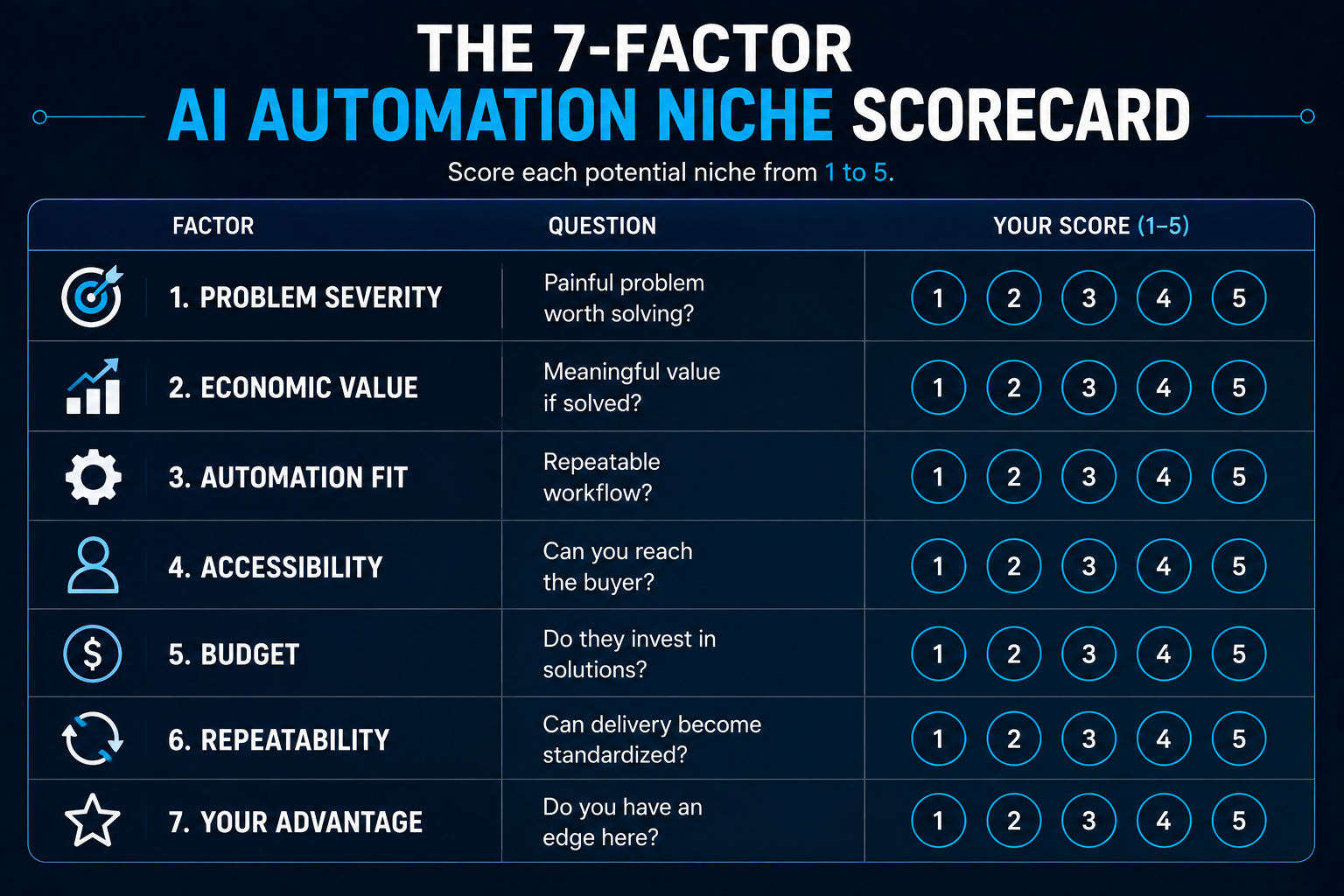
| Factor | Question |
|---|---|
| Problem Severity | Are there painful problems worth solving? |
| Economic Value | Does solving them create meaningful value? |
| Automation Fit | Are important workflows repeatable and automatable? |
| Accessibility | Can you realistically reach decision makers? |
| Budget | Do these businesses invest in solutions? |
| Repeatability | Can your delivery become more standardized over time? |
| Your Advantage | Do you have knowledge, relationships or credibility here? |
Don't treat the final number like divine revelation.
A niche scoring 31 isn't automatically better than one scoring 29.
The scorecard exists to force better thinking.
It makes you evaluate the business instead of choosing based on vibes.
What are some good AI automation agency niches?
Now we can talk about industries.
Not because these are guaranteed winners.
They're examples of markets where recurring workflows and automation opportunities are relatively easy to identify.
1. Home-service businesses
Think:
- HVAC
- roofing
- plumbing
- electrical
- landscaping
- pool companies
- remodeling
- pest control
I naturally like this category because the customer journey is easy to understand.
A homeowner has a problem.
They search.
They call or submit a form.
They want somebody to respond.
The company wants an opportunity to quote or schedule the work.
That creates obvious automation opportunities:
- missed-call response
- web-lead follow-up
- estimate scheduling
- appointment reminders
- unsold estimate follow-up
- review requests
- lead reactivation
If you're interested in this market, our guide to the best AI automation services to sell goes deeper into several of these workflows.
Potential drawback
Some smaller operators may have limited budgets or poor internal processes.
Automation doesn't magically fix a company that refuses to answer customers, use its systems or follow through.
2. Dental practices and appointment-based healthcare
These businesses often revolve around scheduled appointments and recurring patient communication.
Potential automation opportunities include:
- appointment reminders
- reactivation
- intake
- common questions
- scheduling
- missed-call handling
- follow-up
- review requests
Potential drawback
Healthcare introduces privacy, security and compliance considerations.
That doesn't make it a bad niche.
It means you shouldn't wander into it assuming a generic automation stack is appropriate for every workflow.
If you're dealing with protected health information, understand what you're doing before touching it.
3. Real estate
Real estate creates a lot of lead-management opportunities.
Potential workflows include:
- inquiry response
- lead qualification
- nurture
- appointment scheduling
- listing inquiries
- open-house follow-up
- database reactivation
- referral follow-up
Potential drawback
The market is crowded with software, marketing services and automation tools.
Individual agents also vary enormously in production and budget.
"Real estate agents" may still be too broad.
A productive team or brokerage can be a very different customer from a newly licensed solo agent.
4. Law firms
Many law firms depend heavily on intake.
Potential automation opportunities include:
- inquiry acknowledgment
- consultation scheduling
- intake
- document reminders
- status communication
- lead follow-up
- review requests
The economic value of an inquiry can also make responsiveness important.
Potential drawback
Legal services bring confidentiality, ethical and potentially regulatory considerations.
And depending on the practice area, workflows can vary considerably.
Understand the boundaries before automating sensitive communications.
5. Med spas and aesthetic businesses
These businesses can have a useful combination of:
- appointments
- leads
- consultations
- repeat customers
- promotions
- reactivation opportunities
- reviews
Potential automation includes:
- inquiry response
- consultation booking
- reminders
- reactivation
- follow-up
- review requests
- common-question handling
Potential drawback
Competition for these businesses is intense.
Every marketer with Wi-Fi appears to have discovered med spas.
If your pitch sounds exactly like everyone else's, being in a "good niche" won't save you.
6. Property management
I think this one is interesting because the opportunity isn't limited to lead generation.
Property managers deal with recurring communication and administrative processes involving:
- prospective tenants
- current tenants
- property owners
- vendors
- maintenance requests
- inspections
- documents
- scheduling
That creates opportunities for both customer-facing and internal automation.
Potential drawback
The workflows can become operationally complex quickly.
You're potentially touching sensitive information, multiple software systems and processes where mistakes matter.
Start narrow.
7. Professional services
This is a broad category, so you'd likely narrow it further.
Think:
- accountants
- consultants
- financial professionals
- insurance agencies
- recruiters
- business service providers
Common opportunities may include:
- inquiry response
- appointment scheduling
- document collection
- reminders
- onboarding
- follow-up
- CRM workflows
- client communication
Potential drawback
"Professional services" isn't much of a niche by itself.
The more specialized the service, the more you'll need to understand how that business actually operates.
What about restaurants?
Restaurants are a good example of why I don't like blindly ranking niches.
Could restaurants use automation?
Of course.
Reservations.
Reviews.
Customer communication.
Loyalty.
Marketing.
Catering inquiries.
Hiring.
There are plenty of possibilities.
But many restaurants operate on tight margins, already use specialized point-of-sale and reservation platforms, and may be reluctant to add another meaningful monthly expense.
That doesn't mean:
Never sell automation to restaurants.
It means the economics of your particular offer need to make sense.
That's the standard for every niche.
Don't confuse a niche with an offer
This distinction is important.
Roofers is a niche.
Missed-call and lead-response automation for roofers is getting closer to an offer.
We help roofing companies respond to new inquiries and continue following up until the prospect books an estimate or opts out is much clearer.
Choosing a niche doesn't finish your positioning.
You still need to decide what problem you're solving — and package that niche into a defined service people can actually buy.
That's why I would think about niche selection and service selection together.
Your niche tells you who.
Your offer tells you what problem you're helping them solve.
Article #6 on the best AI automation services to sell can help with the other half of that decision.
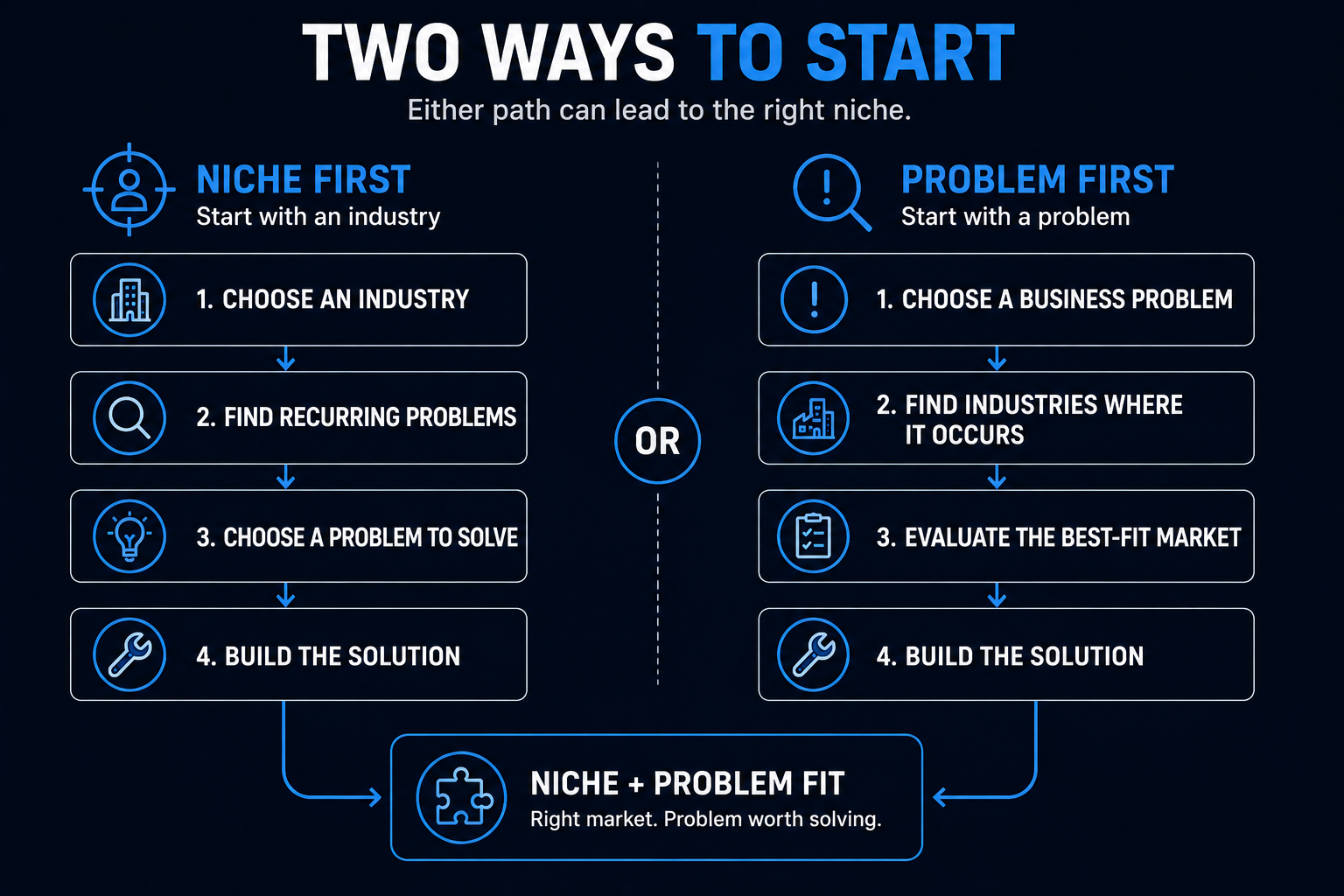
Niche first or problem first?
Either can work.
Niche-first approach
Start with an industry you understand.
Then investigate its recurring problems.
For example:
Roofing → leads → missed calls → estimates → follow-up
You may discover that lead response is the strongest opportunity.
Problem-first approach
Start with a business problem you understand.
Then find markets where it occurs frequently.
For example:
Missed calls → home services → legal → property management → medical offices
Then determine which market has the strongest combination of need, accessibility, economics and fit.
I actually like the problem-first approach for many beginners.
You become good at solving one problem first.
Broad niche vs. narrow niche
You can also go too far.
Small businesses is too broad.
Home services may be useful for early exploration but is still broad.
Roofing companies is more specific.
Residential roofing companies with five to twenty employees in South Florida that generate Google Ads leads but don't respond within seven minutes is probably more specificity than you need to put on your homepage tomorrow.
There's a balance.
Your niche should be specific enough that:
- your message feels relevant
- you can learn the workflow
- you can find prospects
- solutions become repeatable
But large enough that:
- there are enough prospects
- businesses can afford you
- the problem occurs frequently
- you aren't dependent on eleven companies existing worldwide
You can narrow further as you learn.
Local niche or national niche?
This is another false choice.
You could begin locally even if you eventually intend to sell nationally.
Local outreach has advantages:
- easier relationship building
- local networking
- referrals
- market familiarity
- potentially easier trust
Once your offer becomes repeatable, geography may matter much less.
An automation system doesn't care whether the roofing company is twelve miles away or twelve states away.
Your sales strategy might.
Those are different questions.
Should you choose a niche based on competition?
Consider competition.
Don't obsess over it.
Zero competition isn't automatically good.
Sometimes nobody is selling something because nobody wants it.
A competitive market can actually validate that businesses spend money solving the problem.
The more useful question is:
Can I position the offer differently or solve the problem better?
Maybe competitors sell generic chatbots.
You specialize in converting missed calls into conversations.
Maybe everyone sells "AI marketing."
You specialize in reactivating old estimates.
Specificity can create differentiation inside a competitive market.
Validate the niche before marrying it
This is where theory needs to meet reality.
Before rebuilding your entire brand around a niche, talk to businesses.
I'd want to learn:
- How does this process work today?
- Where does it break?
- What happens when nobody responds?
- How frequently does the problem occur?
- What software do they already use?
- Who owns the process?
- Have they tried fixing it?
- What is the problem costing them?
- Would solving it actually matter?
Notice I didn't say:
Would you buy my AI automation?
People are notoriously generous with hypothetical money.
You're trying to understand behavior and pain.
Run a small niche validation test
You don't need a six-month market-research initiative.
Choose two or three candidate niches.
Then:
Step 1: Find 20–30 businesses in each
Can you easily identify prospects?
That's already useful information.
Step 2: Study their customer journey
Visit websites.
Call after hours where appropriate.
Look at forms.
Check scheduling options.
Read reviews.
Understand how customers contact them.
Step 3: Identify one repeated problem
Don't create seventeen offers.
Find one.
Step 4: Build a simple demonstration
Show what an improved process could look like.
Step 5: Have real conversations
Outreach.
Ask questions.
Demonstrate when appropriate.
Step 6: Track what happens
Which niche:
- responds
- understands the problem
- asks good questions
- wants a demo
- moves toward buying
Now you're choosing with evidence.
That's much better than choosing because somebody on YouTube said dentists are printing money. Once you've validated a niche, the next step is getting your first client.
What if you choose the wrong niche?
Then change it.
Seriously.
This isn't a blood oath.
Your first niche is a hypothesis.
You're saying:
I believe this group has a recurring problem I can become good at solving.
Then you test it.
Maybe the market is harder to reach than expected.
Maybe budgets are weak.
Maybe the problem isn't painful enough.
Maybe delivery is awful.
Maybe you simply hate working with them.
Fine.
Take what you learned and adjust.
What you don't want to do is change niches every seven days because another industry looked exciting.
Give a reasonable test enough time to produce information.
Then make a decision.
My preference: start where you already understand the customer
If two niches look similarly attractive and you already understand one of them, I'd usually start there.
Domain knowledge is leverage.
You know the terminology.
You understand how customers arrive.
You recognize the bottlenecks.
You know what sounds ridiculous to the owner.
You may already know where prospects hang out.
That lets you spend less time pretending to be an expert and more time actually becoming useful.
For someone coming from digital marketing, for example, service businesses can be a natural fit because the path from:
traffic → lead → response → follow-up → appointment
is already familiar.
That's also why the broader AI automation agency model makes sense when it's built around problems rather than technology.
You aren't trying to become an expert in every industry.
You're combining what you already understand with new capabilities.
The best niche is the one where you can become useful
Don't pick a niche because it has the highest imaginary retainer in somebody's spreadsheet.
Pick one where:
- meaningful problems exist
- businesses care about solving them
- automation fits the workflow
- you can reach the buyer
- the economics make sense
- delivery can become repeatable
- you have—or can develop—credible expertise
Then talk to the market.
Build something.
Try to sell it.
Learn.
That's how you find out whether you actually have a niche.
Not by staring at another list of the "10 hottest AI industries" until 2:00 a.m.
Want Help Turning a Niche Into an Offer?
Choosing the market is only half the job.
You still need to decide what problem to solve, what system to build, how to package it and how to start putting the offer in front of businesses.
That's where the 48-Hour AI Cashflow Stack comes in.
It's designed to help you move from:
"I want to start an AI business."
to something considerably more concrete:
Who am I helping?
What problem am I solving?
What am I actually selling?
What do I need to build?
No guaranteed-income nonsense.
No requirement to discover the mythical perfect niche.
Just a practical framework for getting out of research mode and starting to build.
Download the 48-Hour AI Cashflow Stack and start turning the idea into an offer.