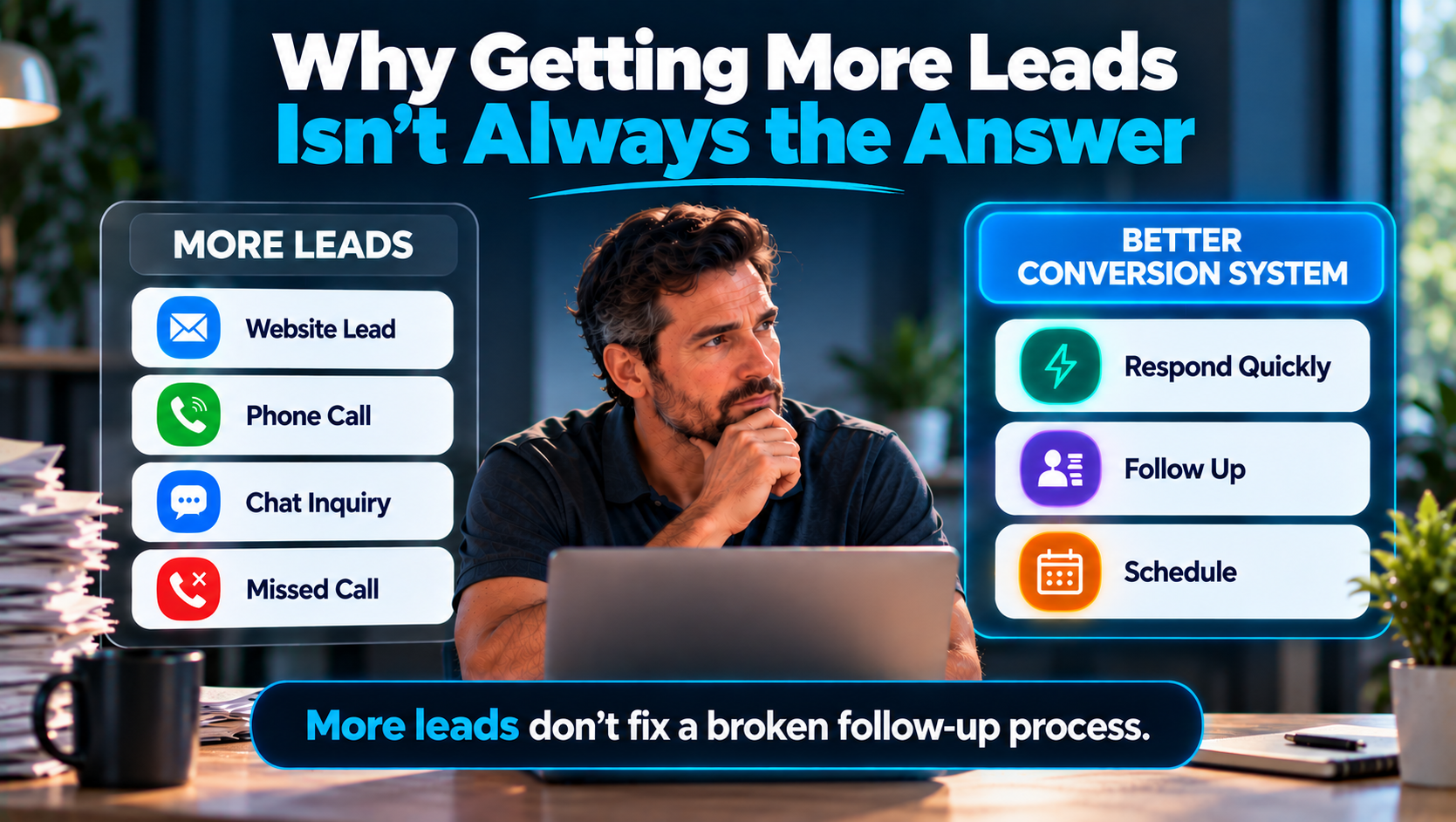
When business slows down, one of the first conclusions is usually pretty predictable:
We need more leads.
So the business increases the Google Ads budget. Hires another marketing company. Starts posting more. Works on SEO. Launches another campaign.
And sometimes that's exactly the right move.
But sometimes it's the business equivalent of turning up the water pressure when there's a hole in the pipe.
If you're already getting calls, forms, messages, referrals, quote requests, or other inquiries and too many of them disappear before becoming real sales opportunities, generating more leads doesn't fix the underlying problem.
It just sends more opportunities through the same broken process.
Before asking "How do we get more leads?", there's another question worth answering:
What actually happens to the leads we're already getting?
That question is a lot less exciting than launching another campaign.
It may also be considerably more valuable.
What is the lead conversion gap?
The lead conversion gap is the space between generating an inquiry and turning that inquiry into a legitimate sales opportunity, such as a conversation, consultation, estimate, or booked appointment.
A simplified customer-acquisition process looks like this:
Traffic → Lead → Response → Follow-Up → Conversation → Appointment → Sales Process → Customer
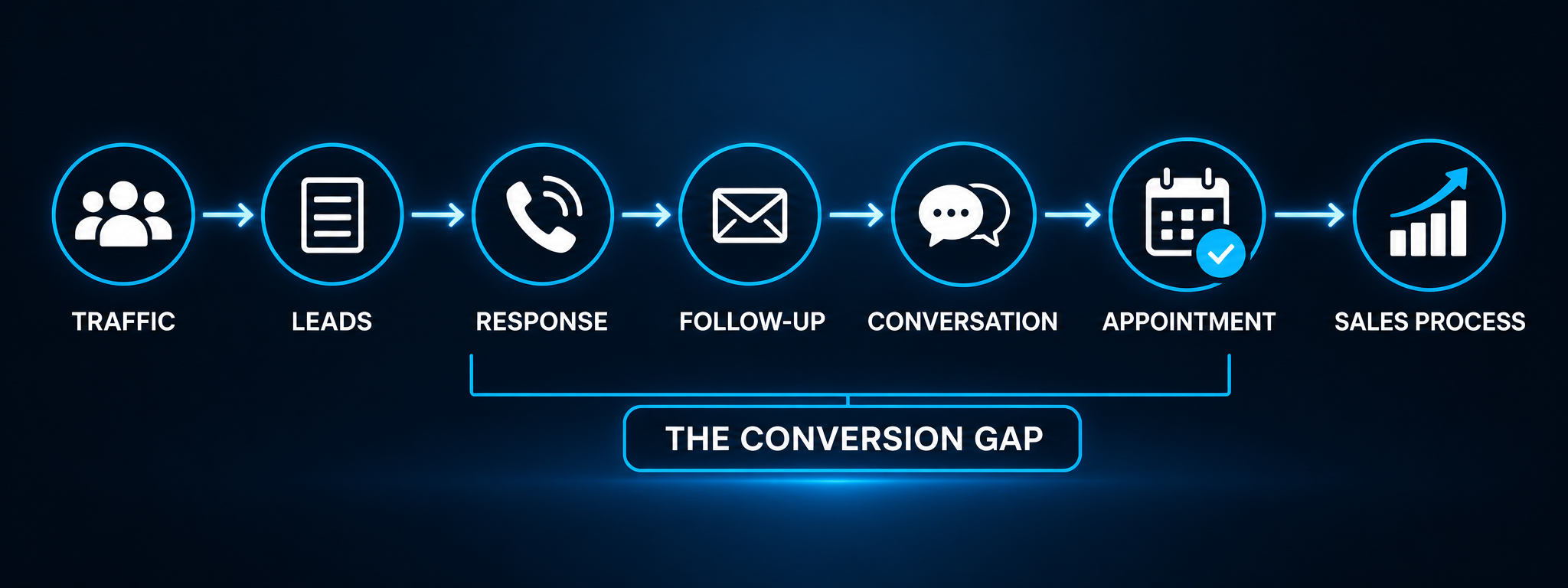
Marketing usually gets most of the attention on the left side.
How many visitors did we get?
How many calls?
How many forms?
What's our cost per lead?
Those are important questions.
But a lead is not a customer.
It's not even necessarily an appointment.
It's a person who has raised their hand.
What happens next determines whether that marketing opportunity actually has a chance to become revenue.
That's the conversion gap.
A marketing problem and a conversion problem aren't the same thing
Suppose two home-service businesses each generate 100 inquiries.
Business A immediately responds, keeps every inquiry organized, follows up consistently, makes scheduling easy, and knows where each opportunity stands.
Business B misses some calls, checks forms when someone gets around to it, sends one follow-up, tracks prospects across inboxes and phones, and relies heavily on somebody remembering what needs to happen next.
Both businesses generated 100 leads.
They do not have the same marketing problem.
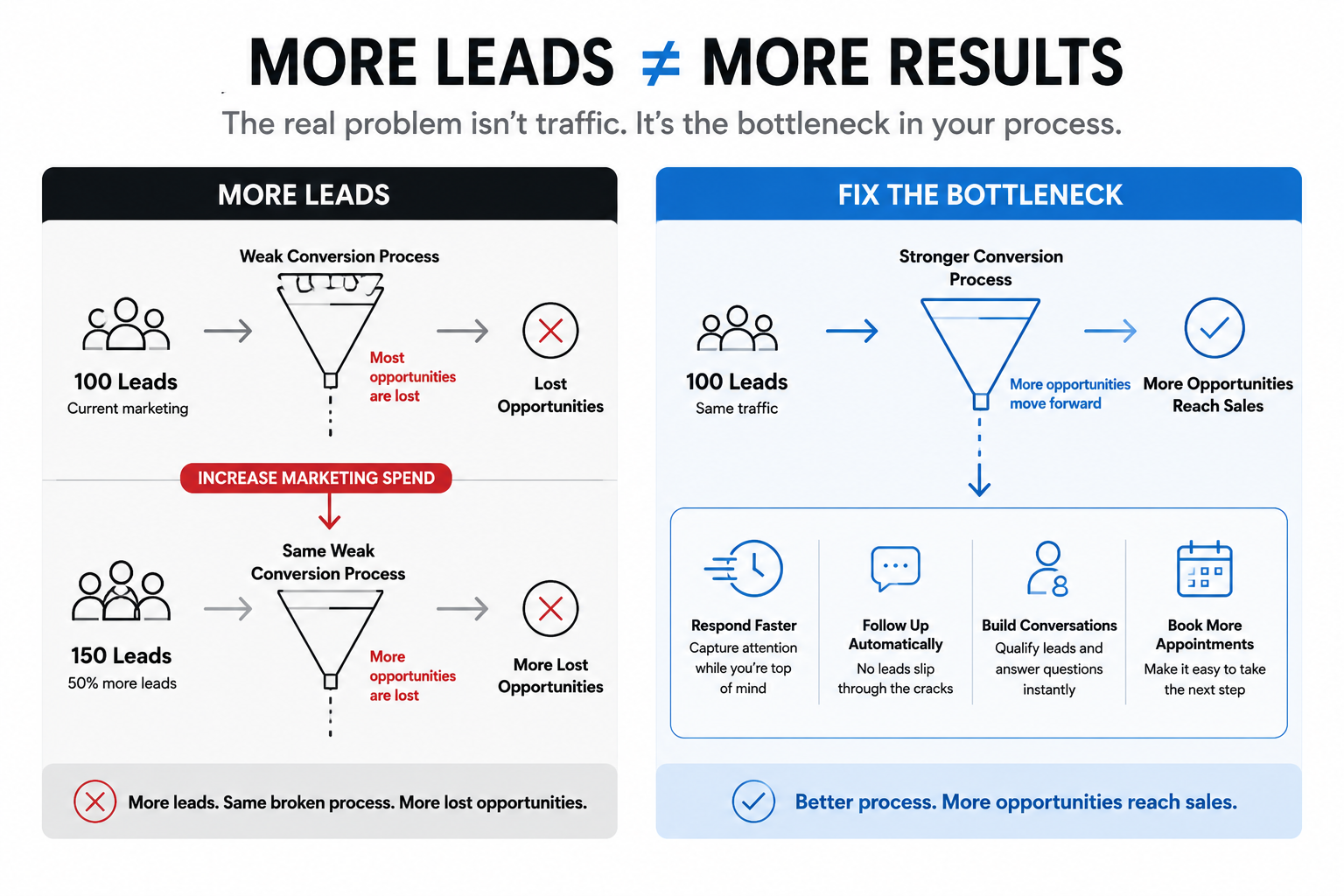
If Business B buys another 50 leads without fixing anything else, it may simply create 50 more opportunities to mishandle.
That's why I think lead generation and lead conversion need to be evaluated separately.
You can have:
- too little traffic
- poor-quality traffic
- weak lead generation
- strong lead generation but poor conversion
- or some combination of all four
The solution depends on the bottleneck.
"Get more leads" isn't a diagnosis.
Where do businesses lose leads after they arrive?
Usually, there isn't one dramatic failure.
It's a series of small leaks.
Nobody answers the phone
This one is painfully ordinary.
A contractor is on a job.
The owner is meeting with a customer.
The receptionist is already on another call.
It's after hours.
The phone rings and goes unanswered.
The caller may leave a voicemail.
Or they may simply call the next business.
The marketing worked. Someone found you and called.
The breakdown happened afterward.
Website forms sit in an inbox
A prospect visits your website at night and submits a request for an estimate.
The form sends an email.
That's technically successful lead generation.
But if nobody sees it until tomorrow afternoon, you've introduced a long period where nothing useful happens. We go deeper into the full process in what should happen after someone fills out a website form.
No acknowledgment.
No expectation about what happens next.
No scheduling option.
No conversation.
Just silence.
The first response takes too long
People don't necessarily submit one inquiry and patiently wait for that business to respond.
They research.
They compare.
They call around.
They continue browsing.
The longer an interested prospect sits without useful contact, the more opportunity there is for something else to win their attention. Research from Harvard Business Review found that the odds of qualifying a lead drop dramatically when response time stretches beyond an hour.
That doesn't mean your team needs to conduct a full sales consultation within 30 seconds.
It means acknowledgment and responsiveness matter.
One attempt is treated as follow-up
Call once.
No answer.
Maybe leave a voicemail.
Done.
Lead marked "unresponsive."
That's not much of a follow-up system.
People miss calls. They're working. They're driving. They're picking up their kids. They forget they submitted the form.
Not responding to one attempt doesn't necessarily mean they aren't interested.
At the same time, good follow-up doesn't mean harassing someone 17 times before lunch.
There needs to be a reasonable process.
Leads are scattered everywhere
One prospect is in someone's email.
Another is a text message.
Another came through Facebook.
Three called the office.
Someone wrote a referral on a sticky note.
And there's probably an Excel spreadsheet lurking somewhere for good measure.
The more fragmented the process becomes, the easier it is for opportunities to disappear.
This is one reason a CRM can matter.
Not because every small business needs an enterprise software monster with 900 features.
Because having a reliable place to answer "Who are our open opportunities, and what needs to happen next?" is useful.
Booking creates unnecessary friction
The business finally connects with the prospect.
Now comes:
"What day works for you?"
"How about Tuesday?"
"I can't Tuesday."
"Wednesday at 2?"
"I work until 3."
"What about Thursday morning?"
And we're six messages into scheduling something that could potentially have taken a minute.
Not every business can use self-scheduling for every appointment. Some jobs need qualification or routing first.
But whenever unnecessary back-and-forth can be removed, it should be.
Nobody owns the next step
This might be the most important leak of all.
A lead came in.
Someone replied.
Now what?
Who follows up tomorrow?
What happens if the prospect says "maybe next month"?
Who checks whether the estimate was received?
What happens to a lead that wasn't ready yet?
If the answer is essentially "somebody will remember," that's not a process.
That's hope with a calendar.
The hidden problem with buying more leads
Let's use a hypothetical example.
This is deliberately simple—not a claim about average conversion rates.
A business generates 100 leads per month.
It spends $10,000 generating them.
That's:
$10,000 ÷ 100 = $100 per lead
Now imagine only 40 of those leads ever progress to a meaningful sales conversation because of missed calls, delayed responses, inconsistent follow-up, scheduling friction, or poor organization.
The business looks at the numbers and decides it needs more volume.
So it increases marketing spend by 50%.
Now it spends:
$15,000
and generates:
150 leads
If the same conversion infrastructure remains in place, the business hasn't actually solved the problem.
It has simply purchased more inputs.
It means you should know which part of the machine is underperforming before feeding more money into it.
More leads can actually make a weak system worse
There's another problem people don't talk about enough.
Volume creates operational pressure.
If a business already struggles to respond to 10 inquiries per day, what happens when marketing increases that to 20?
The inbox gets worse.
Calls get missed.
Follow-up becomes less consistent.
Salespeople start cherry-picking opportunities.
Lead records become incomplete.
Customers wait longer.
Marketing may be doing its job beautifully while the rest of the system becomes overwhelmed.
At some point, increasing lead generation without increasing the business's ability to handle those leads can create diminishing returns.
That is why customer acquisition shouldn't be viewed as marketing operating in one room and operations sitting somewhere else.
They're connected.
Before spending more on leads, audit these seven things
You don't need an elaborate consulting project to begin finding the leaks.
Take a sample of recent inquiries and walk through what actually happened.
1. Lead capture
Where do inquiries come from?
List everything:
- phone calls
- website forms
- chat
- Google Business Profile
- Google Ads
- social media
- referrals
- text messages
- third-party lead sources
Are all of them reliably captured somewhere?
Or could an inquiry disappear without anyone noticing?
2. Response time
How long does it actually take someone to respond?
Not what the policy says.
Not what you assume.
Look at actual leads.
Take ten or twenty recent inquiries and check the timestamps.
You may discover a completely different reality.
3. Missed calls
What happens when nobody answers?
Does the caller receive any immediate acknowledgment?
Is somebody assigned to return the call?
Can the team tell which calls still need attention?
Or does voicemail basically become a graveyard?
4. Follow-up consistency
What happens when a new lead doesn't immediately respond?
Is there a defined process?
How many attempts are made?
Across which channels?
Over what period?
And most importantly:
Does that process actually happen?
A follow-up plan that exists in someone's head isn't much of a system.
5. Lead organization
Can you open one place and see:
- new leads
- contacted leads
- appointments
- estimates or proposals
- leads requiring follow-up
- longer-term opportunities
- won and lost opportunities
If not, improving visibility alone can reveal problems you didn't know existed.
6. Scheduling
How difficult is it for an interested prospect to take the next meaningful step?
For some businesses that's booking a consultation.
For others it's scheduling an estimate, site visit, demo, inspection, or phone call.
Count the steps.
Look for unnecessary friction.
7. Measurement
Most businesses know how many leads they generate.
Far fewer can confidently answer:
- What percentage receive a response?
- How quickly?
- How many become conversations?
- How many become appointments?
- How many appointments actually happen?
- Where are opportunities dropping out?
You don't need twenty dashboards.
You need enough visibility to identify the bottleneck.
The goal isn't to automate everything
This is where AI and automation enter the conversation—and where things can go sideways quickly.
The solution to a conversion problem is not automatically more software.
If your salesperson is terrible at conversations, automating the appointment reminder won't fix that.
If your offer makes no sense, a CRM won't save it.
If leads are genuinely poor quality, sending them seven automated messages won't magically turn them into great prospects.
Technology is useful when it fixes a specific operational problem.
For example:
Problem: Calls are frequently missed while crews are working.
Possible solution: Automatically acknowledge missed callers and create a follow-up task.
Problem: Website leads arrive after hours and sit untouched.
Possible solution: Immediately confirm the inquiry, provide an appropriate next step, and notify the team.
Problem: Employees forget to follow up.
Possible solution: Use CRM workflows, reminders, and appropriate automation to make follow-up systematic.
Problem: Scheduling requires endless back-and-forth.
Possible solution: Give qualified prospects an easier booking pathway.
Notice the pattern.
Problem first. Technology second.
That's the way AI should be implemented in a business.
Where an AI-powered website fits
This is also why I don't think a modern website should be treated as a completely separate marketing asset.
An AI-powered website can become the front end of this larger conversion process.
Instead of simply generating a form notification, the website can potentially connect the inquiry to:
- CRM
- communication
- scheduling
- lead routing
- follow-up
- pipeline management
- AI-assisted conversations
The website gets someone to raise their hand.
The systems behind it help determine what happens after they do.
That connection is far more interesting to me than whether AI happened to write the website copy.
This is the problem Booked Calendar System™ is built around
At Boost Local Biz, we call our approach to this conversion infrastructure the Booked Calendar System™.
The name describes the objective of the system—not a guaranteed outcome.
The idea is straightforward:
Reduce the gap between a lead being generated and a legitimate appointment or sales opportunity being created.
Depending on the business and implementation, that may involve things like:
- inquiry capture
- fast initial response
- missed-call follow-up
- SMS and email communication
- CRM/contact management
- pipeline visibility
- appointment scheduling
- reminders
- longer-term nurturing
- lead reactivation
- AI-assisted conversations
But the individual features aren't really the point.
The system is.
A collection of software features doesn't solve anything unless they work together around an actual customer journey.
So, do you need more leads?
Maybe.
There are absolutely businesses that need more visibility, more traffic, and more inquiries.
BLB still works with SEO, Google Business Profiles, Google Ads, websites, and other parts of digital marketing because lead generation obviously matters.
The mistake is assuming more leads is always the first answer.
Before increasing the marketing budget, I'd want to know:
Are we generating enough opportunities to evaluate the current process?
Are they the right opportunities?
How quickly are we responding?
Are we following up consistently?
How many become actual conversations?
How many reach the appointment or estimate stage?
Where do they disappear?
If the top of the funnel is genuinely the problem, go generate more demand.
But if good opportunities are already coming in and leaking out the bottom, fix the leak first.
Then when you do increase marketing, you're sending those new leads into a stronger system.
That's a much better place to scale from.
Stop measuring marketing at the lead
A lead is an important milestone.
It isn't the finish line.
The real customer-acquisition journey stretches from discovery all the way through response, follow-up, appointment, sales process, and ultimately the customer's decision.
Marketing influences the beginning.
Your conversion infrastructure influences what happens next.
Your sales process influences what happens after that.
When those pieces work together, you can make much smarter decisions about where growth is actually getting stuck.
So the next time the answer seems obvious—
"We need more leads."
—take a look at what happened to the last ones first.
You might find the bigger opportunity is already sitting in your pipeline.
Want to Find the Gaps Between Your Leads and Your Calendar?
Boost Local Biz's Booked Calendar System™ is designed to connect lead capture, response, follow-up, CRM, scheduling, and nurturing into a more consistent conversion process.
The objective isn't to replace your sales process or promise that every lead becomes a customer.
It's to help make sure good opportunities aren't being lost simply because the systems between "I'm interested" and "let's talk" aren't doing their job.
Explore the Booked Calendar System™ or schedule a consultation to see where your current lead-conversion process may be leaking opportunities.