Getting your first AI automation client can feel like a strange little catch-22.
Businesses want to know what you've done.
You need businesses to hire you so you can show what you've done.
And somewhere on the internet, someone is telling you the solution is to scrape 50,000 email addresses, generate personalized opening lines with AI and start blasting.
I'd take a different approach.
Your first client doesn't require a massive client-acquisition machine.
You need a useful offer, access to the right businesses and enough real conversations to learn what people will actually pay you to solve.
At this stage, your biggest advantage isn't scale. If you're still working through the broader business model, our guide to starting an AI automation agency covers the full picture.
It's proximity.
What's the fastest way to get your first AI automation client?
For most people starting out, the fastest realistic path to a first AI automation client isn't building a large-scale marketing machine. It's starting with people and businesses you can already reach, identifying one expensive or frustrating problem you can solve, making a small specific offer, and getting into real conversations. A small win becomes proof, and once you know what actually gets a response, you can expand into more scalable outbound and inbound acquisition.
In other words, optimize for access before scale:
ACCESS → PROBLEM → OFFER → CONVERSATION → SMALL WIN → PROOF → REPEAT
Start with businesses you can actually reach.
That might include:
- people already in your network
- existing business relationships
- former clients or employers
- local businesses
- businesses you personally use
- professional groups
- referral partners
- niche communities
- carefully selected cold prospects
Your goal isn't to immediately build the perfect sales funnel.
Your goal is to get close enough to the market to understand what businesses actually need.
A useful first-client progression looks something like this:
PROXIMITY → CONVERSATIONS → PROBLEM → OFFER → PROOF → REPEAT
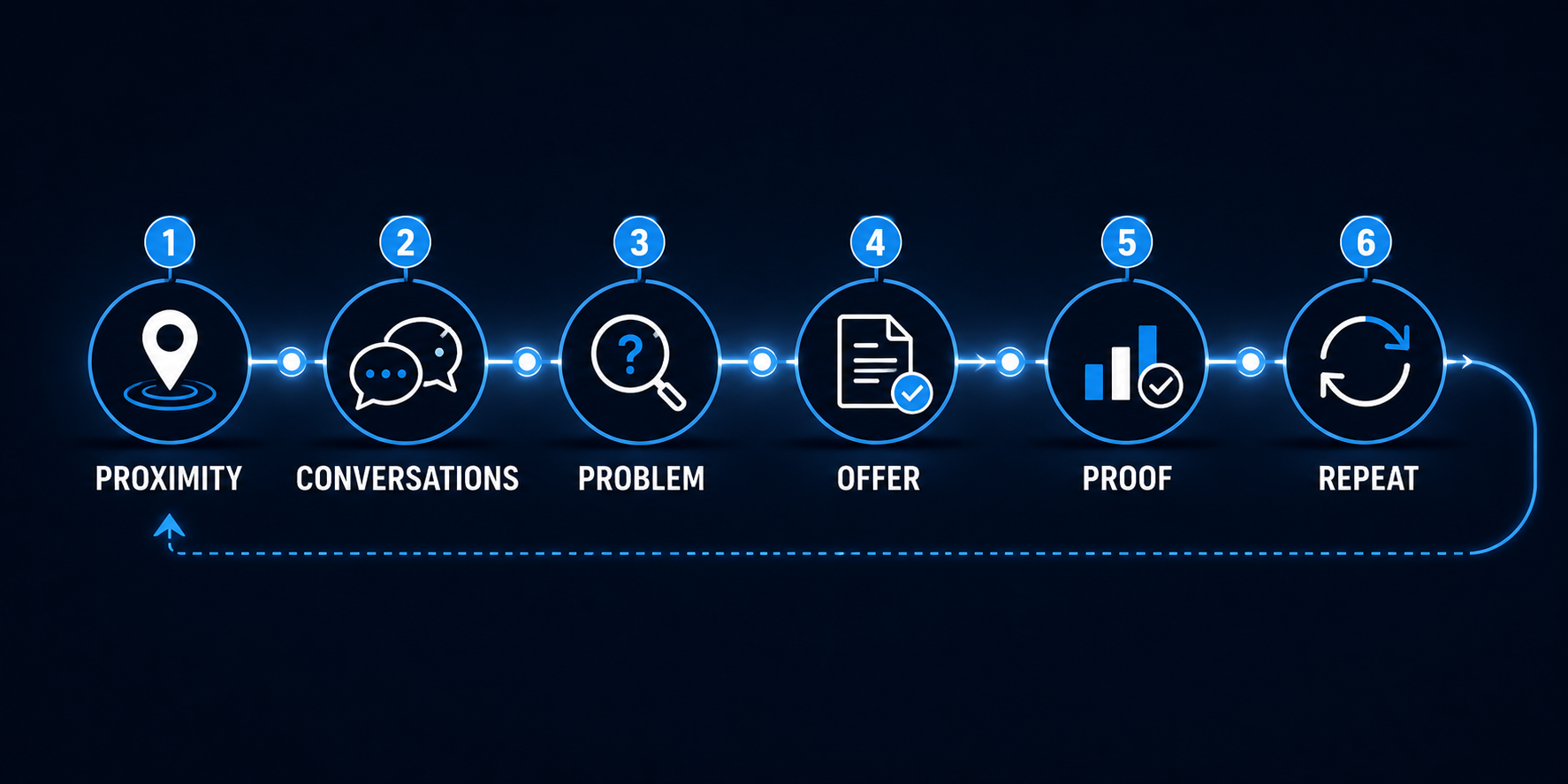
Get near the market.
Start conversations.
Find a meaningful problem.
Offer a clear solution.
Create proof.
Then repeat what works.
That's a much healthier starting point than trying to automate a sales process you haven't figured out manually yet.
First, make sure you have something specific to sell
Before worrying about lead lists, cold email software or LinkedIn scripts, answer a simpler question:
What are you actually offering?
"AI automation" is too broad.
So is:
"We help businesses leverage AI to increase efficiency."
That could mean almost anything.
A better offer might be:
We help home-service companies respond to new inquiries immediately and continue following up until the lead books, replies or opts out.
Now there's something to discuss.
If you're still figuring out the service itself, start with our guide to the best AI automation services to sell.
Then turn the service into something a buyer can actually understand using the framework in how to package AI automation services into an offer.
Client acquisition gets easier when you stop making the prospect figure out what you're selling.
Don't start by selling AI
This is one of the biggest mistakes I see in AI-related offers.
The seller is fascinated by the technology, so the pitch becomes about the technology.
"We use cutting-edge artificial intelligence, intelligent agents, LLMs and advanced workflow automation to transform your business."
Cool.
What problem does it solve?
Most business owners aren't waking up worried that their company doesn't have enough large language models.
They're worried about things like:
- missed opportunities
- slow response times
- repetitive administrative work
- scheduling problems
- inconsistent follow-up
- customer-service bottlenecks
- disconnected systems
- employees wasting time on manual processes
Start there.
AI can be part of the solution.
It doesn't need to be the opening act.
Look for problems, not businesses that "need AI"
Imagine you're targeting contractors.
Don't walk around thinking:
Which contractors need AI?
Look for observable business problems.
Maybe:
- the website only has a generic contact form
- there's no obvious scheduling option
- calls after hours may go unanswered
- quote requests receive no immediate response
- reviews mention communication problems
- the company is hiring administrative staff for repetitive work
- customers repeatedly ask the same questions
- the business has multiple systems that appear disconnected
Not every observation means there's a problem.
That's important.
You don't know what's happening behind the scenes yet.
But you've found something worth asking about.
Instead of:
"You need an AI chatbot."
you can ask:
"What happens when somebody submits a quote request at 9:30 at night?"
That's a business conversation.
Your first-client advantage is proximity
Large agencies can buy lists, run ads, sponsor events and operate sophisticated outbound teams.
You probably don't need any of that for client number one.
Start with people and businesses where the distance between you and a conversation is short.
If you rank the channels below by how much access they give you for client number one, the warmest and fastest usually sit at the top. Treat this list as a hierarchy, not a checklist — work from the channels where you're closest to a real conversation down toward the ones that scale later.
1. Start with your existing network
Make a list of people who:
- own businesses
- manage businesses
- sell to businesses
- work inside businesses
- know business owners
- participate in local business communities
You're not asking everyone to buy automation.
You're looking for conversations and introductions.
A simple message can work:
"I've been building automation systems around things like lead response, follow-up and repetitive business processes. I'm looking to work more closely with a few businesses where there's a real operational problem worth solving. If someone comes to mind, I'd appreciate an introduction."
That's considerably better than announcing:
"I HAVE LAUNCHED AN AI AUTOMATION AGENCY 🚀"
Your cousin doesn't know what that means either.
2. Look at businesses you already know
Think about companies you interact with personally.
Your:
- contractor
- dentist
- landscaper
- gym
- accountant
- property manager
- insurance agent
- auto shop
- local restaurant
- professional service providers
You've already experienced part of their customer journey.
That can give you something cold outreach doesn't:
context.
Maybe you waited two days for a callback.
Maybe scheduling required three phone calls.
Maybe you received the same repetitive email from three employees.
Maybe the business is excellent but clearly overwhelmed administratively.
Again, don't assume.
Ask.
3. Use local prospecting
Local businesses are particularly useful when you're learning how to sell automation because you can often understand the business more easily.
Look at:
- Google Business Profiles
- websites
- reviews
- social profiles
- local directories
- chamber or association memberships
- businesses near you
You're looking for businesses where you can identify a plausible operational or conversion problem.
This is also where traditional digital-marketing experience helps.
A website, Google Business Profile, ad campaign, lead form, phone call and CRM aren't isolated things.
They're parts of a customer-acquisition system.
Sometimes the automation opportunity becomes obvious when you look at what happens between them.
4. Build referral relationships
Some people already have access to the businesses you want to reach.
Think:
- web designers
- marketing agencies
- SEO consultants
- paid-ad specialists
- IT providers
- CRM consultants
- business coaches
- fractional executives
- industry consultants
They may encounter automation problems they don't want to solve themselves.
That's potentially valuable.
Instead of approaching them with:
"Can you send me clients?"
give them a clear picture of the problem you solve.
For example:
"If you have service-business clients generating inquiries but struggling with response and follow-up, that's the piece I specialize in."
Now they know when to think of you.
5. Use personalized cold outreach
Yes, cold outreach can work.
But personalized does not mean:
"Hi John, I noticed you are the CEO of John's Plumbing and love your commitment to plumbing excellence."
Nobody believes you.
Useful personalization is about the business.
You noticed something relevant.
You have a question.
You might have an idea.
That's enough.
A simple cold email example
Subject: Quick question about your website leads
Hey Mike — I noticed your site sends quote requests through a standard contact form. What happens when somebody submits one after hours or while everyone is tied up?
I build automated lead-response and follow-up systems for service businesses, and I had an idea for how that process could work without requiring someone to constantly monitor the inbox.
Happy to show you what I mean if it's relevant.
Notice what's missing.
No AI buzzword soup.
No fake compliment.
No three-paragraph biography.
No calendar link shoved into the first sentence.
No claim that you're going to 10X their revenue.
It's simply:
Observation → Question → Relevance → Conversation
6. Use social outreach like a person
LinkedIn, Facebook, Instagram and niche communities can create conversations.
They can also make you look like a bot wearing human skin.
Don't connect with someone and immediately send:
"Thanks for connecting! I help businesses leverage AI…"
We all know what's coming next.
Instead:
- participate in relevant discussions
- answer questions
- share useful observations
- comment intelligently
- connect when there's a reason
- start conversations naturally
Social selling works better when the "social" part survives.
7. Use freelance marketplaces selectively
Marketplaces can help you get early experience because buyers are already looking for help.
The downside is obvious:
Competition can be intense, pricing pressure can be ugly, and you don't own the platform.
Use them strategically.
Look for projects where:
- you understand the problem
- your skills match
- scope is reasonable
- you can communicate clearly
- the project could produce useful experience
Don't spend six hours competing for a $40 automation job because you think suffering builds character.
There are easier ways to build character.
What should you say when contacting a prospect?
The exact wording matters less than the structure.
A useful outreach framework is:
1. Observation
Show why you're contacting this business.
2. Problem or question
Surface something worth discussing.
3. Relevance
Briefly explain what you do that relates to it.
4. Low-friction next step
Ask for a conversation, permission to send an idea or another simple response.
That's it.
The first message doesn't need to close the deal.
Its job is to start the right conversation.
Weak outreach starts with the seller
A weak AI automation pitch often follows this sequence:
AI → FEATURES → TOOLS → PITCH
"We use AI agents with advanced CRM workflows, conversational automation and omnichannel integrations…"
The prospect is already gone.
A better sequence is:
BUSINESS → PROBLEM → QUESTION → CONVERSATION
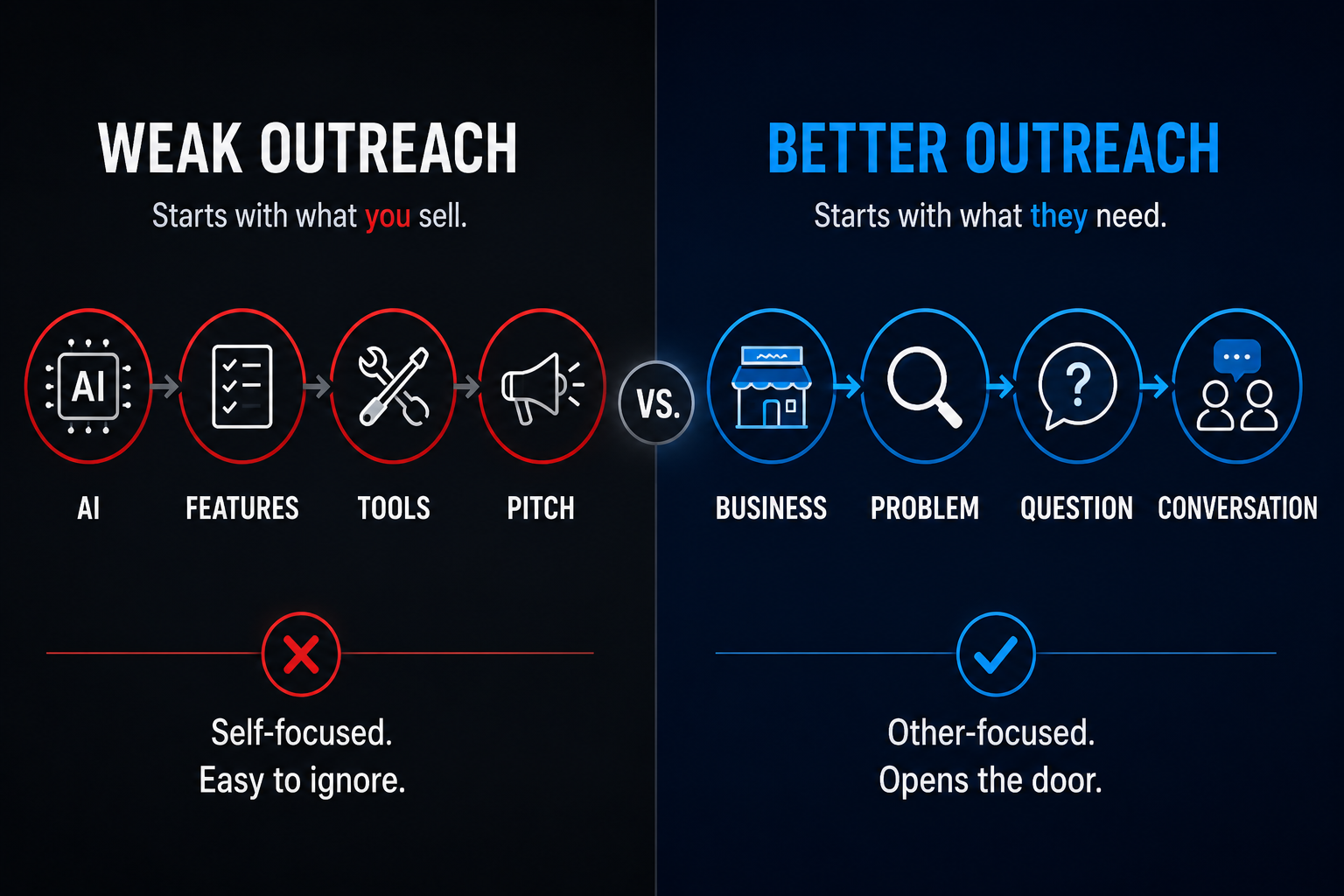
Start where the buyer already is.
Ask better discovery questions
Once someone agrees to talk, resist the urge to immediately demo everything you've built.
Ask questions.
For a lead-response problem, you might ask:
- Where do new inquiries currently come from?
- Who responds?
- What happens after hours?
- How quickly are leads typically contacted?
- What happens if they don't respond?
- How many follow-up attempts happen?
- Where is everything tracked?
- What parts of the process are manual?
- Where does the process tend to break?
- What have you already tried?
You're trying to understand the current system.
Then determine whether automation actually belongs there.
Sometimes the correct answer is:
They don't need what you're selling.
That's okay.
Selling automation into a process that doesn't need automation is how you create expensive toys nobody uses.
Don't build the entire system before the sale
This connects directly to the principle we discussed in how to package AI automation services.
You don't necessarily need a fully built production system before approaching anyone.
You need enough to demonstrate the idea.
That could be:
- a process map
- a small prototype
- a working demo
- a sample conversation
- a sandbox workflow
- a short video walkthrough
- a mock process clearly identified as a demonstration
Show the prospect how the solution would work.
Then build the full implementation once the problem, scope and engagement are real.
Otherwise, you can spend three weeks building something nobody asked for.
How do you get clients when you don't have case studies?
You demonstrate competence before you can demonstrate results.
There's a difference.
If you haven't produced client results yet, don't pretend you have.
Instead, show:
Working demonstrations
Build something the prospect can see functioning.
Process understanding
Map their current workflow and identify where automation may help.
Your own systems
If you've automated something inside your own business, show it where relevant.
Audits and observations
Demonstrate that you understand the operational problem.
Prototypes
Create a limited proof of concept.
Clear thinking
Explain the tradeoffs, limitations and implementation considerations better than someone who's simply selling a tool.
You don't need fake authority.
You need enough real competence for someone to trust you with a manageable first engagement.
Should you work for free to get your first client?
Usually, I wouldn't start there.
Free work creates several problems.
The client has little financial commitment.
Scope can become sloppy.
Your work may be treated casually.
And you're learning the wrong lesson about what the market will pay.
Instead of eliminating the price, consider reducing the risk.
You could offer:
- a smaller initial implementation
- a paid pilot
- a limited scope
- a phased rollout
- a short proof-of-concept engagement
- clearly defined introductory pricing
That allows the client to test the relationship without requiring you to donate your business.
There are situations where doing something free makes strategic sense.
But make it an intentional investment, not your default sales model.
A paid pilot can be a powerful first step
Suppose a business has five processes you believe could be automated.
Don't sell all five immediately.
Pick one.
Define:
- the problem
- what you're building
- timeline
- responsibilities
- success criteria
- what happens afterward
Now both sides can evaluate the relationship with less risk.
If the pilot works well, expansion becomes a logical next conversation.
If it doesn't, you've limited the blast radius.
Don't underprice something just because it's your first client
Your first client doesn't need to know they're your first client.
They need to know whether you can solve the problem.
You may choose introductory pricing because you're building experience or proof.
That's reasonable.
But there is a difference between:
strategic introductory pricing
and
panic pricing.
If the project should reasonably cost several thousand dollars to deliver profitably, charging $300 because you're nervous doesn't magically make the project easier.
It just makes the problems cheaper for the client and more expensive for you.
Our guide to pricing AI automation services walks through the economics in more detail.
Your first client may come from a service you already provide
This is easy to overlook.
If you're already a:
- marketer
- web designer
- developer
- consultant
- freelancer
- SEO provider
- advertising specialist
- CRM implementer
you may already have businesses trusting you.
Look at their existing problems.
Maybe a website client also has poor lead follow-up.
Maybe an ad client is generating inquiries nobody responds to quickly.
Maybe an SEO client has plenty of traffic but weak conversion systems.
Maybe a CRM client has workflows nobody actually uses.
You may not need a new client. You may need a new problem to solve for an existing one.
That's often a much shorter path.
Choosing a niche can make prospecting easier
You don't have to choose a permanent niche before making your first sale.
But narrowing your focus can make outreach considerably easier.
Compare:
"I provide AI automation to businesses."
with:
"I help HVAC companies respond to missed calls and web inquiries faster."
The second gives you:
- a clearer prospect list
- more relevant observations
- better discovery questions
- repeatable problems
- stronger messaging
- more reusable systems
Our guide to choosing an AI automation agency niche explains why I prefer choosing around valuable, repeatable problems rather than chasing whichever industry looks trendy.
How many prospects should you contact?
Enough to learn.
That's intentionally not a magic number.
If you contact five businesses and nobody responds, you don't know much.
If you contact hundreds with the same weak message, you've simply gathered a larger sample of failure.
Early outreach should produce information.
Track:
- who you're contacting
- why you chose them
- what problem you identified
- what you said
- whether they responded
- objections
- questions
- what created interest
- what confused people
Then improve.
The goal isn't activity for activity's sake.
It's learning what creates real conversations.
Don't automate your outreach too early
Yes, this is an automation article telling you not to automate something.
Welcome to nuance.
Automation is useful when you have a process worth scaling.
If you haven't figured out:
- your market
- your message
- your offer
- your targeting
- your objections
automating outreach just helps you make the same mistakes faster.
Do some things manually first.
Learn.
Then automate the parts that should be automated.
Automation should multiply a working process—not rescue a broken one.
Client #1 acquisition isn't the same as agency scaling
Here's a distinction that gets missed a lot.
The best acquisition strategy for your first client is often not the best long-term acquisition strategy for a mature agency.
Warm relationships, local access, and direct conversations are usually the fastest way to land client number one because they give you something cold scale can't: real feedback from real business owners while your offer is still taking shape.
Content, SEO, a personal brand, and an outbound engine are genuinely valuable — but they're slow to build, and they reward businesses that already have an audience, authority, and a proven offer. They're scaling assets, not first-client assets.
So the order matters: use access and conversations to figure out what gets a response, then reinvest what you learned into the channels that scale.
Content matters, but it probably isn't your fastest first-client strategy
You should build authority.
Useful articles, videos, demonstrations and social content can absolutely help prospects discover and trust you.
Over time, that's powerful.
But if you have zero clients today, don't spend six months hiding behind content production because talking to businesses feels uncomfortable.
Content and outbound conversations can work together.
Create something useful.
Send it to someone relevant.
Have a conversation.
Learn what they care about.
Create something better.
That's how authority starts compounding.
What happens when someone is interested?
Don't immediately throw a giant proposal at them.
First understand:
Problem → Current Process → Desired Change → Constraints → Scope
Then determine what solution actually makes sense.
Only after that should you decide:
- deliverables
- implementation
- timeline
- price
- ongoing responsibility
That's where the work we've already done around packaging AI automation services, selling AI automation services and pricing AI automation services becomes useful, and once those are clear you can present the engagement in a defined AI automation proposal.
The articles aren't separate ideas.
They're one process.
Your first-client playbook
If I were starting from zero tomorrow, I'd keep it simple.
Step 1: Pick one problem
Choose something businesses clearly experience and you can realistically solve.
Step 2: Identify a reachable market
Start where you have some proximity.
Step 3: Build enough to demonstrate the idea
Not the entire company infrastructure.
Enough to make the solution understandable.
Step 4: Create a prospect list manually
Choose businesses intentionally.
Step 5: Look for context
Find a reason for contacting each business.
Step 6: Start conversations
Observation.
Question.
Relevance.
Low-friction next step.
Step 7: Run discovery
Understand the current process before prescribing automation. A proper client onboarding process helps you map what's actually happening before you build anything.
Step 8: Offer a manageable first engagement
Reduce risk without automatically giving away the work.
Step 9: Deliver well
The first client is not merely revenue. It's an opportunity to improve your delivery process.
Step 10: Capture legitimate proof
With permission, document:
- what was built
- the problem addressed
- process improvements
- measurable outcomes when available
- client feedback
Don't embellish it.
Real proof gets more valuable as it accumulates.
Step 11: Repeat
Now you have more than a theory.
You have experience.
Use what you learned to improve:
Targeting → Message → Offer → Delivery → Proof
Then go again.
Your first client changes the game—but not for the reason you think
Yes, getting paid matters.
But your first good client gives you something else:
information.
You learn what businesses actually ask.
What they don't understand.
What implementation really takes.
Where scope expands.
What breaks.
What creates value.
What they're willing to pay for.
What you thought mattered but didn't.
That's why I would rather see someone have ten legitimate business conversations than spend a month perfecting an AI agency logo and building 47 automated outreach sequences.
Get close to the market.
The market will teach you things YouTube can't.
Build the Business While You Find the Client
If you're still connecting the pieces—what to sell, who to sell it to, how to package it and how the underlying automation business works—the 48-Hour AI Cashflow Stack gives you a practical framework for putting those pieces together.
It isn't a promise that you'll land a client in 48 hours.
And it isn't another "copy this AI agency and get rich" blueprint.
It's designed to help you build a legitimate AI-powered service business around problems companies actually care about solving.
Download the 48-Hour AI Cashflow Stack and start building the system behind the business.