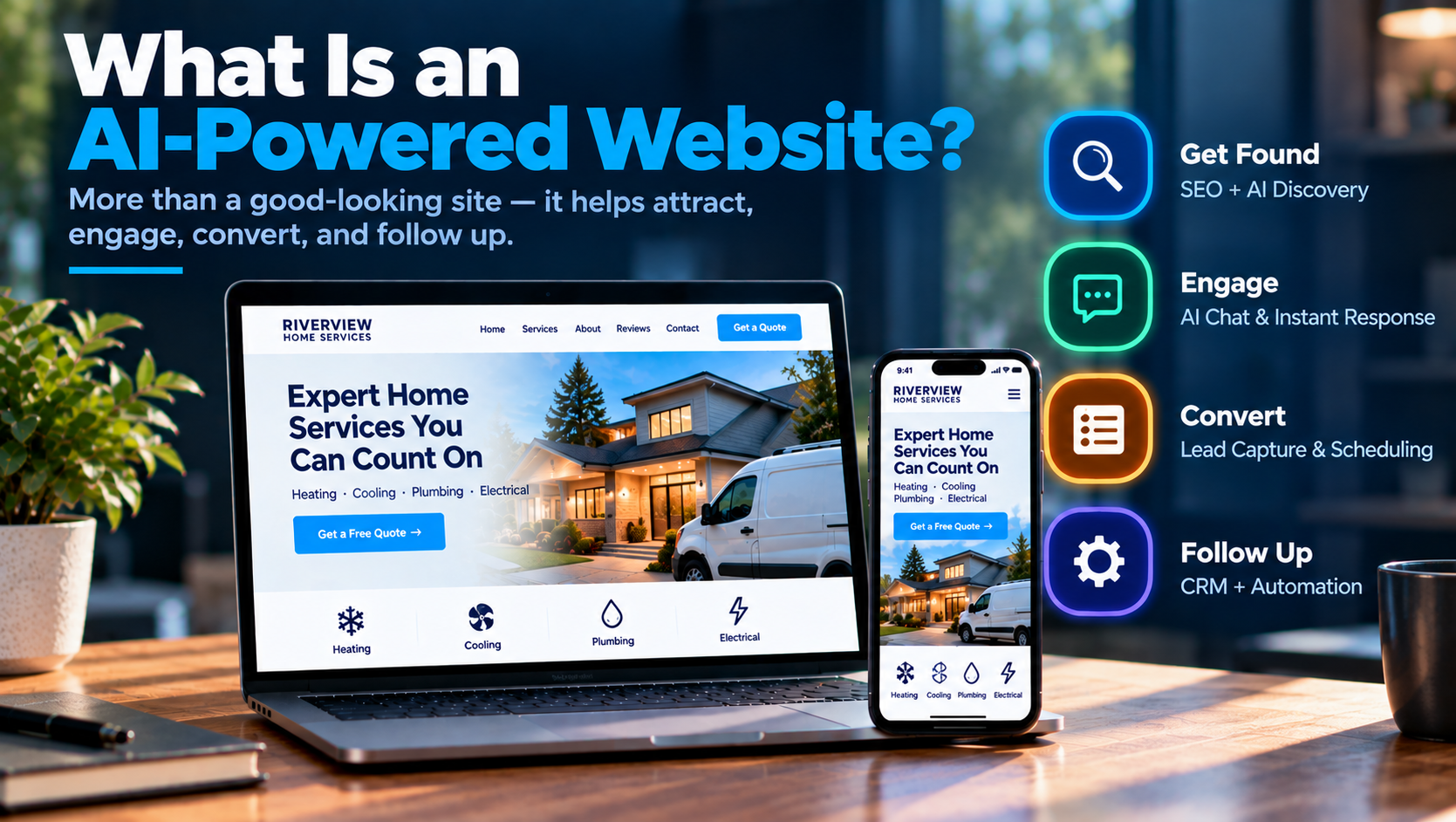
"AI-powered website" is quickly becoming one of those phrases that can mean almost anything.
Sometimes it means a website was created with an AI website builder. Sometimes it means there's an AI website chatbot sitting in the bottom-right corner. Other times, it describes a much larger system involving AI conversations, lead capture, CRM, appointment scheduling, automated follow-up, and other tools working behind the scenes.
Those aren't the same thing.
And if you're a business owner, I don't think the most important question is whether AI was used to build your website anyway.
The better question is:
What can the website actually do for your business once someone lands on it?
That's where the idea of an AI-powered website becomes much more useful.
What is an AI-powered website?
An AI-powered website is a website that uses AI, automation, and connected business systems to do more than simply display information.
Depending on how it's built, it can help a business capture inquiries, answer questions, respond to prospects, schedule appointments, organize contacts, trigger follow-up, and connect website activity to the systems the business uses after a lead comes in.
The important distinction is that AI becomes part of the website's function, not simply part of how the website was created.
Using ChatGPT to write a headline doesn't suddenly make a website intelligent.
Neither does generating the layout with an AI website builder.
Those tools may make website creation faster, and there is nothing wrong with using them. But from a business owner's perspective, that's mostly a production detail.
What matters is what happens when a real prospective customer visits the finished website.
An AI-built website and an AI-powered website aren't necessarily the same thing
This distinction is going to matter more as AI becomes standard in web development.
Imagine two contractors each launch a new website.
Website A
AI helps generate the design, copy, images, or code.
The finished site has:
- service information
- photos
- an About page
- a phone number
- a contact form
Someone submits the form.
An email gets sent to the contractor.
That's where the website's job ends.
Website B
AI may or may not have been used to create it.
But when a prospective customer visits, the website can be connected to systems that:
- capture the visitor's inquiry
- answer common questions conversationally
- create or update a contact in the CRM
- immediately acknowledge an inquiry
- start an appropriate follow-up sequence
- offer an appointment or consultation
- notify the business
- keep the opportunity organized in a sales pipeline
- continue following up when appropriate
Which one is really the more intelligent website?
I'd argue it's Website B.
The tool used to build the page matters a lot less than the system the finished page becomes part of.
The traditional website model is mostly passive
There is nothing inherently wrong with a traditional website.
A good one can still do a lot of important things.
It can help people find your business. It can explain your services, demonstrate credibility, show previous work, answer questions, rank in search engines, and give visitors a way to contact you.
The weakness appears when the entire strategy is basically:
Visitor arrives → visitor reads → hopefully visitor calls or fills out a form.
If they do, the website has completed its mission.
Everything that happens afterward becomes somebody else's responsibility.
Someone needs to notice the email.
Someone needs to return the call.
Someone needs to remember to follow up.
Someone needs to enter the prospect into whatever system the company uses.
Someone needs to schedule the appointment.
And if the prospect doesn't respond the first time, someone needs to remember to try again.
For a lot of businesses, that's exactly where opportunities start disappearing.
The website may have technically "generated a lead," while the larger system still failed to create a real sales opportunity. If you want a deeper look at what should happen after someone fills out your form, we cover that in what should happen after a website lead comes in.
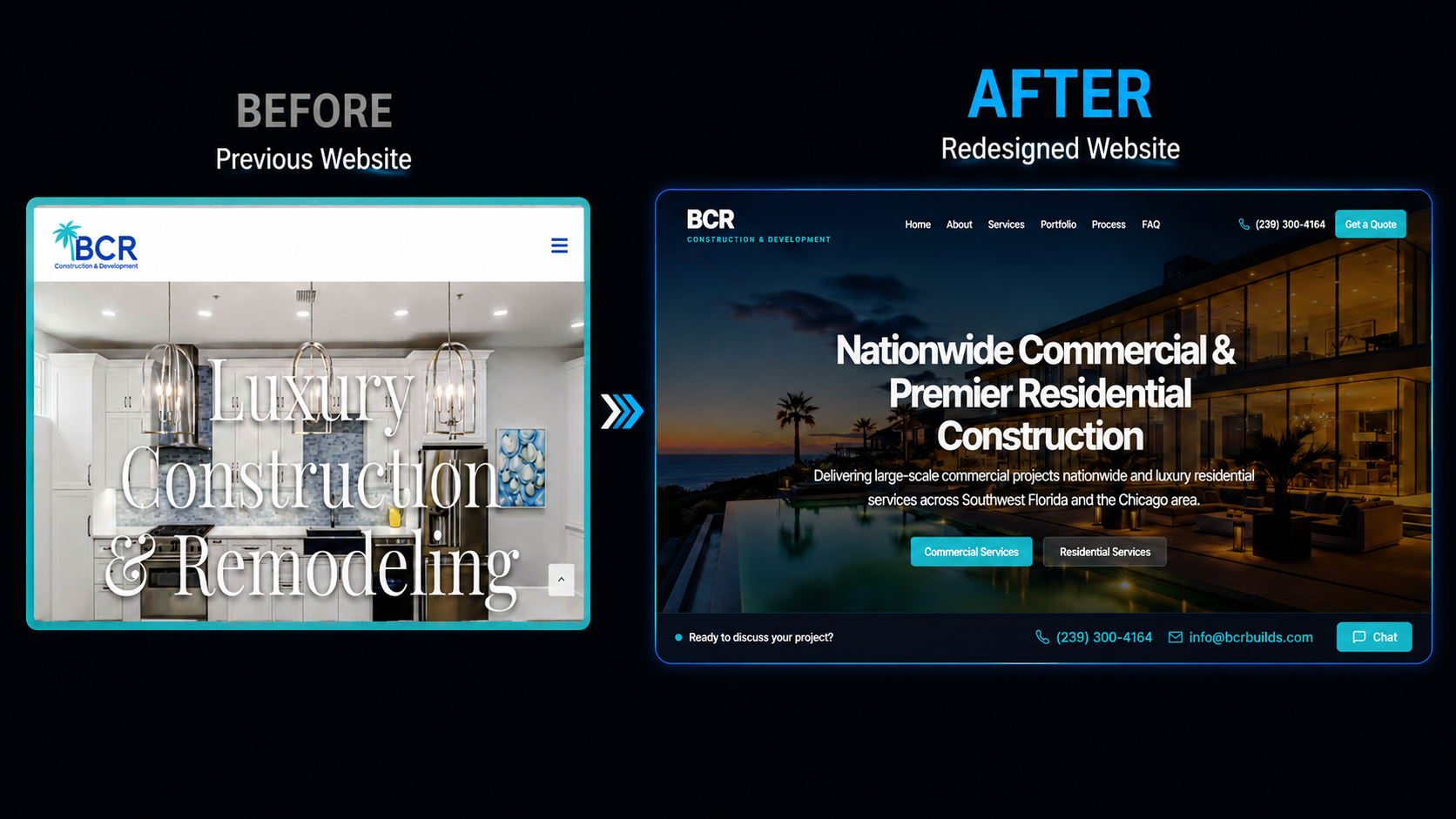
An AI-powered website can become part of the conversion system
This is the part I think gets missed when people talk about AI websites.
The website shouldn't be viewed as an isolated digital brochure.
It can become the front end of a larger customer-acquisition and conversion system — which is the broader argument behind treating your website as part of your sales process rather than a standalone marketing asset.
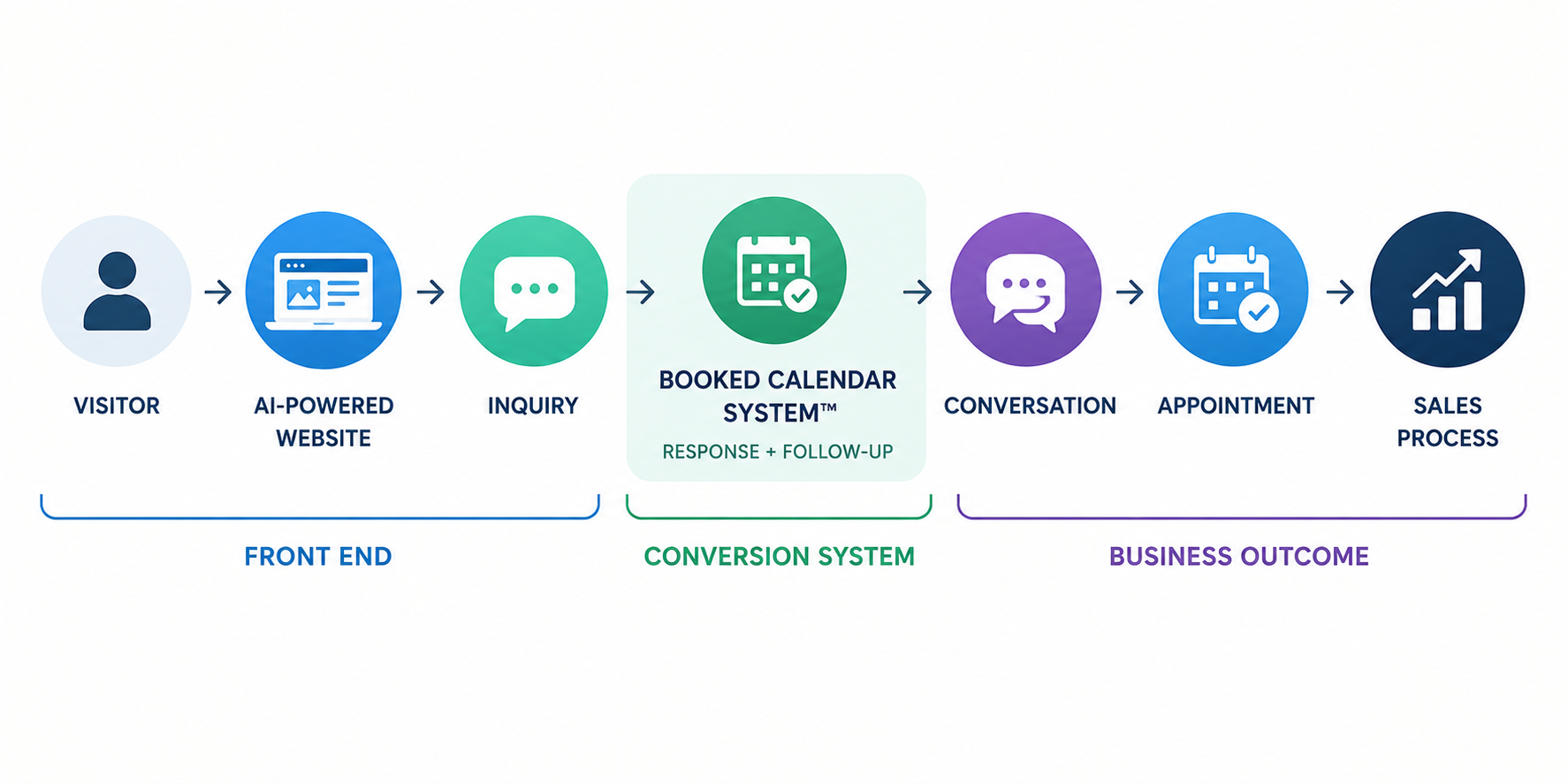
A simplified version looks something like this:
Traffic → Website → Inquiry → Response → Conversation → Appointment → Sales Process
Practical AI automation can potentially help at several points in that journey.
That doesn't mean AI should handle everything.
It means we can stop pretending the website's responsibility ends the second someone clicks Submit.
1. Attract and educate the right visitors
Before AI enters the picture, the fundamentals still matter.
A business website needs clear positioning, useful content, logical navigation, strong service pages, good mobile usability, calls to action, search visibility, trust signals, and a reason for someone to choose the business.
AI doesn't rescue a confusing offer.
Automation doesn't rescue terrible copy.
A chatbot doesn't rescue a website nobody can find.
The fundamentals still come first.
2. Capture interest in more useful ways
A phone number and contact form are still valuable, but they don't have to be the only options.
Depending on the business, a website might also offer:
- conversational chat
- online appointment scheduling
- quote or estimate requests
- guided forms
- click-to-call functionality
- text-based contact options
Different visitors prefer different ways of communicating.
The objective isn't to cram every possible widget onto the page. It's to reduce unnecessary friction between "I'm interested" and "I've started a conversation with this business."
Choosing the right conversion path depends on the visitor and the situation—our breakdown of website forms vs. chat vs. online scheduling covers when each makes the most sense.
3. Respond faster
This is where connecting the website to automation starts becoming especially useful.
A lead submits a request at 7:42 p.m.
Does that person simply receive:
Thanks. Your message has been sent.
And then wait until somebody checks an inbox tomorrow?
Or can the system immediately acknowledge the inquiry, provide a useful next step, begin gathering relevant information, or offer an opportunity to schedule?
Fast response doesn't require pretending a human is available when one isn't.
It means designing a better experience than silence.
4. Connect inquiries to a CRM
One of the least glamorous parts of this entire conversation may also be one of the most important.
Where does the lead go?
If website inquiries are scattered between email inboxes, text messages, handwritten notes, call logs, and somebody's memory, adding AI isn't the first problem I'd solve.
A connected website can feed inquiries into a CRM pipeline or contact-management system where the business can see:
- who contacted them
- how to reach them
- what they're interested in
- previous conversations
- appointment status
- where they are in the sales process
- what follow-up has already occurred
That's not sexy AI.
It's just useful infrastructure.
And useful infrastructure usually beats a flashy feature nobody actually needs.
5. Automate appropriate follow-up
Not every prospect books immediately.
Some get distracted.
Some are comparing companies.
Some aren't ready yet.
Some submit a request and then forget they did it.
A connected website can trigger follow-up based on what happened.
That might include email, SMS, reminders, scheduling links, internal notifications, or longer-term nurturing depending on the business and implementation.
The point isn't to relentlessly blast people until they surrender.
Good automation should reduce friction while still feeling like communication from an actual business.
There is a line between consistent follow-up and being incredibly annoying.
We should probably stay on the right side of it.
6. Help move conversations toward appointments
For appointment-driven businesses, one of the most useful outcomes is shortening the distance between an inquiry and a scheduled conversation.
That could involve:
- answering basic questions before scheduling
- gathering preliminary information
- directing people toward the appropriate calendar
- showing available appointment times
- confirming appointments
- sending reminders
- following up when someone doesn't complete the booking process
This is also where the website begins connecting naturally to what we call the Booked Calendar System™ at Boost Local Biz.
The website is where many prospects discover and engage with the business.
The systems behind it help move those opportunities forward.
They're connected, but they aren't the same thing.
AI-powered doesn't mean "let AI do everything"
This deserves its own section because AI gets oversold constantly. We covered this in more detail in how AI is changing service businesses, but the point matters here too.
If the strategy is to automate every possible human interaction simply because the technology exists, I think that's the wrong strategy.
Some conversations should involve a person.
Some decisions require judgment.
Some customers want reassurance from an actual human being.
And some automations create more frustration than they eliminate.
The goal should be to determine:
Where does technology genuinely make the customer experience or business process better?
Use it there.
For example, AI might be useful for answering routine questions at night, gathering initial information, routing an inquiry, or helping someone find the right next step.
A complicated sales conversation involving unusual project requirements may be much better handed to a knowledgeable employee.
That's not a failure of automation.
That's good system design.
What can an AI-powered website include?
There is no universal feature checklist, and I'd be skeptical of anyone claiming there is.
The right setup depends on the business.
An AI-powered website ecosystem can include things such as:
| Capability | What it can help with |
|---|---|
| Conversion-focused website | Guiding visitors toward meaningful actions |
| AI/conversational chat | Answering questions and engaging visitors |
| Lead capture | Collecting useful prospect information |
| CRM integration | Keeping inquiries and conversations organized |
| Automated SMS/email | Responding and following up consistently |
| Online scheduling | Moving interested prospects toward appointments |
| Missed-opportunity recovery | Re-engaging inquiries that didn't immediately convert |
| Pipeline management | Tracking opportunities through the sales process |
| Review/reputation workflows | Supporting customer-review processes |
| SEO/local-search foundations | Helping relevant prospects discover the business |
| Tracking and attribution | Understanding where opportunities originate |
That does not mean every business needs every capability.
A roofing contractor, dentist, attorney, landscaper, consultant, and restaurant all have different customer journeys.
Technology should fit the business.
The business shouldn't be twisted into whatever software happens to be fashionable this month.
AI-powered website vs. traditional website
At a high level, the difference looks like this:
| Traditional Website | AI-Powered Website Ecosystem |
|---|---|
| Primarily presents information | Presents information and can participate in conversion |
| Relies heavily on forms and calls | Can support multiple engagement pathways |
| Inquiry may terminate in an inbox | Inquiry can connect directly to CRM/workflows |
| Follow-up is usually separate | Follow-up can be triggered automatically |
| Scheduling may happen manually | Scheduling can be integrated |
| Visitor questions wait for a person | Appropriate questions may be handled conversationally |
| Website and sales process often operate separately | Website can connect to the larger customer journey |
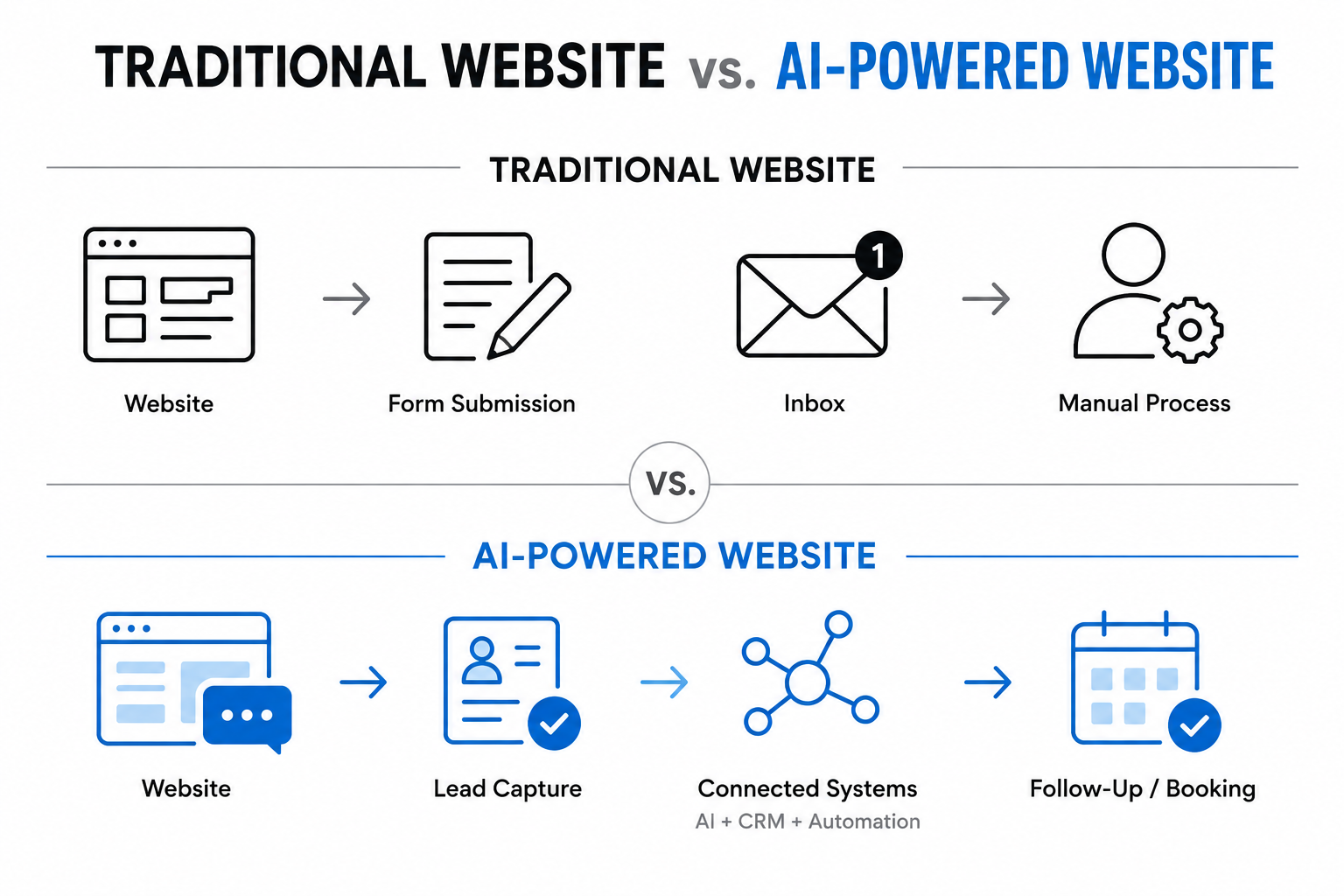
Again, this isn't an argument that every traditional website is bad.
The biggest mistake: adding AI without fixing the underlying strategy
This is probably the easiest trap to fall into right now.
Add an AI chatbot.
Add a voice agent.
Add automation.
Add personalization.
Add another dashboard.
Congratulations. You now have more technology.
But do you have a better system?
If visitors don't understand what you do, fix the messaging.
If the site is miserable on mobile, fix the mobile experience.
If nobody knows where leads are going, fix the CRM process.
If your team doesn't have a defined follow-up process, define it.
If nobody wants to book because the offer is weak, an AI scheduling assistant isn't going to save you.
AI should improve a sound business process—not disguise a broken one.
That's one of the reasons I don't particularly care whether somebody calls a website "AI-powered," "smart," "automated," or anything else.
I care whether it solves a real problem.
Does every business need an AI-powered website?
No.
At least not in the sense of loading every available AI feature onto the site.
A business with very little inbound activity, a highly unusual sales process, or a customer base that strongly prefers direct personal communication may need a much simpler setup.
But there are some useful questions to ask:
- Are inquiries sometimes missed?
- Does follow-up happen inconsistently?
- Do prospects frequently ask the same questions?
- Are website leads sitting in an email inbox?
- Do people have to wait unnecessarily for basic information?
- Is appointment scheduling creating back-and-forth?
- Are leads scattered across multiple systems?
- Do old opportunities disappear because nobody follows up?
- Is the website disconnected from the CRM or sales process?
The more often the answer is yes, the more opportunity there may be to make the website and the systems behind it work harder.
What should you look for when evaluating an AI-powered website?
Don't start by asking how much AI it has.
Start with the customer journey.
Ask what happens before the inquiry
Can the right people find the website?
Does the page make the business easy to understand?
Does it establish trust?
Is there a clear next step?
Ask what happens during the inquiry
Can visitors communicate in a way that feels natural?
Can they get useful answers?
Is the process easy on a phone?
Are you collecting the information the business actually needs?
Ask what happens after the inquiry
This is the part I'd pay the most attention to.
Where does the lead go?
How quickly does the business respond?
What happens if the person doesn't answer?
Is there a follow-up process?
Can they schedule?
Does the business know where the opportunity stands?
If the person isn't ready today, what happens next?
Those questions tell you much more about the value of the system than asking which AI model is hiding behind the curtain.
The website is becoming infrastructure, not just marketing collateral
For years, businesses have treated websites primarily as destinations.
Run an ad → send someone to the website.
Rank on Google → send someone to the website.
Hand out a business card → send someone to the website.
That's still important.
But the more interesting shift is what happens when the website becomes connected to everything that comes next.
The site can become the point where marketing, customer communication, CRM, automation, scheduling, and follow-up begin working together.
That's the way I look at an AI-powered website.
Not as a website that happens to contain AI.
Not as a page somebody generated in 45 seconds by typing a prompt.
And definitely not as an excuse to stick a robot icon on a homepage and increase the price.
An AI-powered website should be an active part of the system a business uses to turn attention into opportunities.
If AI helps accomplish that, great.
If automation helps, use it.
If a simple form and a very good human follow-up process is the better solution in a particular situation, use that instead.
The business outcome comes first.
The technology comes second.
Want your website to do more than sit there?
At Boost Local Biz, our approach to AI-Powered Websites starts with the business process—not the buzzword.
The goal is to connect the website, lead capture, communication, automation, CRM, and follow-up in a way that helps turn more of the opportunities you're already generating into real conversations and appointments.
If your current website looks fine but stops working the second someone submits a form, it may be time to rethink what a website can actually do for your business.
Explore Boost Local Biz AI-Powered Websites or schedule a consultation to see what that could look like for your business.