AI automation can be impressive.
Your prospect probably doesn't care.
At least not yet.
A business owner usually isn't sitting at their desk thinking:
"I really need someone to build me an AI-powered workflow."
They're thinking about the estimate requests nobody followed up with.
The calls their team couldn't answer.
The repetitive work eating up someone's afternoon.
The appointments that need to be scheduled.
The customers who never received a review request.
The information scattered across too many places.
Those are business problems.
And if you want to sell AI automation services, that's where the conversation should usually begin.
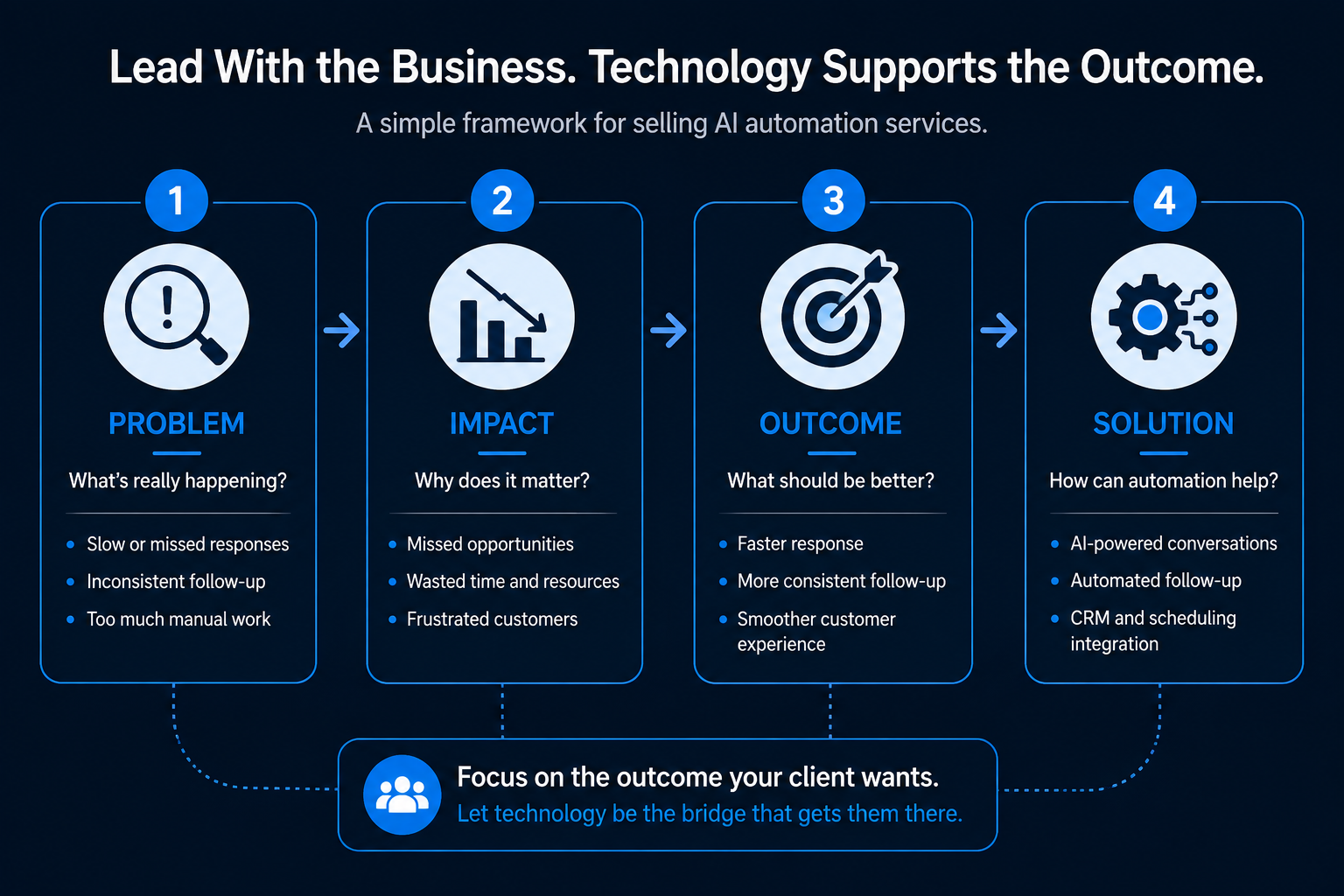
The best way to sell AI automation services is to identify a specific business problem, understand its impact, define the outcome the business wants, and then explain how automation can help create that outcome.
In other words:
PROBLEM → IMPACT → OUTCOME → SOLUTION
The technology matters.
But it shouldn't have to do all the selling.
Why Selling "AI" Can Make the Sale Harder
AI gets attention.
That can help you start a conversation.
But attention and value aren't the same thing.
Tell a local business owner you build AI agents, automated workflows and intelligent CRM systems and you may get one of two reactions.
The first:
"That sounds cool."
The second:
"I have absolutely no idea what you just said."
Neither one necessarily gets you closer to a sale.
The problem isn't that you mentioned AI.
The problem is that you haven't connected it to something the buyer already cares about.
Compare these two pitches:
We build AI-powered lead nurturing automations integrated with your CRM.
Versus:
We can help make sure new inquiries receive a quick response and don't disappear just because your team couldn't reach them the first time.
They could describe parts of the exact same system.
But the second version gives the business owner something concrete to evaluate.
That's the skill you need to develop.
Don't Hide the Technology. Translate It.
There's an important distinction here.
I'm not suggesting that you disguise AI, avoid telling clients how their systems work or pretend a person is doing something that is actually automated.
That's not the point.
Don't hide the technology. Translate the technology into business language.
Once the client understands the problem you're solving and the outcome you're trying to create, you can explain how the system works.
That conversation is much easier because now the technology has context.
Instead of asking the buyer to understand why an AI agent is exciting, you're showing them why solving a particular problem is useful.
What You're Selling vs. What the Business Hears
A lot of automation terminology makes perfect sense to us because we work with it.
That doesn't mean it belongs at the front of the sales conversation.
| What you might call it | What it means to the business |
|---|---|
| AI chatbot | Give website visitors another way to start a conversation or get help |
| CRM automation | Keep leads and customer activity organized without relying entirely on memory |
| Missed-call automation | Respond when someone calls and nobody can answer |
| AI lead qualification | Understand what a prospect needs before the right person takes over |
| Automated follow-up | Continue following up when the first attempt doesn't get a response |
| AI receptionist | Help handle common incoming conversations and route people appropriately |
| Review automation | Create a repeatable process for asking customers for feedback |
You can still explain the actual technology.
Just don't make the buyer translate your software vocabulary before they can understand why they should care.
Start With the Problem
Before presenting an automation, understand what's actually happening.
This is where beginners often get backwards.
They learn how to build something cool and immediately start searching for somebody to sell it to.
A better approach is to identify the type of problem you want to solve first.
We used the same principle when discussing which AI automation services are worth selling.
Look for processes that are:
- slow
- repetitive
- inconsistent
- easy to forget
- dependent on someone manually moving information
- causing customer or lead communication to stall
- creating unnecessary administrative work
Those are signals.
They don't automatically mean AI is the answer.
But they tell you where to investigate.
Then Understand the Impact
Finding a messy process isn't enough.
You need to understand why it matters.
Suppose a business tells you:
Sometimes website inquiries sit in the inbox for a while before someone responds.
Don't immediately say:
Great. I can automate that.
Keep asking questions.
How often does that happen?
Who normally responds?
What happens when they're busy?
What happens after the first response?
Does someone follow up again?
Can the prospect schedule anything?
Where is the lead stored?
Now you're beginning to understand the process.
The impact might involve missed opportunities.
It might create extra administrative work.
It might simply make the customer experience inconsistent.
Or the owner might tell you it isn't a particularly important problem at all.
That's useful too.
Good discovery can prevent you from selling a solution nobody actually needs.
Define the Outcome Before the Solution
Once you understand the problem and its impact, define what "better" should look like.
For example:
Problem: New website inquiries aren't always answered quickly.
Impact: Some prospects may wait longer than the business would like, and follow-up can become inconsistent.
Outcome: Every new inquiry should be acknowledged quickly, organized in one place and receive appropriate follow-up.
Now you can discuss the solution.
Maybe that involves:
- an automated first response
- a CRM
- text and email follow-up
- appointment scheduling
- AI-assisted conversation
- staff notifications
- human takeover when necessary
Now the technology makes sense because the buyer already understands what it's supposed to accomplish.
That's:
PROBLEM → IMPACT → OUTCOME → SOLUTION
Ask Better Discovery Questions
You don't need a 47-page consulting questionnaire to have a useful conversation with a small business owner.
You need to understand how the business actually operates.
Here are some questions I'd rather hear a beginner ask:
"Walk me through what happens when a new lead comes in."
This is one of my favorites because it doesn't assume there's a problem.
Let them describe the process.
You'll often hear where the gaps are naturally.
"How quickly does someone normally respond?"
Now you're learning about speed-to-lead without giving them a lecture about speed-to-lead.
"What happens if you don't reach the person the first time?"
This reveals the follow-up process.
Sometimes there is one.
Sometimes the answer is basically:
"We try again if we remember."
That's useful information.
"Where do you keep track of all of this?"
Now you're learning whether there's a CRM, spreadsheet, inbox, notebook, someone's memory or some combination of all five.
"What does your team spend time doing over and over?"
This can uncover opportunities that have nothing to do with leads.
"Where do things tend to get forgotten or fall through the cracks?"
That's often where automation can become genuinely useful.
"If you could fix one part of this process, what would make the biggest difference?"
Now the prospect is helping prioritize the opportunity.
Notice what we haven't asked yet:
Would you like to buy my AI automation package?
We're diagnosing before prescribing.
A Real Example: Bella Lawn Maintenance
Here's what this looks like in the real world.
Bella Lawn Maintenance is a Boost Local Biz client.
We completely rebuilt the company's website as an AI-powered website and connected it to a broader system that includes:
- an AI chatbot
- instant automated responses to website form submissions
- CRM-based email and text communication
- centralized social media communication
- an automated review-request sequence
- automated responses to five-star reviews
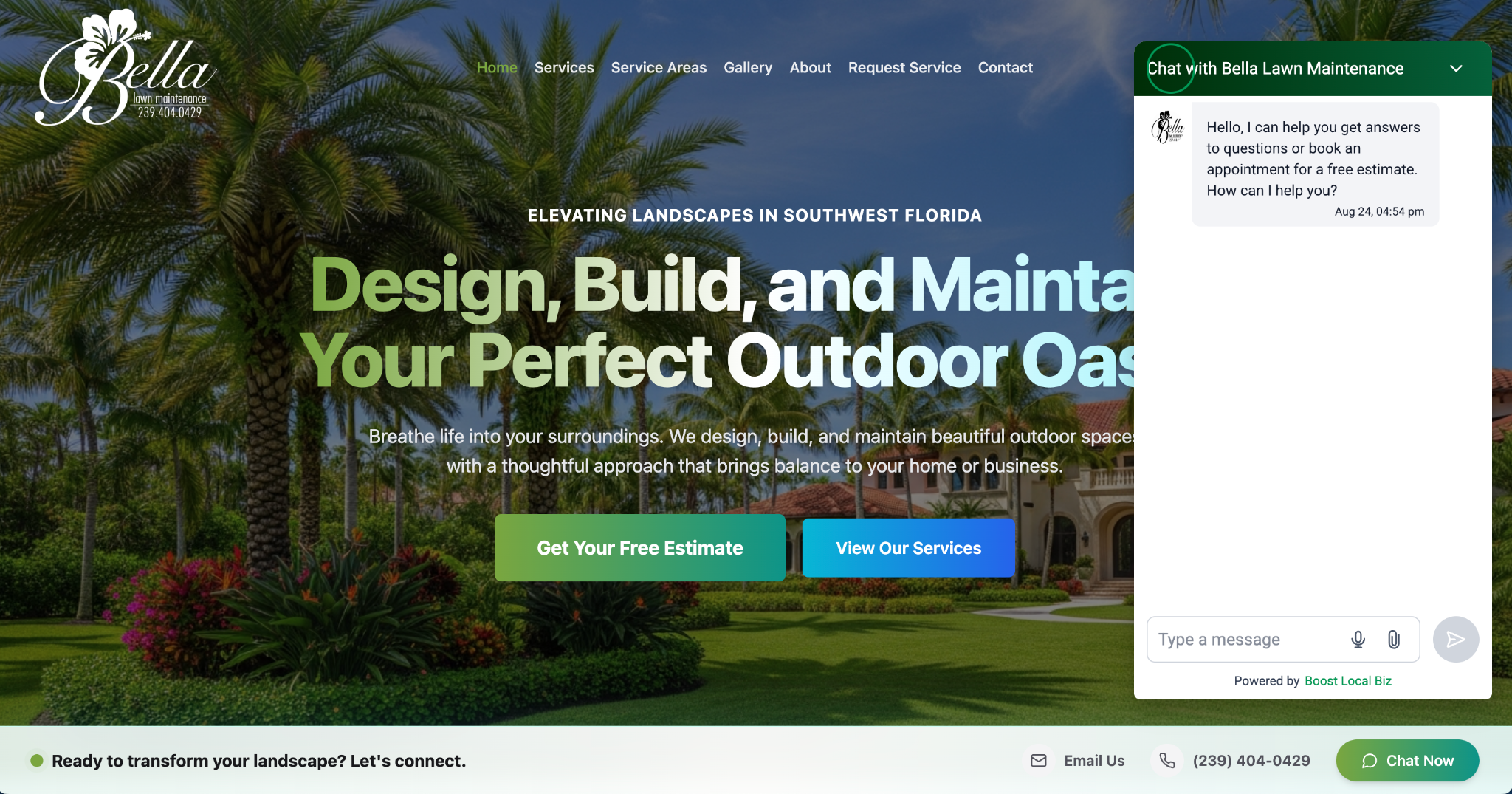
Those are the technical features.
But that's not necessarily the clearest way to explain what was built.
Let's translate them.
| What we implemented | What it does |
|---|---|
| AI chatbot | Gives website visitors another way to start a conversation |
| Instant form response | Acknowledges a new website inquiry without waiting for someone to notice an email |
| CRM email and text communication | Gives the business a system for communicating with contacts from one platform |
| Centralized social communication | Brings customer conversations from multiple channels into a more manageable place |
| Automated review requests | Creates a repeatable process for asking customers for feedback |
| Automated five-star review responses | Helps make sure positive reviews receive a response without requiring the same manual task every time |
Notice what I'm not telling you.
I'm not claiming the system increased Bella's revenue by some made-up percentage.
I'm not telling you it doubled their appointments.
I'm not inventing a conversion statistic because it would make the story sound more impressive.
The value of this example is simpler:
This is a real service business where the website, CRM, communication and automation were designed to work together instead of being treated as unrelated pieces of software.
And the website itself still needs to look good.
Automation doesn't excuse a lousy website.
An AI-powered website should improve what happens before, during and after someone contacts the business without sacrificing the experience of actually using the site.
That's much closer to how we think about AI at Boost Local Biz.
Show the Before and After
Another effective way to explain automation is to show the process instead of describing the software.
Consider this hypothetical example.
Before
Website visitor submits an estimate request.
↓
An email notification arrives.
↓
Someone notices it when they have time.
↓
They call the prospect.
↓
Nobody answers.
↓
Someone intends to try again later.
↓
The day gets busy.
↓
The lead goes quiet.
Now compare that with a possible automated process.
After
Website visitor submits an estimate request.
↓
The contact is organized automatically.
↓
The prospect receives an immediate acknowledgment.
↓
The conversation can continue by text, email or another appropriate channel.
↓
Staff can be notified when human attention is needed.
↓
Follow-up continues according to the business's process.
↓
The prospect can be given an opportunity to schedule when appropriate.
That's easier to understand than:
"We're implementing an omnichannel AI-powered CRM automation architecture."
Please don't say that at lunch.
Sell the Improvement, Then Explain the System
Once the buyer understands the before and after, the software conversation becomes easier.
Now you can say:
Here's how we'd build that.
You can explain that you're using a CRM.
You can explain where AI participates.
You can explain which parts are normal automation.
You can explain when a person takes over.
You can explain what the client will see.
That's where your technical knowledge becomes valuable.
But now it supports the business case instead of replacing it.
This is also why packaging AI automation services around a defined problem and outcome is usually stronger than selling random technical tasks.
Don't Promise ROI You Can't Support
"Sell the ROI" sounds great until someone asks where your numbers came from.
There is nothing wrong with discussing financial impact.
You should.
But use numbers you can defend.
Suppose a prospect tells you:
- how many inquiries they receive
- how many typically receive follow-up
- what percentage turn into appointments
- what an average customer is worth
Now you have information you can use to discuss the business case.
You can model possibilities.
You can show where opportunities may be leaking.
You can identify what would need to improve for the automation to pay for itself.
Just separate:
Known facts
from
Assumptions
from
Potential outcomes
Don't turn an assumption into a promise.
And don't tell a prospect:
"This will increase your revenue 37%."
unless you have legitimate evidence that supports that statement.
You probably don't.
Credibility is worth more than a sexy spreadsheet.
What If the Business Already Has Someone Doing It?
Good.
Automation doesn't automatically mean replacing a person.
Sometimes the best use of automation is handling the repetitive portion so the person can focus on the parts requiring judgment, relationships or actual human attention.
For example:
Automation acknowledges the inquiry immediately.
A salesperson takes over once the prospect replies.
Automation sends reminders.
A staff member handles the actual consultation.
AI helps categorize a message.
A person makes the decision.
You don't have to automate everything just because you can.
What If They Don't Want AI Talking to Their Customers?
Then listen to them.
Seriously.
If a business owner is uncomfortable having AI conduct customer conversations, don't spend twenty minutes explaining why they're wrong.
Maybe the right system uses ordinary automation.
Maybe AI works behind the scenes instead.
Maybe a human handles every customer conversation while automation manages routing, reminders and follow-up tasks.
Maybe they're simply not the right client for the service you're selling.
The technology should fit the business.
The business shouldn't have to reshape itself around your favorite tool.
What If They Ask, "What Happens When the AI Gets Something Wrong?"
That's a legitimate question.
And "don't worry, the AI is really smart" is not a legitimate answer.
The system should be designed around what AI is allowed to do.
That can include:
- clear boundaries
- appropriate instructions
- testing
- monitoring
- human handoff
- limiting AI from making decisions it shouldn't make
We covered this more deeply in our guide to building an AI automation for a client.
The important sales lesson is this:
You don't build trust by pretending automation can't fail. You build trust by showing that you've thought about what happens when it does.
Don't Demo Technology for 30 Minutes
This is another trap.
You built something cool.
You want to show it.
I get it.
But your prospect doesn't necessarily need a guided tour of every workflow branch.
Demo the parts that matter to them.
If their problem is slow lead response:
Submit a test inquiry.
Show the response.
Show where the contact appears.
Show what happens next.
Show when the employee gets involved.
Done.
Now they can picture the system operating inside their business.
That's much more persuasive than clicking through twenty settings they will never touch.
The Offer Should Be Easier to Understand Than the Technology
By the time you make the offer, the prospect should understand:
What problem you're addressing
What you're proposing to improve
What the system will do
What their team still needs to do
What it costs
What happens next
They do not need to understand every technical component you've assembled behind the scenes.
That's your job.
This is also where your pricing needs to match the scope and responsibility involved. If you're still figuring that out, read our guide to pricing AI automation services.
Don't Sell a Tool With Your Logo on It
This became especially relevant when we looked at the tools an AI automation agency actually needs.
Your client generally doesn't care that you know how to use Zapier.
Or Make.
Or n8n.
Or GoHighLevel.
Or an AI model.
Those are tools.
They're important tools.
But they're still tools.
A contractor doesn't hire someone because they own a particularly impressive drill.
They hire them because they want the kitchen remodeled.
Same idea.
Your software stack helps you deliver the result.
It isn't automatically the result.
A Simple Way to Structure the Sales Conversation
If you're new to selling AI automation, you can keep the conversation surprisingly simple.
1. Understand the current process
Ask them to walk you through what happens today.
2. Find the friction
Where is the process slow, repetitive, inconsistent or easy to forget?
3. Understand the impact
Why does that matter to the business?
4. Define the desired outcome
What should happen instead?
5. Explain the solution
Show how automation could help create that process.
6. Set realistic expectations
Explain what will be automated, what still requires people, what needs testing and what success should actually mean.
7. Present the offer
Scope the work, explain the investment and define the next step — then document the engagement in a clear AI automation proposal.
That's a sales process a beginner can actually use.
No manipulation required.
You Still Need to Get in Front of Businesses
Knowing how to explain automation doesn't matter much if nobody hears the explanation.
You'll still need outreach, referrals, networking, partnerships, content, prospecting or some other way to create conversations.
That's a separate problem.
We've covered that in how to get AI automation clients.
The purpose of this article is what happens once the conversation begins.
Your job isn't to impress the prospect with how much AI terminology you know.
It's to understand their business well enough to determine whether you can help.
The Best AI Automation Pitch Often Doesn't Sound Like an AI Pitch
That's the irony.
The better you become at selling AI automation, the less you may feel the need to constantly say "AI automation."
You talk about:
response time
follow-up
customer communication
appointments
repetitive work
missed opportunities
organization
handoffs
reviews
processes
Then, when the solution involves AI, you explain exactly where AI fits and why.
That's a much stronger position than leading with technology and hoping the business owner figures out the value.
Remember the sequence:
PROBLEM → IMPACT → OUTCOME → SOLUTION
Understand the problem.
Understand why it matters.
Define what better looks like.
Then build and sell the solution.
That's how you sell AI automation without making the technology do all the selling.
Want to Build the Business Behind the Service?
Selling is only one part of building an AI automation business.
You still need to decide what you're selling, who you're selling it to, how you'll package it, what you'll charge, how you'll get clients and how you'll actually deliver the work.
That's why I created the 48-Hour AI Cashflow Stack.
It's designed to help you put the pieces of an AI-powered service business together without turning the entire exercise into a hunt for the newest AI tool.
If that's the business you're trying to build, download the 48-Hour AI Cashflow Stack and use it as your next step.