If you're trying to build an AI automation business, there is no shortage of things you could sell.
AI chatbots.
Voice agents.
CRM automations.
Lead nurturing.
Appointment systems.
Custom workflows.
AI content.
Review automation.
Internal agents.
You could probably spend the next six months learning how to build all of them.
Don't.
One of the biggest mistakes you can make when starting an AI automation agency is confusing what technology can do with what makes a good service to sell.
Those aren't the same thing.
A technically impressive automation can be a terrible offer.
Meanwhile, something relatively simple—like making sure a contractor's website leads actually receive consistent follow-up—can solve a problem the business immediately understands.
So instead of giving you another giant list of cool AI automations — if you're looking for practical business workflows that can be automated, our practical AI automation ideas covers that separately — let's use a more useful filter:
Which AI automation services actually make sense to build a profitable AI automation business around?
What makes an AI automation service worth selling?
Before ranking services, we need criteria.
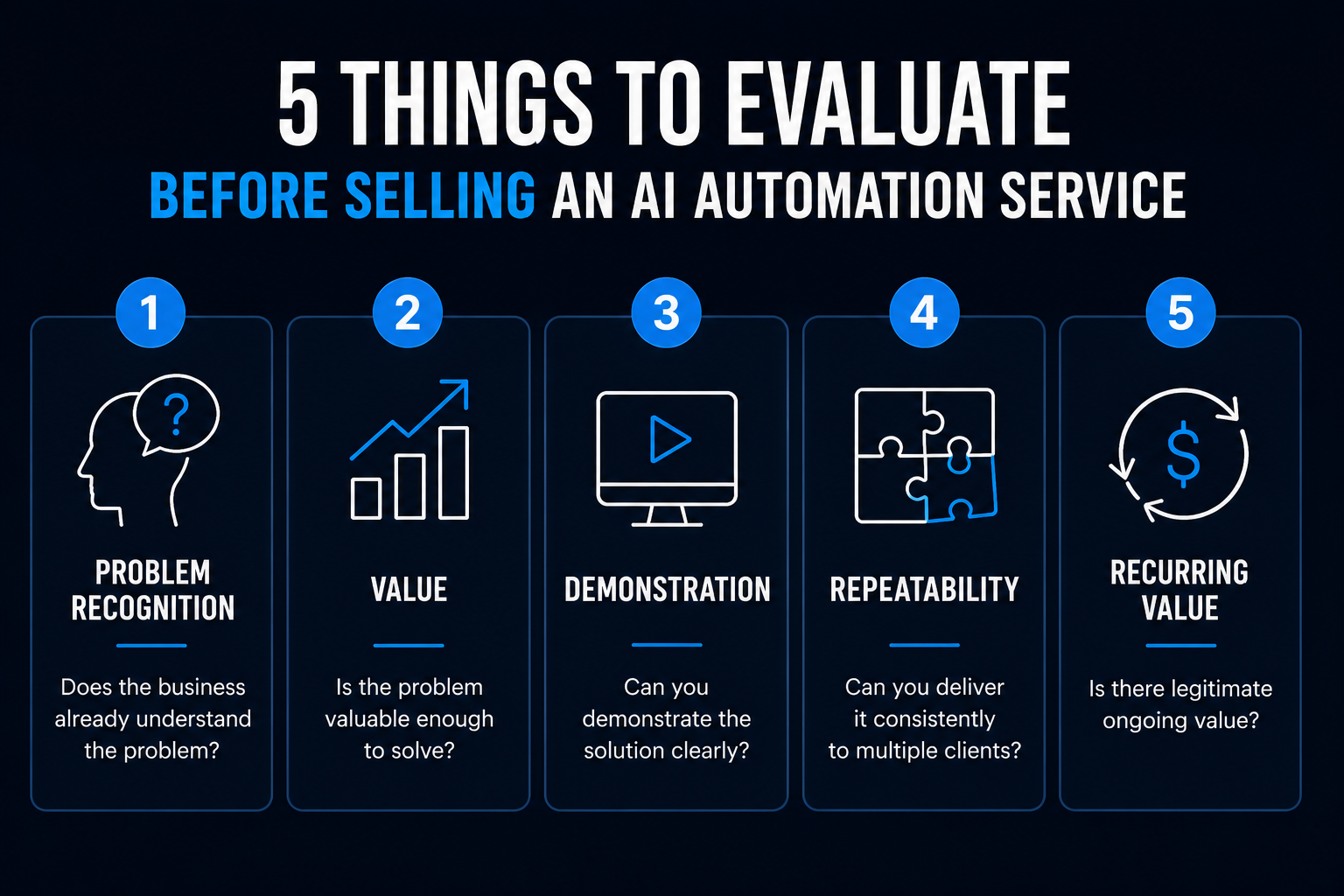
I would evaluate an automation offer across five areas.
1. Does the business already understand the problem?
This matters more than people think.
Compare:
“We build autonomous multi-agent orchestration systems.”
with:
“We help you follow up with leads who don't answer the first time.”
The second conversation is considerably easier.
You don't need to educate the prospect about an entirely new category of problem before explaining your solution.
2. Is the problem valuable enough to solve?
Automating something merely because it can be automated isn't a business model.
Look for problems connected to:
- revenue
- missed opportunities
- employee time
- customer experience
- repetitive labor
- scheduling
- sales
- operational bottlenecks
The closer the problem sits to something the owner already values, the easier your offer becomes to understand.
3. Can you demonstrate it?
Automation is intangible.
A strong demo changes that.
If you can show:
New inquiry → response → qualification → appointment
the prospect can imagine it operating inside the business.
That's much easier than selling a 40-slide vision of “AI transformation.”
4. Can you deliver it repeatedly?
Custom work can make money.
But if every client requires you to reinvent the entire system, scaling becomes harder.
The strongest agency offers usually contain some repeatable architecture even when individual implementations vary.
5. Is there legitimate recurring value?
Recurring revenue is attractive.
But as we discussed in How to Start an AI Automation Agency in 2026, recurring billing should come from recurring value.
That might include:
- software
- AI usage
- communication
- monitoring
- maintenance
- optimization
- support
- ongoing campaigns
- workflow management
With those criteria in mind, here's how I'd rank the opportunities.
The best AI automation services to sell in 2026
| Rank | Service | Ease of Selling | Recurring Potential | Complexity | Beginner Fit |
|---|---|---|---|---|---|
| 1 | Lead Response & Follow-Up | High | High | Medium | Excellent |
| 2 | Missed-Call Text Back | Very High | High | Low | Excellent |
| 3 | Appointment Booking & Reminders | High | High | Low–Medium | Excellent |
| 4 | Lead Reactivation | High | High | Medium | Very Good |
| 5 | AI Website Chat | Medium–High | High | Medium | Very Good |
| 6 | CRM & Pipeline Automation | Medium | High | Medium | Good |
| 7 | Review & Reputation Automation | High | Medium–High | Low | Excellent |
| 8 | AI Voice Agents | Medium–High | High | High | Intermediate |
| 9 | Customer Support Automation | Medium | High | Medium–High | Intermediate |
| 10 | Internal Workflow Automation | Medium | Medium–High | Varies | Intermediate |
That's my ranking for someone trying to build a sellable service business, not a ranking of which technology is most impressive.
Let's break them down.
1. Lead response and follow-up automation
If I were starting an automation business aimed at service businesses, this would be near the top of my list.
The problem is incredibly easy to understand.
Businesses generate inquiries from:
- websites
- ads
- referrals
- social media
- phone calls
- directories
- Google Business Profiles
Then reality happens.
Someone is on a jobsite.
The office is busy.
A form lands in an inbox.
The prospect doesn't answer the first callback.
Nobody follows up again.
The opportunity slowly disappears.
A lead-response system can help:
- capture the inquiry
- create or update the contact
- acknowledge the prospect
- notify the appropriate person
- trigger follow-up
- provide a scheduling path
- track what happened
We've already gone deeper into what should happen after someone fills out a website form.
Why I like this service
The pain is recognizable.
You don't have to convince a business owner that unanswered leads are undesirable.
It also connects directly to money the business may already be spending on marketing.
That's a powerful conversation.
Instead of:
“Buy my AI automation.”
the conversation becomes:
“You're already paying to generate opportunities. Let's improve what happens after they arrive.”
That is much stronger.
Recurring-value potential: High
Follow-up systems require communication infrastructure, software, monitoring, optimization and ongoing management.
Beginner fit: Excellent
You can begin with straightforward automations and add AI where it genuinely improves the experience.
You do not need to build an autonomous sales robot on day one.
2. Missed-call text-back
This may be one of the least glamorous services on this list.
That's part of why I like it.
The concept is simple:
Someone calls the business.
Nobody answers.
A text conversation is initiated automatically.
That's it.
The system might say something appropriate like:
“Sorry we missed your call. How can we help?”
From there, the workflow can collect information, notify the business, schedule a callback or potentially move toward an appointment.
Why it's sellable
You can explain the entire service in about 15 seconds.
That matters.
Many service businesses rely heavily on inbound phone calls.
And unlike some futuristic AI pitch, the owner already understands what a missed call is.
Recurring-value potential: High
The system relies on ongoing phone/SMS infrastructure and may connect with broader lead-management workflows.
Beginner fit: Excellent
Technically, it can be considerably simpler than many AI services.
It also illustrates an important lesson:
The best automation offer isn't necessarily the one with the most AI in it.
3. Appointment booking and reminder automation
Businesses that sell consultations, estimates, appointments or scheduled services have a very obvious workflow to improve.
Automation can help prospects:
- choose a time
- receive confirmations
- get reminders
- reschedule
- receive pre-appointment instructions
- trigger follow-up after the appointment
This becomes even more valuable when combined with lead-response automation.
A prospect shouldn't necessarily have to:
Submit form → wait → receive phone call → miss phone call → call back → leave voicemail → wait again
just to schedule a conversation.
Why it's sellable
The before-and-after experience is easy to demonstrate.
Recurring-value potential: High
Scheduling systems continue operating every day, which can support ongoing software and management fees.
Beginner fit: Excellent
Calendar automation is mature, understandable and relatively easy to demonstrate.
4. Lead reactivation
This one gets overlooked.
Many businesses have databases full of:
- old leads
- unsold estimates
- past inquiries
- previous customers
- abandoned opportunities
- prospects who said “not right now”
And then...
nothing.
The database sits there.
A reactivation system uses email, SMS and potentially AI-assisted conversations to reconnect with appropriate contacts and identify people who may now be interested.
Why I like it
You aren't necessarily asking the business to buy more leads.
You're asking:
“What about the opportunities you already paid to acquire?”
That's closely related to the argument I made in Why Getting More Leads Isn't Always the Answer.
For certain businesses, that can be a very compelling entry point.
Recurring-value potential: High
Reactivation can become periodic rather than one-and-done.
Different segments can be contacted at different times with different offers or messages.
Beginner fit: Very good
The technology isn't necessarily difficult.
The harder part is good segmentation, messaging, consent and knowing when automation should stop.
5. AI website chat
This is probably one of the first services people think about when they hear “AI automation agency.”
And yes, it can be useful.
But I'd sell it differently.
Don't sell:
AI CHATBOT FOR YOUR WEBSITE
Sell what it helps the visitor do.
For example:
- get common questions answered
- find the right service
- provide project information
- submit an inquiry
- qualify themselves
- schedule
- reach a human when necessary
That's a very different value proposition.
A genuinely AI-powered website should be able to participate in the customer journey—not simply sit there looking modern.
Why it's #5 instead of #1
Chatbots are increasingly commoditized.
Simply installing one isn't much of a moat.
The value comes from:
- what it knows
- what it can do
- what systems it connects to
- how conversations are handled
- when it hands off to humans
- what happens afterward
Recurring-value potential: High
AI usage, software, maintenance, knowledge updates and integrations can justify ongoing management.
Beginner fit: Very good
Just don't promise that a chatbot can replace the entire company.
It can't.
6. CRM and pipeline automation
This category is less flashy but extremely useful.
A CRM only helps if the information inside it is reasonably accurate and somebody actually uses it.
Automation can:
- create contacts
- update records
- assign opportunities
- move pipeline stages
- create tasks
- trigger follow-up
- record communication
- notify team members
- segment contacts
Why it's valuable
CRM automation often becomes the connective tissue between several other services.
Lead response needs somewhere to record the lead.
Appointments need to connect to the customer.
Follow-up needs to know the prospect's status.
Reactivation needs clean contact data.
Why it isn't ranked higher
CRM problems can become messy.
Every business has its own process.
Or thinks it has a process.
Sometimes the first phase of CRM automation is discovering that nobody agrees on what the sales process actually is.
Recurring-value potential: High
Once you're involved in the client's CRM and automation infrastructure, ongoing maintenance and optimization can create legitimate recurring value.
Beginner fit: Good
Start with simple pipelines. If you want a concrete example of how to structure one, see my guide to GoHighLevel pipelines.
Don't redesign Salesforce for a multinational corporation as your first Tuesday afternoon project.
7. Review and reputation automation
The workflow is straightforward.
At the appropriate point after a customer interaction:
- trigger a review request
- send the customer to the appropriate review destination
- follow up appropriately
- notify the business
- track activity
AI may also assist with drafting responses to reviews, although I would keep human oversight involved.
Why it's sellable
Business owners understand reviews.
You don't have to explain why reputation matters.
Recurring-value potential: Medium to high
The workflow continues as new customers complete transactions.
It can also be bundled into a broader customer-communication or reputation-management service.
Beginner fit: Excellent
This is another example where straightforward automation may be more useful than sophisticated AI.
8. AI voice agents
Now we get into the fun stuff.
AI voice systems can potentially handle workflows such as:
- answering calls
- capturing caller information
- answering approved questions
- qualifying inquiries
- scheduling
- routing
- after-hours coverage
- follow-up calls
This can be extremely compelling when demonstrated well.
A prospect can literally call the system and experience it.
So why isn't voice AI #1?
Because the complexity and risk are higher.
Voice interactions are unpredictable.
Callers interrupt.
They have accents.
Background noise exists.
People ask strange questions.
The system needs clear boundaries and human escalation.
There are also legal and compliance considerations around automated calling, consent, recording and messaging that need to be understood for the use case and jurisdiction.
Recurring-value potential: High
Voice systems naturally create ongoing usage costs, maintenance and optimization requirements.
Beginner fit: Intermediate
I like voice AI.
I just wouldn't make a complicated voice deployment the first automation you've ever sold.
Learn to walk before teaching a robot receptionist to run.
9. Customer support automation
AI can help with repetitive support tasks such as:
- answering common questions
- categorizing requests
- gathering information
- routing tickets
- summarizing conversations
- suggesting responses
- escalating issues
For businesses with meaningful support volume, this can create substantial operational value.
Why it ranks lower for beginners
Customer support touches existing customers.
Mistakes can damage relationships.
That raises the stakes.
You need good knowledge sources, escalation rules, testing and human oversight.
Recurring-value potential: High
Support systems operate continuously and require maintenance as products, policies and information change.
Beginner fit: Intermediate
Start with narrow, low-risk tasks before letting AI handle sensitive customer situations.
10. Internal workflow automation
This category might eventually become one of the largest opportunities. If you want a practical framework for building these kinds of automations inside a platform, my guide to HighLevel workflows walks through how triggers and actions fit together.
It includes things like:
- moving information between applications
- document generation
- invoice processing
- data extraction
- reporting
- email triage
- task creation
- meeting summaries
- database updates
- internal knowledge retrieval
The possibilities are enormous.
Which is also the problem.
Why it's harder to sell initially
“Internal workflow automation” is vague.
You need to discover the actual workflow before you know what you're selling.
Compare:
“We provide AI workflow automation.”
with:
“Your staff manually copies every new order from this system into that spreadsheet. We can remove that step.”
Now we have a conversation.
Recurring-value potential: Medium to high
It depends heavily on the implementation.
Beginner fit: Intermediate
Great opportunity once you're comfortable analyzing business processes.
What I would NOT sell first
There are also AI services I would hesitate to build an agency around—at least initially.
Generic AI content creation
Businesses can already access powerful content-generation tools directly.
You need a stronger value proposition than:
“We'll use AI to write stuff for you.”
Content strategy, SEO, distribution, editorial judgment and business expertise can absolutely be valuable.
Typing prompts into an LLM is not much of a moat.
Standalone custom GPTs
A custom assistant can be useful.
But by itself, it often isn't enough of a business outcome to support a substantial recurring service.
Use assistants as components of larger solutions when appropriate.
“AI transformation consulting”
If you have deep experience and can genuinely advise organizations at that level, fine.
If you learned what an API was last Thursday, maybe don't sell the CEO a $50,000 AI transformation roadmap on Friday.
Fully autonomous “AI employees”
Be careful with this framing.
Some workflows can operate with significant autonomy.
But presenting AI as a magical digital employee that reliably replaces entire roles creates expectations you're eventually going to have to live with.
Sell what the system can actually do.
The strongest services often work together
Here's where this gets more interesting.
You don't necessarily need to sell these as ten separate products.
Some naturally combine into a stronger system.
For example:
Missed-call text back
+
Website lead response
+
AI conversation
+
CRM
+
Appointment booking
+
Automated follow-up
Now you're not selling six little automations.
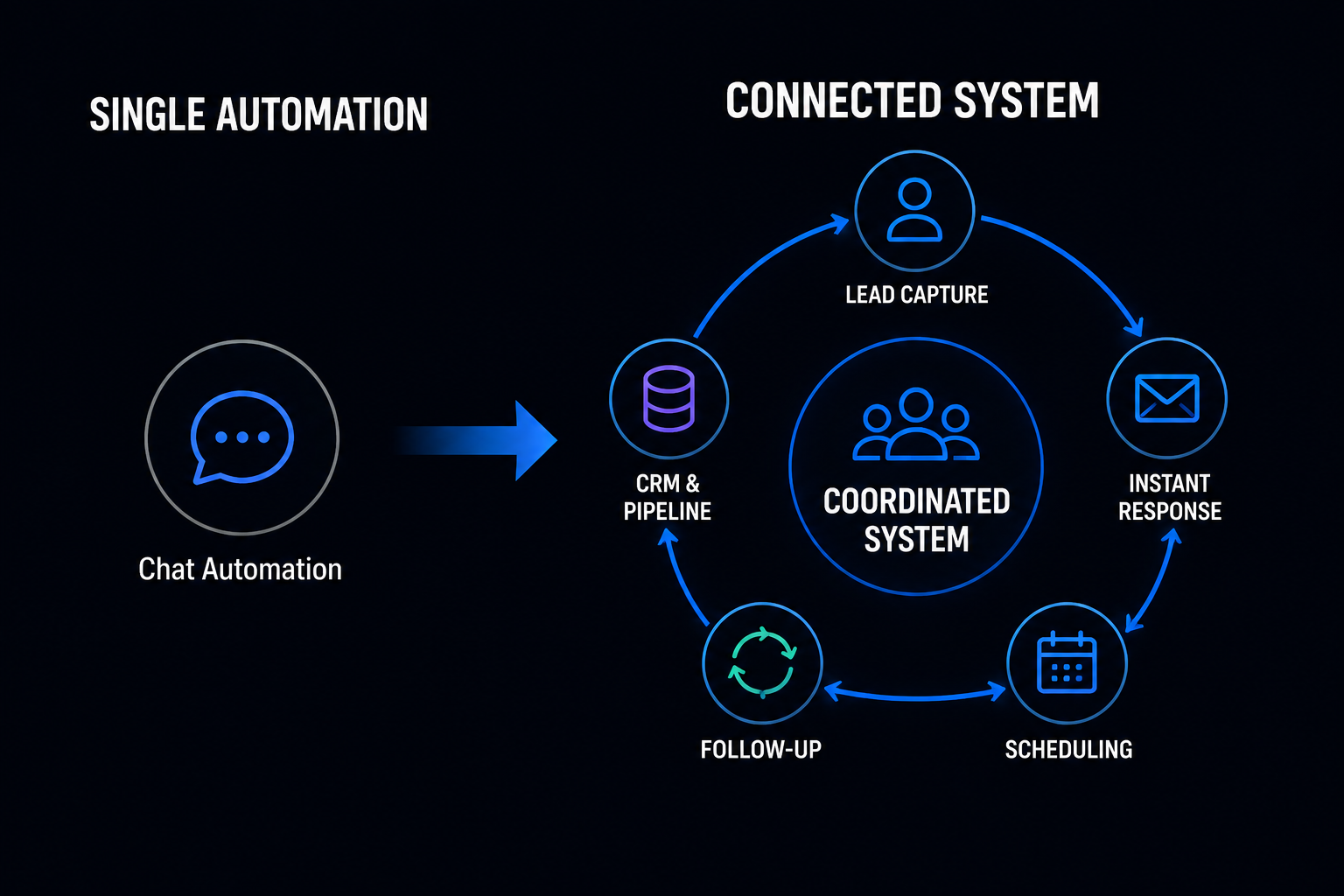
You're solving a larger problem:
You're solving a larger problem:
What happens after a potential customer contacts the business?
That's the thinking behind the Booked Calendar System™ we've developed at Boost Local Biz.
It's not about cramming AI into every step.
It's about connecting the steps that help move an opportunity from inquiry toward an actual business conversation or appointment.
That distinction matters.
Should you sell one service or a package?
If you're starting, I prefer one clear core problem with a defined system around it.
Not ten unrelated services.
For example, instead of:
AI chatbot — $297
Review automation — $197
Missed-call text back — $99
CRM — $297
Scheduling — $149
you might offer:
Lead Conversion System for Home-Service Companies
Then explain what the system includes.
The technology becomes part of the delivery.
The problem becomes the offer.
That's considerably easier to position.
How to choose your first AI automation service
If you're deciding what to sell, score the opportunity from 1–5 on these questions:
Problem
Does the prospect already recognize the problem?
Value
Does solving it affect money, time, opportunities or customer experience?
Demonstration
Can I show the solution working in a few minutes?
Repeatability
Can I deliver a similar system to multiple clients?
Recurring value
Does the system require legitimate ongoing software, management, maintenance or optimization?
Risk
Can I safely deliver this at my current skill level?
The winner isn't necessarily the most technically impressive idea.
It's the one where:
business need + your capability + repeatability + economics
line up.
My pick for a beginner
If I were starting an AI automation agency today and wanted to sell to service businesses, I would start somewhere around:
lead response + follow-up + appointment booking.
Why?
Because the story is easy.
The business is already generating opportunities.
Some of those opportunities aren't being handled as consistently as they could be.
You build a system that improves what happens next.
Then, once you're inside that workflow, there are logical ways to expand:
- missed-call response
- AI conversations
- CRM automation
- reminders
- reactivation
- voice
- reviews
You aren't trying to sell the client the entire AI universe on day one.
You're solving one expensive problem and earning the right to solve the next one. Once you've chosen a service, packaging it into a clear offer is the next step.
Don't choose a service because it's trending
Voice AI will evolve.
AI agents will evolve.
Models will evolve.
Platforms will evolve.
Something we haven't heard of yet will inevitably be declared the ONLY AI BUSINESS YOU NEED TO START IN 2027 by a guy making a shocked face in a thumbnail.
Ignore the noise.
Look underneath the technology.
Businesses will continue having:
- leads
- calls
- appointments
- customers
- repetitive work
- sales processes
- administrative tasks
- communication problems
Build expertise around those.
Then use the best available technology to improve them.
That's a much more durable strategy than rebuilding your business every time a new AI tool trends on X. And if you haven't yet decided which market to target, that's worth figuring out alongside your service.
The best AI automation service is the one you can actually sell and deliver
There's no universal winner.
Voice AI might be perfect for one agency.
CRM automation might be perfect for another.
Internal workflows could become an entire consultancy.
But if you're starting from zero, don't optimize for technological sophistication.
Optimize for:
Clear problem.
Clear customer.
Clear solution.
Clear value.
Reliable delivery.
That's enough to build something real.
Then you can make it more sophisticated.
Want to Turn One of These Services Into an Actual Offer?
Knowing what's possible is useful.
Choosing what to build, how to package it and how to start selling it is the harder part.
That's why I created the 48-Hour AI Cashflow Stack.
It's designed to help you move from:
“I want to build something with AI.”
to:
“Here's the problem I'm solving, the offer I'm building and the system I'm going to use.”
No imaginary overnight riches.
No requirement to master every AI tool on the internet.
Just a practical starting point for turning AI and automation into something businesses may actually pay for.
Download the 48-Hour AI Cashflow Stack and start building your first offer.