You've figured out what you're selling.
Now comes the uncomfortable part.
What do you charge for it?
Search around long enough and you'll find someone selling an automation for $500, someone charging $5,000, and someone confidently explaining why the same general category of work should cost $25,000.
Helpful.
The problem is that "AI automation" isn't a standardized product.
Setting up a relatively simple missed-call workflow for a small business is not the same project as integrating AI across a company's CRM, phone system, scheduling platform, internal database and customer-support process.
They shouldn't cost the same.
So instead of asking:
"What's the going rate for AI automation?"
start with:
"What am I actually responsible for building, operating and improving?"
That's where useful pricing begins.
How much should you charge for AI automation services?
There isn't one correct rate.
Current published pricing illustrates just how wide the market is.
Some providers publish entry-level projects under $1,000, while others list multi-workflow implementations and managed retainers reaching several thousand dollars per month or more.
Those aren't recommendations for what you should charge.
They're evidence of something more important:
Scope matters enormously.
Published pricing guides generally show the same pattern: defined automation projects can range from the low thousands into tens of thousands of dollars as integrations, custom development, organizational complexity and ongoing responsibility increase.
So I'm not going to hand you a magic price sheet.
I'm going to give you a way to think about the price.
Start by separating Build, Run and Improve
One of the easiest ways to make automation pricing clearer is to separate the work into three economic layers.
1. Build
What has to happen to get the system working?
That may include:
- discovery
- process mapping
- solution design
- workflow development
- integrations
- prompt development
- CRM configuration
- data preparation
- testing
- deployment
- documentation
- team training
This is implementation value.
2. Run
What does it cost for the system to continue operating?
Potential costs include:
- software subscriptions
- AI and usage costs
- phone minutes
- SMS
- hosting
- databases
- workflow executions
- third-party services
This is infrastructure and usage.
3. Improve
What work continues after launch?
Maybe:
- monitoring
- troubleshooting
- optimization
- prompt refinement
- conversation review
- workflow changes
- new automations
- reporting
- support
- strategy
This is ongoing service value.
BUILD → RUN → IMPROVE
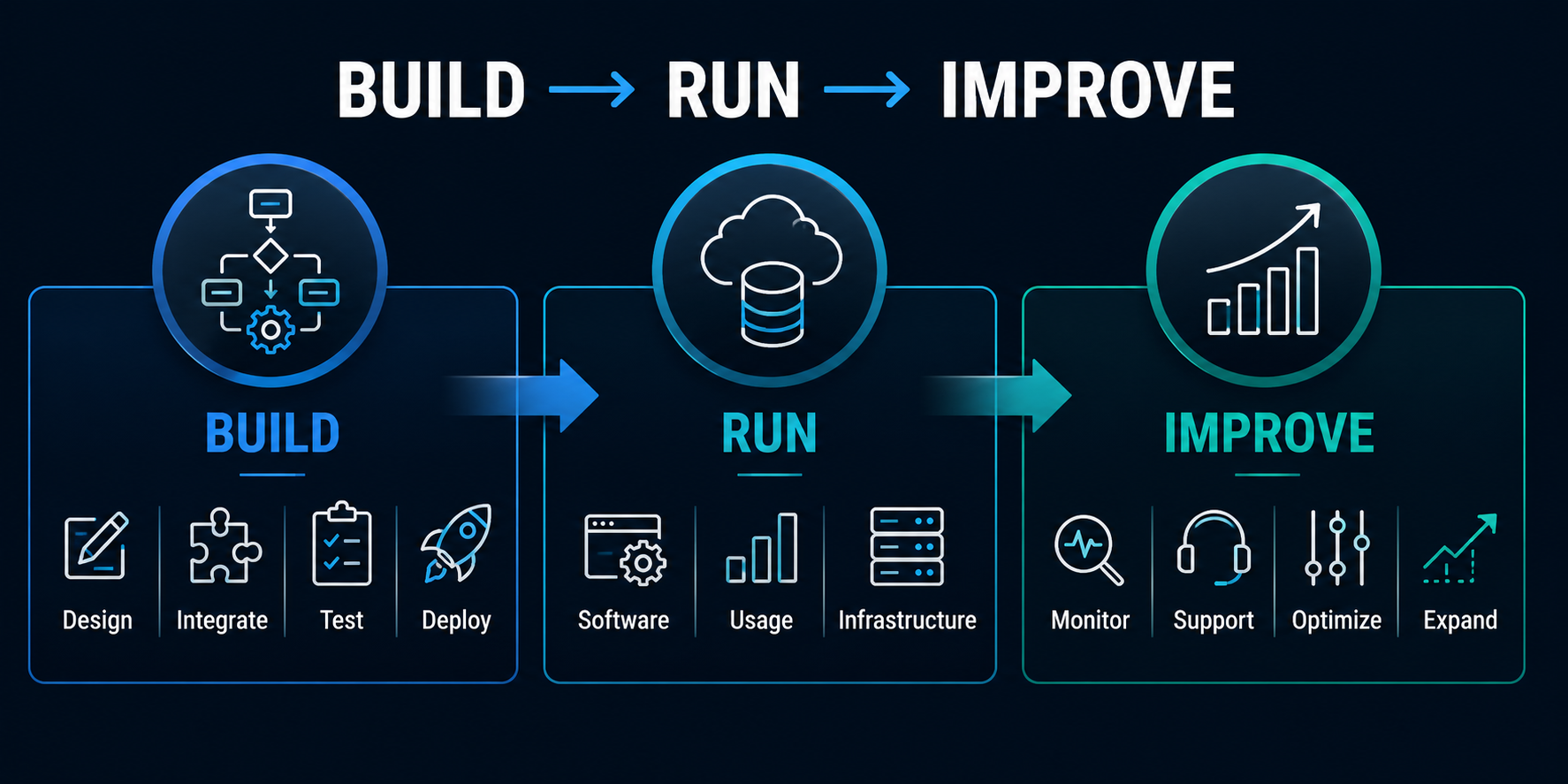
Those three layers don't always need three separate line items.
But you should understand them before deciding what the client pays.
Don't price the software. Price the responsibility.
This is a common beginner mistake.
You build an automation using inexpensive tools and think:
"The software only costs me $80 a month. How can I charge $1,000?"
Because the client isn't necessarily paying you for an $80 software subscription.
They're paying for your ability to:
- understand the process
- design the solution
- configure the technology
- connect systems
- handle exceptions
- test it
- deploy it
- troubleshoot it
- maintain it
- support the team
- take responsibility for the system working as scoped
A contractor doesn't price a kitchen remodel by adding up the screws.
Your underlying technology costs matter enormously to your margin.
They don't automatically determine the value of your work.
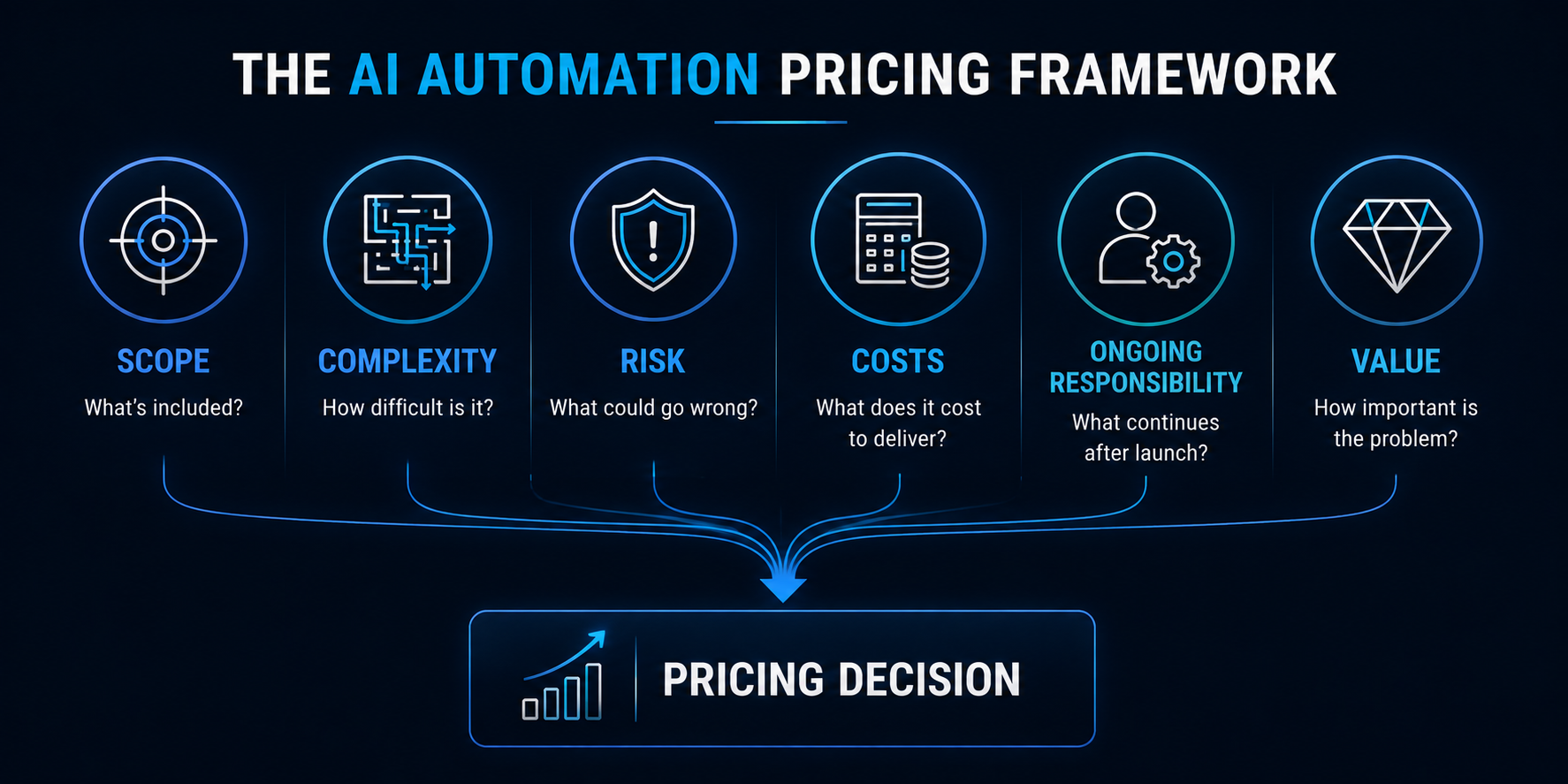
Six factors that should influence your AI automation price
Before choosing a pricing model, evaluate the actual engagement.
1. Scope
How much are you responsible for?
One workflow?
Five?
One department?
Multiple locations?
One communication channel?
Phone, SMS, email and web chat?
Scope changes price quickly.
2. Complexity
A workflow with:
Form submitted → Send email
isn't equivalent to:
Lead arrives → Identify source → Qualify → Check CRM → Start AI conversation → Route based on responses → Schedule → Notify team → Handle exceptions
Count the decisions, dependencies and edge cases—not just the number of boxes in your workflow builder. For a practical walkthrough of how that build process works, see how to build an AI automation for a client.
3. Integration difficulty
What systems need to communicate?
Native integrations may be straightforward.
Some software connects easily. Other systems require custom connections, older software, technical setup, data cleanup or additional development.
"I just need it connected to our system" can contain an impressive amount of hidden pain.
Price accordingly.
4. Risk
What happens when the automation fails?
A failed internal notification is annoying.
An automation that sends incorrect financial information, mishandles sensitive data or disrupts a mission-critical business process is another category of responsibility.
Higher-risk systems may require more:
- testing
- safeguards
- human review
- documentation
- monitoring
- redundancy
- expertise
That belongs in the pricing conversation.
5. Your costs
Know what the system costs you.
That includes more than software.
Consider:
- platform fees
- AI and usage costs
- SMS and phone usage
- hosting
- contractors
- support time
- maintenance
- sales costs
- administrative overhead
- payment processing
- taxes
- your own labor
Revenue isn't margin.
A $1,000 monthly client generating $700 in usage, support and delivery costs is not the recurring-revenue masterpiece it appears to be on Instagram.
6. Value
Finally, what is the problem worth solving?
This matters.
An automation supporting a low-volume administrative convenience doesn't have the same economic importance as a system sitting inside a high-volume revenue or operational process.
But value-based thinking doesn't mean inventing enormous ROI calculations until the price looks exciting.
It means understanding:
- frequency of the problem
- labor involved
- delays created
- opportunities affected
- cost of errors
- strategic importance
- alternatives available
Price should make sense relative to the problem.
The AI automation pricing equation
A useful framework is:
Scope + Complexity + Risk + Costs + Ongoing Responsibility + Value
Not a literal mathematical equation.
A decision framework.
If someone asks:
"What should I charge for a chatbot?"
you don't have enough information.
What kind of chatbot?
Doing what?
Connected to what?
How much knowledge?
How many conversations?
Who monitors it?
What happens when it can't answer?
Are you maintaining it?
Is sensitive information involved?
The more clearly you answer those questions, the less arbitrary your pricing becomes.
Common AI automation pricing models
There are several legitimate ways to structure an engagement.
The right model depends on the work.
1. Fixed project pricing
You quote one price for a clearly defined deliverable.
For example:
Build and deploy a website lead-response workflow connected to the client's existing CRM and scheduling system.
Works well when:
- scope is clear
- deliverables are defined
- the project has a beginning and end
- you understand the implementation
- changes can be handled separately
Watch out for:
Scope creep.
Fixed-price work becomes painful when "one automation" slowly evolves into seventeen integrations and a small software company.
Define what the project includes.
2. Setup fee + monthly service
This is a natural model for many automation offers.
The setup fee covers implementation.
The monthly fee covers legitimate ongoing value.
For example:
Setup: discovery, configuration, integrations, testing and launch.
Monthly: software access, monitoring, support, usage allowance and optimization.
Current public pricing provides plenty of examples of this general structure, although the amounts and included services vary substantially.
Works well when:
- implementation is substantial
- the system continues operating through your infrastructure
- support is ongoing
- usage continues
- monitoring matters
- optimization creates additional value
Watch out for:
Charging monthly simply because you want monthly recurring revenue.
We'll come back to that.
3. Monthly retainer
A retainer can make sense when your role extends beyond maintaining one finished automation.
Maybe you're continuously:
- identifying automation opportunities
- building new workflows
- improving existing systems
- monitoring performance
- advising the business
- managing integrations
In that case, the client isn't renting a workflow.
They're retaining automation capability and expertise.
Works well when:
The ongoing responsibility is substantial and clearly defined.
Watch out for:
Unlimited everything.
If "monthly automation support" means the client can request anything at any time, congratulations—you've accidentally sold a full-time job with no salary protections.
Define capacity and scope.
4. Hourly pricing
Hourly work still has a place.
It can make sense for:
- consulting
- troubleshooting
- discovery
- audits
- technical support
- small undefined tasks
Some 2026 pricing guides put specialized AI automation consulting in roughly the low-to-mid hundreds of dollars per hour, but published estimates vary considerably by expertise and engagement type.
Works well when:
The work is difficult to scope or genuinely advisory.
Watch out for:
Punishing yourself for getting faster.
If you become capable of solving in two hours what previously took you ten, pure hourly pricing can disconnect your compensation from the value of your expertise.
5. Usage-based pricing
Some systems have meaningful variable costs.
Voice AI is an obvious example.
Usage may depend on:
- minutes
- messages
- tokens
- calls
- workflow executions
- documents processed
- conversations
You might include an allowance and charge overages, pass certain costs through, or create usage tiers.
Works well when:
Your costs scale directly with customer usage.
Watch out for:
Complexity and surprise bills.
Clients should understand how usage affects what they pay.
So should you.
6. Hybrid pricing
In practice, automation often fits naturally into a hybrid.
For example:
Implementation fee + monthly platform/support fee + usage beyond an allowance
or:
Fixed project + optional optimization retainer
or:
Paid discovery + implementation + managed operations
The advantage is that different types of value aren't forced into one number.
The disadvantage?
You can turn the proposal into a Verizon bill if you aren't careful.
Keep it understandable.
Which pricing model is best?
There isn't one.
For a defined one-time workflow:
Fixed project may be perfect.
For a lead-response system you host, monitor and support:
Setup + monthly may make more sense.
For an organization continuously deploying automation:
Retainer may fit.
For strategic advisory:
Hourly or fixed consulting may work.
For voice or other consumption-heavy services:
Usage-based components may be necessary.
Choose the model that reflects how the work actually behaves.
Not whichever model sounds coolest on X this week.
What are AI automation agencies charging in 2026?
Now let's address the numbers directly.
Published pricing is inconsistent because providers are selling very different things.
As broad market reference points—not recommended prices—current sources show:
| Engagement | Published 2026 reference points |
|---|---|
| Small/simple scoped work | Can begin around $1,000–$2,000 |
| Single workflow / automation project | Often several thousand dollars; some published guides extend into $15,000 depending on complexity |
| Multi-workflow/custom systems | Frequently move into five figures |
| Ongoing managed automation | Published offers/ranges span hundreds to many thousands per month |
| Specialized consulting | Often quoted in the low-to-mid hundreds per hour |
For example, some providers publish single-workflow pricing in the $1,500–$5,000 range, multi-workflow programs from $5,000–$20,000, and managed automation beginning around $500/month. Other published guides give wider ranges for single automations and ongoing retainers.
The takeaway is not:
"Charge somewhere between $500 and $100,000."
That would be impressively useless advice.
The takeaway is:
Define your offer before comparing your price to the market.
A productized workflow for a small business and a custom multi-system AI implementation are not competing products just because both contain the words "AI automation."
A practical starting point for newer agencies
If you're new, don't immediately ask:
What's the maximum I can charge?
Ask:
What can I confidently deliver?
You need enough margin to make the work worthwhile.
But your early pricing also has to account for reality:
- you're still learning delivery
- your process may be inefficient
- you may lack proof
- your scope estimates may be imperfect
- implementations may take longer than expected
That doesn't mean work for free.
It means don't price yourself like an enterprise consultancy because you successfully connected Calendly to a spreadsheet last Thursday.
Your pricing can increase as:
- expertise improves
- delivery becomes repeatable
- proof accumulates
- demand increases
- your offer becomes more valuable
- your positioning gets stronger
Price is not a tattoo.
A hypothetical pricing example
Let's use the type of offer we built in how to package AI automation services into an offer.
Suppose you're building a lead-response system for a home-service company.
It includes:
- missed-call text back
- website form response
- CRM pipeline
- automated follow-up
- appointment scheduling
- internal notifications
Assume you've mapped the implementation and believe it will require meaningful configuration, testing and deployment.
Hypothetical structure
You might decide the economics support:
Implementation: $2,500
Ongoing platform, monitoring and support: $500/month
Usage: Included up to a defined threshold, then billed separately
Those numbers are illustrative, not a recommendation.
Another provider could reasonably charge less.
A more experienced agency with a more sophisticated implementation could charge substantially more.
The point is the structure:
Build → Run → Improve
Now the client can understand what they're paying for.
And you can understand whether the engagement is profitable.
Another hypothetical example: custom internal automation
Suppose a 40-person company wants to automate an internal document process.
The project requires:
- discovery
- workflow mapping
- document extraction
- AI classification
- human approval logic
- custom connections
- permissions
- exception handling
- testing
- documentation
- training
Calling that "one automation" would be misleading.
Even though the final workflow may look simple to the user, the responsibility and complexity underneath it are much greater.
That should affect the price.
This is why counting automations is usually a poor pricing strategy.
One workflow can be twenty minutes of configuration or six weeks of engineering.
Should you charge a setup fee?
If meaningful implementation work exists, usually there should be a mechanism for getting paid for it.
That doesn't necessarily have to be labeled a setup fee.
You could call it:
- implementation
- deployment
- build
- onboarding
- installation
- project fee
The label matters less than the economics.
If you're doing 30 hours of work before the recurring service begins and charging nothing for it, you're financing the client's implementation.
Maybe you've intentionally structured the offer that way.
Fine.
But know that you're doing it.
How much should your monthly retainer be?
Start by defining what continues monthly.
Ask:
What would stop happening if the client stopped paying me?
That's a fantastic test.
Maybe they lose:
- software/platform access
- hosted infrastructure
- AI usage
- messaging
- monitoring
- support
- optimization
- ongoing campaigns
- new automation capacity
- reporting
Now the recurring fee has substance.
If the honest answer is:
"Nothing. The workflow would keep running exactly the same and they haven't needed me for eight months."
you may not have much of a recurring service.
Stop manufacturing fake MRR
Recurring revenue is fantastic.
Fake recurring value isn't.
If you build a workflow, hand it over and provide no continuing service, charging indefinitely because "agencies need MRR" is weak positioning.
Instead, create recurring value where it genuinely makes sense.
Maybe you provide:
Managed Automation
where you're responsible for:
- monitoring
- maintenance
- troubleshooting
- optimization
- usage
- reporting
- system improvements
Now there's an ongoing relationship.
Or perhaps the client owns the finished system and pays their software vendors directly.
That's fine too.
Not every dollar needs to recur.
Should you mark up software and AI usage?
You can.
But do it deliberately.
There are several approaches.
Pass-through
The client pays vendors directly.
Simple and transparent.
Included allowance
Your monthly fee includes a defined level of usage.
Easy for the client to understand.
Markup
You pay the underlying costs and charge the client more.
That margin may compensate you for administration, infrastructure and risk.
Tiered usage
Different usage levels have different pricing.
Useful when consumption varies substantially.
Whatever you choose, know your unit economics.
Voice minutes, SMS, tokens and workflow executions can quietly eat your margin if you've promised "unlimited" everything.
Unlimited is a dangerous word when your vendors send very limited invoices.
Value-based pricing: useful idea, dangerous shortcut
I like value-based thinking.
I don't love some of the advice built around it.
The reasonable version is:
Understand how important the problem is and price the solution partly in relation to that value.
The ridiculous version is:
This automation might theoretically generate $500,000, therefore I'll charge $50,000.
Slow down, Warren Buffett.
You may not control the result.
Your assumptions may be wrong.
The client may never realize the projected value.
Use value to understand the economics of the problem.
Don't use hypothetical ROI as a machine for manufacturing whatever price you wanted to charge anyway.
What about performance-based pricing?
Be careful.
Getting paid based on results sounds aligned.
Sometimes it is.
But first ask:
Can you accurately measure the result, and do you control enough of the variables that produce it?
Suppose you're paid per booked appointment.
What happens when:
- lead quality collapses
- the client changes ad campaigns
- employees interfere with conversations
- the calendar has no availability
- the offer changes
- prospects book but don't show
- tracking breaks
Performance pricing can work in the right environment.
But it can also make you financially responsible for parts of the business you don't control.
Don't accept risk just because the pricing model sounds sophisticated.
Price the offer, not every tiny component
Suppose your system includes:
- CRM
- SMS
- calendar
- AI conversation
- missed-call response
- follow-up workflows
You probably don't need to price the proposal like:
CRM: $127
SMS automation: $183
Calendar integration: $94
AI chatbot: $347
That's not an offer.
That's a diner receipt.
If those components work together to solve one problem, price the system.
Article #8 on packaging AI automation services explains why this distinction matters.
Protect yourself from scope creep
Pricing and scope are inseparable.
Your proposal should make clear:
- what you're building
- systems being integrated
- workflows included
- communication channels
- revisions
- support
- training
- timeline
- client responsibilities
- ongoing work
- exclusions
Then define what happens when scope changes.
Maybe additional work requires:
- a change order
- a separate project
- hourly billing
- movement into another package
The exact mechanism is less important than having one.
Because:
"Can you also automate this?"
is one of the most expensive sentences in the agency business.
Know your floor before you quote
Before sending a price, know the minimum economics that make the engagement worthwhile.
Consider:
Estimated delivery time
Direct costs
Ongoing support
Risk buffer
Required profit
You don't necessarily show that calculation to the client.
But you should know it.
If your price doesn't comfortably cover the cost and risk of delivery, the fact that the client said yes isn't necessarily good news.
You may have just sold yourself a problem.
Don't copy someone else's pricing
Competitor pricing is useful context.
It is not your pricing strategy.
Another agency may have:
- different costs
- offshore developers
- proprietary software
- more experience
- better templates
- stronger demand
- different clients
- different scope
- different support
- different margins
You can look at the market.
You should look at the market.
But eventually you have to price your offer and your economics.
That's also why choosing a market matters. Our guide to choosing an AI automation agency niche explains how different customers can have very different problems, budgets and economics.
A simple pricing process
If I were pricing a new automation offer, I'd work through it in this order:
Step 1: Define the problem
What are we solving?
Step 2: Define the deliverable
What exactly are we building?
Step 3: Map the implementation
What work is required to launch it?
Step 4: Estimate direct costs
What software, usage and labor will the system consume?
Step 5: Evaluate complexity and risk
What could make this harder than it appears?
Step 6: Identify ongoing responsibility
What will we continue doing after launch?
Step 7: Understand the value
How important is this problem to the client?
Step 8: Choose the pricing model
Project?
Setup + monthly?
Retainer?
Usage?
Hybrid?
Step 9: Check your margin
Does the price actually create a healthy engagement?
Step 10: Define the scope in writing
Now quote it.
That process isn't as sexy as:
"Charge $5K bro."
It is considerably more useful.
The goal isn't to charge the most
The goal is to build a pricing model where:
The client understands what they're buying.
The price makes sense relative to the problem.
You can deliver profitably.
Ongoing fees correspond to ongoing value.
The relationship still makes sense six months later.
Sometimes that means a $1,500 project.
Sometimes it means a $10,000 implementation.
Sometimes it means a substantial monthly engagement.
Sometimes it means walking away.
That's business.
Pricing gets easier when the offer gets clearer. And once your pricing is dialed in, selling the offer and getting your first client are the next steps.
And if you still can't explain what you're selling, going back to the best AI automation services to sell may be more useful than staring at somebody else's rate card.
Ready to Turn the Numbers Into a Real Offer?
Pricing gets much easier once you've stopped selling "AI automation" and started building a specific solution for a specific customer.
If you're still connecting the pieces—market, problem, offer, system and business model—the 48-Hour AI Cashflow Stack is designed to help you turn those pieces into something concrete.
Not a guaranteed-income formula.
Not a magic rate card.
A practical starting point for building an AI-powered service business around problems companies actually care about solving.
Download the 48-Hour AI Cashflow Stack and start putting the business together.