You learned how to build an AI chatbot.
You can automate SMS.
You know how to connect a CRM.
You can trigger follow-up sequences, book appointments, route leads and probably make three different apps talk to each other before breakfast.
Great.
What exactly are you selling?
That's where a lot of new AI automation agencies get stuck.
They learn a collection of tools and capabilities, bundle them into a proposal and call the bundle an offer.
Something like:
AI chatbot + CRM + SMS automation + calendar + workflows + integrations
Technically, that's a list of things you can deliver.
From the business owner's perspective, though, it raises another question:
Why do I need all of that?
A strong AI automation offer answers that question before the buyer has to ask it.
Instead of packaging technology around technology, you package the technology around a specific business problem worth solving.
That's the shift we're going to make.
What is an AI automation offer?
An AI automation offer is the complete solution you're proposing to a particular type of customer for a particular problem.
It may include several services or technologies underneath it.
But those components aren't necessarily the thing you're selling.
Imagine a home-service company is losing opportunities because nobody consistently responds to new inquiries.
The solution might require:
- missed-call text back
- website lead response
- automated SMS
- AI-assisted conversations
- CRM pipelines
- appointment scheduling
- follow-up sequences
- notifications
Those are the components.
The offer is closer to:
A lead-response and follow-up system that helps the company engage new inquiries and move qualified prospects toward an appointment.
That's considerably easier to understand.
The buyer doesn't need to become fascinated by workflow triggers.
They need to understand the problem you're helping them solve.
Service vs. offer: what's the difference?
This distinction matters.
A service describes something you do.
An offer packages what you do into something a specific customer can understand, evaluate and potentially buy.
For example:
| Service | Offer |
|---|---|
| AI chatbot | Website inquiry system that answers common questions and helps qualified visitors take the next step |
| CRM automation | Lead follow-up system that organizes new inquiries and keeps follow-up moving |
| Missed-call text back | Missed-call response system that immediately starts a text conversation when the business can't answer |
| Database reactivation | Reactivation campaign designed to restart conversations with older leads or opportunities |
| Appointment automation | Scheduling and reminder system that reduces manual booking work and keeps appointments organized |
Notice that the right side isn't necessarily promising a result.
It's explaining why the system exists.
That's an important difference.
Businesses don't wake up wanting more automations
This sounds obvious, but look at how automation services are marketed.
"Custom AI agents."
"Intelligent workflows."
"AI-powered CRM."
"Omnichannel conversational automation."
"Agentic business process orchestration."
You can practically hear the business owner reaching for the back button.
Most businesses aren't shopping for automation because automation itself is exciting.
They're dealing with something.
Maybe:
- leads aren't being followed up with
- employees spend hours on repetitive work
- calls are being missed
- appointment scheduling is messy
- customer questions consume staff time
- old leads sit untouched
- information has to be copied between systems
- nobody knows where opportunities are in the pipeline
The problem creates the reason to buy.
Automation is how you solve it.
That's why our guide to the best AI automation services to sell starts by evaluating whether a service addresses a recognizable and valuable problem.
A cool automation with no meaningful problem attached to it is still just a cool automation.
Start with one core problem
When you're packaging an offer, resist the temptation to solve everything.
A new agency often wants the proposal to look valuable, so it keeps adding features.
Chatbot.
Voice AI.
CRM.
Email.
SMS.
Reviews.
Social media.
Reporting.
Lead generation.
Automated birthday wishes.
At some point you've created the Cheesecake Factory menu of AI automation.
More stuff doesn't automatically make the offer stronger.
It can make the offer harder to understand, harder to price, harder to deliver and harder for the customer to evaluate.
Start with one core question:
What important problem is this offer designed to solve?
For example:
Problem: New inquiries aren't consistently receiving a fast response.
Now you have a filter.
Does missed-call text back help?
Probably.
Does web-lead automation help?
Yes.
Does scheduling help?
Potentially.
Does an automated social-media content generator belong in the package?
Probably not.
The problem tells you what belongs.
Define who the offer is for
The same automation can have very different value depending on the customer.
A lead-response system might make sense for a roofing company generating a steady flow of estimate requests.
It may be nearly pointless for a consultant who receives three highly qualified referrals per month and personally responds to every one.
That's why your offer needs a customer.
Not:
Businesses that need AI.
Something closer to:
Home-service businesses generating inbound calls and web inquiries that need a more consistent way to respond and follow up.
Now we're getting somewhere.
Article #7 on how to choose an AI automation agency niche goes deeper into evaluating markets.
For the offer itself, you need enough specificity to understand:
- what the customer does
- how the problem appears
- what systems they already use
- how frequently the problem occurs
- who is involved
- what a better process would look like
You can't package a strong solution for a customer you don't understand.
Define the change you're trying to create
Be careful here.
This is where "outcome-based selling" can turn into nonsense.
You don't need to promise:
We'll increase your revenue by 37%.
You probably can't control that.
Instead, define the operational change your system is designed to create.
For example:
Before: New website leads wait for someone to manually respond.
After: New website leads immediately receive an initial response, enter an organized follow-up process and can move toward scheduling when appropriate.
That's concrete.
Or:
Before: Missed callers may leave a voicemail and wait for a callback.
After: Missed callers immediately receive a text that gives them another way to start the conversation.
Or:
Before: Staff manually sends appointment reminders.
After: Confirmations and reminders are triggered automatically based on the appointment.
These are changes you can actually design a system around.
Build the smallest system that solves the problem well
This is one of the most useful disciplines you can develop.
Don't ask:
What else can I add?
Ask:
What's actually required?
Suppose the problem is:
New leads aren't being followed up consistently.
You may need:
Lead Capture → Instant Response → CRM → Follow-Up → Scheduling
That's a system.
You probably don't need:
- AI voice
- review automation
- social posting
- reputation management
- website redesign
- invoicing automation
- twelve dashboards
Not yet, anyway.
If those things solve another important problem later, they can become another offer, an expansion or part of a larger system.
But don't bury the first problem under every capability you know how to build.
Use this framework to build the offer
Here's the framework I would use:
1. Customer
Who specifically is this for?
Example:
Home-service businesses generating inbound calls and website leads.
2. Problem
What recurring problem are they experiencing?
Example:
New inquiries aren't consistently receiving a fast response or continued follow-up.
3. Operational change
What should work differently after implementation?
Example:
New inquiries receive an immediate initial response and enter a structured follow-up process.
4. System
What components are actually required to create that change?
Example:
- missed-call text back
- web-lead response
- CRM pipeline
- automated follow-up
- appointment scheduling
- internal notifications
5. Scope
Where does your responsibility begin and end?
Example:
You build, configure and test the response and follow-up system.
You do not generate the leads, close the sales or guarantee appointments.
6. Ongoing value
What legitimately needs to continue after launch?
Maybe:
- software access
- workflow monitoring
- conversation usage
- maintenance
- optimization
- support
- reporting
- additional campaigns
- system updates
If nothing meaningful continues, don't invent a monthly fee just because recurring revenue sounds nice.
7. Proof
How can the buyer understand what they're getting before purchasing?
Potentially:
- live demonstration
- process map
- prototype
- example workflow
- audit
- sample conversation
- before-and-after process comparison
Put those seven pieces together and you have something much closer to an actual offer.
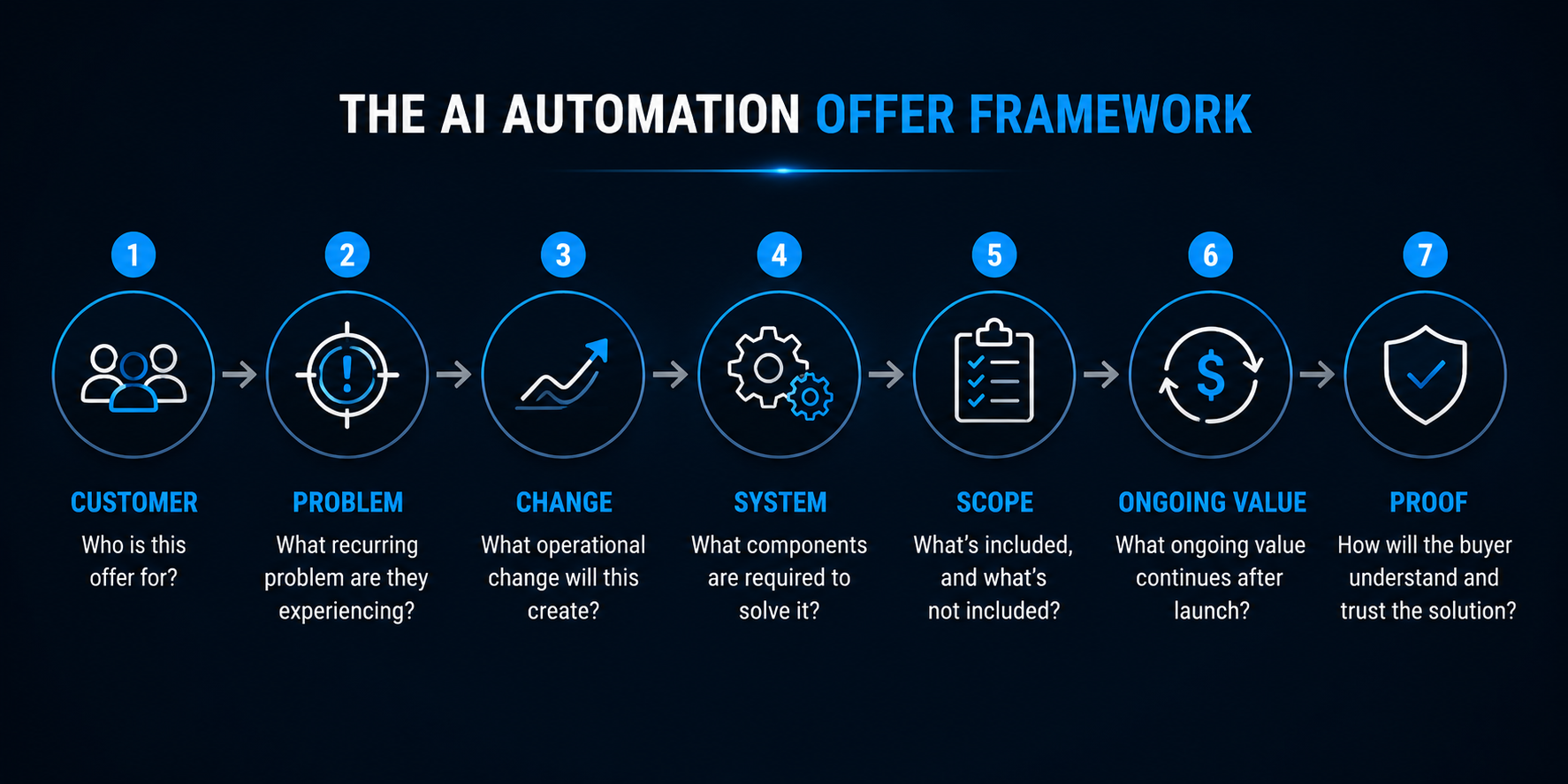
The AI automation offer framework
A simple way to remember it:
Customer → Problem → Change → System → Scope → Ongoing Value → Proof
The technology sits inside the system.
It doesn't lead the conversation.
This also gives you a useful test.
If you can't clearly fill in one of those seven pieces, the offer probably isn't finished.
Don't confuse features with value
Features still matter.
Eventually the customer needs to know what they're getting.
The mistake is leading with them.
Compare these:
Feature-first
Includes AI chatbot, automated SMS, CRM workflows, calendar integration and lead nurturing.
Problem-first
When a new inquiry comes in, the system responds, organizes the opportunity, continues following up and gives qualified prospects a path to schedule.
Then you can explain:
Under the hood, we use automated messaging, CRM workflows, scheduling and AI-assisted conversations to make that happen.
Same technology.
Better sequence.
Problem first. System second. Technology third.
Make the offer easy to explain in one sentence
If explaining your offer requires a screen share and twelve minutes, keep working.
Try this structure:
We help [customer] improve [problem/process] by building [type of system].
For example:
We help home-service companies improve how they respond to and follow up with new inquiries by building an automated lead-response and scheduling system.
That's not necessarily your final sales copy.
It's a clarity exercise.
Another version:
We build [system] for [customer] so [operational change].
We build lead-response systems for contractors so new inquiries don't have to depend entirely on someone manually responding and remembering to follow up.
You should be able to explain the basic idea without saying "AI" fifteen times.
Should you call it an AI offer?
Sometimes.
AI can create interest.
It can also create confusion.
If AI is central to the solution, there's nothing wrong with explaining that.
But consider these two names:
AI Conversational Workflow Automation Package
versus:
Lead Response & Booking System
Which one does a roofing company understand faster?
Exactly.
Name the offer around the job it performs when possible.
Then explain how AI and automation make the system work.
Should you create packages?
Eventually, maybe.
But I wouldn't start by inventing:
Starter
Growth
Pro
before you've even sold the core offer once.
Packages are useful when meaningful differences exist between customer needs.
For example, perhaps one version handles:
Lead response only
while another adds:
Longer-term follow-up and scheduling
and a larger version includes:
Reactivation and additional communication channels
That's a real difference in scope.
But adding three pricing cards because SaaS websites have three pricing cards isn't strategy.
First create one offer people understand.
Then let actual sales conversations show you where variations are needed.
Productized doesn't mean identical
Productizing an AI automation service doesn't mean every client receives an identical copy.
Businesses have different:
- CRMs
- calendars
- phone systems
- forms
- workflows
- team structures
- terminology
- compliance requirements
The goal is not necessarily:
Every implementation is exactly the same.
The goal is:
The problem, core solution, delivery process and boundaries become increasingly repeatable.
You can standardize:
- discovery
- onboarding
- workflow architecture
- templates
- testing
- documentation
- training
- reporting
- support
while still adapting the implementation where necessary.
That's a much more realistic version of productization.
Decide what's included — and what's not
Scope is part of the offer.
Without it, "AI automation" can become an endless series of:
Hey, while you're in there...
Define things such as:
- systems being connected
- number of workflows
- communication channels
- supported use cases
- integrations
- implementation timeline
- revision limits
- training
- support
- monitoring
- ongoing changes
Just as importantly, define exclusions.
If you're building lead follow-up, are you also writing every sales script?
Are you managing Google Ads?
Are you rebuilding the website?
Are you manually handling conversations?
Are you responsible for closing deals?
Maybe.
Maybe not.
But decide.
Clear scope protects both sides.
One-time setup vs. recurring service
This deserves more thought than:
"I want MRR."
Some automation work naturally has two layers.
Implementation value
Work required to:
- map the process
- configure systems
- build workflows
- connect integrations
- write prompts
- test
- deploy
- train the team
That's implementation.
Ongoing value
After launch, the system may legitimately require:
- platform access
- monitoring
- maintenance
- AI or messaging usage
- optimization
- support
- reporting
- workflow changes
- additional campaigns
That's recurring value.
Those are different things.
Your business model can reflect both.
But don't manufacture recurring work that doesn't exist.
A client will eventually notice they're paying you every month for a workflow you haven't touched since Easter.
Booked Calendar System™ is an example of packaging around a problem
Here's a useful example from our own business.
Boost Local Biz could describe a collection of capabilities like this:
- CRM
- automated SMS
- missed-call text back
- AI conversations
- pipelines
- follow-up sequences
- scheduling
- reminders
- reactivation
Instead, we package those capabilities around a larger problem:
What happens after a business receives an inquiry?
That's the thinking behind Booked Calendar System™.
The point isn't that every automation entrepreneur should copy it.
Don't.
The lesson is that multiple technologies become easier to understand when they're organized around a recognizable business process.
That's also the same idea we explore from the business-owner side in what happens after a website lead comes in.
The technology supports the system.
The system supports the business process.
Don't promise what you don't control
This deserves its own section because weak offers often compensate with huge promises.
Be careful with claims like:
- guaranteed appointments
- guaranteed revenue
- guaranteed cost savings
- guaranteed close rates
- guaranteed time savings
Unless you can genuinely substantiate and control the claim, don't build your positioning around it.
Your automation can improve a process.
But you may not control:
- lead quality
- sales ability
- pricing
- staffing
- customer demand
- seasonality
- whether employees use the system
- whether the owner follows up
- whether prospects actually buy
A strong offer doesn't need fake certainty.
Be specific about what the system does and what process it's designed to improve.
That's credible enough.
Don't build the entire system before validating the offer
This is where technically minded entrepreneurs can burn a ridiculous amount of time.
They build first.
Then they go looking for somebody who wants what they built.
Reverse it.
Start with:
Problem → Customer → Offer → Validate → Build → Deliver → Refine
Not:
Build → Build More → Add AI → Add Dashboard → Add Features → Finally Ask Someone If They Want It
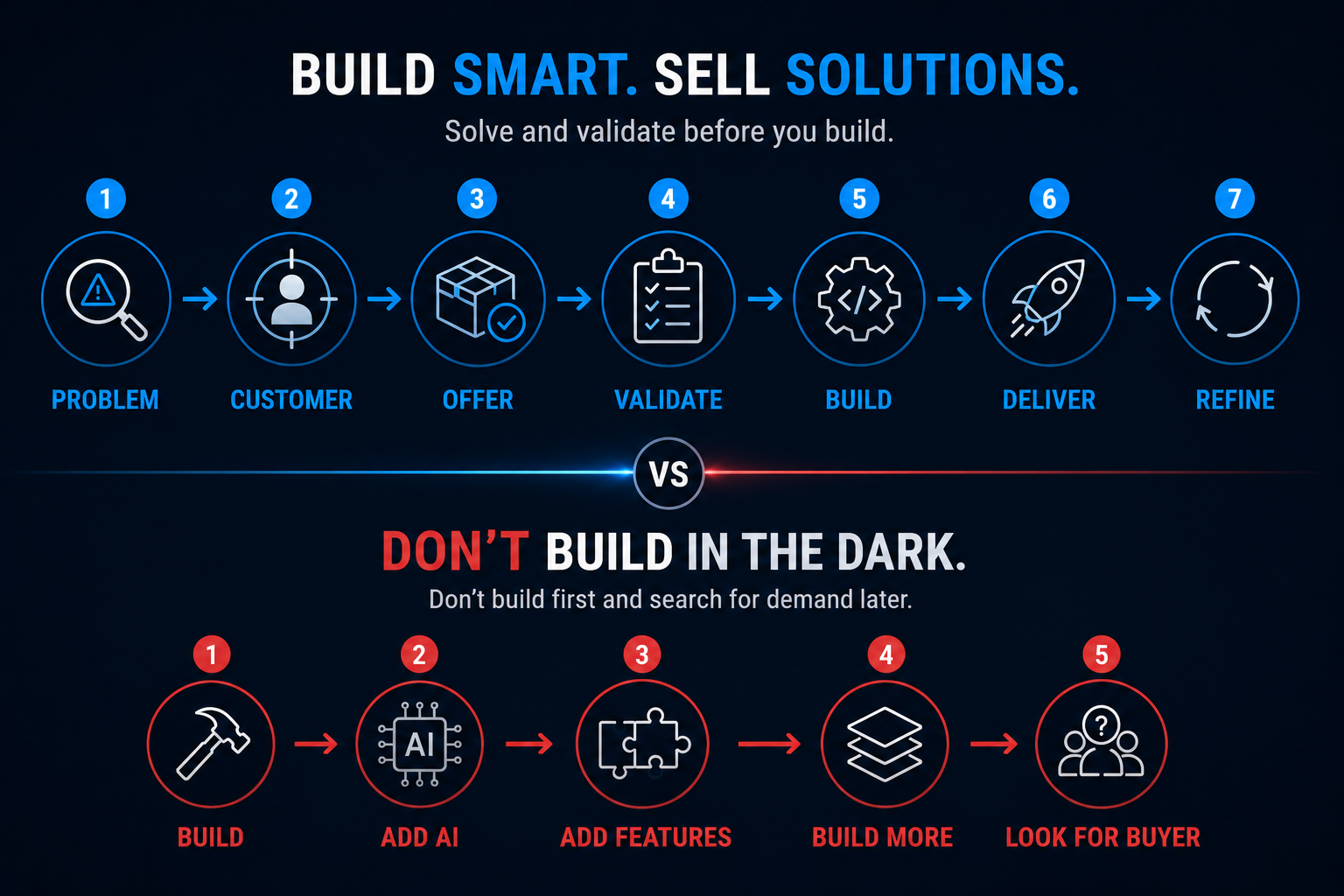
Before building the full system, you can validate through:
- customer conversations
- workflow interviews
- demonstrations
- prototypes
- process maps
- audits
- manual versions of the service
- pre-selling when appropriate
You're looking for evidence that the problem matters and that your proposed solution makes sense.
Then build what the market actually needs.
How to validate an AI automation offer
You don't need hundreds of responses.
Start small.
Talk to the target customer
Ask how the process currently works.
Find where it breaks
What gets delayed, forgotten, duplicated or handled manually?
Understand what they've already tried
Existing behavior tells you more than hypothetical enthusiasm.
Show the proposed change
A simple workflow diagram can sometimes communicate more than a full technical demo.
Ask what would stop them from using it
Integrations?
Team adoption?
Compliance?
Cost?
Control?
Trust?
Listen for repeated objections
One objection may be personal.
The same objection from six prospects is product research.
Refine the offer
Adjust the scope, messaging or system based on what you're learning.
That's offer development. Once the offer is validated, finding your first client becomes the next focus.
Not guessing in a Notion document for three weeks.
Turn successful delivery into a repeatable system
Once you've sold and delivered the offer, document what happened.
What did you need from the client?
What took too long?
What broke?
What was reusable?
Which integrations appeared again?
What questions did the client ask?
What needed customization?
What could become a template?
That's how a custom service gradually becomes more productized.
Your first implementation may be messy.
That's normal.
The goal is to make the second one less messy.
Then the third.
Eventually, you aren't starting from zero every time.
You're deploying a system you understand into a market you understand to solve a problem you understand.
That's a much stronger agency model.
A simple AI automation offer example
Let's put the framework together.
Customer
Residential roofing companies generating inbound calls and web leads.
Problem
New inquiries aren't consistently receiving an immediate response and continued follow-up.
Operational change
Every new inquiry enters an organized response and follow-up process rather than relying entirely on manual callbacks.
System
- missed-call text back
- website lead response
- CRM pipeline
- automated follow-up
- scheduling
- internal notifications
Scope
Implementation, configuration, testing and support for the defined lead-response workflow.
Lead generation and sales closing are not included.
Ongoing value
Platform access, monitoring, maintenance, messaging/AI usage where applicable, support and agreed optimization.
Proof
Demonstration showing exactly what happens when a hypothetical new lead calls or submits a form.
Now compare that to:
We sell AI automation for roofing companies.
One sounds like a category.
The other sounds like something you could actually discuss with a prospect.
The offer should get clearer as you get better
Don't expect version one to be perfect.
Your early offer is a hypothesis.
Sales conversations sharpen it.
Delivery sharpens it.
Client questions sharpen it.
Objections sharpen it.
Results—or lack of them—sharpen it.
Over time, you may discover that the thing you thought customers cared about isn't what they care about at all.
Good.
That's useful information.
The goal isn't to defend your original offer forever.
It's to become increasingly good at solving a valuable problem for a particular type of customer.
Before you sell it, answer these 10 questions
Run your offer through this checklist:
- Who exactly is it for?
- What specific problem does it address?
- Why does that problem matter?
- What changes after implementation?
- What components are actually necessary?
- What's included?
- What's explicitly not included?
- What ongoing value exists after launch?
- How can I demonstrate the solution clearly?
- Can I explain the offer without relying on AI jargon?
If those answers are clear, you're getting close.
If they're fuzzy, adding another automation probably isn't the solution.
Sell the solution, not the pile of tools
The AI automation opportunity isn't about collecting as many capabilities as possible.
It's about learning how to apply those capabilities to problems businesses care about.
That's the progression:
Learn the technology.
Then:
Understand the customer.
Then:
Understand the problem.
Then:
Build the right system.
Then package that system so the buyer can understand what it does, why it matters and where your responsibility begins and ends.
That's an offer.
And once you have one that businesses actually want, then it becomes worth figuring out how to sell it, exactly what to charge for it and how to present the scope in a clear AI automation proposal.
Ready to Turn the Pieces Into an Actual Offer?
If you've been bouncing between niches, tools, automations and business models, the hardest part may not be learning one more platform.
It may be turning everything you've learned into something concrete enough to sell.
The 48-Hour AI Cashflow Stack is designed to help you work through that process and start assembling a legitimate AI-powered service business around problems companies actually pay to solve.
No imaginary income guarantees.
No requirement to build an "AI empire" by Tuesday.
Just a practical path from idea to offer to action.
Download the 48-Hour AI Cashflow Stack and start building the offer.