GoHighLevel can help you build a business.
It cannot be the business for you.
That distinction gets lost when somebody shows you a dashboard, talks about recurring revenue, and makes it sound like subscribing to software is the same thing as acquiring customers.
It isn't.
HighLevel gives you CRM tools, automation, forms, calendars, websites, funnels, communication tools, client accounts, and ways to package and resell certain capabilities. Those are useful building blocks. But a customer still needs a reason to pay you.
The money comes from solving a problem, delivering the solution, and continuing to provide value—not from owning access to the platform.
I've used HighLevel for about two and a half years across my own business and client systems. One of the things I appreciate most is that you can use different combinations of the same platform to support very different offers.
You don't have to sell everything it does.
You do have to decide what business you're actually building.
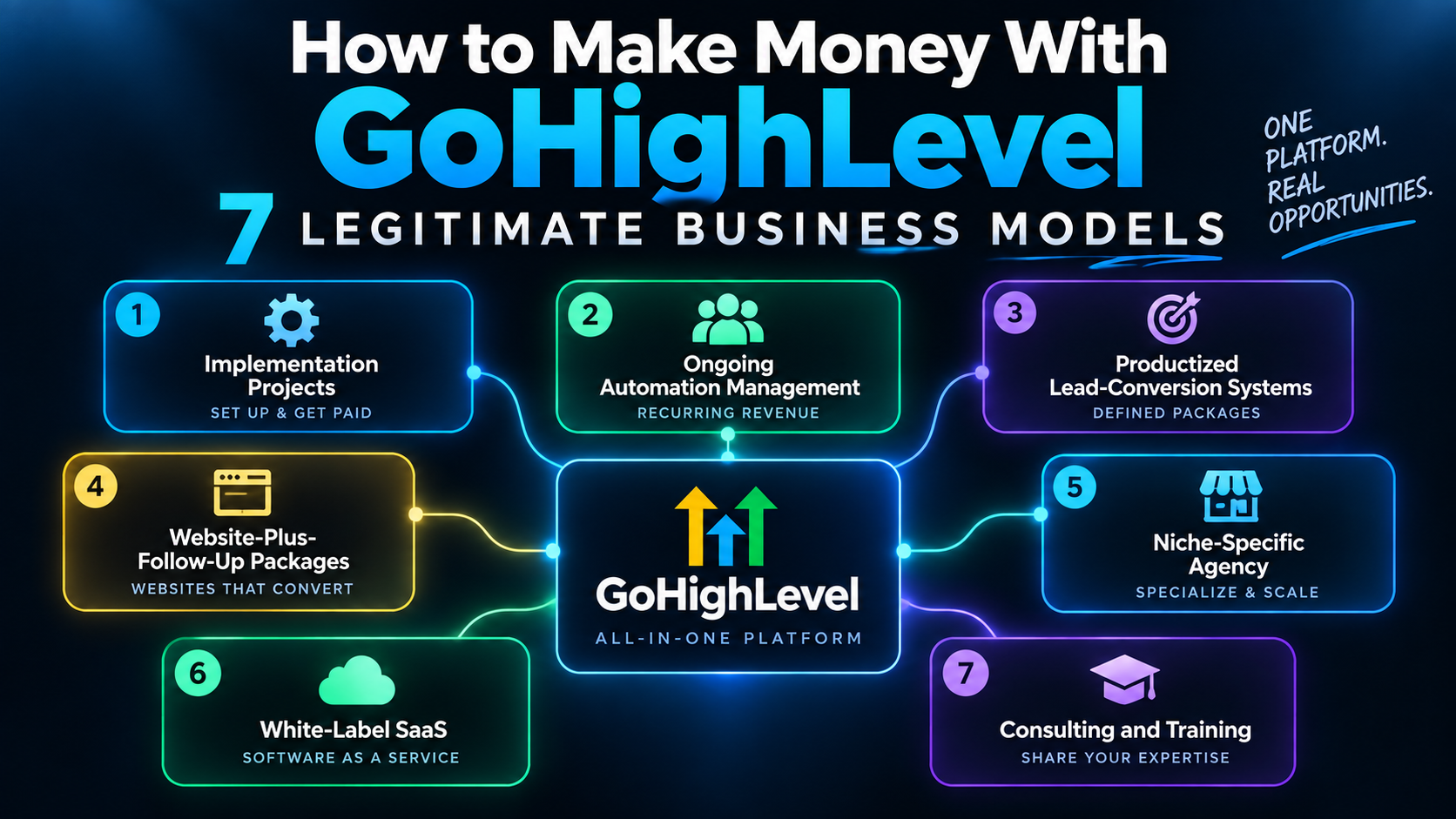
This guide covers seven legitimate business models, what customers would be paying for, how each can generate revenue, and where the operational work tends to show up.
First, Separate the Business Model From the Service
A service is what you deliver.
A business model is how you organize, sell, deliver, and get paid for that value.
For example, missed-call text back is a service. You could sell it as a one-time implementation, include it in a monthly lead-conversion package, or make it one component of a software-enabled subscription.
Same underlying feature. Different business models.
That matters because beginners often spend weeks asking, “What HighLevel feature should I sell?”
A more useful question is:
“What problem can I solve repeatedly, for which customers, and what would they reasonably pay me to take off their plate?”
If you haven't chosen a market or an offer yet, start with how to choose a profitable niche for an AI automation agency and how to package AI automation services.
Here's how the seven models differ.
| Business model | What customers buy | Typical revenue structure |
|---|---|---|
| 1. Implementation projects | A working system built for them | One-time project fee |
| 2. Ongoing automation management | Maintenance, monitoring, and improvements | Monthly retainer |
| 3. Productized lead-conversion systems | A defined outcome-focused package | Setup fee plus monthly service |
| 4. Website-plus-follow-up packages | A website connected to lead handling | Project fee plus optional recurring service |
| 5. Niche-specific agency | Specialized systems and ongoing help for one market | Projects, retainers, or packages |
| 6. White-label SaaS | Access to a configured software offering | Recurring subscription |
| 7. Consulting and training | Expertise, implementation guidance, and enablement | Sessions, projects, or advisory retainers |
These aren't seven equally easy paths. They also aren't mutually exclusive. A business can begin with implementation projects and later add management, productized packages, or software subscriptions.
The important part is knowing which promise you're making to the customer.
1. Sell HighLevel Implementation Projects
This is one of the most straightforward models to understand.
A business needs something set up. You build it, test it, hand it over, and get paid for the project.
Examples include:
- Setting up a CRM and sales pipeline
- Connecting website forms to lead notifications
- Building an appointment-booking process
- Creating automated inquiry follow-up
- Migrating contacts and configuring the account
- Setting up review-request automation
- Connecting several existing processes into one system
The customer is not buying “five workflows and three calendars.”
They're buying a working setup that solves a specific operational problem.
Hypothetical example
A home-service company gets inquiries through its website, but those inquiries land in an email inbox. Nobody has a reliable view of which prospects received a response, which estimates are pending, or which jobs were booked.
You could implement a system that:
- Captures the inquiry.
- Creates or updates the contact.
- Adds an opportunity to a pipeline.
- Alerts the appropriate person.
- Sends an appropriate initial response.
- Supports scheduling and follow-up.
You would charge for scoping, building, testing, and handing over that system.
The fee needs to account for the real work, including discovery, integrations, data cleanup, revisions, and training—not just the time spent clicking around HighLevel.
Where this model gets difficult
Every client may have a different process.
A seemingly simple setup can become complicated when the business has multiple locations, inconsistent data, unusual booking rules, or employees who handle inquiries differently.
A clearly defined scope matters.
So does a decision about what happens after delivery. If the client calls three weeks later because a connected account needs attention, is that included, billable support, or part of an ongoing agreement?
Set that expectation before the project starts.
For the delivery side, see how to onboard an AI automation client and how to build an AI automation for a client.
2. Manage Automations for a Monthly Fee
Building a system and keeping it useful are two different jobs.
An implementation might work perfectly on launch day. Then the business changes its hours, hires another salesperson, updates its services, changes a form, or asks for a different follow-up sequence.
Connected systems also need attention. Something that depends on an external integration may occasionally require reconnection or adjustment.
That's where ongoing management can become a legitimate recurring service.
You might provide:
- Workflow monitoring and troubleshooting
- Changes to lead-routing rules
- Follow-up sequence adjustments
- Calendar and pipeline maintenance
- Form and integration checks
- Contact-data cleanup
- Monthly reporting and recommendations
- Staff support and small improvements
A monthly fee should buy ongoing work or ongoing value. It shouldn't be a charge for a system you built once and never look at again.
The mistake to avoid
Don't promise unlimited changes under a vague “automation management” plan.
One client may need a few routine adjustments per month. Another may effectively want an on-call operations department.
Define the maintenance included, response expectations, change-request process, and what counts as a new project.
This is also why creating recurring revenue with AI automation services deserves its own strategy. Recurring billing is easy to describe. Recurring value takes more thought.
3. Sell a Productized Lead-Conversion System
This is where HighLevel can support something more focused than general automation services.
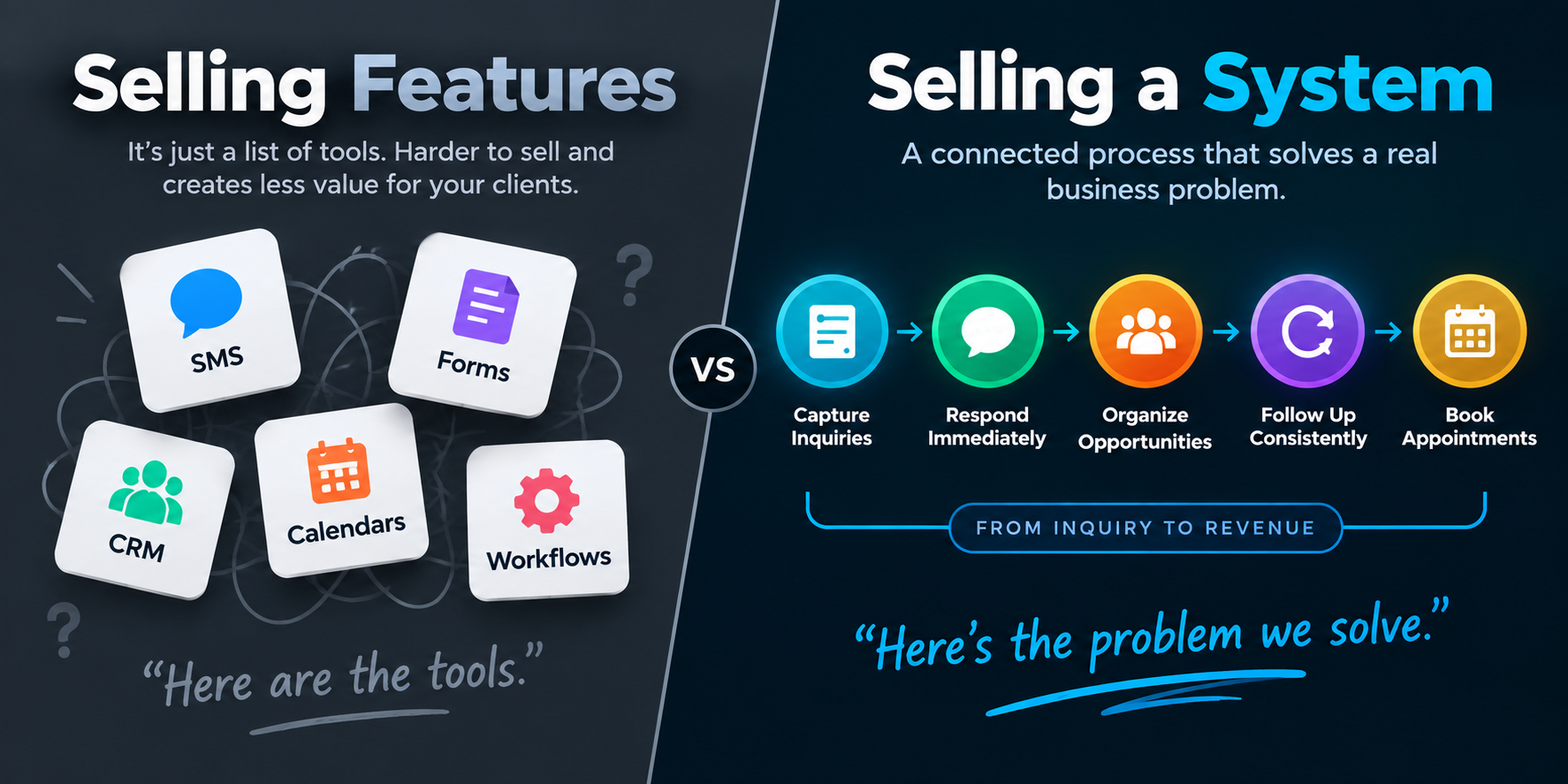
Instead of asking every prospect what they might want automated, you create a defined package around a recurring business problem.
For example:
“We help service businesses respond to new inquiries, organize opportunities, follow up consistently, and move interested prospects toward booked appointments.”
The package might include:
- Inquiry capture
- CRM contact creation
- A sales pipeline
- Immediate response
- Automated follow-up
- Scheduling
- Notifications
- Appointment reminders
- Basic reporting
That's a system, not a menu of unrelated features.
At Boost Local Biz, this is the thinking behind the Booked Calendar System™: connecting marketing and inquiries to actual opportunities instead of treating lead generation as the finish line.
Why productization changes the business
You can standardize parts of your delivery.
The sales conversation becomes more focused. Your onboarding questions become more consistent. You can reuse tested architecture and customize the pieces that depend on the individual business.
HighLevel snapshots can help with reusable configuration, while workflows and pipelines support different parts of the operating system.
But don't confuse reusable setup with identical clients.
A roofing contractor, dental practice, and pool builder may all need follow-up. They won't necessarily share the same qualification questions, appointment process, sales cycle, or customer expectations.
Standardize the foundation. Customize the business logic.
4. Build Websites That Connect to Follow-Up and Conversion
A website project can be more valuable when the work doesn't stop at publishing pages.
A service business may need a website that explains its services, earns trust, and captures inquiries. But what happens after somebody fills out the form?
Does anyone receive an alert?
Does the prospect get a response?
Is the inquiry recorded somewhere?
Can the business see whether it became an appointment, estimate, or customer?
You can package website strategy and implementation with the systems that handle what happens next.
Possible components include:
- Website or landing-page creation
- Mobile-friendly contact paths
- Forms and lead capture
- CRM integration
- Notifications
- Follow-up
- Scheduling
- Conversion tracking
The commercial offer is not simply “a website built with AI.”
It's a website connected to a practical customer-acquisition and conversion process.
Our guide to what makes a service business website convert covers the website side, while what should happen after somebody fills out your website form covers the handoff.
How you could charge
One option is a website project fee, with an optional ongoing agreement for hosting, maintenance, follow-up systems, and optimization.
Another is a more standardized website-and-systems package with a setup fee and monthly service.
The structure depends on what you're actually delivering and responsible for.
Don't hide essential implementation work inside an unrealistically cheap monthly price and hope you'll recover it eventually. Calculate the work, ongoing costs, and support obligation first.
5. Build a Niche-Specific HighLevel Agency
This model is about specialization.
Rather than being the person who “does GoHighLevel for anyone,” you develop a strong understanding of a particular type of business and the problems it repeatedly encounters.
You might focus on:
- Contractors who need estimate follow-up
- Home-service companies handling missed calls
- Appointment-based businesses dealing with no-shows
- Businesses with long sales cycles and stale opportunities
- Multi-location service companies that need consistent inquiry handling
The niche alone is not the offer.
“HighLevel for roofers” tells a prospect which industry you serve. It doesn't tell them what problem you solve.
“An organized inquiry-to-estimate follow-up process for roofing companies” is much more specific.
What specialization can improve
Over time, you can learn the terminology, common objections, lead sources, handoffs, and operational constraints of your chosen market.
You may also develop reusable onboarding questions, templates, workflow architecture, reporting, and training.
But specialization only helps if it reflects genuine understanding. Changing the word “plumber” to “roofer” in the same sales page is not a niche strategy.
This model can combine implementation projects, monthly management, and productized offers. It's a way to organize the business around a market rather than a separate HighLevel feature.
6. Create a White-Label SaaS Offering
This is the model that gets a lot of attention because the recurring-revenue story sounds appealing.
HighLevel has agency and SaaS capabilities that can support packaged software subscriptions, client sub-accounts, and certain resale or rebilling arrangements.
But white-label SaaS is not the same thing as effortless recurring revenue.
A subscription customer still needs onboarding, a usable product, support, billing, and a reason to stay.
What would you actually sell?
Consider a hypothetical subscription for a defined group of service businesses.
It might provide access to:
- A configured CRM
- A pipeline
- Forms
- Calendars
- Follow-up tools
- A client-facing dashboard or workspace
- Selected add-ons, depending on the package
You would need to decide which parts are self-service, which are done for the customer, and what support is included.
That's the product design work.
Understand the costs before choosing a price
Your monthly platform subscription is not necessarily your total operating cost.
Depending on the setup, there may be communication usage, AI charges, add-ons, payment-related costs, and support expenses. HighLevel's SaaS and rebilling documentation distinguishes different billing arrangements, and some bundled add-ons can be charged to the agency rather than directly to the sub-account.
Check the current HighLevel pricing guide and the platform's official billing documentation before building a pricing model around an assumed margin.
A subscription that looks profitable before usage and support can look very different afterward.
SaaS versus a managed service
Here's a useful distinction:
| SaaS-style offer | Managed service |
|---|---|
| Customer pays primarily for access to a configured product | Customer pays primarily for work and outcomes you manage |
| Customer may perform more of the day-to-day work | Your team may operate more of the system |
| Product usability and support are central | Delivery capacity and service scope are central |
| Standardization is especially important | Customization may be more extensive |
Many real offers blend the two. That's fine—as long as the customer understands what they're buying.
I would not build a SaaS offer simply because the platform has a SaaS feature. I'd start with a customer problem and decide whether a subscription product is an appropriate way to solve it.
7. Offer HighLevel Consulting and Training
Not every customer needs you to own and manage their entire system.
Some already use HighLevel but need help making it work for their business.
Others have an employee who will manage it after setup, but that employee needs a clearer process and practical training.
Possible offers include:
- Account audits
- Workflow troubleshooting
- CRM and pipeline strategy
- Implementation planning
- Staff training
- Process documentation
- Advisory sessions
- Fractional automation or systems guidance
This model is especially dependent on actual expertise.
You need to be able to diagnose a problem, explain trade-offs, and help the customer make decisions—not just repeat feature descriptions.
The limitation
Consulting can be harder to standardize than a tightly scoped implementation.
The customer may arrive with a messy account, unclear objectives, or a problem that turns out to involve a third-party tool.
Be explicit about whether you're providing advice, making changes yourself, or taking responsibility for the final implementation.
And don't claim expertise in every corner of HighLevel just because you've used part of it. The platform is broad enough that knowing where your experience ends is useful to the customer.
Which Business Model Should You Start With?
Don't choose based on which model sounds most passive.
Choose based on what you can competently deliver, who you can reach, and what problem you've validated.
A practical way to think about the options:
| If your current strength is… | Explore… | Validate first… |
|---|---|---|
| Building and troubleshooting systems | Implementation projects | Can you scope and deliver a specific result? |
| Maintaining and improving existing systems | Ongoing management | Is there enough recurring work to justify the fee? |
| Solving one repeated business problem | Productized system | Does the same core problem recur across customers? |
| Website strategy and conversion | Website-plus-follow-up package | Can you own the full inquiry handoff? |
| Deep understanding of one industry | Niche-specific agency | Is your offer specific beyond the industry label? |
| Product design, onboarding, and support | White-label SaaS | Will customers use and retain the subscription? |
| Established platform and operational expertise | Consulting and training | Can you solve problems without relying on a canned tutorial? |
You don't have to commit to your forever business model today.
An implementation project can teach you what customers need. Repeated requests can reveal a package. Ongoing support can reveal recurring value.
Just don't mistake having several possible revenue streams for having a clear offer.
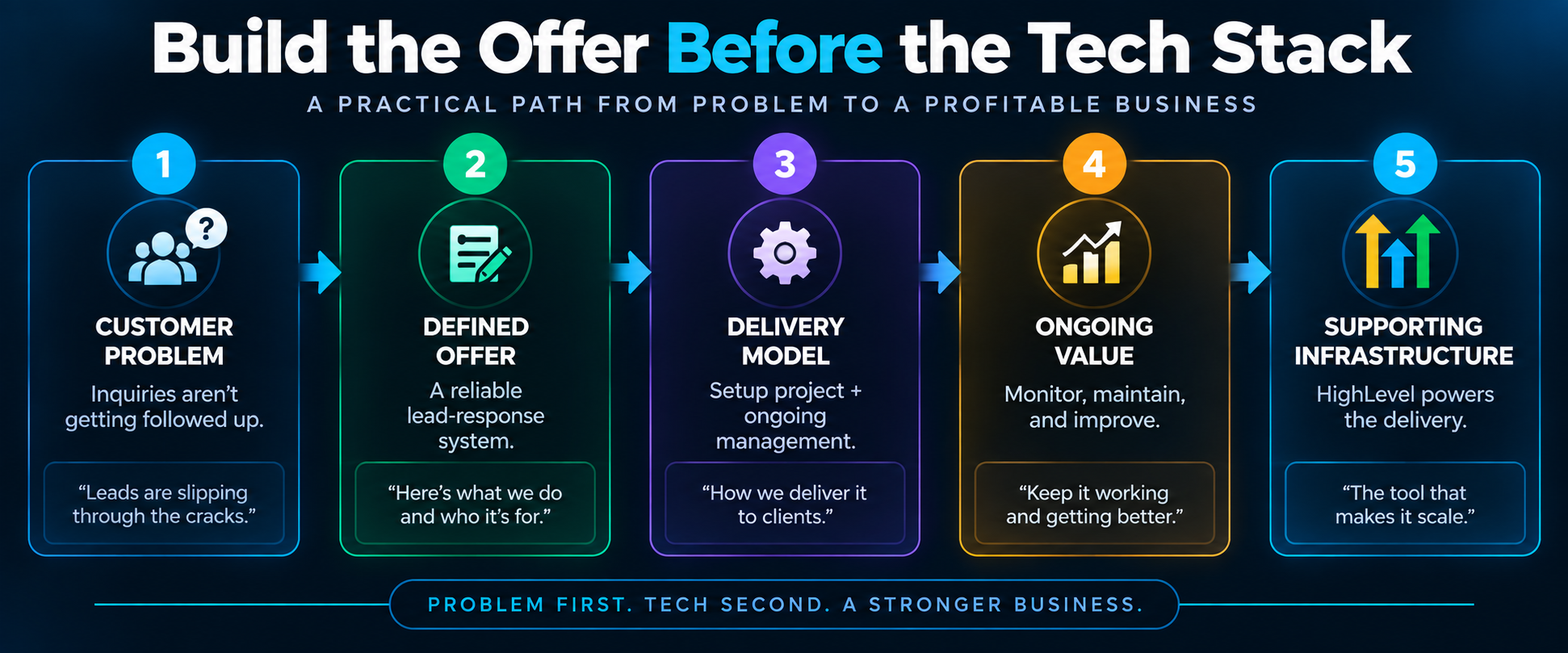
A Simple Way to Test an Offer Before Building Everything
Here's a hypothetical example.
You decide to work with local contractors who receive website inquiries but don't have consistent follow-up.
Before creating an elaborate agency website, ten pricing tiers, and a giant snapshot, define one offer:
“I set up a process that captures new inquiries, alerts your team, organizes opportunities, and follows up when prospects haven't responded.”
Then work through five questions:
- Who specifically has this problem? Not “all small businesses.”
- What happens today? Understand the current process and where opportunities get lost.
- What would change? Define the working system and what the business will be able to do afterward.
- What does delivery require? Account setup, integrations, messaging, testing, training, and support.
- Why would they keep paying? If you want a monthly fee, define the ongoing value.
Only then decide how much HighLevel you need and how to package the work.
If you're struggling with the customer-acquisition part, read how to get your first AI automation client. If you're unsure what to charge, see how to price AI automation services.
The Costs and Responsibilities People Forget
The subscription is only one line in the business.
Depending on your model, you'll also need to account for:
- Your time learning and implementing
- Client acquisition
- Onboarding and data migration
- SMS, email, phone, and AI usage where applicable
- Paid add-ons and integrations
- Testing and troubleshooting
- Customer support
- Documentation and training
- Cancellations and offboarding
If you're sending messages or making calls on behalf of businesses, you also need appropriate consent, compliant processes, and clear responsibility for how customer information is handled.
And if your offer depends on another company's platform, you need to be comfortable maintaining it as features, pricing, and integrations evolve.
None of that makes the opportunity illegitimate.
It makes it a business.
Do You Need GoHighLevel Agency Pro to Start?
Not automatically.
The plan should follow the model and the capabilities you actually need.
A person learning the platform or serving a small number of clients may have different requirements from an agency building an automated SaaS subscription business.
I've personally used the $497 Agency Pro plan for essentially my entire time with HighLevel. It fits how I use the platform across my business and client systems.
That doesn't mean a beginner should buy the most expensive plan before finding a customer.
Compare the current plans in GoHighLevel Starter vs. Unlimited vs. Agency Pro, then match the subscription to your intended delivery.
Don't buy capabilities you haven't found a business reason to use.
The Bottom Line: Sell the Result, Not the Software
You can use HighLevel to support implementation work, managed automation, productized lead-conversion systems, website packages, niche-specific services, SaaS subscriptions, and consulting.
Those are different ways to build a business.
What they have in common is that somebody must be willing to pay for the problem you solve—and you must be able to deliver what you promise.
HighLevel gives you infrastructure.
You still need the customer, the offer, the execution, and the ongoing value.
Want to Build a Practical AI Automation Business?
If you're still figuring out what to sell, who to sell it to, and how to turn useful automation into a real offer, start with the 48-Hour AI Cashflow Stack.
It's a practical starting point for thinking through the business—not a promise that buying software will create income.
Ready to Explore HighLevel?
If you've identified a problem you want to solve and HighLevel looks like the right infrastructure, you can explore the platform through my link.
Disclosure: Some links on this page are affiliate links. If you sign up through one of them, I may earn a commission at no additional cost to you. I only recommend tools I have personally used and believe are worth considering.