Recurring revenue is one of the most attractive parts of building an AI automation business.
Build something once.
Get paid every month.
Sounds pretty good.
There's just one problem with that idea:
Your client needs a reason to keep paying you.
A monthly invoice isn't a business model by itself.
If you want to create recurring revenue with AI automation services, the recurring fee should be connected to recurring value — such as monitoring, maintenance, support, optimization, software access, ongoing management or continued development.
That's the part that sometimes gets lost when people talk about building an AI agency around MRR.
Recurring revenue can absolutely make the business stronger.
But recurring revenue also creates recurring responsibility.
Let's look at how to build both sides of that equation properly.
What Is Recurring Revenue in an AI Automation Business?
Recurring revenue is money a client continues paying after the initial automation or system has been implemented.
Instead of the entire relationship looking like this:
Build → Deliver → Invoice → Goodbye
it might look more like:
Build → Launch → Support → Monitor → Improve → Expand
The initial implementation can still have its own fee.
The difference is that the relationship doesn't necessarily end when the system goes live.
The client continues receiving something of value, and you continue receiving revenue for providing it.
That ongoing value might involve maintaining the automation, providing software, supporting the client, monitoring important workflows, making improvements or helping the system evolve as the business changes.
Recurring Revenue Should Follow Recurring Value
This is the principle I'd keep in mind:
Don't start by asking, "How can I charge this client every month?"
Ask:
"What will I still be responsible for every month?"
That's a much better question.
Suppose you build a straightforward automation for a client, thoroughly test it, transfer ownership, provide documentation and have no continuing involvement.
Maybe that's simply a project.
There's nothing wrong with that.
Now imagine you're providing a system that includes software access, customer communication, automated follow-up, AI conversations, appointment scheduling and ongoing support.
That's different.
The client continues using something you're providing and you continue carrying responsibility for it.
Now a recurring model makes much more sense.
Four Types of Recurring Value
Recurring AI automation revenue can come from several different places.
Four categories are especially useful to understand:
Maintenance
Managed service
Software and infrastructure
Expansion
They can overlap, and you don't necessarily need to put four separate charges on an invoice.
The point is to understand what the client is actually paying for.
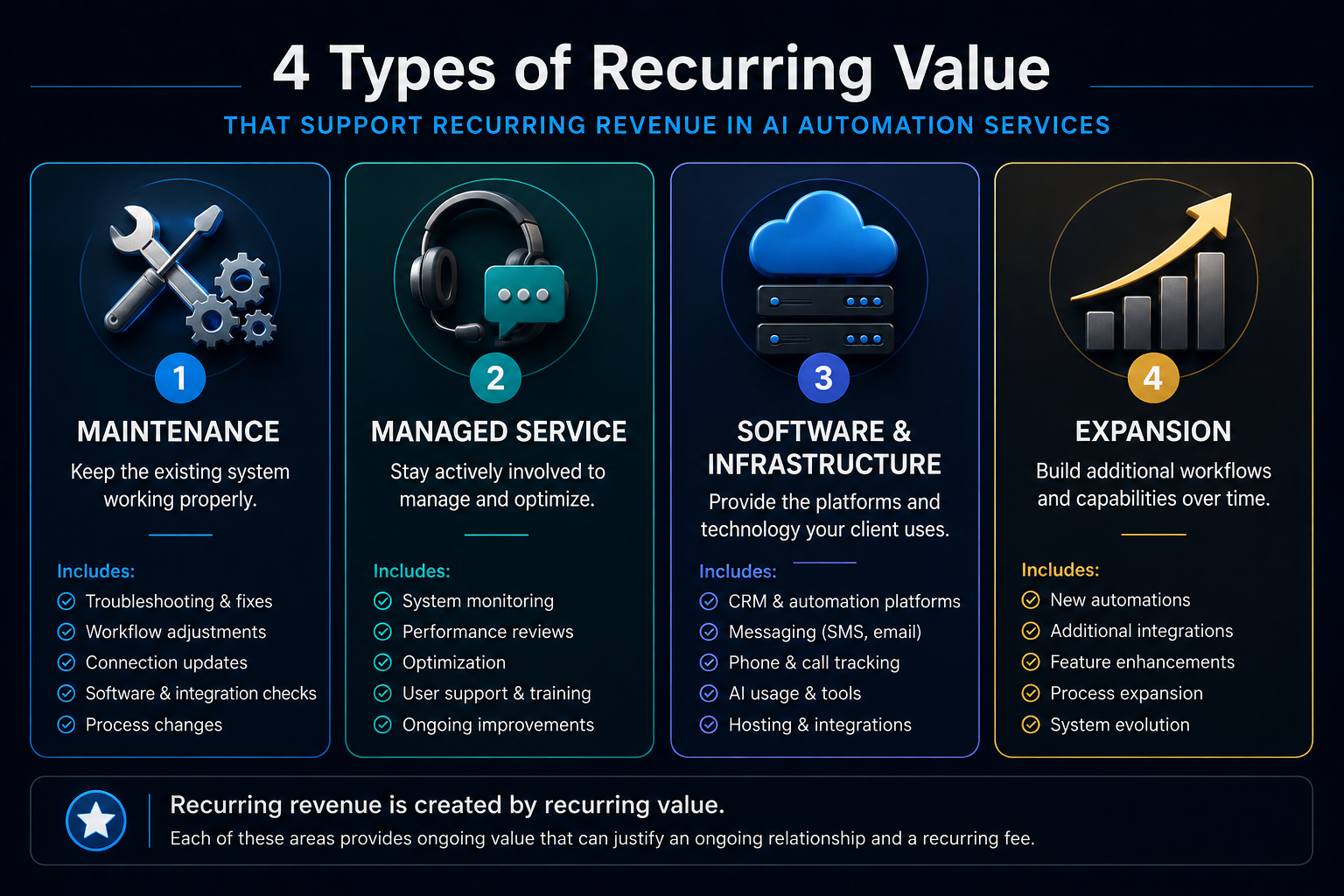
1. Maintenance: Keep the System Working
Maintenance is the most straightforward recurring service.
You built something.
Your job is to help keep it working.
An automation rarely exists completely by itself.
It may depend on:
- forms
- calendars
- CRM settings
- text messaging
- AI tools
- third-party applications
- website changes
- user permissions
- business processes
Things change.
Someone replaces a form.
The client changes calendars.
A staff member leaves.
A workflow needs an adjustment.
A connected application changes something.
The business decides to handle a process differently.
Maintenance gives the client somewhere to go when the system needs attention.
That might include:
- troubleshooting
- fixing broken connections
- making small configuration changes
- updating workflows when a process changes
- checking that important automations are still operating as expected
The exact scope matters.
"Maintenance included" shouldn't secretly mean:
Call me whenever you want and I'll rebuild anything forever.
We'll come back to that.
2. Managed Service: Stay Involved
A managed service goes beyond fixing something when it breaks.
You're continuing to play an active role in the system.
That might include:
- monitoring important workflows
- reviewing how the system is being used
- making agreed-upon improvements
- managing communication sequences
- updating automations
- supporting users
- adjusting processes as the business changes
- helping determine what should be automated next
Think of the difference this way:
Maintenance asks: Is it still working?
Managed service asks: Is it still working well for the business?
That's a bigger responsibility.
It can also justify a more substantial ongoing relationship because you're not merely waiting for something to break.
You're continuing to help manage the system.
3. Software and Infrastructure: Provide the Platform
Sometimes recurring value includes the actual technology the client uses — and choosing the tools that make recurring delivery sustainable is part of that picture.
That might involve:
- CRM access
- automation software
- phone capabilities
- text messaging
- email services
- calendars
- AI usage
- hosting
- client portals
- reporting tools
- other platform functionality
This is where the line between a service business and a software-enabled service can start to blur.
For example, a platform such as GoHighLevel can provide CRM, messaging, calendars, automation and other capabilities that an agency may use as part of an ongoing client system.
Affiliate disclosure: That is my GoHighLevel affiliate link. If you sign up through it, Boost Local Biz may earn a commission at no additional cost to you. I only include it here because the platform is directly relevant to this type of agency model.
But there's an important distinction:
Software access alone doesn't automatically make your service valuable.
The client still needs a reason to use the system.
That's why the strongest recurring offers often combine technology with implementation, support, management or expertise.
Otherwise you're just reselling another login.
4. Expansion: Keep Improving the System
The first automation you build for a business doesn't have to be the last.
In fact, successfully solving one problem often makes the next opportunity easier to see.
Maybe you start with:
Lead response and follow-up
Later the business wants:
Appointment reminders
Then:
Review requests
Then:
Customer reactivation
Then:
Internal notifications
Then:
AI-assisted customer conversations
This doesn't mean you should automate everything.
It means businesses change, and useful systems can evolve with them.
Expansion can be handled as:
- additional projects
- included development hours
- a larger managed-service plan
- separately scoped upgrades
You don't have to decide that every future improvement belongs inside one monthly fee.
Sometimes the cleanest approach is recurring support plus separately priced expansion work.
Maintenance vs. Managed Service vs. Software vs. Expansion
Here's the simple version:
| Type | What the client is paying for |
|---|---|
| Maintenance | Keeping the existing system working |
| Managed service | Ongoing involvement, monitoring, support and improvement |
| Software / infrastructure | Continued access to platforms and usage-based capabilities |
| Expansion | New workflows, features or automation capabilities |
These can be combined.
For example, one monthly service might include software access, basic maintenance and a defined amount of support.
Another might include active optimization and continued automation development.
The important thing is that you know what you're promising before the client starts paying for it.
How to Structure Setup + Recurring Revenue
There isn't one correct way to structure an AI automation offer.
The right model depends on what you're building and what happens after launch.
Here are several common approaches.
Model 1: Implementation Fee + Maintenance
The client pays an initial fee to build the system.
Then they pay a smaller recurring fee for defined maintenance and support.
This can work well when the automation is relatively stable but still needs someone responsible for keeping it operational.
Model 2: Implementation Fee + Managed Service
The initial fee covers strategy, setup, configuration and launch.
The recurring fee covers your continued involvement.
That might include monitoring, optimization, support and agreed-upon changes.
This is appropriate when you're continuing to actively manage part of the client's process.
Model 3: Implementation Fee + Software + Support
The client pays for implementation and then continues paying for access to the platform and your support around it.
This can work when the technology itself is part of what you're providing.
The mistake would be thinking:
"I gave them software, so now I deserve recurring revenue."
No.
The software and service still need to solve something worth paying for.
Model 4: Ongoing Automation Partnership
Some client relationships won't fit neatly into one automation.
You're continuously helping the business identify, build and improve systems.
That could involve multiple workflows over time.
This is closer to an ongoing automation consultant or managed automation partner than a one-time builder.
It can be a strong model.
It can also become a nightmare if the scope is:
"Just automate whatever we ask for."
Define the boundaries.
What Should an AI Automation Retainer Include?
A retainer should answer a very basic question:
What does the client get every month?
Possible inclusions might be:
- monitoring of defined workflows
- troubleshooting
- a specified level of support
- minor workflow adjustments
- software access
- agreed-upon usage allowances
- reporting or review meetings
- optimization
- a certain amount of development time
- priority support
You don't need all of those.
You need a scope that matches the service you're actually providing.
If you're still working through the broader offer, our guide to packaging AI automation services explains why the package should start with the problem and outcome rather than a pile of technical features.
What Should NOT Be Included?
Here's where recurring revenue can go sideways fast.
Be very careful with words like:
Unlimited
Unlimited support.
Unlimited changes.
Unlimited workflows.
Unlimited revisions.
Unlimited integrations.
Sounds generous.
Until one client discovers they're apparently entitled to your entire Tuesday.
Set boundaries.
Define what counts as maintenance.
Define what counts as a new build.
Define response expectations.
Define what's included.
Define what costs extra.
If your monthly service includes a certain amount of improvement work, say what that means.
If major new automations require separate scoping, say that too.
Good boundaries aren't anti-customer.
They help both sides understand the relationship.
Documenting those boundaries before approval is exactly what a clear AI automation proposal is for.
Recurring Revenue Isn't Passive Revenue
This deserves its own section because the two ideas get confused constantly.
Recurring revenue means the client pays you repeatedly.
Passive revenue implies you don't have to do much to continue earning it.
Those are not the same thing.
If you're responsible for:
- software
- support
- workflows
- customer communication
- AI systems
- troubleshooting
- ongoing improvements
then you have an ongoing job.
That's not bad.
It's actually part of what makes the revenue defensible.
But don't build a recurring service and then act surprised when clients expect recurring service.
How We Think About Recurring Value at Boost Local Biz
At Boost Local Biz, we don't think of automation as simply building a workflow, handing someone a diagram and disappearing.
The types of systems we build can connect:
- an AI-powered website
- CRM
- chatbot
- lead communication
- automated follow-up
- calendars
- reputation management
- automation
- ongoing software capabilities
The website is one part of the system.
What happens when someone contacts the business is another.
What happens after that conversation starts is another.
Those systems continue being used after the initial implementation.
That can create a legitimate ongoing relationship involving software, support, management, monitoring, adjustments and future improvements.
It doesn't mean every client needs the exact same package.
And it doesn't mean every piece of work should have a monthly fee attached to it.
The principle is simpler:
If we're going to charge repeatedly, we should continue providing something worth paying for.
That's the standard.
A Simple Example
Imagine you build a lead-response system for a service business.
The initial implementation includes:
- connecting the website form
- organizing the lead in the CRM
- sending an immediate acknowledgment
- creating follow-up
- connecting scheduling
- notifying the appropriate staff member
That's the project.
Now consider what could happen afterward.
The client continues using the CRM.
Messages continue being sent.
Appointments continue being scheduled.
Workflows need to remain operational.
The client may need support.
The follow-up sequence may need adjustments.
New staff members may need access.
The business may want additional automations.
Now there are legitimate ongoing responsibilities.
That's where recurring value comes from.
Not from putting "monthly management" on an invoice and hoping nobody asks what it means.
How Much Should You Charge Monthly?
There isn't one useful universal number.
The monthly fee should reflect things such as:
- what you're responsible for
- how much support is included
- how critical the system is
- how much active management is required
- your software and usage costs
- how much ongoing work is expected
- the complexity of the system
- the value of the service to the client
A small maintenance agreement and a fully managed automation system are not the same service.
They shouldn't automatically have the same price.
If you want to go deeper on this, we've already covered how to price AI automation services.
The important point here is:
Price the recurring responsibility, not just your desire for MRR.
Watch Your Usage Costs
Some automation systems have ongoing costs that can change with usage.
Depending on your stack, those might include:
- text messages
- phone calls
- emails
- AI usage
- workflow executions
- contact volume
- software subscriptions
- third-party services
Understand those costs before promising an all-inclusive monthly price.
If one client suddenly uses ten times more of something, you don't want to discover that your "high-margin recurring revenue" is quietly eating itself.
Your pricing structure might include:
- reasonable usage allowances
- pass-through costs
- usage tiers
- overage charges
- separately billed services
The exact model depends on what you're providing.
Just don't ignore the math.
When You Should NOT Charge Monthly
This may be the most important section in the article.
You do not need to force recurring revenue onto every automation project.
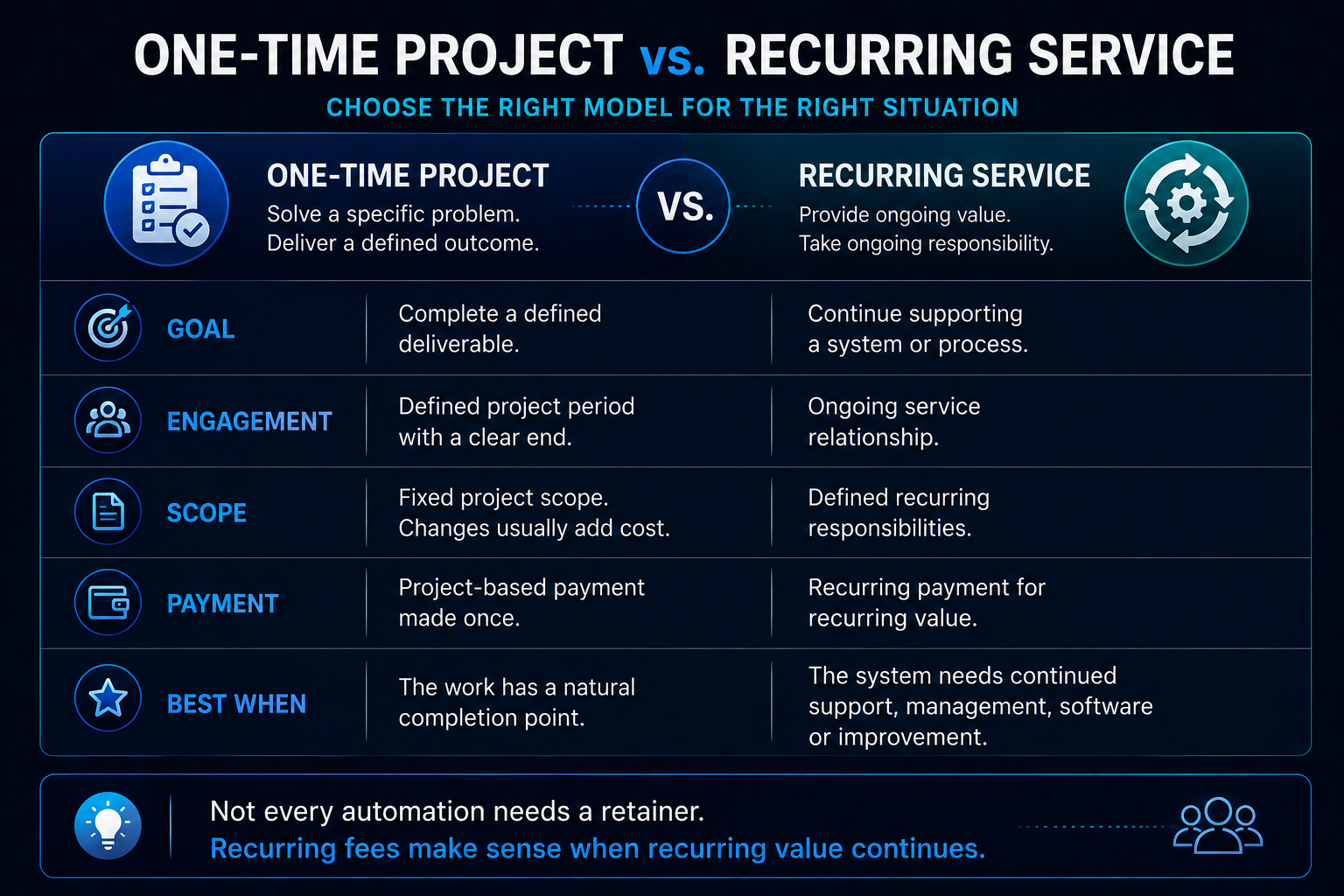
A one-time project may make more sense when:
- the automation is simple and stable
- the client owns and manages the software
- there are no meaningful ongoing costs
- the client has internal technical support
- you've transferred ownership
- no monitoring is required
- no continued optimization is expected
- you have no ongoing responsibility
In that situation, charge appropriately for the project.
You can still offer optional support.
You can still come back later for expansion work.
You don't need to manufacture a subscription.
Recurring revenue is great.
Recurring revenue without recurring value is just a client wondering why they're still getting an invoice.
Recurring Revenue Changes the Agency Model
There are obvious advantages to recurring revenue.
You aren't starting every month at zero.
You can develop deeper client relationships.
You learn more about how the client's business operates.
Successful systems can lead naturally to additional work.
Revenue can become more predictable.
But the other side matters too.
More recurring clients can mean:
- more systems to monitor
- more support requests
- more software to manage
- more potential points of failure
- more client expectations
- more responsibility
Eventually, you need systems for your own business too.
Client onboarding.
Support.
Documentation.
Billing.
Monitoring.
Communication.
That's one reason our guide to AI automation client onboarding matters more as your recurring client base grows.
You don't want to automate everyone else's business while running yours from sticky notes.
Start Small and Earn the Recurring Relationship
If you're just starting an AI automation agency, you don't need an elaborate six-tier subscription menu.
Solve one real problem.
Deliver the system well.
Make the ongoing responsibilities clear.
Then determine whether a recurring relationship makes sense.
Maybe your first recurring offer is simply:
Software + maintenance + support
That's enough.
You can add more sophisticated managed services as your skills, systems and client needs grow.
The goal isn't to create the biggest monthly package possible.
The goal is to create a service the client continues wanting because it continues helping.
Recurring Revenue Is Earned Every Month
That's probably the healthiest way to think about it.
The contract may say the client pays monthly.
But the relationship still has to make sense monthly.
Keep the system useful.
Support what you promised.
Communicate.
Fix problems.
Improve things when appropriate.
Don't disappear after the setup fee clears.
If you do those things well, recurring revenue becomes more than a billing strategy.
It becomes the financial result of an ongoing business relationship.
And that's much harder to copy than simply offering "AI automation."
Want to Build an AI Automation Business Around Recurring Value?
Recurring revenue is only one part of the model.
You still need to decide what you're selling, choose a market, package the service, price it, get clients, sell the solution, onboard them and actually deliver the automation.
That's exactly why I created the 48-Hour AI Cashflow Stack.
It's designed to help you put those pieces together around a legitimate AI-powered service business rather than chasing random tools or imaginary passive income.
If that's what you're building, download the 48-Hour AI Cashflow Stack and use it as your next step.