
Most businesses understand that they need leads.
What gets considerably less attention is what happens after they get one.
A homeowner submits a form.
Someone calls.
A prospect sends a message.
The phone rings while everybody is busy.
Then what?
For some businesses, there's a clear process.
For others, the process is basically:
Hopefully somebody sees it and remembers to follow up.
That's where a lead conversion system comes in.
A lead conversion system is the combination of processes, software, communication and automation a business uses to move an inquiry toward a real sales opportunity or customer.
Depending on the business, that can include lead capture, immediate acknowledgment, CRM organization, follow-up, conversations, qualification, scheduling, reminders and human sales activity.
The important word there is system.
Getting the lead is only the beginning.
Lead Generation and Lead Conversion Are Different Jobs
These terms get mixed together constantly.
They shouldn't.
Here's a simple way to think about it:
Marketing creates attention.
Lead generation creates opportunities.
Lead conversion moves those opportunities forward.
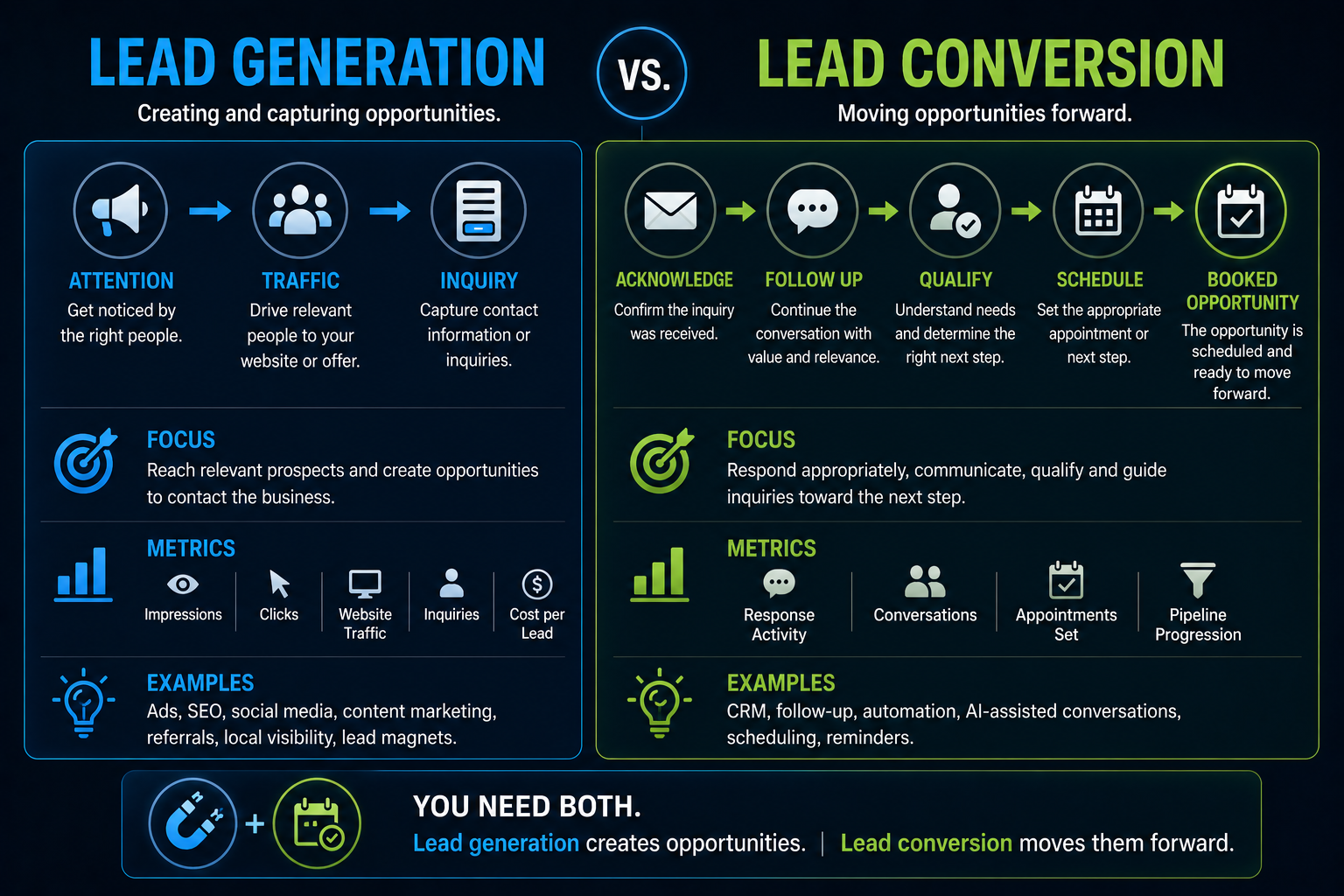
There's obviously overlap between them, but they aren't interchangeable.
Suppose someone finds your business through Google, visits your website and submits a request for an estimate.
Your marketing helped attract them.
Your website captured the lead.
Now another process begins.
Who responds?
How quickly?
Where is the lead stored?
What happens if they don't answer?
Who follows up?
Can they schedule?
Does anyone know whether the lead is still active?
Those are lead-conversion questions.
This distinction matters because throwing more money at lead generation doesn't automatically fix what happens after those leads arrive.
That's the larger point behind why getting more leads isn't always the answer.
Sometimes the top of the funnel isn't the biggest problem.
Sometimes it's everything underneath it.
What Does a Lead Conversion System Actually Do?
A lead conversion system creates a defined path for handling an opportunity after someone expresses interest in the business.
That path will vary.
A roofing company doesn't necessarily need the same process as an orthodontist.
A high-ticket contractor may require several conversations before an appointment makes sense.
Another service business may allow qualified prospects to schedule immediately.
The point isn't to force every company into the same workflow.
The point is to stop relying entirely on chance, memory and disconnected tools.
A useful lead conversion system answers questions such as:
- Where do new inquiries go?
- How are they acknowledged?
- Who is responsible for responding?
- What happens when the first contact attempt fails?
- Where are conversations tracked?
- When should automation continue?
- When should a person take over?
- How does a prospect reach the next appropriate step?
- How does the business know which opportunities are still active?
That's the infrastructure behind conversion.
The Lead Conversion Lifecycle
A simple service-business lead journey might look something like this:
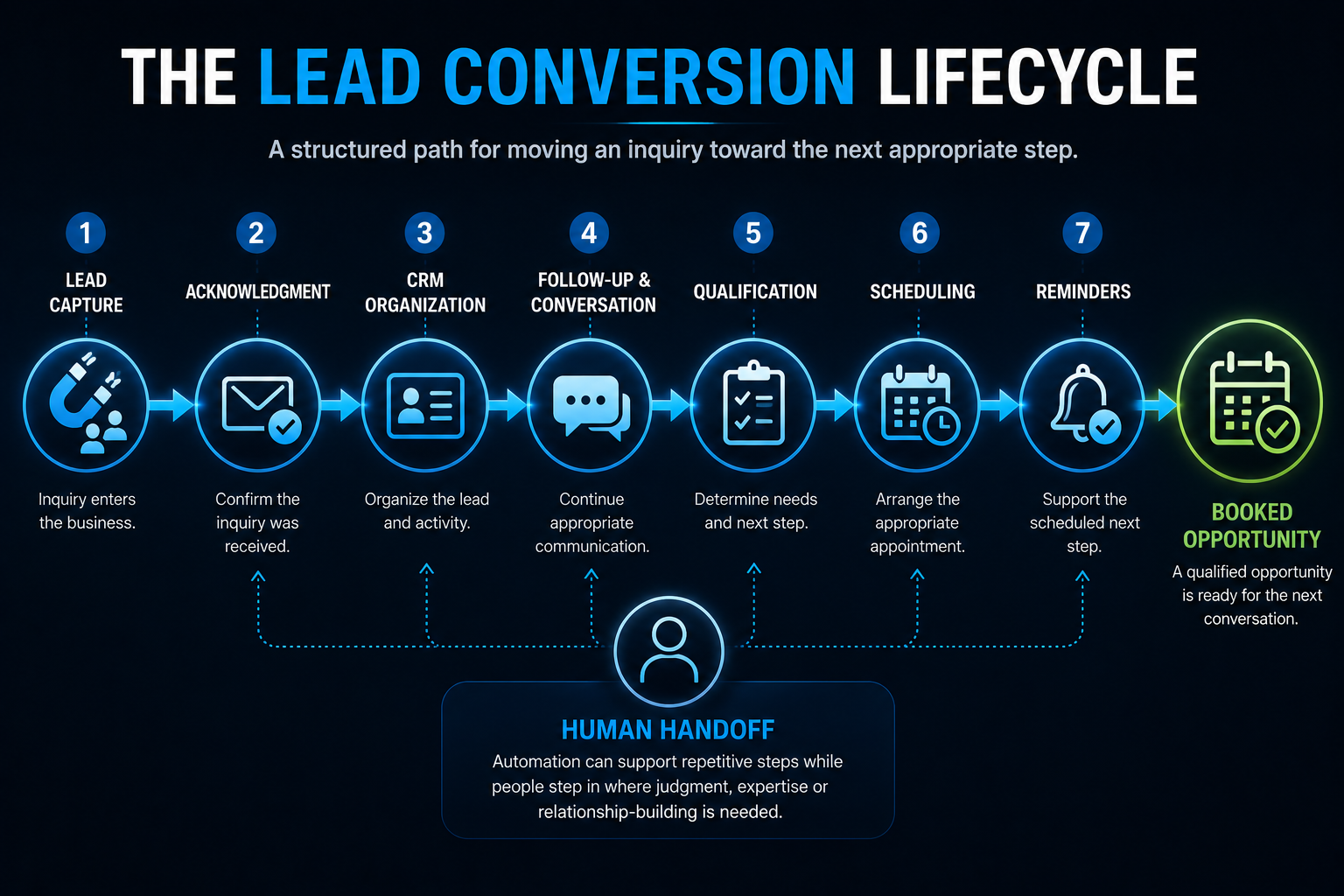
Visitor → Inquiry → Response → Conversation → Qualification → Appointment → Sales Opportunity → Customer
Not every lead will follow that exact path.
Some businesses don't need formal qualification.
Some don't use appointments.
Some prospects call and immediately speak with someone.
Others may move back and forth between stages.
The value of mapping the lifecycle isn't to create a perfect diagram.
It's to identify what should happen next.
Because one of the easiest ways to lose an opportunity is for nobody — and no system — to know what the next step is.
1. Lead Capture
First, the business needs a reliable way to capture the inquiry.
That could happen through:
- a website form
- a phone call
- web chat
- text messaging
- social messaging
- an advertisement
- another lead source
The exact channel matters less than what happens to the information afterward.
If leads arrive through five different places and nobody has a consistent way to organize them, the conversion process becomes harder before it even starts.
This is one reason an AI-powered website should do more than simply display information.
The website can be one of the entry points into the broader conversion system.
2. Immediate Acknowledgment
When someone contacts a business, they should generally know that their inquiry was received.
That's different from saying:
Every lead must instantly receive a complete AI sales conversation.
Sometimes a simple acknowledgment is enough to start.
For example:
Thanks for reaching out. We received your request and someone from our team will follow up.
Depending on the business and the situation, the system might also ask an appropriate question, provide scheduling options or continue the conversation.
The important distinction is:
Acknowledgment confirms receipt. Conversion still requires a process.
An automatic "Thanks, we'll be in touch" message followed by silence isn't much of a conversion system.
3. CRM Organization
Once the inquiry exists, the business needs somewhere to keep track of it.
That's one of the basic jobs of a CRM.
At minimum, the business may want to know:
- who the person is
- how to contact them
- where the inquiry came from
- what they're interested in
- whether anyone has responded
- what stage they're in
- what should happen next
A CRM isn't valuable just because the word CRM appears on a software invoice.
It's valuable when the team actually uses it to create visibility and consistency.
Otherwise you've just replaced one messy inbox with a more expensive messy inbox.
4. Follow-Up
A single contact attempt doesn't always create a conversation.
People are working.
Driving.
Putting their kids to bed.
Ignoring unknown numbers.
Planning to call back and forgetting.
A lead conversion system should define what happens when the first attempt doesn't work — or when an estimate has been sent and a decision is still pending. We cover the general follow-up process in detail separately, and the specifics of how to follow up after sending an estimate deserve their own attention.
That might include an appropriate combination of:
- text
- phone calls
- automated follow-up
- human follow-up
- reminders for staff
The goal isn't to harass someone until they surrender.
It's to create a reasonable follow-up process instead of abandoning an opportunity after one attempt.
5. Conversation and Qualification
Eventually, the business needs to understand what the prospect actually wants.
This is where conversations matter.
Depending on the business, that could mean determining:
- the service needed
- location
- timing
- project type
- basic requirements
- whether an appointment makes sense
- who on the team should handle the opportunity
Automation or AI can sometimes help gather straightforward information.
That doesn't mean AI should make every decision.
Complex questions, unusual situations, high-value conversations and anything requiring professional judgment may be better handled by a person.
The goal isn't maximum automation.
It's an effective process.
6. Scheduling
For many service businesses, the next meaningful conversion isn't the sale.
It's the appointment.
A consultation.
Estimate.
Site visit.
Discovery call.
Inspection.
Whatever the appropriate next step happens to be.
Once a prospect is ready, the process should make that step reasonably easy.
That could mean providing scheduling options directly or having a staff member coordinate the appointment.
Either way, scheduling shouldn't become another place where the opportunity gets unnecessarily stuck.
7. Reminders
Booking the appointment doesn't mean the process is finished.
People forget.
Schedules change.
Details get lost.
A conversion system can support the next step with reminders and useful appointment information.
Again, automation doesn't replace the business.
It supports the process.
8. Human Handoff
This might be one of the most important parts of the entire system.
Good automation should know when it needs a human.
AI and automation can be useful for:
- acknowledging inquiries
- collecting basic information
- organizing contacts
- sending follow-up
- providing scheduling options
- triggering notifications
- handling straightforward conversations
Humans are still extremely valuable for:
- judgment
- complex questions
- relationship building
- unusual circumstances
- negotiation
- expertise
- closing many types of sales
The goal isn't:
Automate everything.
It's:
Automate what should happen automatically so people can focus on the parts where people matter most.
9. Pipeline Visibility
Finally, the business should be able to see what's happening.
Which opportunities are new?
Which ones have been contacted?
Which ones are in conversation?
Which appointments are scheduled?
Which prospects need attention?
Which opportunities have gone quiet?
Without visibility, owners often end up trying to reconstruct the sales pipeline from emails, text threads, call logs and memory.
That's not a system.
That's detective work.
A Simple Example: What Happens After an Evening Website Lead?
Let's use a hypothetical service business.
A homeowner submits an estimate request through the company's website at 7:42 PM.
Without a defined conversion system
Form submitted.
↓
An email notification arrives.
↓
Nobody is working at that moment.
↓
Someone notices it the following day.
↓
They call the homeowner.
↓
No answer.
↓
Someone intends to try again later.
↓
The day gets busy.
↓
The opportunity may quietly disappear.
Nothing necessarily went catastrophically wrong.
That's the problem.
There wasn't one giant failure.
There was simply no reliable process carrying the opportunity forward.
With a more structured conversion system
Form submitted.
↓
The lead is organized in the CRM.
↓
The homeowner receives an immediate acknowledgment.
↓
An appropriate conversation or follow-up process begins.
↓
Scheduling can be offered when it makes sense.
↓
A staff member is notified or takes over when human attention is needed.
↓
If an appointment is scheduled, reminders support the next step.
Does that guarantee the homeowner becomes a customer?
Of course not.
Maybe they're shopping around.
Maybe the project isn't a fit.
Maybe the price doesn't work.
Maybe they change their mind.
The system doesn't guarantee the sale.
It gives the opportunity a defined path forward.
That's the difference.
Automation Is Part of the System, Not the Entire System
This matters especially now that practically everything gets labeled "AI."
A lead conversion system isn't automatically an AI system.
And adding AI doesn't automatically make it better.
Some steps may only need conventional automation.
For example:
Form submitted → create CRM contact → send acknowledgment → notify employee
There's no reason to cram AI into that sequence just so you can put "AI-powered" on a slide.
Other situations may benefit from AI.
A conversational assistant might answer common questions, collect information or help determine the appropriate next step.
The right question isn't:
Where can we add AI?
It's:
What should happen here, and what's the best way to make that happen?
Sometimes that's AI.
Sometimes it's automation.
Sometimes it's a human being picking up the phone.
Where Businesses Commonly Lose Leads
Lead leakage usually isn't one dramatic event.
It's often a collection of small gaps.
For example:
Slow response
The inquiry arrives while the team is busy. When the inquiry is a phone call nobody can answer, missed-call text back can help reopen the conversation — and seeing a few missed-call text back examples makes it easier to picture what that reply should actually say.
No follow-up process
One call is made and nobody answers.
Disconnected channels
Calls are in one place, forms somewhere else and social messages somewhere else.
No clear ownership
Everyone assumes someone else handled it. A lead routing process makes responsibility explicit.
No pipeline visibility
Nobody knows which opportunities still need attention.
Scheduling friction
The prospect is interested, but getting the next step arranged takes unnecessary back-and-forth.
Poor handoffs
Automation starts the conversation but doesn't smoothly transfer it to the right person.
Any one of those might seem minor.
Stack several together and you don't necessarily have a lead-generation problem.
You may have a conversion-process problem.
Lead Conversion System vs. CRM
A CRM can be an important part of a lead conversion system.
But they're not the same thing.
A CRM is a tool for organizing and managing customer and prospect information and activity.
A lead conversion system is the broader process that determines how an opportunity moves forward.
The CRM may support that process.
So might:
- the website
- phone system
- text messaging
- automation
- AI
- calendars
- salespeople
- operating procedures
Buying a CRM doesn't automatically create a conversion system any more than buying a treadmill automatically creates a fitness routine.
You still have to use it properly.
Lead Conversion System vs. Marketing Automation
There's overlap here too.
Marketing automation can help automate communications, campaigns, nurturing and other marketing activities.
A lead conversion system is more specifically concerned with what happens to an opportunity once it enters the business and how that opportunity progresses toward the appropriate next step.
Depending on the business, marketing automation may be one component of that system.
Again, the terminology matters less than the process.
What happens to the lead?
That's the question.
What a Lead Conversion System Cannot Fix
This is where we need to keep expectations grounded.
A lead conversion system can improve how a business handles opportunities.
It cannot make every opportunity good.
It cannot permanently compensate for:
- terrible lead quality
- weak demand
- an offer the market doesn't want
- pricing customers won't accept
- poor sales conversations
- bad customer service
- serious reputation problems
- a product or service that doesn't deliver
If the leads are garbage, responding to them faster gives you faster conversations with garbage leads.
Congratulations, I guess.
Likewise, automation can't save a business that handles the actual customer interaction badly.
Lead conversion infrastructure supports the sales process.
It doesn't replace the fundamentals of running a good business.
Do You Need More Leads or Better Lead Conversion?
Sometimes the answer genuinely is:
More leads.
If the business has a strong conversion process but simply isn't creating enough opportunities, lead generation deserves attention.
But if the business is already generating inquiries and can't clearly answer:
- how quickly they're handled
- what happens after the first attempt
- where they're tracked
- who owns the next step
- how follow-up works
- how appointments get scheduled
I'd investigate that before automatically increasing the marketing budget.
This isn't an either/or argument.
A healthy business eventually needs both:
A reliable way to create opportunities.
and
A reliable way to handle them.
Driving more traffic into a broken process just gives the broken process more work.
How Boost Local Biz Approaches Lead Conversion
This philosophy is a big part of why we built the Booked Calendar System™.
It's not simply a CRM.
It's not just an AI chatbot.
And it's not another lead-generation service disguised as automation.
The Booked Calendar System™ is designed to connect the pieces involved in moving an inquiry forward:
lead capture → response → follow-up → conversation → CRM organization → scheduling
Depending on the business, that can include automation, AI-assisted conversations, text and email communication, calendars, reminders, pipeline management and human handoff.
The exact configuration should depend on how the business actually sells.
The objective isn't to remove people from the process.
It's to make sure opportunities don't depend entirely on somebody noticing an email, remembering to call again or manually piecing together what happened.
That's the larger system connecting marketing activity to actual business opportunities.
Your Website Should Connect to the Conversion Process
This is also why we don't think a business website should exist as an isolated digital brochure.
A prospect visits.
They become interested.
They contact you.
The website did its job, right?
Partly.
Now the business has to do something with that interest.
An effective website can connect directly into the systems responsible for:
- capturing the inquiry
- organizing the contact
- acknowledging the prospect
- beginning appropriate follow-up
- notifying staff
- starting conversations
- scheduling the next step
That's the difference between thinking only about the website and thinking about what happens after a website lead comes in.
The website is an entry point.
The conversion system carries the opportunity forward.
How to Evaluate Your Current Lead Conversion Process
You don't need to rebuild your entire technology stack tomorrow.
Start by mapping what actually happens today.
Take your most common lead source and follow it from beginning to end.
Ask:
- Where does the inquiry originate?
- Where does the information go?
- How quickly is it acknowledged?
- Who responds?
- What happens if the prospect doesn't answer?
- Where is the conversation tracked?
- How does the prospect reach the next step?
- When does a human need to take over?
- How do you know when an opportunity needs attention?
- What happens when the lead goes quiet?
You'll probably find some parts that work perfectly well.
Keep them.
Then look for the gaps where opportunities depend on memory, manual work or luck.
Those are the places worth improving first.
A Better System Doesn't Have to Be More Complicated
This is worth emphasizing.
The goal isn't to build the most technologically impressive lead-conversion machine possible.
Complexity isn't the prize.
Reliability is.
If a simple workflow consistently gets the right information to the right person at the right time, that's better than twelve AI agents having a committee meeting in the background.
Start with the process.
Use technology where it makes the process better.
Keep people involved where people make the process better.
That's usually the smarter way to build.
The Lead Isn't the Finish Line
Businesses spend a lot of time thinking about how to get someone to call, click, submit or message.
Understandably.
Without opportunities, there's nothing to convert.
But the form submission isn't the finish line.
It's a handoff.
Marketing created interest.
Lead generation captured the opportunity.
Now the conversion system has to carry it forward.
That's why the question isn't only:
How many leads are we getting?
It's also:
What happens to them after we get them?
A business that can answer that clearly has something much more valuable than another disconnected marketing tactic.
It has a process.
Want to Improve What Happens After the Lead Comes In?
If your business is already generating calls, forms or inquiries but the process after that feels inconsistent, Booked Calendar System™ is designed to help connect those pieces.
Boost Local Biz can help you evaluate how leads currently enter your business, how they're responded to, how follow-up works, where opportunities are tracked and how prospects reach the next appropriate step.
The goal isn't automation for automation's sake.
It's a better path from inquiry to conversation to booked opportunity.
Explore the Booked Calendar System™ and see where your current lead-conversion process may be breaking down.