You met with the customer.
Looked at the job.
Answered questions.
Put together the estimate.
Sent it.
And then...
Nothing.
Now comes the awkward part.
Do you follow up tomorrow? Wait three days? Call? Text? Send another email? Leave them alone because you don't want to seem desperate?
For a lot of service businesses, this is where perfectly good opportunities quietly disappear.
Not necessarily because the customer said no.
They simply haven't said yes.
A good estimate follow-up process helps the customer reach the next step without turning every message into pressure.
That means following up with a reason, paying attention to what the customer tells you, and knowing when to keep going, when to wait, and when to close the loop.
How Should You Follow Up After Sending an Estimate?
The short answer:
Give the customer reasonable time to review the estimate, then follow up with a short, useful message that makes responding easy.
Don't immediately assume silence means rejection.
The customer might be:
- comparing estimates
- reviewing the scope
- talking with a spouse, partner, manager, or property owner
- figuring out timing
- thinking about the budget
- waiting for additional information
- busy with something completely unrelated to your project
Of course, they may also have decided not to move forward.
You don't know yet.
That's the point of following up.
The objective isn't to pressure them into saying yes. It's to figure out what the appropriate next step is.
When Should You Follow Up After Sending an Estimate?
There isn't a universal perfect schedule.
A small repair someone wants completed this week is different from a major remodel someone may spend weeks evaluating.
A commercial proposal can have a different decision process from a residential landscaping estimate.
A customer who tells you, "We're making a decision Friday," has already given you better information than any generic follow-up template can.
Your timing can depend on:
- project size
- urgency
- how the estimate was presented
- what the customer said during the conversation
- whether other decision-makers are involved
- the customer's preferred communication channel
- the expected buying timeline
- whether you established a next step before leaving
For many service businesses, an initial follow-up after the customer has had a reasonable opportunity to review the estimate is a sensible starting point.
After that, space additional follow-ups according to the situation rather than blindly firing messages because a timer expired.
Our broader guide to how many times you should follow up with a lead explains why there isn't one magic number for every opportunity.
Better Yet: Establish the Follow-Up Before You Leave
One of the easiest ways to make a future follow-up feel less awkward is to make it expected.
For example:
"I'll send the estimate over this afternoon. Take some time to look through it, and I'll check back with you Thursday in case you have any questions."
Now Thursday's message isn't a random sales nudge.
It's the next step you already discussed.
That small habit can make the entire process feel more organized.
"Just Checking In" Isn't a Follow-Up Strategy
There's nothing inherently wrong with saying you're checking in.
The problem is when that's all you have to say.
Imagine receiving this three times:
Just checking in to see if you've made a decision.
Then:
Just following up again.
Then:
Wanted to touch base one more time.
The customer hasn't learned anything.
You haven't learned anything.
You're basically knocking on the same digital door repeatedly.
A better question is:
What job is this follow-up supposed to do?
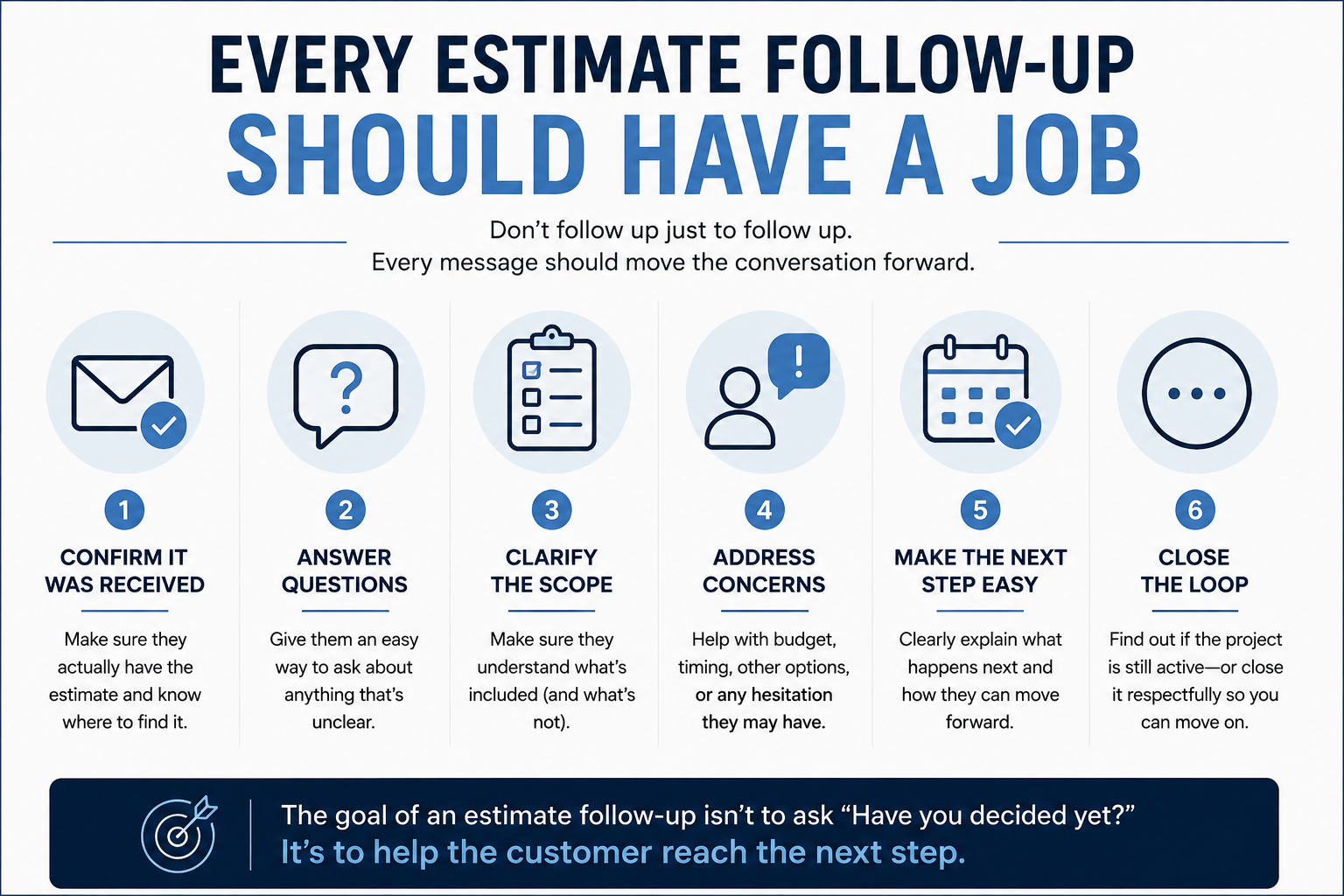
Every Estimate Follow-Up Should Have a Job
This principle applies to automated lead follow-up generally, but it's especially useful after an estimate has been sent.
A follow-up might exist to:
Confirm the Estimate Was Received
Email goes to spam.
Attachments get overlooked.
People forget where something was sent.
Sometimes the first useful follow-up is simply making sure the customer actually has what they need.
Answer Questions
The customer may not understand part of the scope, material choice, timeline, warranty, payment structure, or another detail.
Give them an easy opportunity to ask.
Clarify the Scope
Sometimes two estimates appear dramatically different because they aren't quoting the same work.
If something may be unclear, explaining what's included can be more useful than defending the price.
Address a Concern
Maybe budget is the issue.
Maybe timing is.
Maybe another decision-maker needs information.
Maybe the customer isn't sure which option fits.
You can't address every possible concern in advance, but you can make it easy for them to tell you what's holding things up.
Make the Next Step Easier
If they're ready, what happens?
Do they approve the estimate?
Pay a deposit?
Schedule the project?
Sign something?
Call the office?
Reply YES?
A customer shouldn't need a treasure map to figure out how to hire you.
Close the Loop
Sometimes the appropriate next action is simply finding out whether the opportunity is still active.
That is useful information too.
A Practical Estimate Follow-Up Sequence
Instead of treating this as a rigid Day 1 / Day 3 / Day 7 formula, think of it as a progression.
1. Deliver the Estimate Clearly
The follow-up process actually starts when you send the estimate.
Make sure the customer understands:
- what they're receiving
- what is included
- anything important they should review
- how to ask questions
- what happens if they want to proceed
If appropriate, tell them when you'll follow up.
2. Confirm and Open the Conversation
After they've had a reasonable chance to receive and review it, your first follow-up can simply reopen the conversation.
For example:
Hi Sarah, this is Mike from ABC Landscaping. I wanted to make sure you received the estimate for the backyard project. If anything in the scope or pricing needs clarification, I'm happy to walk through it with you.
Notice what isn't there:
"Are you ready to buy?"
You're giving them somewhere easy to take the conversation.
3. Follow Up Around the Actual Decision
If there is still no response, the next message should ideally add context.
Maybe there is a legitimate scheduling consideration.
Maybe there's a common question worth answering.
Maybe you need to determine whether the project is still active.
For example:
Hi Sarah, following up on the backyard estimate. You mentioned you were hoping to have the project completed before your family visits in October. Is that still the timeline you're working toward?
Now the message is connected to something the customer actually told you.
That's much better than:
Just following up again!!!
Exclamation points are not a conversion strategy.
4. Close the Loop
Eventually, continuing to send the same type of follow-up stops being useful.
A final message can respectfully give the customer an easy way to tell you where things stand.
For example:
Hi Sarah, I don't want to keep filling up your inbox, so I'll close the loop on the backyard estimate for now. If you'd still like to move forward or have any questions, just reply here and we'll be happy to pick it back up.
You're not burning the bridge.
You're simply ending active follow-up.
Estimate Follow-Up Text Message Examples
Text works well when it matches how the customer has been communicating with your business and your messaging practices are appropriate for the situation.
The best text usually isn't the cleverest one. It's the one that's short, specific, and easy to answer.
Simple Receipt Check
Hi [Name], this is [Your Name] from [Company]. Just making sure the estimate for [project] came through. Happy to answer any questions when you've had a chance to review it.
Scope Question
Hi [Name], following up on the estimate for [project]. If anything in the scope isn't clear, I'm happy to walk through what's included.
Timing Follow-Up
Hi [Name], you mentioned wanting to complete [project] around [timeframe]. Is that still what you're aiming for?
Real Scheduling Availability
If you genuinely have relevant availability:
Hi [Name], quick update on [project]: we currently have an opening around [date/timeframe]. If you're still considering the estimate, I wanted to make sure you had the current scheduling information.
The word genuinely matters.
Don't invent a disappearing appointment slot because somebody on YouTube told you scarcity closes deals.
Easy Decision Check
Hi [Name], checking back on the [project] estimate. Are you still considering the project, or would it make more sense for me to close this out for now?
That gives them more than one socially comfortable answer. Sometimes getting a clear "not right now" is better than another month of guessing.
Estimate Follow-Up Email Examples
Email gives you more room when the project is complex or additional context would actually help.
Simple Estimate Follow-Up Email
Subject: Your estimate for [project]
Hi [Name],
I wanted to follow up on the estimate for [project] and make sure you received everything.
If you have any questions about the scope, pricing, timing, or next steps, just reply here. I'm happy to go through it with you.
Thanks,
[Name]
[Company]
Follow-Up When the Project Has Multiple Options
Subject: Questions about the [project] estimate?
Hi [Name],
I wanted to check back on the estimate we sent for [project].
Since we discussed a couple of different options, I wanted to make sure the differences were clear. If it would help, I can walk through the options with you and explain what changes between them.
No pressure either way. Just let me know what would be useful.
Thanks,
[Name]
Close-the-Loop Email
Subject: Closing the loop on your [project] estimate
Hi [Name],
I wanted to reach out one last time about the estimate for [project].
I know plans and timing can change, so I'll close this out on our side for now rather than continuing to follow up.
If the project is still on your radar later, just reply to this email and we'll be happy to pick the conversation back up.
Thanks again for considering us.
[Name]
[Company]
What If You Think Price Is the Problem?
Don't immediately discount.
Silence doesn't tell you why someone hasn't moved forward.
Instead, create an opening for the conversation.
You might say:
If the overall budget is affecting the decision, I'm happy to talk through the scope and see whether there are legitimate options worth considering.
That's very different from:
How about 10% off if you sign today?
There may be legitimate ways to adjust scope, phase work, select different options, or clarify why your estimate differs from another one.
There may also be no appropriate adjustment at all.
The objective is to understand the issue before trying to solve it.
What If Timing Is the Problem?
Timing is often easier to work with once the customer actually tells you.
Suppose they respond:
We definitely want to do it, but probably not until January.
Great.
You learned something.
The wrong automation says:
Awesome! Are you ready to schedule now?
The better response is to acknowledge what they said and adjust the process.
You might ask:
No problem. Would it be helpful if I checked back with you in early December?
If they agree, now you have a meaningful future follow-up date.
That's not a dead lead.
It's an opportunity with a different timeline.
What If They Need to Talk to Someone Else?
This happens constantly.
A spouse.
Business partner.
Property manager.
HOA.
Department head.
Building owner.
Instead of repeatedly asking whether they've decided, ask whether the other decision-maker needs anything.
For example:
Absolutely. If it helps, I can send a short summary of the scope and options that you can share with them, or I'm happy to answer any questions that come up.
Now you're helping the decision process instead of hovering over it.
When Should You Stop Following Up on an Estimate?
There isn't one universal stopping point either.
You should consider stopping or changing the follow-up when:
- the customer says no
- they choose another provider
- they ask you to stop contacting them
- they opt out of messages
- the project is no longer happening
- the estimate is no longer valid
- the opportunity clearly belongs in longer-term nurture
- repeated attempts aren't producing a response and continued contact is no longer appropriate
Stopping active follow-up doesn't necessarily mean deleting the contact.
It means changing the status of the opportunity appropriately.
That's an important distinction.
An Estimate Should Have a Status, Not Just a Sent Date
This is where follow-up becomes an operational system rather than a pile of messages.
After an estimate is sent, your business should ideally be able to answer:
Where does this opportunity stand?
Maybe it's:
Estimate sent.
Customer reviewing.
Follow-up due.
Waiting for decision-maker.
Revision requested.
Approved.
Lost.
Future follow-up.
The exact labels depend on your business.
The important part is that someone can look at the opportunity and understand what's happening.
That's one of the jobs of a CRM pipeline.
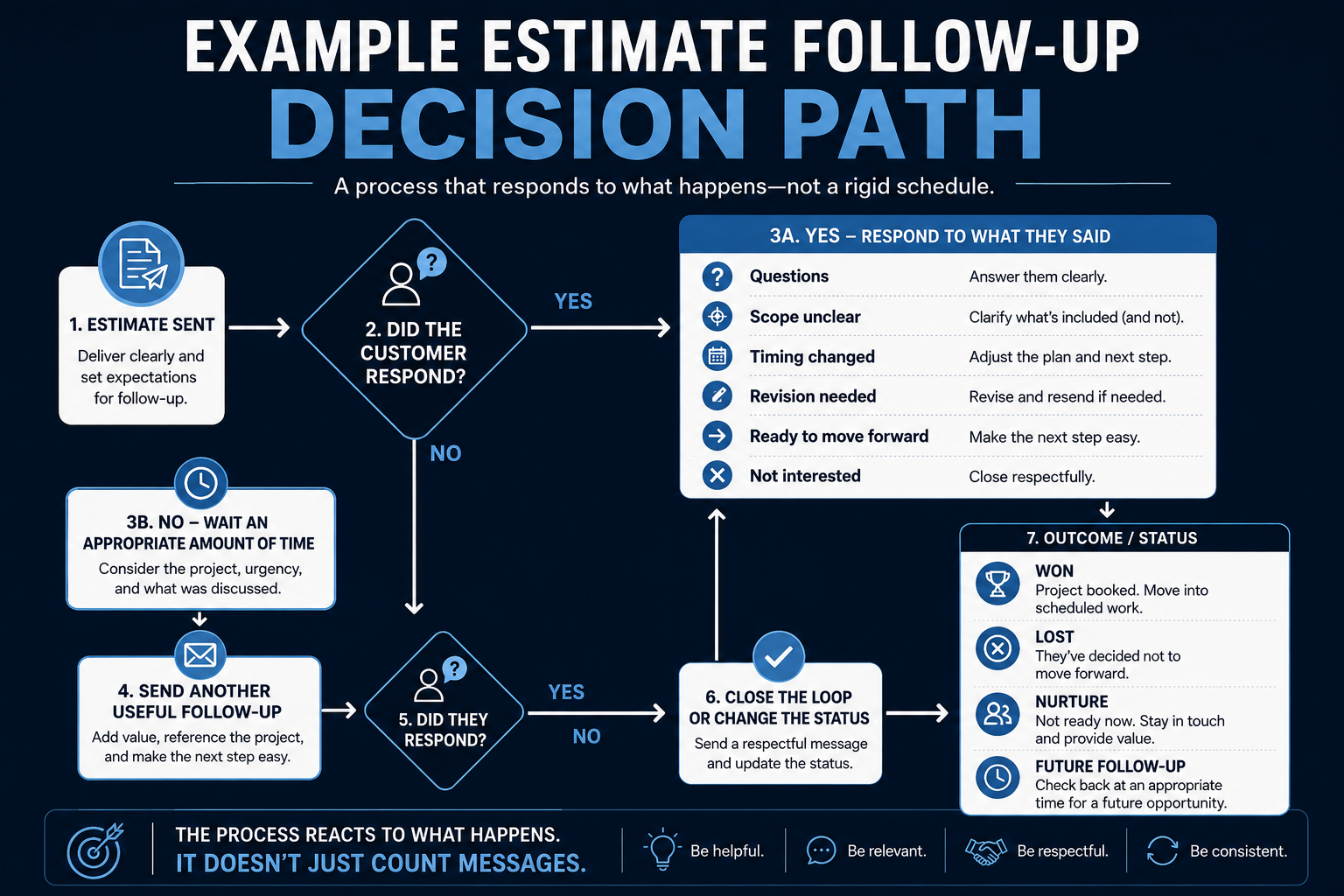
An Example Estimate Follow-Up Decision Path
A useful process might look something like this:
Estimate sent
↓
Has the customer acknowledged or responded?
Yes → respond to what they actually said.
No → appropriate first follow-up.
↓
Did they respond?
Yes → answer questions, clarify scope, discuss timing, revise if appropriate, schedule the next step, or close the opportunity.
No → wait an appropriate amount of time and determine whether another useful follow-up makes sense.
↓
Still no response after reasonable attempts?
Send a respectful close-the-loop message.
↓
Move the opportunity to the appropriate status.
That could be:
Won / Lost / Nurture / Future Follow-Up
The point isn't the exact diagram.
It's that the process reacts to what happens.
How to Automate Estimate Follow-Up Without Sounding Automated
Automation can be extremely useful here.
It can also make bad follow-up spectacularly efficient.
A basic system might detect when an opportunity moves into an Estimate Sent stage and then:
- schedule the appropriate next action
- remind the assigned person to follow up
- send an appropriate message when conditions are met
- stop or pause automation when the customer replies
- update the opportunity when something changes
- create a future follow-up task when timing changes
- notify a human when the conversation requires judgment
But the workflow should not blindly continue after the customer has responded.
If Sarah replies:
We're interested, but we're waiting until January.
and your system sends two hours later:
Hey Sarah! Still interested in your project?
Congratulations.
You've successfully automated not listening.
Our guide to automated lead follow-up goes deeper into triggers, stop conditions, human handoffs, and why good automation should respond to what the prospect actually does.
AI Doesn't Need to Handle Everything
Some estimate follow-up is simple rule-based automation.
Estimate sent → create follow-up task.
No AI required.
AI may become useful when the system needs to interpret what a customer says, summarize a conversation, identify context, or help determine where human attention is needed.
And humans remain important when the conversation involves:
- negotiation
- complex pricing
- technical questions
- unusual scope
- objections
- relationship-building
- judgment
Use the simplest tool appropriate for the job.
A Brief Note About Automated Text Messaging
If you automate estimate follow-up by SMS, don't treat compliance as an afterthought.
In the United States, certain automated calls and text messages can be subject to the Telephone Consumer Protection Act and FCC rules involving consent and revocation.
The practical point isn't to turn your estimator into a telecommunications attorney. It's to make sure your messaging process has appropriate consent practices where required, recognizes opt-out requests, honors them appropriately, and doesn't assume one customer inquiry creates unlimited permission for future automated marketing.
Your exact obligations can depend on how you're communicating and why, so businesses using automated messaging at scale should get qualified guidance for their specific practices.
This article is not legal advice.
What Happens to Estimates That Aren't Ready Yet?
Some customers aren't saying no.
They're saying:
Not this month.
After the holidays.
When financing is figured out.
When the tenant moves out.
When the rainy season ends.
When the budget resets.
Those opportunities shouldn't necessarily stay in an active short-term follow-up sequence forever.
If future contact is appropriate, move them into a status that reflects reality and record when the next relevant action should happen.
That's where longer-term nurture and old lead reactivation become different from active estimate follow-up.
The distinction matters:
Follow-up is trying to move an active opportunity toward its next step.
Nurture maintains an appropriate relationship when the buying timeline is longer.
Reactivation revisits an older opportunity after the active conversation has gone quiet or dormant.
Those shouldn't all be the same workflow.
Estimate Follow-Up Is Part of Lead Conversion
Businesses spend a lot of time thinking about generating the inquiry.
Google Ads.
SEO.
Google Business Profile.
Referrals.
Social media.
Website traffic.
Then they send an estimate and leave the rest to memory.
That's a strange place to stop caring about conversion.
The opportunity already exists.
You've already invested time in it.
That's why more leads aren't always the answer.
Sometimes the better question is:
What are we doing with the opportunities we've already created?
A lead conversion system connects those stages instead of treating every inquiry, conversation, appointment, estimate, and follow-up as a separate event.
Where Booked Calendar System™ Fits
At Boost Local Biz, Booked Calendar System™ is built around the larger path from inquiry to opportunity.
Depending on how a service business sells, that can include:
- lead capture
- initial response
- follow-up
- AI-assisted conversations
- CRM organization
- qualification
- scheduling
- pipeline management
- reminders
- estimate follow-up
- longer-term nurture
- human handoff
Not every business needs the same workflow.
And not every estimate should receive the same sequence.
The goal is to create a system where the business can see what happened, what the customer said, where the opportunity stands, and what should happen next.
Because the real problem usually isn't:
"We forgot to send Message #4."
It's:
"Nobody knew this opportunity still needed attention."