Not every lead is a good opportunity.
That's true.
But businesses sometimes take that idea too far.
They build enormous contact forms. Ask twelve questions before allowing someone to schedule. Create complicated scoring systems. Make prospects prove they're serious before anyone will actually talk to them.
In an effort to avoid wasting time on bad leads, they create friction for good ones.
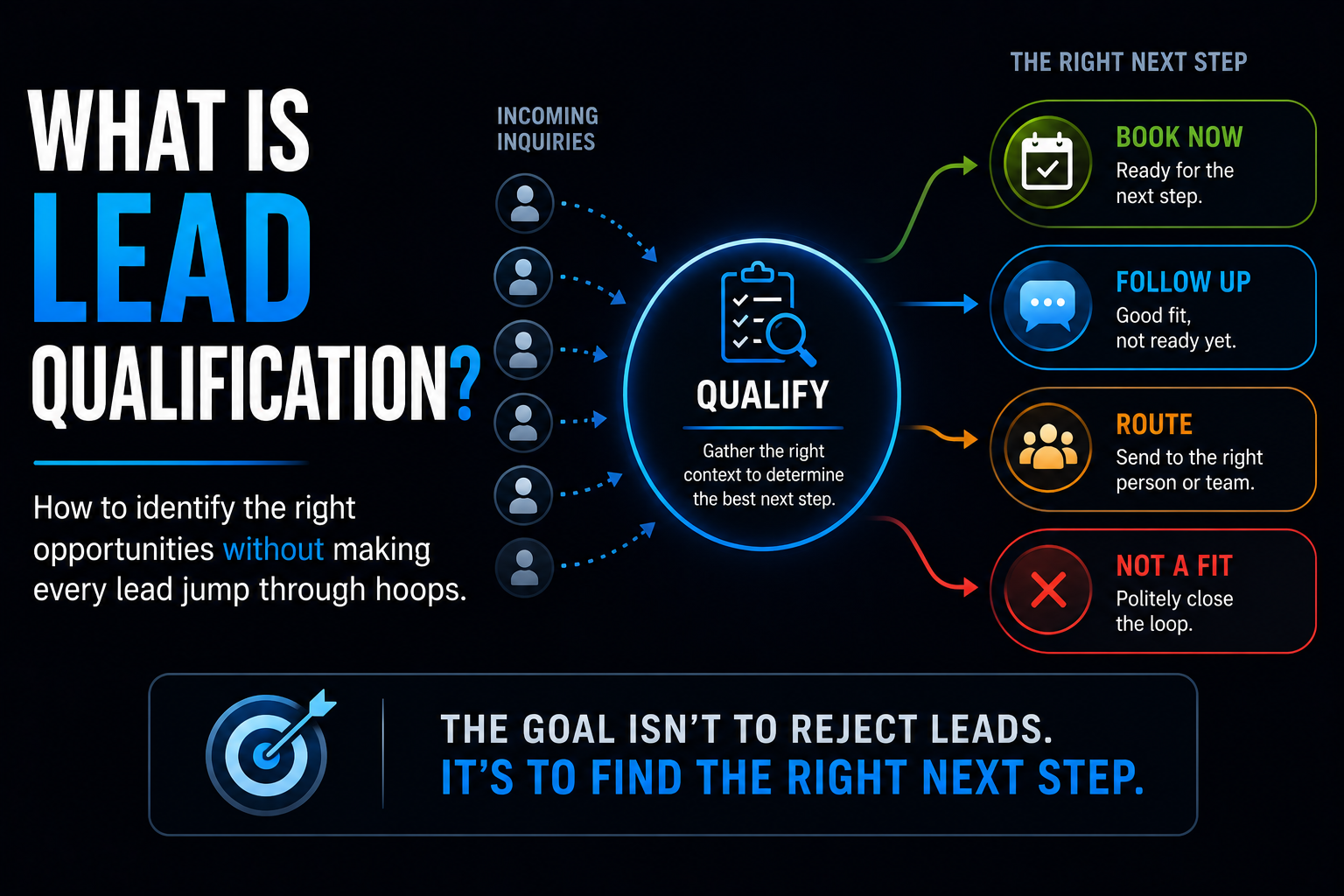
Lead qualification should help a business determine the right next step—not make interested prospects pass an entrance exam.
For service businesses in particular, the best qualification process is often simpler than people think.
What Is Lead Qualification?
Lead qualification is the process of learning enough about a prospect to determine whether there is a reasonable fit, how much buying intent exists, and what should happen next.
Depending on the business, that might mean understanding:
- what service the person needs
- where the project is located
- whether the request falls within the company's scope
- how urgent the need is
- the approximate size or type of project
- whether there is a realistic budget fit
- who is involved in the decision
- whether the person wants an estimate, consultation, appointment, or simply information
The goal isn't necessarily to label someone GOOD LEAD or BAD LEAD.
The goal is to make a better decision about what happens next.
Why Lead Qualification Matters
Imagine a contractor receives five inquiries.
One is outside the service area.
One needs a service the company doesn't provide.
One is researching a project for next year.
One wants an estimate sometime this month.
And one has an urgent problem and is ready to schedule.
Those five people shouldn't necessarily receive the exact same response.
Qualification provides context.
That context can help the business determine whether to:
- schedule an appointment
- provide additional information
- ask another question
- route the inquiry to a particular person
- place the opportunity into longer-term follow-up
- politely decline the request
- prioritize immediate human contact
Without qualification, every inquiry looks roughly the same in the CRM.
With qualification, the business can respond according to what the opportunity actually needs.
That's one reason qualification belongs inside a broader lead conversion system, rather than operating as an isolated form or questionnaire.
Qualification Shouldn't Become a Barrier
This is where businesses get themselves into trouble.
Someone visits the website because their air conditioner stopped working.
Before they can request service, the company asks:
Name.
Email.
Phone.
Address.
Property type.
Square footage.
Budget.
Timeline.
How did you hear about us?
Preferred communication method.
Best appointment window.
Describe the problem in 500 characters.
At some point the prospect starts wondering whether fixing the AC requires a mortgage application.
Every question creates some amount of friction.
That doesn't mean forms should contain only a name and phone number.
It means each question should earn its place.
Ask:
Do we need this information right now to determine the next useful step?
If not, perhaps it can be collected later.
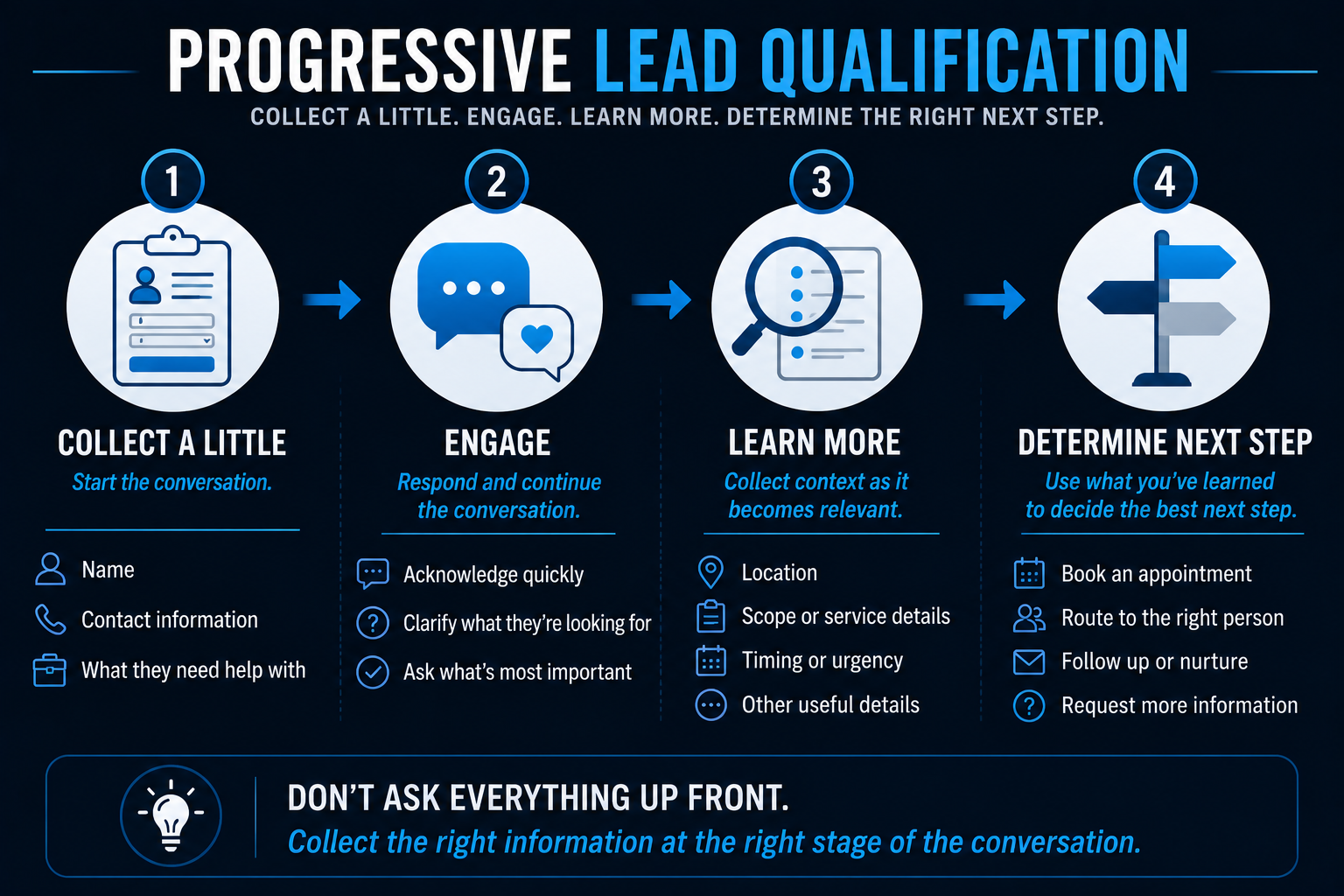
Qualification Can Happen Over Time
Lead qualification does not have to occur in one giant moment.
This is especially important for service businesses.
A prospect might initially provide:
Name + contact information + service needed
That's enough to acknowledge the inquiry immediately.
Then an automated or human conversation might determine:
Location + project details + urgency
If the opportunity progresses, the business might later collect:
Budget expectations + measurements + photos + decision-making details
This is sometimes called progressive qualification.
Instead of demanding everything before the relationship begins, the business collects the appropriate information as the conversation develops.
That can preserve momentum while still giving the team the context it needs.
What Information Should You Use to Qualify a Lead?
There isn't one universal qualification checklist.
A roofer, attorney, landscaper, dentist, remodeling contractor, and commercial construction company shouldn't qualify prospects identically.
But several categories are useful across many service businesses.
Service Fit
First question:
Can you actually help this person?
If someone requests pool remodeling from a landscaping company that only handles lawn maintenance, the rest of the qualification process isn't particularly important.
Service fit may include:
- type of service requested
- project scope
- residential vs. commercial
- repair vs. replacement
- type of property
- specialized requirements
This is usually fundamental.
Geographic Fit
For local and regional businesses, location can immediately affect whether an inquiry is viable.
A company serving Naples may not want to dispatch a crew to Jacksonville.
A contractor operating across multiple states may need to route the inquiry according to market, licensing, office, or project type.
Location can therefore serve two functions:
qualification and routing.
Those functions are related, but they're not identical.
We'll come back to that distinction.
Need or Problem
What is the person actually trying to accomplish?
"Interested in remodeling" provides less context than:
We want to remodel our kitchen and two bathrooms before moving into the property this fall.
Understanding the problem helps determine whether the opportunity fits and what the next conversation should cover.
Timing and Urgency
A prospect who needs emergency service today is different from someone planning a project twelve months from now.
Neither is automatically better.
They simply require different next steps.
Timing can help determine:
- priority
- scheduling
- follow-up cadence
- whether a human should be notified immediately
- whether the lead belongs in longer-term nurture
Budget or Project Size
Budget questions can be useful.
They can also be mishandled.
For some services, an approximate budget range prevents obvious mismatches.
For others, asking for budget before the prospect understands the likely cost is premature.
Instead of blindly adding "What is your budget?" to every form, ask whether budget information genuinely helps at that stage of the conversation.
Sometimes project type, scope, or size is a better early qualifier.
Buying Intent
Intent answers a different question:
How close is this person to taking action?
Compare:
I'm researching what impact windows typically cost.
with:
I need an estimate for replacing 14 windows and would like someone to come out next week.
Both inquiries may be legitimate.
But their intent is different.
That should affect what happens next.
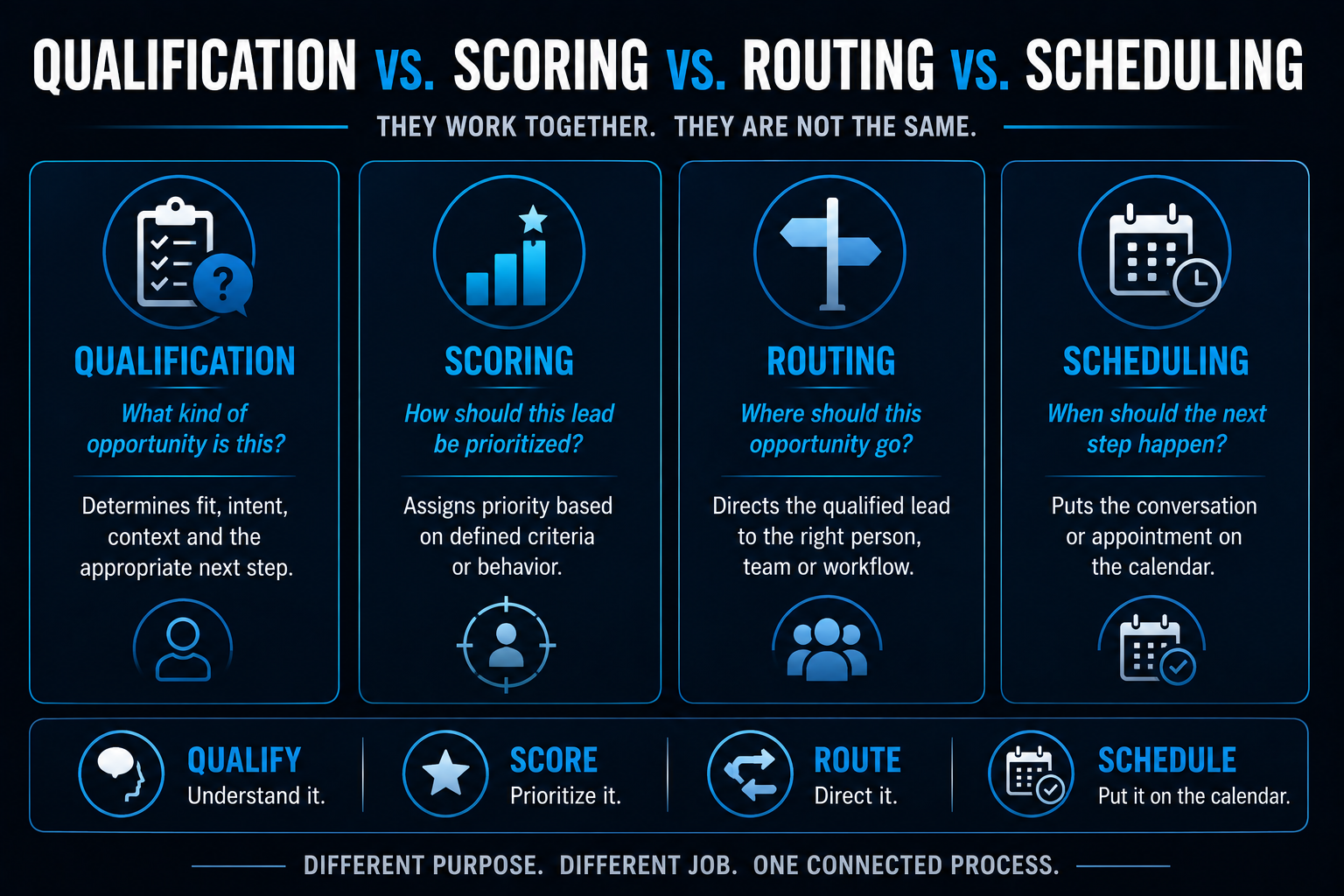
Lead Qualification vs. Lead Scoring
These terms are often treated as though they're interchangeable.
They're not.
Lead qualification is the process of determining fit, intent, context, and appropriate next action.
Lead scoring assigns some form of value or priority to a lead based on defined criteria or behavior.
For example, a business might score:
- service fit
- location
- urgency
- project size
- engagement
- stated timeline
and use those inputs to prioritize opportunities.
That can be useful at sufficient lead volume.
But you do not need to invent a 100-point scoring algorithm just to qualify someone who wants a fence installed.
For many small service businesses, a few meaningful statuses can be more useful:
Ready now
Good fit, needs follow-up
Future opportunity
Not a fit
The system should match the complexity of the business.
Not the complexity of the software.
Lead Qualification vs. Lead Routing
Qualification asks:
What kind of opportunity is this?
Routing asks:
Where should this opportunity go?
Suppose a contractor receives a qualified commercial inquiry.
Qualification may establish that:
- the requested service is offered
- the project is in the correct geography
- the project type is appropriate
- the timing is legitimate
Routing then determines whether the inquiry should go to:
- commercial estimating
- a specific salesperson
- a regional office
- a project manager
- a particular pipeline
That's the role of lead routing.
Good qualification can improve routing because the system has better information to work with.
But they're still separate jobs.
Lead Qualification vs. Scheduling
Scheduling is another point where businesses accidentally create friction.
If the only information you need before booking an estimate is:
- service
- location
- basic project type
then asking 15 additional questions before showing the calendar may not improve anything.
On the other hand, some appointments are expensive or highly specialized.
Those may require more qualification before reserving someone's time.
There is no rule that says:
Every lead should book immediately.
There is also no rule that says:
Every lead must be thoroughly qualified before seeing a calendar.
The right process depends on the service and the cost of the next step.
This is one reason we compare website forms, chat, and online scheduling based on the job each mechanism needs to perform rather than declaring one universally superior.
Don't Make Good Leads Wait While You Qualify Them
Qualification shouldn't become an excuse for slow response.
If someone submits an inquiry at 10:02 AM, the business doesn't necessarily need every detail before acknowledging them.
A simple response can happen immediately:
Thanks for reaching out. We received your request about the kitchen remodel. I have a couple of quick questions so we can point you in the right direction.
Now the qualification process has begun.
The lead knows the inquiry went through.
The business can gather context.
And nobody had to wait until an employee cleared their inbox at 4:30.
As covered in How Fast Should You Respond to a New Lead?, acknowledgment and meaningful engagement are related but don't always need to be the exact same event.
Where Should Qualification Happen?
Potentially across several places.
On the Website Form
Useful for basic information the business genuinely needs before responding.
Examples:
- service requested
- ZIP code
- project type
- preferred contact information
Keep it proportional to the request.
In Website Chat
Chat can collect information conversationally instead of presenting a long questionnaire.
It can also adapt.
If the prospect selects Commercial Project, the next question might differ from someone selecting Residential Remodel.
Through SMS
After a form submission, a short text conversation can collect missing context while the inquiry is still fresh.
This works particularly well when the next question is simple.
On the Phone
For complex or high-value services, a human conversation may still be the best qualification method.
Automation doesn't eliminate that.
It can help get the right opportunity to the right person faster.
During Scheduling
Sometimes one or two qualification questions belong directly in the booking process.
The key is not to make scheduling feel like completing a tax return.
What Should Happen After a Lead Is Qualified?
Qualification is useful only if it changes something.
If every lead receives the same treatment regardless of the answers, why ask the questions?
A qualified opportunity might trigger:
- immediate scheduling
- assignment to a specific employee
- a phone call
- an estimate workflow
- a request for photos or documents
- a particular pipeline stage
- a specific follow-up sequence
A future opportunity may enter nurture.
A poor-fit inquiry may receive a polite response explaining that the business isn't the right provider.
An urgent opportunity may trigger an internal notification.
Qualification should create a decision.
Otherwise you're just collecting data.
Can AI Qualify Leads?
Yes—but this is another area where the phrase "AI-powered" can make something sound more magical than it is.
AI can potentially help:
- understand conversational responses
- ask appropriate follow-up questions
- summarize what a prospect said
- classify inquiries
- identify intent
- apply predefined qualification criteria
- update CRM fields
- determine which workflow should happen next
That's useful.
But the business still needs to decide what qualified means.
AI doesn't know whether a $7,000 project is attractive to your company.
It doesn't inherently know which ZIP codes you serve.
It doesn't know which jobs your crews hate doing.
It doesn't know when an unusual opportunity deserves an exception.
Those are business decisions.
AI can help execute qualification logic. It shouldn't invent the logic for you.
Should Every Lead Be Qualified Automatically?
No.
Automation makes the most sense where it removes repetitive work or speeds up useful decisions.
Sometimes the correct workflow is:
New inquiry → immediate acknowledgment → two qualification questions → scheduling
Sometimes it's:
New inquiry → immediate human call
Sometimes it's:
New inquiry → detailed project intake → internal review → consultation
The objective isn't maximum automation.
It's the right path for the opportunity.
What About Leads That Don't Qualify Yet?
This is another reason binary qualification can be misleading.
Someone may be a legitimate prospect but simply not ready.
Perhaps:
- the project is six months away
- financing isn't arranged
- they need approval from someone else
- they're researching options
- the service is relevant but timing is wrong
That doesn't necessarily mean disqualified forever.
It may mean not ready yet.
Those opportunities can move into appropriate follow-up rather than disappearing.
And as we've discussed in How Many Times Should You Follow Up With a Lead?, the lead's actual status should influence what happens next.
A Simple Qualification Framework for Service Businesses
If your current qualification process is either nonexistent or ridiculously complicated, start with five questions:
1. Can We Help?
Does the requested service fit what the business actually provides?
2. Can We Serve Them?
Is the location, property, project type, or other basic requirement appropriate?
3. What Do They Need?
What problem or outcome is driving the inquiry?
4. When Do They Need It?
Is this urgent, near-term, future, or exploratory?
5. What Is the Right Next Step?
Should they book, speak to someone, receive information, provide more details, enter follow-up, or be politely declined?
That's qualification.
No 97-point algorithm required.
Where the Booked Calendar System™ Fits
Qualification is one part of a larger conversion process.
A lead arrives.
The business responds.
Useful context is collected.
The opportunity is qualified.
It gets routed.
Follow-up happens where necessary.
The right prospects reach the calendar.
That's the broader thinking behind the Booked Calendar System™.
The objective isn't to automate every interaction or force every lead onto a calendar.
It's to make sure legitimate opportunities have a clear path toward the appropriate next step.