The phone rings.
Nobody answers.
Maybe you're with another customer. Maybe you're driving. Maybe the office is closed. Maybe everyone is simply busy doing the work customers are paying you to do.
Whatever the reason, the caller hears ringing or voicemail.
Now there's a gap.
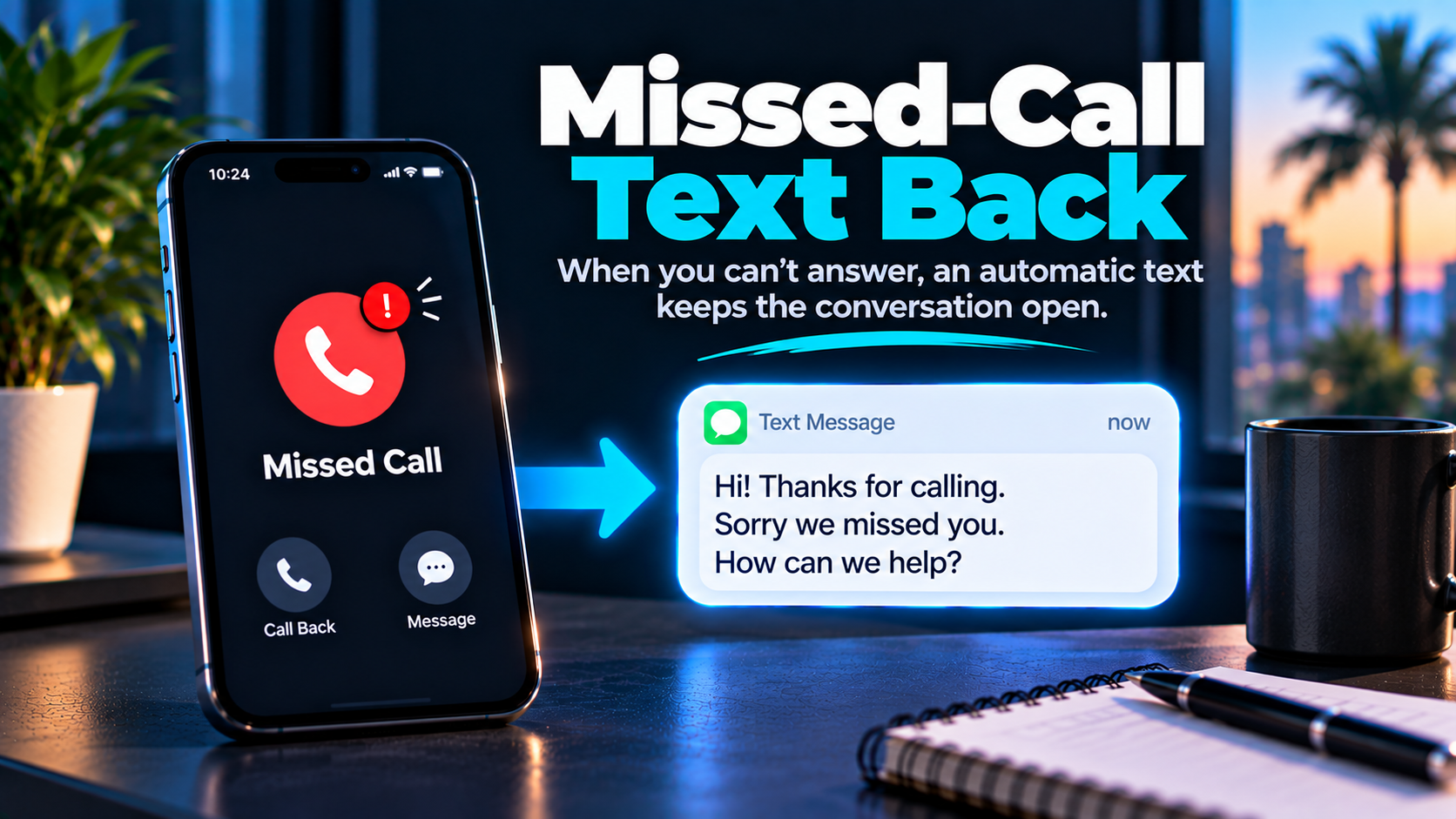
Missed-call text back is an automated response that sends an appropriate text message after an inbound call goes unanswered, giving the caller another way to continue the conversation while the business prepares to respond appropriately.
It's a simple idea.
But the useful version is more than:
Missed call → send text → done.
The text should be the beginning of a response process, not the entire process.
Why Missed Calls Are a Lead-Response Problem
You'll sometimes hear claims like:
Every missed call is a lost customer.
That's catchy.
It also isn't true.
A missed caller might be a prospective customer.
Or an existing customer.
Or a vendor.
Or somebody looking for directions.
Or spam trying to sell you an extended warranty for a vehicle you haven't owned since 2019.
You don't know simply because the phone rang.
What you do know is that someone attempted to communicate with the business and didn't reach a person.
That creates a communication gap.
The business now needs to decide what should happen next.
This is why missed calls fit into the larger idea of speed to lead.
Speed to lead isn't about chasing an arbitrary response-time record.
It's about reducing unnecessary delay between someone expressing interest and the business responding appropriately.
For phone inquiries, a missed-call text can help bridge that gap.
How Does Missed-Call Text Back Work?
At its simplest, the process looks like this:
Incoming call
↓
Call goes unanswered
↓
System recognizes the missed call
↓
Appropriate text is sent
↓
Caller can reply
↓
Business responds based on what happens next
That last step matters.
A weak system focuses almost entirely on sending the text.
A better system pays attention to what happens after the text.
What Should a Missed-Call Text Say?
There isn't one universal script, and a set of missed-call text back examples can show how the wording shifts by situation.
A roofing company, dentist, remodeling contractor and law office don't necessarily need the same message.
But a useful missed-call response will often do a few basic things.
Acknowledge the Missed Call
The caller should understand why they're receiving the message.
Something as simple as:
Thanks for calling. We weren't able to answer your call.
does the job.
Identify the Business
Don't make someone wonder who just texted them.
The message should clearly identify the company.
Make It Easy to Continue
Give the caller an obvious way to respond.
For example:
If you'd like, reply here with what you need help with.
Now the communication can continue without requiring another phone call immediately.
Keep It Reasonably Short
The first text doesn't need to explain your entire company history, service catalog and founding philosophy.
It has one primary job:
Reopen the communication channel.
Don't Immediately Turn It Into a Sales Pitch
Someone tried to call you.
They haven't necessarily asked to enter a seven-message promotional sequence.
Start by helping them continue the conversation.
A Simple Missed-Call Text Example
A hypothetical service business might use something like:
Hi, this is ABC Home Services. Sorry we missed your call. If you'd like, reply here with your name and what you need help with, and we'll make sure the right person gets back to you.
That's not the “perfect” missed-call text.
There isn't one.
But notice what it does:
- identifies the business
- acknowledges the missed call
- gives the caller a simple next action
- doesn't pretend someone manually typed it
- doesn't immediately push an appointment
- leaves room for a person to become involved
That's enough to get the conversation moving.
The Text Is an Acknowledgment, Not Necessarily the Full Response
This distinction is important.
In our guide to speed to lead, we separated:
acknowledgment
from
meaningful response
from
conversation
from
human handoff
A missed-call text may initially provide only the acknowledgment:
We received your call. Here's another way to reach us.
That's useful.
But it doesn't necessarily mean the caller's actual question has been answered.
If someone called because their air conditioner stopped working, receiving:
Sorry we missed you!
isn't the same thing as receiving actual help.
The automation should create a bridge to the next appropriate response.
What Happens After Someone Replies?
This is where missed-call text back becomes much more interesting.
Suppose the caller replies:
Hi, I need an estimate to replace my driveway.
Now the business has context.
Depending on how the business operates, the system might:
- create or update the CRM contact
- identify what service the person is asking about
- continue an appropriate text conversation
- ask for basic information
- notify a staff member
- create a callback task
- offer scheduling options
- hand the conversation to the appropriate person
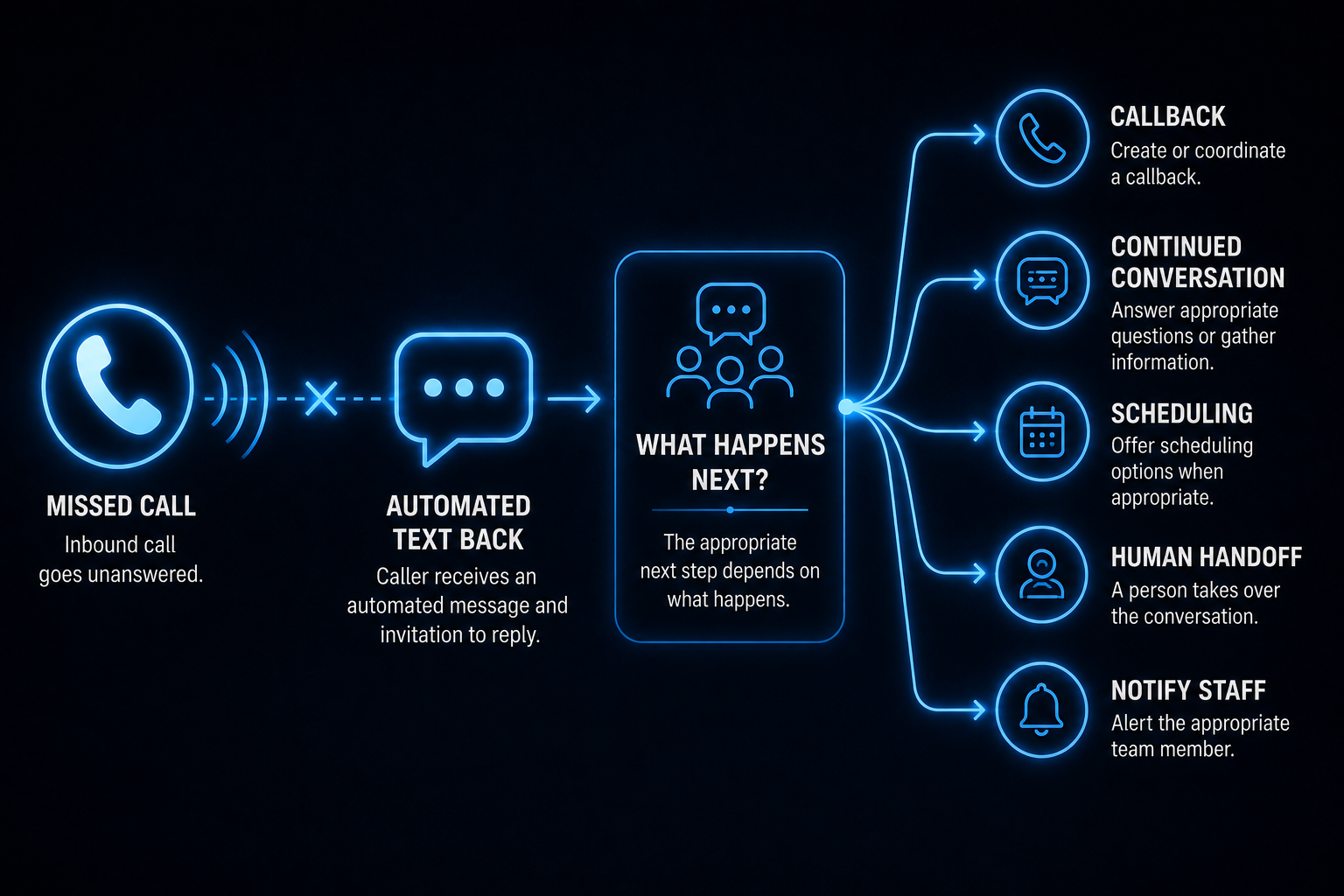
The right next step depends on the business and the inquiry.
That's why missed-call text back shouldn't be treated as an isolated autoresponder.
It should connect to the rest of the lead-response process.
Missed-Call Text Back Does Not Replace Calling People Back
This deserves its own section because automation vendors sometimes make it sound like texting solves the entire missed-call problem.
It doesn't.
For many service businesses, a human callback may still be the appropriate next action.
Someone asking about a complex remodeling project may want to talk.
A customer with a problem on an existing job may need a person.
A technical question may require expertise.
A high-value opportunity may deserve personal attention.
The text can help while that happens.
It can:
- acknowledge the caller
- keep communication open
- gather some initial context
- tell the caller what to expect
- help coordinate the callback
Think of it as a bridge.
Not a replacement for the other side.
What If the Caller Doesn't Reply?
Nothing says the person has to text back.
They may prefer a phone call.
They may call again later.
They may leave a voicemail.
They may visit the website.
They may decide they don't need anything after all.
The system shouldn't assume silence means one specific thing.
Depending on the business, an unanswered missed-call text might trigger:
- a callback task for a staff member
- another appropriate follow-up
- a voicemail review
- no additional automated action
- longer-term follow-up where appropriate
This is where the principles from automated lead follow-up become important.
The goal isn't:
Keep sending messages until something happens.
It's:
Determine the appropriate next action based on what is actually happening.
What About Calls After Business Hours?
After-hours calls are one of the more obvious uses for missed-call text back.
But even here, context matters.
A useful message might acknowledge:
- that the business is currently closed
- when someone can reasonably expect a response
- whether they can provide information by text in the meantime
- whether another option is available
For example:
Thanks for calling ABC Home Services. We're currently closed, but you can reply here with what you need help with and our team will follow up during business hours.
For an emergency-oriented service, the workflow may be completely different.
Again:
The automation should match how the business actually operates.
What About Existing Customers?
This is another reason not to treat every missed call like a brand-new lead.
An existing customer might be calling about:
- an appointment
- an active project
- billing
- warranty work
- a service issue
- a delivery
- a question for a specific employee
If the CRM already recognizes the phone number, the workflow may be able to handle that caller differently.
At minimum, the system shouldn't automatically assume:
Missed call = new sales lead.
Context makes automation smarter.
What About Repeat Calls?
Suppose someone calls three times in five minutes.
Should they receive the exact same automated text three times?
Probably not.
A good system should consider whether the contact recently received the same acknowledgment.
Depending on the setup, duplicate suppression or other workflow conditions can prevent the automation from becoming ridiculous.
Because:
Thanks for calling!
followed 90 seconds later by:
Thanks for calling!
followed by:
Thanks for calling!
doesn't make the company look responsive.
It makes the automation look broken.
What About Spam Calls?
Not every missed call deserves a workflow.
Spam, robocalls and irrelevant callers exist.
Depending on the phone system and automation platform, businesses may be able to use filtering, contact status, call data or workflow conditions to reduce unnecessary responses.
No system will classify every call perfectly.
The point is simply not to assume every phone number that touches the business belongs in the sales pipeline.
What If the Number Can't Receive Text Messages?
Landlines and some other numbers may not support SMS.
If the missed-call workflow relies entirely on text, those callers may never receive the acknowledgment.
That's another reason the business still needs a broader call-handling process.
Missed-call text back is useful.
It isn't magic.
What If the Caller Asks for a Callback?
Then the system has learned something useful.
Suppose the caller replies:
Can someone call me after 3?
A good next step might be:
capture the request
↓
create or update the contact
↓
notify or assign the appropriate person
↓
create the callback task
↓
pause unnecessary automated sales messages
The caller told you what they want.
The system should use that information.
Where Does AI Fit?
You don't need AI simply to detect a missed call and send a text.
Traditional automation can handle predictable tasks such as:
- detecting the missed call
- sending an acknowledgment
- creating or updating a contact
- notifying staff
- creating a callback task
- changing pipeline status
- stopping a workflow when conditions are met
AI becomes more useful when language and context matter.
For example, someone replies:
I'm looking to redo the pool deck but I'm not sure if I want travertine or porcelain. Can somebody come out next week?
AI may be able to help interpret the request, gather appropriate information, answer basic questions or assist with the next step.
But that doesn't mean AI should handle the entire interaction.
If judgment, expertise or relationship-building is needed, bring in a person.
Use AI where it helps.
Not where the brochure says you're supposed to.
Missed-Call Text Back Needs Stop Conditions Too
The same principle we discussed with automated follow-up applies here.
Automation needs to know when circumstances change.
For example, the workflow may need to stop, pause or redirect when:
- the caller replies
- a staff member calls them back
- an appointment is booked
- the person opts out
- the contact is identified as spam
- the caller says they're no longer interested
- a human takes ownership of the conversation
- the opportunity moves into another stage
Otherwise you get nonsense like:
Customer: Thanks, I just spoke with Mike. We're all set.
Automation, 20 minutes later: Sorry we missed your call! How can we help?
That's not follow-up.
That's the system ignoring reality.
Missed-Call Text Back and Your CRM
Connecting the phone system to a CRM makes the process much more useful.
Instead of treating the call as an isolated event, the business can potentially see:
- who called
- whether they're already a contact
- previous conversations
- what service they're interested in
- whether an opportunity already exists
- who is responsible for following up
- whether an appointment has been scheduled
- what happened after the missed call
The CRM becomes the memory behind the communication.
That's an important piece of a larger lead conversion system.
A Simple Missed-Call Response Framework
If you're thinking about implementing missed-call text back, start with five questions.
1. What Counts as a Missed Call?
Define the event that triggers the workflow.
Don't leave that ambiguous.
2. What Should the Initial Message Accomplish?
Usually, the first job is acknowledgment and reopening communication.
Don't make the first text carry the entire sales process.
3. What Happens If They Reply?
Who or what handles the conversation?
Automation?
AI?
A staff member?
Some combination?
4. What Happens If They Don't Reply?
Does someone call them back?
Does another follow-up occur?
Does the workflow stop?
Define it.
5. What Stops or Redirects the Automation?
Reply?
Callback completed?
Appointment booked?
Opt-out?
Human takeover?
Spam classification?
If you can't answer this question, the workflow isn't finished.
A Note About Automated Texting and Consent
Automated messaging can involve legal and compliance requirements.
In the United States, automated calls and texts may be subject to the Telephone Consumer Protection Act and related FCC rules depending on how the communication is made and its purpose.
Responding to an inbound call is not the same thing as assuming the caller has agreed to unlimited future promotional messaging.
Businesses should use appropriate consent practices, clearly honor opt-out requests and maintain accurate communication records.
Specific requirements can depend on the circumstances and technology involved, so businesses should obtain qualified legal or compliance guidance for their own messaging practices when necessary.
This isn't legal advice.
It's another reason to build rules into the system rather than treating every phone number as permission to automate forever.
Where Missed-Call Text Back Fits Into Booked Calendar System™
Missed-call text back is one component of Booked Calendar System™.
It helps address one specific moment:
Someone tried to call the business and nobody answered.
The broader system can connect that event to:
Missed Call
↓
Acknowledgment
↓
Conversation
↓
CRM Organization
↓
Follow-Up
↓
Scheduling
↓
Reminders
↓
Human Handoff
Not every caller needs every step.
Not every business needs the same workflow.
And missed-call text back by itself isn't Booked Calendar System™.
It's one mechanism within the larger system for helping businesses respond to and manage incoming opportunities more consistently.
The Goal Isn't to Replace the Phone
People still call businesses because sometimes talking to another person is exactly what they want.
The goal of missed-call text back isn't to eliminate that.
It's to prevent an unanswered phone call from creating an unnecessary communication dead end.
Someone called.
You couldn't answer.
The system acknowledged them.
They had another way to respond.
Your team had another opportunity to continue the conversation appropriately.
That's the job.
Want a Better System for Handling Missed Calls?
If missed calls currently depend on someone checking voicemail, remembering to call back and manually tracking what happened afterward, there may be room to improve the process.
Booked Calendar System™ can connect missed-call response with follow-up, conversations, CRM organization, scheduling and human handoff.
Boost Local Biz can help identify:
- what should happen when a call is missed
- when an automated text is appropriate
- what should happen when someone replies
- when a person should call back
- what should stop the automation
- how the interaction should connect to your CRM and scheduling process
The objective isn't to automate every phone call.
It's to make sure an unanswered call doesn't automatically become a dead end.