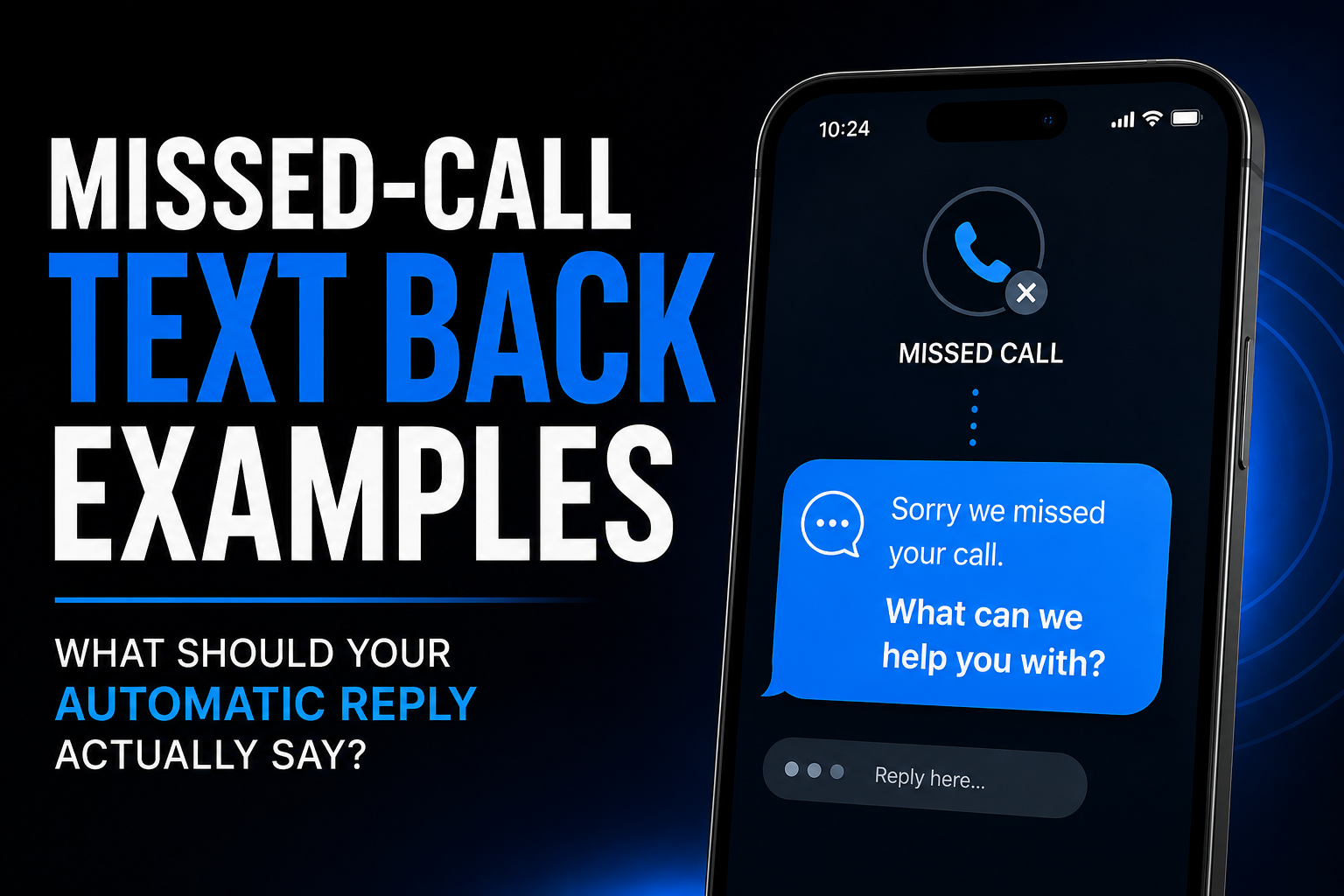
Someone calls your business.
Nobody answers.
A few seconds later, they get this:
Sorry we missed your call. We'll get back to you as soon as possible.
It's polite.
It's also doing almost nothing.
The caller still doesn't know when you'll respond, whether texting you is okay, what information you need, or what they should do next.
A useful missed-call text should do more than acknowledge that the phone rang.
It should make continuing the conversation easy.
That's the difference between having a missed-call text-back feature turned on and actually having a useful missed-call text-back system.
The Short Answer: What Should a Missed-Call Text Say?
For most service businesses, a good starting point is:
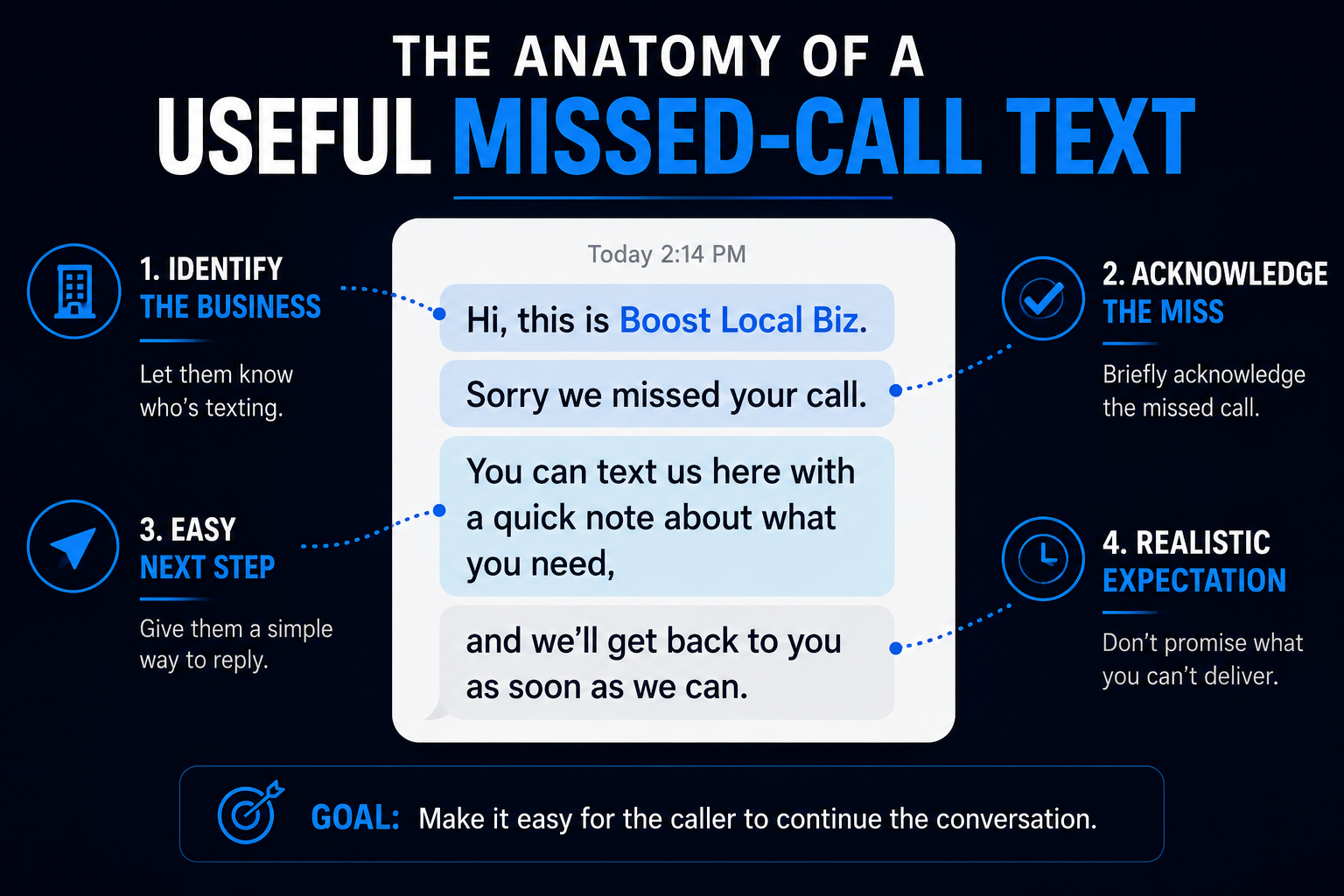
Hi, this is [Business Name]. Sorry we missed your call. You can text us here with a quick note about what you need, and we'll get back to you as soon as we can.
Simple.
It:
- identifies the business
- acknowledges the missed call
- tells the caller they can reply
- gives them an easy next step
- avoids making a promise the business may not be able to keep
But that doesn't mean every business should copy that exact message.
A plumber handling emergency calls has different needs than a remodeling contractor.
An existing customer may need something different from a brand-new prospect.
A call at 2:00 p.m. may deserve a different response from one at 11:30 p.m.
The template matters.
The context matters more.
What Makes a Good Missed-Call Text Back?
The best messages tend to accomplish four things quickly.
1. Identify the business
Remember: you're texting a phone that may not have your number saved.
Start with something like:
Hi, this is [Business Name].
Don't make the caller solve a mystery before they can respond.
2. Acknowledge what happened
You don't need a five-sentence apology.
Something as simple as:
Sorry we missed your call.
is enough.
3. Give them an easy way to continue
This is where many default messages fall apart.
“Someone will contact you soon” tells the caller to wait.
“Text us what you need” gives them something to do.
That's a meaningful difference.
4. Set an expectation you can actually meet
If someone really will call back within 15 minutes, you can say that.
If nobody is available until tomorrow morning, don't say:
We'll call you right back!
Automation shouldn't make promises on behalf of people who aren't there.
A useful automated response reduces uncertainty. It doesn't manufacture certainty.
Missed-Call Text Back Examples for Service Businesses
There isn't one perfect message for every company.
These are starting points. Adjust them for how your business actually handles calls.
General Service Business
Hi, this is [Business Name]. Sorry we missed your call. You can text us here with a quick note about what you need, and we'll follow up as soon as we can.
This is probably the safest default for a business that receives several types of calls.
It's short and doesn't ask the caller to complete an application just because nobody picked up the phone.
Contractor or Home-Service Business
Hi, this is [Business Name]. Sorry we missed you. What type of work are you calling about? You can reply here and we'll help you with the next step.
This gives the contractor some context before calling back without demanding too much information.
Estimate or Quote Request
Thanks for calling [Business Name]. Sorry we missed you. If you're looking for an estimate, reply with a quick description of the project and the city where the work is needed. We'll let you know the best next step.
Notice what this does not say:
Send your full address, budget, project timeline, square footage, seven photos, mother's maiden name and three professional references.
You can gather more information later.
The first job is getting the conversation moving.
After-Hours Call
Thanks for calling [Business Name]. We're currently closed, but we received your call. You can reply here with what you need, and our team will follow up when we're available again.
If your business reopens at a predictable time, you can be more specific:
Thanks for calling [Business Name]. We're closed for the evening, but you can reply here with what you need. Our team will follow up tomorrow morning.
That's much better than pretending someone is standing by when nobody is.
Urgent-Service Business
For plumbers, HVAC companies, electricians, restoration companies and similar businesses, urgency can matter.
A message might say:
Hi, this is [Business Name]. Sorry we missed your call. If this is urgent, reply with a quick description of what's happening and your location. If there is an immediate threat to life or safety, contact the appropriate emergency service.
But be careful here.
Don't tell people to reply URGENT and promise an immediate dispatch unless your operation is actually equipped to monitor and respond that way.
An automated text should reflect the service you can really provide.
Appointment-Based Business
Hi, this is [Business Name]. Sorry we missed your call. If you're trying to schedule an appointment, reply with the service you're interested in and we'll help you find the right next step.
If your scheduling process is genuinely simple, you might offer a booking link.
But don't automatically dump a scheduling link into every conversation.
Someone may have been calling with a question, an existing appointment issue, a billing concern or something that has nothing to do with booking.
Existing Customers
If your phone system or CRM can reliably distinguish an existing customer, the message can change.
Hi, this is [Business Name]. Sorry we missed you. If this is about an existing service or appointment, reply here with a quick note and we'll make sure it gets to the right person.
That can be more useful than treating every caller as a brand-new sales lead.
When You Know Someone Will Call Back Soon
Hi, this is [Business Name]. Sorry we missed your call. Someone from our team should be able to call you back within about 30 minutes. If it's easier, reply here with what you need and we'll have some context before we call.
Only use a timeframe like that if it's operationally realistic.
Otherwise, leave it out.
Your Missed-Call Text Doesn't Need to Sound Clever
Businesses sometimes overthink the copy.
They try to make an automatic SMS sound funny, ultra-personal or suspiciously enthusiastic:
Heyyyyy! 👋 We are SO sorry we missed you!!! 😭 But GREAT NEWS—we're here to help!!! 🎉
Please don't.
Exclamation points cannot answer the phone either.
The message should sound like a competent business acknowledging the caller and helping them move forward.
That's enough.
Bad Missed-Call Text Examples—and Why They Fail
Bad Example #1: The Dead End
Sorry we missed your call. We'll get back to you soon.
What's wrong with it?
There's no next step.
The caller can only wait.
Bad Example #2: The Interrogation
Thanks for calling. Please reply with your full name, email, address, ZIP code, service requested, preferred appointment date, budget and how you heard about us.
You missed their call.
They didn't volunteer to complete a census.
Collect what you need progressively as the conversation develops.
Bad Example #3: The Fake Human
Hey John! It's Mike. Sorry I couldn't grab the phone—I was probably helping another customer!
If “Mike” isn't actually the person who will respond—or doesn't exist—don't do this.
Automation can sound conversational without pretending to be a specific human.
Bad Example #4: The Fake Promise
Sorry we missed you! Someone will call you back in 5 minutes.
At 11:47 p.m.
When everyone is asleep.
That's not automation.
That's a tiny automated liar.
Bad Example #5: The Link Dump
Sorry we missed your call. Book here: [link]
Maybe they weren't trying to book.
A booking link can be useful when scheduling is clearly the logical next step. It shouldn't replace understanding why someone called.
What Should Happen When the Caller Replies?
This is where missed-call text back becomes more than a notification.
Suppose the automatic message says:
Hi, this is Bella Lawn & Landscape. Sorry we missed your call. What can we help you with?
The caller replies:
Looking for someone to redo the landscaping around our pool in Naples.
Now the system has information.
What happens next might include:
- notifying the appropriate person
- creating or updating the contact
- creating an opportunity in the CRM
- identifying the type of service requested
- asking one useful follow-up question
- routing the conversation appropriately
- offering scheduling when it makes sense
- handing the conversation to a human
This is where lead routing, CRM and automation start working together.
The automatic text was just the opening move.
The response is where the real conversation begins.
One Missed Call Shouldn't Automatically Mean One Identical Workflow
There's another problem businesses often overlook.
Automation can technically work exactly as configured and still create a lousy customer experience.
For example, HighLevel's standard Missed Call Text Back feature can trigger an SMS for every missed call, including repeated calls from the same person within a short period. HighLevel itself recommends using workflow logic when businesses want more control over that behavior.
You can see the current behavior in HighLevel's official Missed Call Text Back documentation.
Why does that matter?
Imagine someone calls.
They get your automatic text.
Thirty seconds later they call again because the issue is urgent.
They get the same automatic text again.
They call a third time.
Same text.
Congratulations.
Your automation is extremely consistent.
It's also extremely annoying.
Smarter Missed-Call Automation Responds to Context
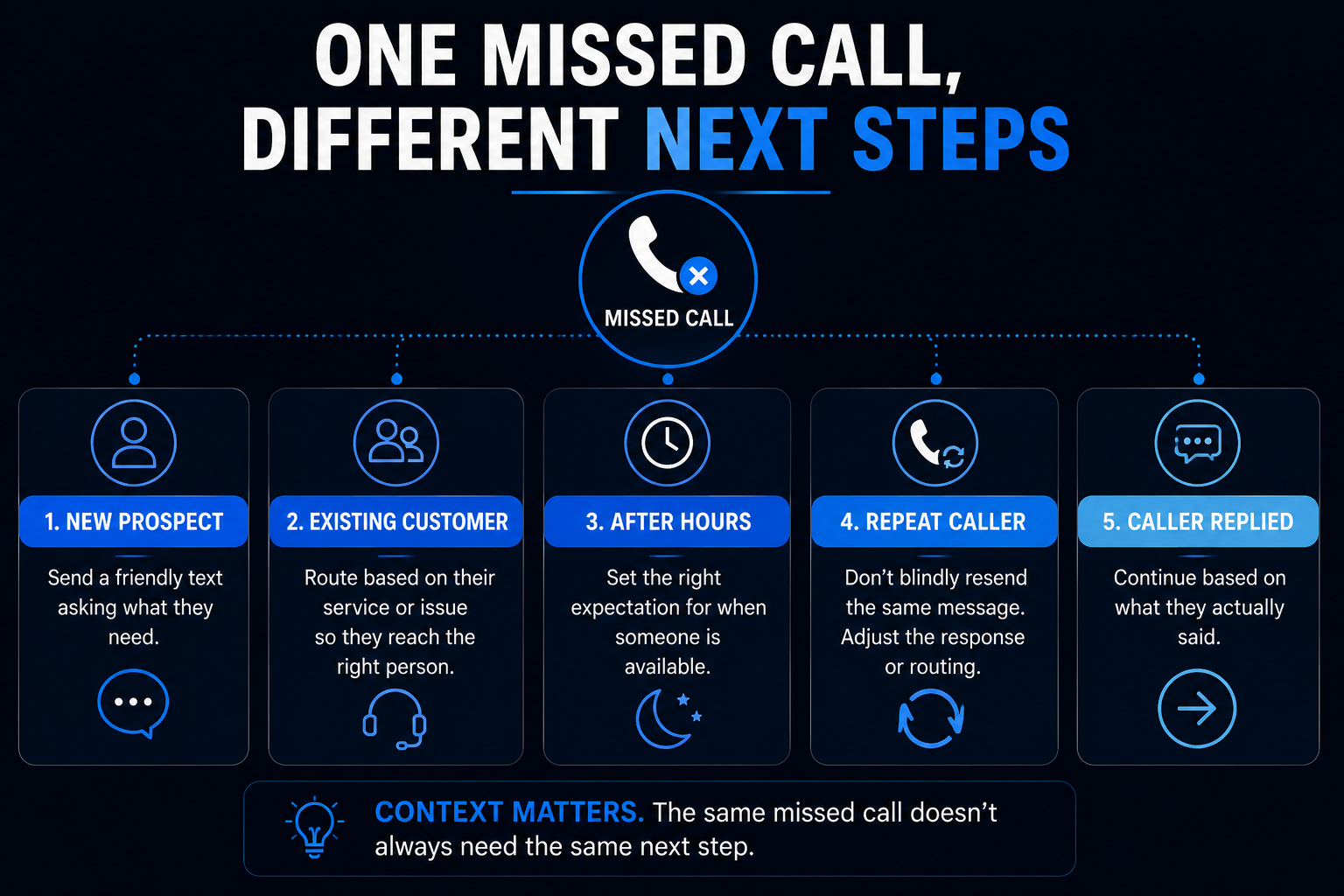
A more thoughtful system can consider things such as:
Is this the first missed call or a repeated attempt?
A repeat caller may need escalation rather than another copy of the same message.
Is the business open or closed?
The response expectation should change.
Is this a new prospect or an existing customer?
The conversation may need to go somewhere completely different.
Did the person reply to the text?
If they did, the next automation should respond to what they said—not continue sending generic missed-call messages.
Does the request appear urgent?
Some businesses may need routing or notification logic for certain situations.
Has someone on the team already taken over?
Automation should know when to get out of the way.
This is the same principle behind good automated lead follow-up:
Automate the process without automating your ability to listen.
How Fast Should the Missed-Call Text Be Sent?
Generally, the acknowledgement should happen quickly.
That's one of the main reasons to automate it.
If someone calls at 2:14 and your automatic “sorry we missed you” message arrives at 4:47, we've somewhat missed the point.
But speed isn't the only thing that matters.
A fast useless message is still a useless message.
The goal is:
fast acknowledgement + useful next step + appropriate follow-through.
That connects directly to speed to lead, but missed-call recovery has an additional advantage: the person has already demonstrated enough interest to pick up the phone and call.
Don't make continuing that conversation harder than it needs to be.
Should the Text Include a Booking Link?
Sometimes.
Not automatically.
A booking link makes sense when:
- the caller's likely objective is scheduling
- your business can actually accept self-booked appointments
- the calendar reflects real availability
- the appointment type is appropriate for self-scheduling
It makes less sense when the business needs to understand the request first.
A remodeling contractor probably doesn't want every caller blindly booking an “estimate” before anyone knows whether the project fits.
A salon may be perfectly happy letting someone schedule directly.
The next step should fit the business process—not the software feature.
Should AI Respond After the Missed-Call Text?
It can.
But AI isn't necessary just to send:
Sorry we missed your call.
A basic automation can handle that.
AI becomes more useful after the person responds.
If the caller texts:
My AC stopped working and the house is getting really hot.
an AI-assisted system may be able to interpret the request, gather appropriate information, route the opportunity, answer basic questions or move the conversation toward scheduling.
If they say:
I'm calling about an invoice from last month.
that's a completely different path.
That's what makes an AI-assisted conversation potentially useful: understanding context and helping determine what should happen next.
AI shouldn't be added merely so a business can say its missed-call text is “AI-powered.”
Missed-Call Text Back Is a Recovery Mechanism, Not a Phone Strategy
One important distinction:
The goal isn't to miss more calls because the automation can text people.
If a valuable call can be answered by the right person, that's usually preferable.
Missed-call text back exists for the calls that inevitably slip through:
- someone is already on another call
- crews are working
- the office is closed
- the business is short-staffed
- call volume spikes
- the owner is driving
- nobody can answer safely at that moment
It creates a bridge between:
“Nobody answered.”
and:
“The conversation can still continue.”
That's why it belongs inside a broader lead conversion system, rather than existing as a random phone-system feature.
Don't Forget What Happens After the Text
This is the part that matters most.
A business installs missed-call text back.
Fantastic.
Someone replies.
Then what?
If the response sits unnoticed in an inbox for four hours, the business hasn't solved the problem.
It moved the bottleneck.
The complete process might look more like:
Missed call → immediate acknowledgement → caller replies → conversation continues → opportunity gets routed → next step happens → follow-up continues if necessary.
That's much closer to how the Booked Calendar System™ fits into the picture.
The text isn't the system.
It's one moment inside the system.
And this is another example of why more leads aren't always the answer.
Sometimes the opportunity already called you.
The bigger question is what your business did with it.
A Simple Starting Point
If you're setting this up today, don't spend three hours debating punctuation.
Start with:
Hi, this is [Business Name]. Sorry we missed your call. You can text us here with a quick note about what you need, and we'll get back to you as soon as we can.
Then look at what actually happens.
What do callers reply with?
What questions does your team need answered?
Which calls need different routing?
What happens after hours?
Where do conversations stall?
Do callers frequently want to schedule?
Are repeat calls getting inappropriate duplicate messages?
Use those real interactions to improve the process.
Your best missed-call text isn't necessarily the one someone posted in a template library.
It's the one that fits what your customers need and what your business can actually do next.