AI is apparently going to replace your employees, run your company, answer every customer, create your marketing, close your sales, do your bookkeeping, build your website and probably clean the office before everyone arrives Monday morning.
Or at least that's what the internet would have you believe.
The reality for most service businesses is considerably less dramatic—and a lot more useful.
AI is changing how businesses operate.
But the biggest opportunity isn't necessarily replacing people or installing some futuristic autonomous company.
It's identifying the repetitive places where opportunities get lost, employees waste time, customers wait unnecessarily, or information gets stuck—and applying practical AI automation inside those processes.
For a contractor, home-service company, professional service firm or other local business, that's where things get interesting.
AI adoption is real. But "using AI" can mean almost anything.
You've probably seen wildly different statistics about how many businesses are using AI.
There's a reason for that.
The U.S. Census Bureau reported that overall business AI usage hovered around 17% to 20% between December 2025 and May 2026. Its survey asks whether companies use AI in business functions.
Meanwhile, the Federal Reserve's Small Business Credit Survey found nearly 40% of small-business respondents were either already using AI or planning to use it. Reported applications included productivity, marketing, communications, graphic design, customer service, analytics and forecasting.
Other surveys using broader definitions produce considerably higher numbers.
That's not necessarily contradictory.
Someone occasionally asking ChatGPT to rewrite an email is technically using AI.
So is a company using AI-assisted software throughout customer service, marketing and operations.
Those are very different levels of implementation.
For business owners, I think that's a more useful distinction than arguing about the exact adoption percentage.
Using an AI tool isn't the same thing as building AI into how the business operates.
The shift that actually matters: AI is moving from tool to workflow
The first wave of generative AI was mostly about creating things.
Write this email.
Summarize this document.
Create this image.
Give me ten Facebook posts.
Rewrite this proposal.
Useful? Absolutely.
Transformational? Sometimes.
But the bigger shift is AI increasingly becoming part of a workflow rather than something you visit in a separate browser tab.
Consider the difference.
AI as a tool
An employee receives an inquiry.
They copy the message.
Open an AI application.
Ask it to draft a response.
Copy the response.
Edit it.
Send it.
AI inside a workflow
An inquiry arrives.
The system identifies where it came from.
The contact is created or updated.
The inquiry is categorized.
The customer receives an appropriate acknowledgment.
The right person is notified.
A next step is created.
The interaction is recorded.
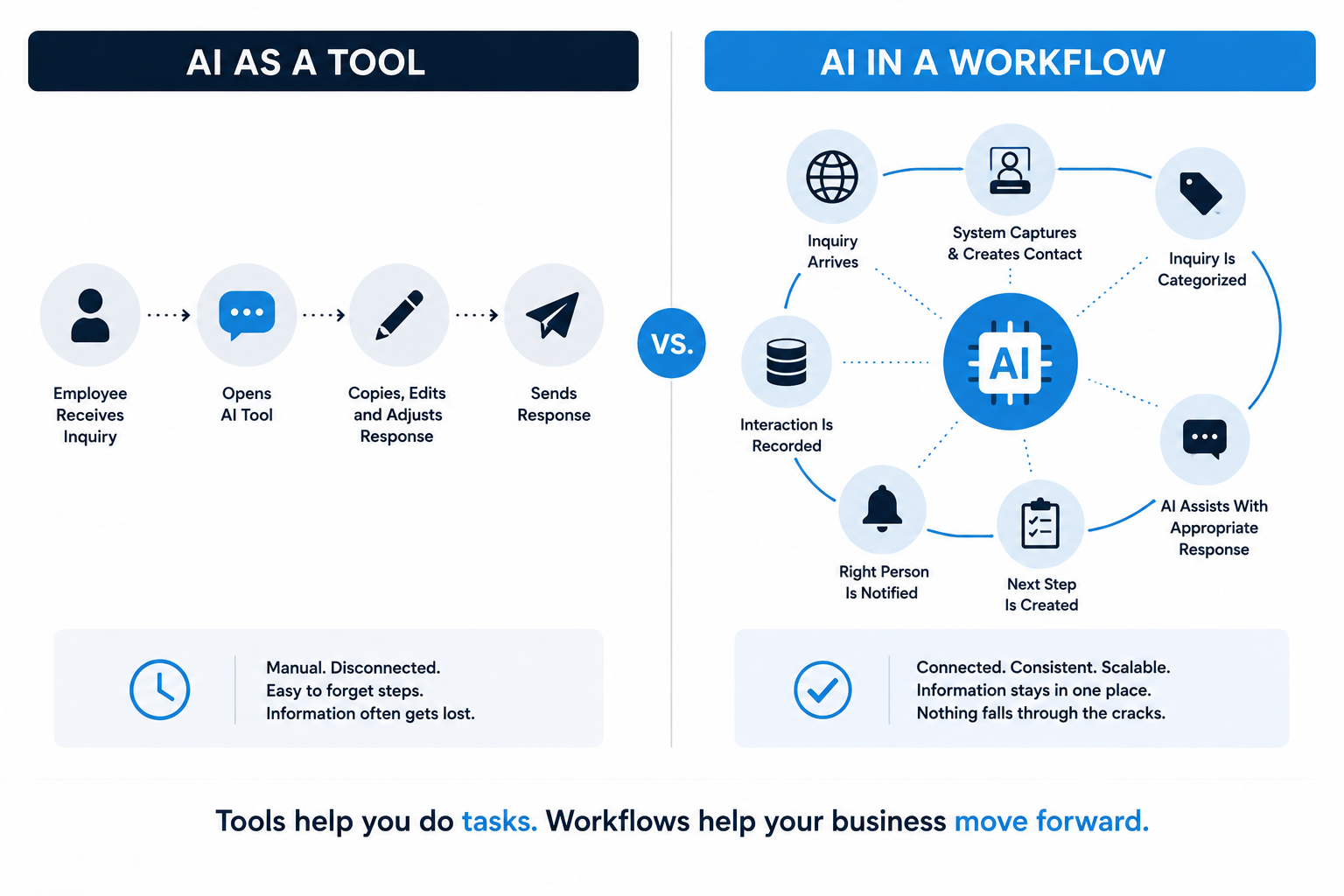
That's a much more meaningful operational change.
McKinsey's research into organizational AI adoption reached a similar conclusion at a much larger scale: among the practices it studied, redesigning workflows had the strongest relationship with organizations reporting financial impact from generative AI.
The lesson for a small business isn't "copy what a Fortune 500 company does."
It's simpler:
Don't start with AI. Start with the workflow.
Where AI can actually matter in a service business
The best opportunities usually aren't the flashiest.
They're the places where small improvements happen repeatedly.
1. Responding to new inquiries
A potential customer fills out a form at 8:47 p.m.
Traditionally, that might mean an email lands in someone's inbox and waits until morning. We cover the full response process in what should happen after someone fills out a website form.
AI and automation can potentially help the business acknowledge the inquiry immediately, collect additional information, answer appropriate questions or provide the next step.
Notice the wording: potentially help.
Not every inquiry should be handed entirely to an AI agent.
A $50,000 remodeling project probably deserves a different conversational process than someone asking whether the business is open Saturday.
The opportunity is matching the technology to the interaction.
2. Handling missed calls
Service businesses miss calls.
That's reality.
Crews are working.
Owners are driving.
Employees are already speaking with customers.
The problem isn't necessarily the missed call itself.
It's what happens afterward.
Automation can immediately acknowledge the caller and create a pathway back into the conversation.
AI can potentially assist once that conversation continues.
That's a practical use of technology because it addresses a real operational problem:
Someone was interested enough to call, but nobody was available at that exact moment.
3. Answering repetitive customer questions
Businesses answer the same questions constantly.
- Do you service my area?
- What are your hours?
- Do you offer financing?
- What happens after I request an estimate?
- How long does the process usually take?
- Do you handle this particular service?
An appropriately configured AI website chatbot can help answer straightforward questions using information the business has provided.
That doesn't eliminate human customer service.
It can reduce the amount of human attention spent answering questions that don't necessarily require human judgment.
4. Lead qualification
Not every inquiry is equally relevant.
A commercial contractor may need project type, location, estimated timeline and scope before deciding where an inquiry belongs.
A pool remodeling company might need to know whether the customer wants resurfacing, decking, equipment work or a complete renovation.
AI can assist with gathering and organizing that information conversationally.
The important word is assist.
I'd be cautious about allowing an AI system to make high-stakes lead qualification decisions without appropriate rules and oversight.
But gathering information before a human conversation?
That's useful.
5. Scheduling
Scheduling is one of those mundane business processes nobody gets excited about until they realize how much time it consumes.
AI doesn't need to reinvent calendars.
Often the real improvement comes from connecting conversation, qualification and existing scheduling automation.
A prospect asks for an estimate.
The system gathers enough information to determine the appropriate next step.
Available appointment options are presented.
The prospect books.
The calendar updates.
The appropriate person gets notified.
Reminders follow.
That's not science fiction.
It's workflow design.
6. Follow-up
This is one of the areas where automation can be more important than AI.
A business doesn't need a sophisticated language model to remember that a lead hasn't replied.
It needs a reliable system.
Automation can trigger reminders and follow-up sequences.
AI can potentially make parts of those interactions more conversational or help interpret responses.
But don't use AI where a simple rule does the job better.
That's an important principle.
The best AI system sometimes contains surprisingly little AI.
7. Organizing conversations and customer information
A customer calls.
Then texts.
Then sends another question three days later.
Meanwhile, an employee leaves a note.
Someone else updates the estimate.
Without good systems, the history becomes fragmented.
AI can help summarize conversations, categorize information, extract useful details and reduce administrative work.
But again, the value isn't "AI summarized something."
The value is:
The next person dealing with that customer can understand what's going on faster.
8. Internal administrative work
Not every useful AI application touches the customer.
AI can assist with:
- summarizing meetings
- drafting routine communications
- organizing notes
- creating first drafts
- extracting information from documents
- creating internal documentation
- analyzing datasets
- helping employees research unfamiliar topics
Recent Federal Reserve research found small businesses reporting AI use across both customer-facing and support functions, including productivity, communications, marketing, customer service and analytics.
For many companies, these quiet productivity improvements may be more valuable than building an elaborate AI agent.
AI is not the same thing as automation
These terms get mashed together constantly.
They're related, but they're not identical.
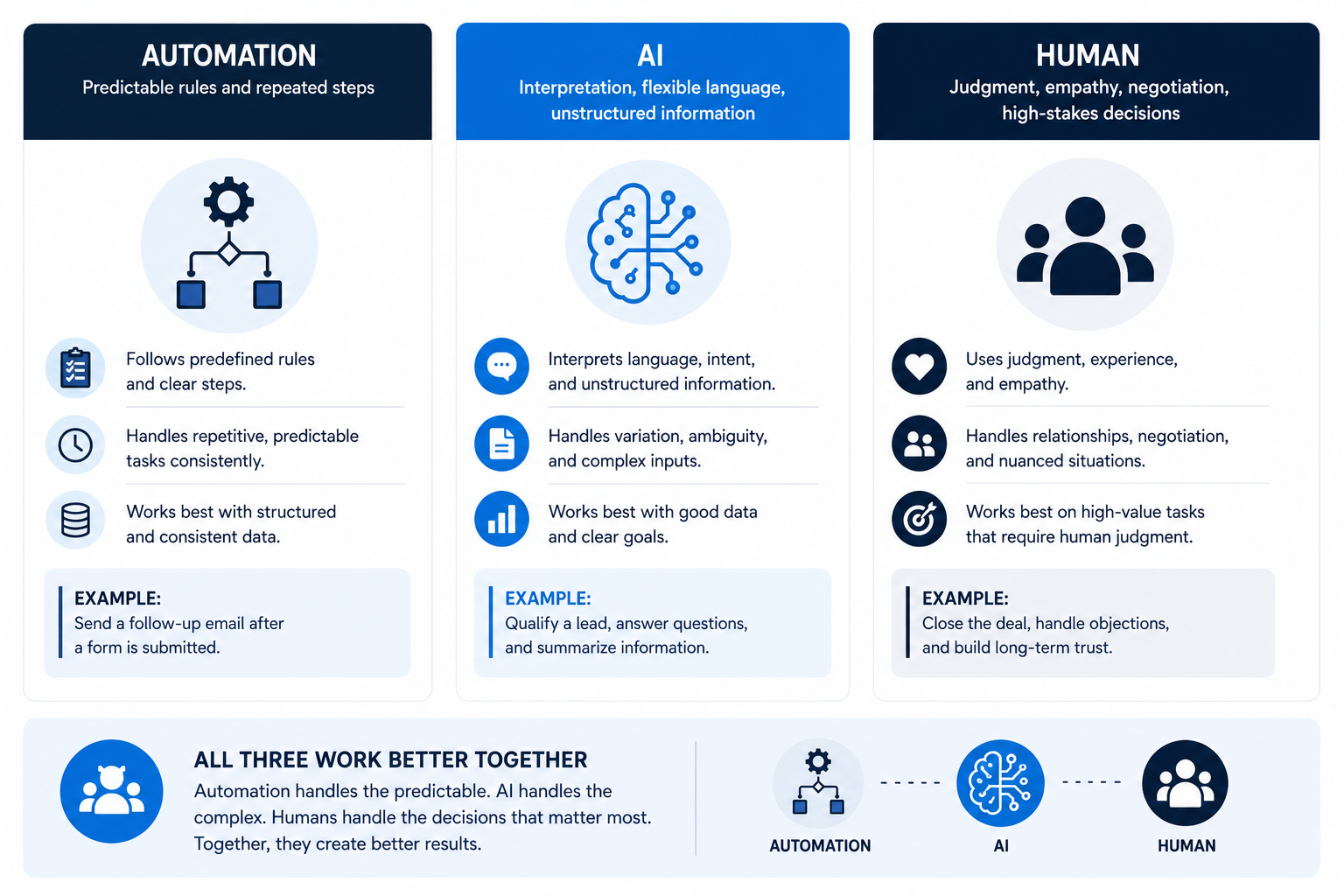
Automation follows predetermined rules.
For example:
When a website form is submitted → create a contact → notify salesperson → send confirmation.
You don't need AI for that.
AI interprets, generates, predicts or makes probabilistic decisions based on information.
For example:
Read the customer's message → determine what they're asking → generate an appropriate response based on approved business information.
Many useful business systems combine both.
Automation provides consistency.
AI provides flexibility where interpretation is useful.
Knowing which one you actually need can prevent a business from paying for complexity it doesn't need.
Where the AI hype starts getting dangerous
AI demonstrations are incredibly persuasive.
Someone types three sentences.
The software does something that would have seemed impossible five years ago.
Everyone says:
"Holy crap."
Then somebody tries to build a business process around the demo.
That's where problems begin.
Hype: "AI can run the whole business"
Could increasingly capable systems coordinate many tasks?
Sure.
Should a local service business hand every customer interaction, operational decision and sales conversation to autonomous AI?
Probably not.
Businesses contain exceptions.
Customers are unpredictable.
Information can be incomplete.
Judgment matters.
Accountability matters.
AI can expand what a small team is capable of doing without requiring the owner to pretend employees have become obsolete.
Hype: "Every conversation should be automated"
No.
Some conversations should be automated.
Some should be assisted.
Some should be human.
If someone asks:
"Do you service Naples?"
Automation or AI can probably handle that.
If someone is furious about a $30,000 project and threatening legal action?
Maybe don't let Robo-Bob freestyle.
Technology should know when to hand something off.
Hype: "You need an AI agent"
Maybe you do.
Maybe you need a form that works properly.
Or missed-call text back.
Or a CRM.
Or appointment reminders.
Or somebody to actually return calls.
"AI agent" has become a solution looking for problems.
The business problem should determine the technology—not the vocabulary currently getting clicks on LinkedIn.
Hype: "AI automatically saves money"
Software costs money.
Implementation costs money.
Mistakes cost money.
Bad integrations cost money.
Employee confusion costs money.
AI creates value when the improvement is worth more than the complexity required to create and maintain it.
That's why implementation matters.
Hype: "AI means set it and forget it"
This one is particularly dangerous.
- Business information changes.
- Offers change.
- Pricing changes.
- Employees change.
- Policies change.
- AI models change.
- Software integrations change.
- Customer behavior changes.
Any system interacting with customers or business data needs monitoring.
Automation isn't autopilot forever.
A simple framework for deciding where AI belongs
Instead of asking:
"How can we use AI?"
I'd ask five different questions.
1. Where are we repeatedly losing time?
Look for tasks employees perform again and again.
- Manual data entry.
- Repeated explanations.
- Copying information between systems.
- Routine status updates.
- Scheduling.
- Follow-up.
These are potential opportunities.
2. Where are customers unnecessarily waiting?
- New inquiry response.
- Scheduling.
- Basic questions.
- Status information.
- Internal routing.
Waiting often reveals where a better system could improve the experience.
3. Where are opportunities being lost?
- Missed calls.
- Forgotten follow-up.
- Unanswered forms.
- Old leads nobody revisits.
- Estimates nobody checks on.
This connects directly to the lead conversion gap.
Before buying more leads, understand what happens to the ones you already have.
4. Does this require judgment or consistency?
This question helps determine the tool.
If the task needs:
Consistency and predictable rules → automation may be enough.
If it needs:
Interpretation or flexible language → AI may help.
If it needs:
Sometimes you need all three.
5. What business outcome are we trying to improve?
This is the question that kills a lot of bad AI ideas.
Not:
"How cool would this be?"
Ask:
Are we trying to:
- respond faster?
- reduce missed opportunities?
- save employee time?
- improve scheduling?
- increase consistency?
- reduce administrative work?
- improve customer experience?
- create better visibility into the pipeline?
If you can't identify the outcome, you're probably experimenting—not implementing.
Experimentation is fine.
Just call it what it is.
What this means for the website
One of the most interesting changes is that the website can become more connected to business operations.
Traditionally, the website's job often ended here:
Visitor → Form Submission → Email Notification
That's useful.
But it's limited.
An AI-powered website can potentially become part of a larger system connecting:
Website → Inquiry → Conversation → CRM → Follow-Up → Scheduling → Sales Opportunity
That doesn't mean every website needs an AI chatbot dancing in the bottom-right corner.
It means the website shouldn't necessarily be isolated from everything that happens after someone becomes interested.
For service businesses especially, that connection can be valuable because customer acquisition often depends on what happens after the click.
If you want to go deeper, what actually makes a service business website convert is worth understanding before adding more technology.
What this means for employees
AI discussions often jump immediately to job replacement.
That's understandable.
But current small-business research paints a more nuanced picture.
A June 2026 U.S. Chamber of Commerce Foundation/Ipsos study found that half of workers at small businesses reported using AI at work, with usage focused heavily on productivity rather than simply automating jobs away.
That's closer to how I think many service businesses should approach this.
Give employees leverage.
Let technology handle repetitive administrative steps where appropriate.
Help people find information faster.
Make follow-up harder to forget.
Reduce unnecessary copy-and-paste work.
Let humans spend more time where humans actually add value.
A great salesperson shouldn't spend half the afternoon manually updating five systems.
A skilled contractor shouldn't be writing the same appointment-confirmation text twenty times.
An office administrator shouldn't have to remember every follow-up from memory.
The point isn't to remove people from the company.
It's to stop wasting people on work a system can reliably handle.
Start smaller than the AI influencers tell you to
If you're running a service business and haven't implemented much AI yet, I would not begin by trying to build an autonomous AI workforce.
Start with one painful process.
Maybe:
We miss too many calls.
Or:
Website inquiries don't get answered quickly enough.
Or:
Nobody consistently follows up with old leads.
Or:
Scheduling consumes too much administrative time.
Map what happens today.
Identify the failure.
Then determine whether:
- the process simply needs improvement
- automation can fix it
- AI can improve part of it
- or some combination makes sense
Implement.
Measure.
Adjust.
Then move to the next bottleneck.
That's not as exciting as announcing that you've deployed seventeen AI agents.
It has a much better chance of actually helping the business.
AI should make the business better, not merely more "AI-powered"
There's going to be enormous pressure over the next few years for companies to advertise how much AI they use.
I don't think customers care nearly as much as technology companies hope they do.
Customers care whether:
- someone responds
- their question gets answered
- scheduling is easy
- communication is clear
- the company remembers who they are
- the service is good
- problems get resolved
If AI helps accomplish those things, fantastic.
If traditional automation does it better, use automation.
If a human should handle it, use a human.
The goal isn't to win an award for having the most artificial intelligence.
The goal is to build a better business.