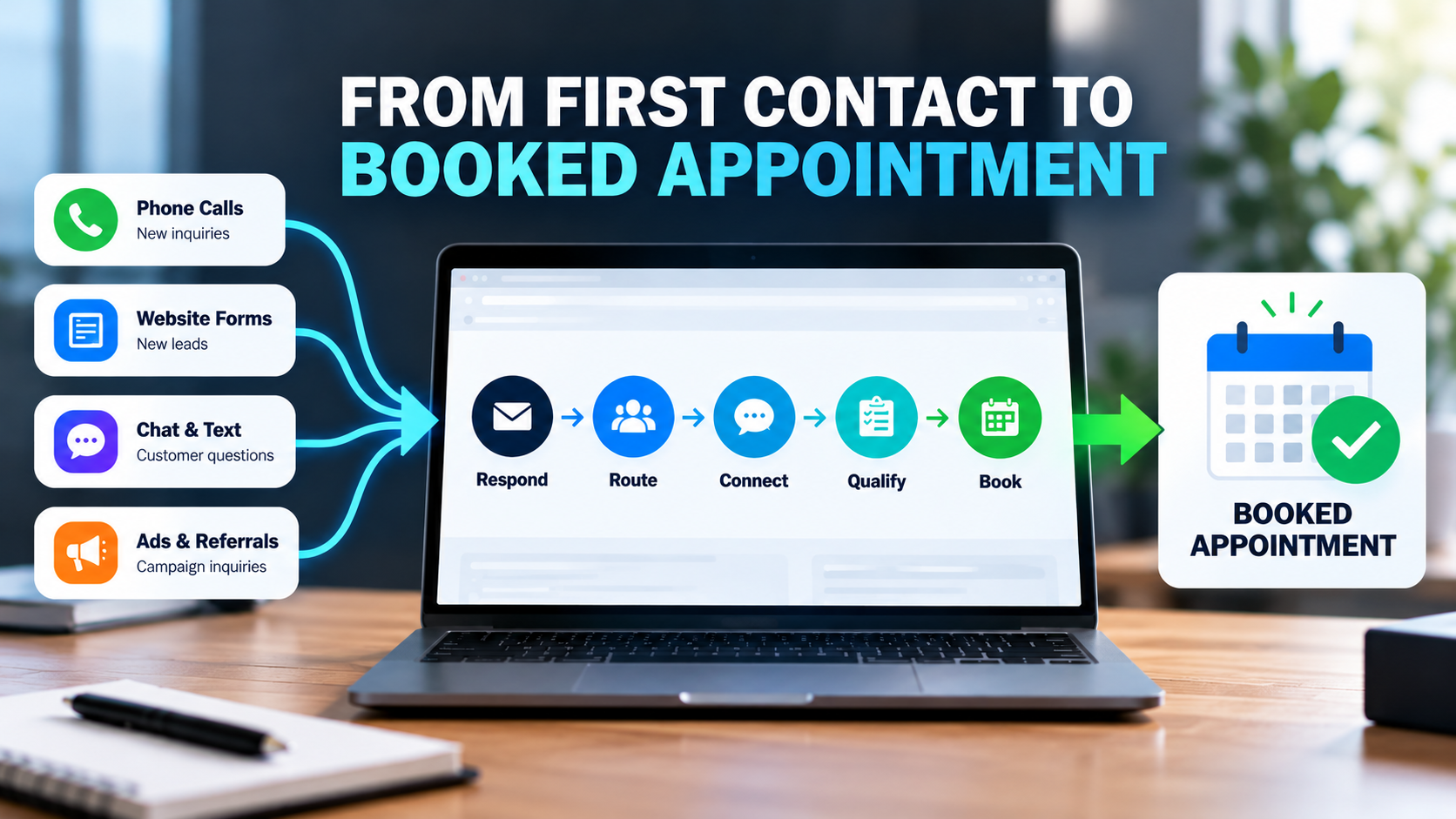
A prospect calls your business.
Or fills out a form.
Or starts a chat.
Or sends a text after seeing an ad.
Or messages you because a friend recommended you.
What happens next?
That sounds like a simple question. For a surprising number of businesses, it isn't.
The inquiry may hit someone's inbox. A notification may appear on a phone. Somebody may scribble a name on a notepad. The lead may get entered into a CRM. Maybe someone calls back. Maybe they don't. Maybe the prospect hears from three people. Maybe they hear from nobody.
Marketing did its job. Someone raised their hand.
Now the business has to do something useful with the opportunity.
And that's where the real lead-conversion process begins.
The Lead-to-Appointment Journey
A healthy lead process does not need to be complicated.
But it does need to be intentional.
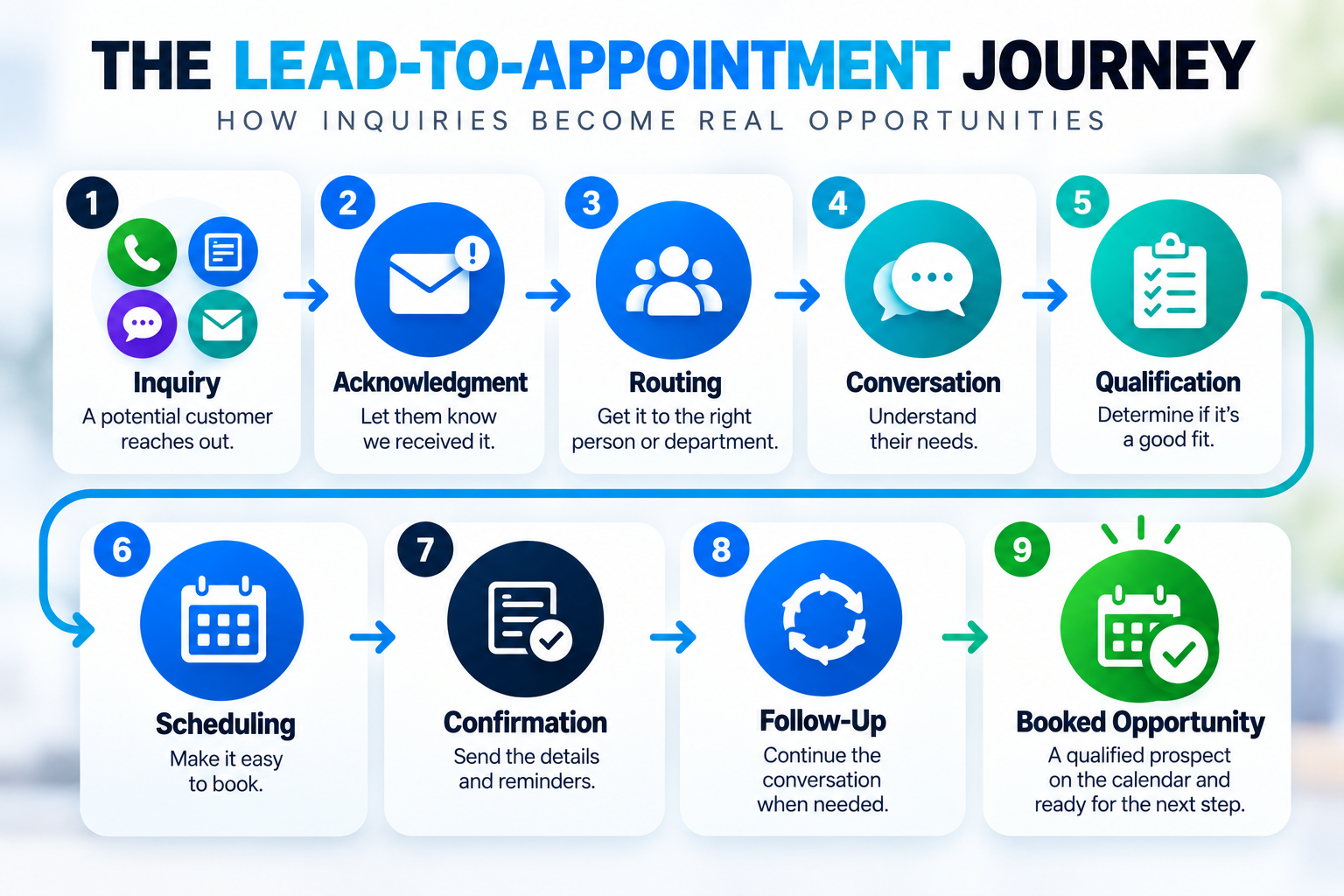
At a high level, the journey looks something like this:
Inquiry → Acknowledgment → Routing → Conversation → Qualification → Scheduling → Confirmation → Follow-Up → Booked Opportunity
That does not mean every prospect follows an identical path.
Someone calling with an urgent HVAC problem should not necessarily experience the same process as someone requesting a consultation for a six-month remodeling project.
The point is that the business should know what is supposed to happen.
A lead should not depend entirely on whether the right employee happens to notice the right notification at the right moment.
1. Inquiry: Someone Raises Their Hand
The journey starts when a potential customer makes contact.
That contact might come through:
- a phone call,
- a missed call,
- a website form,
- live chat,
- text,
- social media,
- an advertising campaign,
- a referral,
- or another channel.
Businesses often treat these as separate marketing activities.
The prospect doesn't.
From their perspective, they contacted your business.
They don't care that Facebook messages are handled in one place, website forms land somewhere else, and phone calls go through another system.
They care whether somebody helps them.
This is why the first question isn't just:
Where did the lead come from?
It's also:
Where does the lead go now?
If the inquiry came through your website specifically, I've covered the website-form handoff in more detail in What Should Happen After Someone Fills Out Your Website Form?.
This article goes wider than that. We're following the opportunity through the entire process.
2. Acknowledgment: Let Them Know Someone Is There
One of the simplest improvements a business can make is also one of the easiest to overlook:
Acknowledge the inquiry.
If someone reaches out and gets silence, they don't know whether:
- the message went through,
- anyone saw it,
- the company is open,
- somebody plans to respond,
- or they should contact the next business on Google.
Acknowledgment doesn't necessarily mean the entire sales conversation has to happen instantly.
It means removing uncertainty.
That might be a person answering the phone.
It might be an immediate text after a missed call.
It might be a useful confirmation after a form submission.
It might be an automated message that tells the prospect what happens next.
The important distinction is this:
Fast acknowledgment and meaningful response are related, but they are not exactly the same thing.
An instant message saying “We received your request” is helpful.
It is not a substitute for actually handling the request.
We've gone deeper on this distinction in What Is Speed to Lead? and How Fast Should You Respond to a New Lead?.
3. Routing: Get the Opportunity to the Right Place
Once the inquiry exists, who owns it?
That question becomes increasingly important as a business grows.
Maybe every lead goes to the owner.
Maybe residential and commercial inquiries go to different people.
Maybe one salesperson handles a particular service area.
Maybe emergency calls need one process while estimate requests need another.
Maybe a lead should enter a central inbox or CRM before anyone touches it.
Whatever the system is, somebody—or something—needs to decide where the opportunity belongs.
Bad routing creates some painfully avoidable problems:
- two employees contact the same person,
- everyone assumes somebody else responded,
- a lead sits in an inbox nobody checks,
- the wrong department receives the inquiry,
- nobody can tell who owns the follow-up.
This is why lead routing matters.
Routing is not glamorous.
Neither is discovering two days later that nobody called the $15,000 opportunity back.
4. Conversation: Move Beyond Capturing Contact Information
A form submission is data.
A name and phone number in your CRM is data.
A missed-call notification is data.
The business opportunity starts becoming clearer when an actual conversation happens.
That conversation may happen by phone, text, chat, email, or some combination.
The goal is not to force every prospect into the same communication channel.
It's to keep the process moving.
A useful response should help answer questions such as:
- What does the prospect need?
- How soon do they need it?
- Where are they located?
- What questions are preventing them from moving forward?
- What would an appropriate next step be?
This is where businesses sometimes make automation unnecessarily robotic.
Automation can help initiate and maintain the process.
It should not make a real customer feel trapped inside a phone tree made out of text messages.
Use technology to reduce waiting and administrative friction.
Use people where judgment, nuance, trust, or a real sales conversation matters.
5. Qualification: Determine the Right Next Step
Not every inquiry should become an appointment.
That's okay.
Qualification helps the business determine whether the prospect, need, location, timing, budget, service, or project is a reasonable fit.
The mistake is turning qualification into an interrogation.
Nobody wants to submit a website form and immediately receive a 17-question homework assignment.
Collect what you actually need to determine the next useful step.
For one business, that might be:
- service needed,
- ZIP code,
- property type,
- desired timeframe.
For another, the business may need more information before scheduling makes sense.
The point of lead qualification is not to create more friction.
It is to route the right opportunities toward the right next step while handling poor-fit inquiries appropriately.
6. Scheduling: Make Moving Forward Easy
Once a prospect is ready for an appointment, estimate, consultation, inspection, demo, or other next step, how difficult is it to arrange one?
This is an underrated part of conversion.
A prospect should not have to exchange nine messages just to discover whether Tuesday at 2:00 works.
Depending on the business, scheduling might happen:
- directly during a phone call,
- through a scheduling link,
- through text,
- through an employee checking availability,
- through an AI-assisted conversation,
- or through another controlled booking process.
Not every business should throw an unrestricted public calendar onto its website.
The appropriate scheduling method depends on the service and sales process.
But once someone is qualified and ready to move forward, unnecessary friction rarely improves the experience.
7. Confirmation: Don't Make the Prospect Wonder What Happens Now
The appointment is booked.
Good.
Now confirm it.
A useful confirmation may include:
- date and time,
- location or meeting method,
- who they are meeting,
- what to expect,
- what they should prepare,
- how to reschedule if necessary,
- any important instructions.
This reduces uncertainty for the customer and prevents avoidable confusion for the business.
For appointments where no-shows are costly, a sensible reminder process can help as well. We've covered that separately in How to Reduce Appointment No-Shows.
Again, the purpose isn't to bombard somebody with notifications.
It's to make the next step obvious.
8. Follow-Up: What If They Don't Respond?
This is where a lot of otherwise decent lead systems quietly fall apart.
Someone inquires.
The business responds once.
The prospect doesn't answer.
The lead disappears.
That isn't much of a follow-up process.
People fail to respond for all kinds of reasons:
- they're working,
- they're driving,
- they're comparing options,
- their kid interrupted them,
- the project isn't urgent yet,
- they forgot,
- they intended to reply later.
Silence does not automatically mean “not interested.”
That doesn't mean chasing somebody forever, either.
It means having a reasonable process.
For example:
- initial response,
- another contact attempt,
- an alternate channel when appropriate,
- useful follow-up over a sensible period,
- a clear way for the prospect to re-engage.
The exact cadence should fit the business and the type of inquiry.
We've addressed that separately in How Many Times Should You Follow Up With a Lead?.
The important point here is simpler:
Follow-up should be a process, not a memory test.
9. Booked Opportunity: The Calendar Is Not the Finish Line
A booked appointment is valuable.
It is not revenue.
The prospect can still:
- cancel,
- no-show,
- choose someone else,
- discover the service isn't a fit,
- postpone the project,
- decide not to buy.
That's why I prefer thinking in terms of a booked opportunity rather than pretending every calendar event is a customer.
The business has successfully moved a person from:
“I'm interested”
to:
“I'm willing to spend time taking the next step.”
That's meaningful.
Now the sales and service process has to do its job.
This distinction matters when businesses evaluate marketing.
Twenty leads, ten real conversations, six appointments, four proposals, and two customers tell you much more than simply saying:
“We got twenty leads.”
Businesses Think in Tools. Customers Experience a Journey.
This may be the most important idea in the article.
Inside the business, we tend to see:
Phone system
Website forms
Chat
CRM
Pipeline
Automations
Calendar
Reminders
Those tools matter.
But your customer isn't sitting there admiring your software stack.
They experience something more like:
I reached out.
Did anybody notice?
Do they understand what I need?
Who am I talking to?
What should I do next?
Can I easily schedule?
Did they remember our appointment?
What happens if I don't answer immediately?
That's the experience you should design.
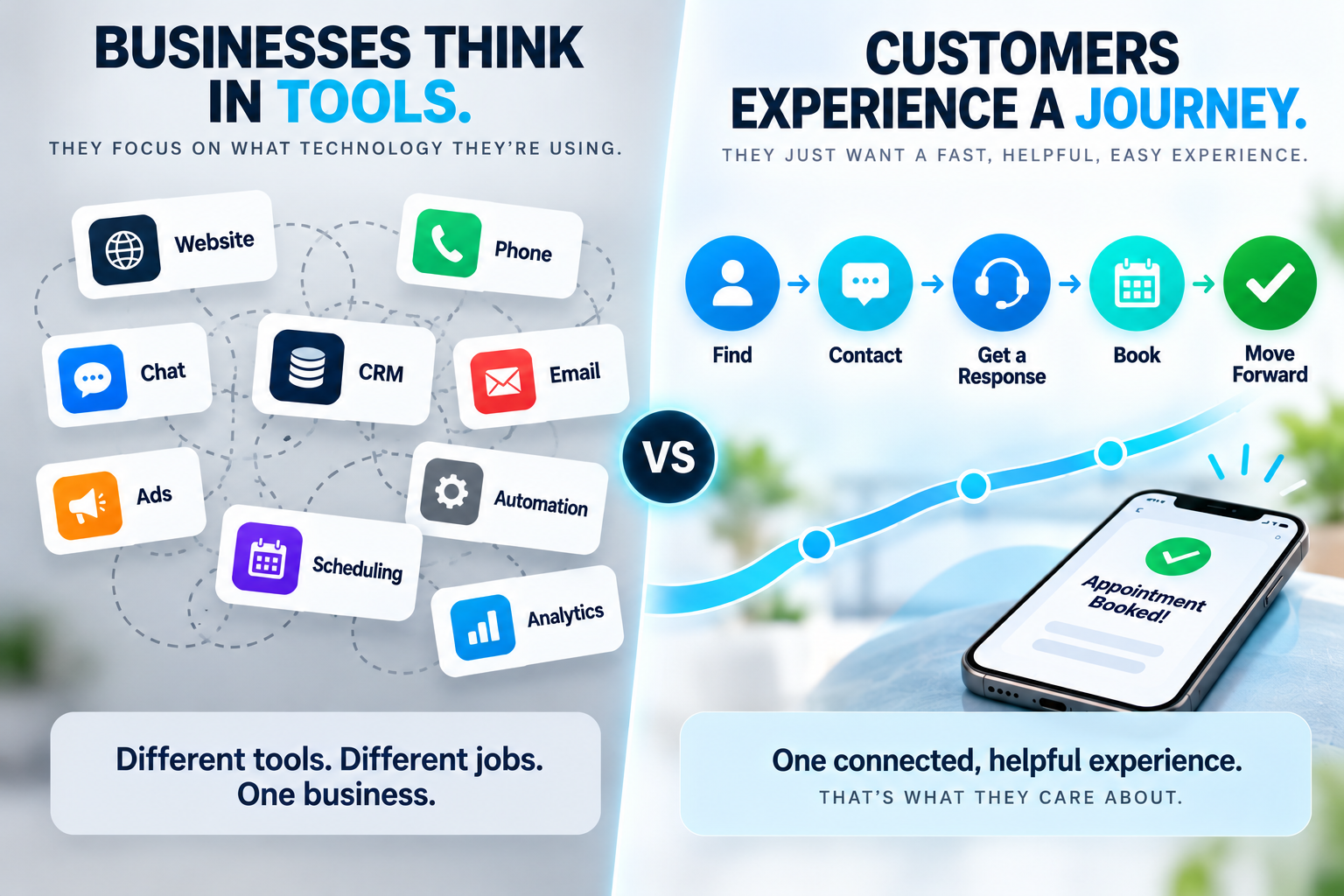
The best lead-conversion systems often feel surprisingly simple from the customer's side.
That's usually a good sign.
Complexity can live behind the scenes.
The customer should mostly experience responsiveness, clarity, continuity, and an obvious next step.
Run a Lead-to-Appointment Handoff Audit
You don't need a giant consulting engagement to find obvious holes in this process.
Pick one real inquiry source.
For example:
Someone calls your business from Google and nobody answers.
Now follow that hypothetical lead all the way through the system.
At each handoff, ask:
Who owns this step?
Is there one clearly responsible person or process?
Or does everybody assume somebody else has it?
How quickly should this happen?
Immediately?
Within five minutes?
Within the same business day?
The appropriate answer depends on the step, but there should be an answer.
Where is the information recorded?
Is the opportunity in a CRM?
A shared system?
One employee's phone?
An email inbox?
A sticky note with surprisingly ambitious career goals?
What should the prospect experience?
Do they know the business received their inquiry?
Do they know who is helping them?
Do they know the next step?
What is the next desired action?
Reply?
Answer the phone?
Schedule?
Send photos?
Confirm an address?
Attend an appointment?
If the business doesn't know the next desired action, the prospect probably doesn't either.
What happens if the prospect doesn't respond?
Is there follow-up?
For how long?
Through which channels?
When does the opportunity move into longer-term nurturing rather than active pursuit?
What happens if an employee misses the task?
Does the system catch it?
Does someone else see it?
Or is the opportunity effectively gone?
How do you know whether the opportunity is still active?
This is where a well-organized CRM pipeline can help.
The purpose of a pipeline isn't to create colorful columns for management to stare at.
It's to answer a useful operational question:
Where does this opportunity stand right now?
Run this audit for:
- phone calls,
- missed calls,
- website forms,
- chat,
- ad leads,
- referrals,
- text inquiries.
You may discover that your marketing is working considerably better than your handoffs.
Where Automation Helps—and Where It Doesn't
Automation is extremely useful when it eliminates preventable delay or repetitive work.
It can help with things like:
- instant acknowledgment,
- missed-call responses,
- routing,
- CRM updates,
- follow-up sequences,
- reminders,
- scheduling workflows,
- lead nurturing,
- reactivation.
But automation works best when the underlying process makes sense.
Automating confusion just creates faster confusion.
Before asking:
“What should we automate?”
ask:
“What should happen?”
Then decide which parts benefit from automation and which parts need a person.
A good system should make the business more responsive without making the customer feel like they are negotiating with a vending machine.
The Real Test: What Happens to the Next Lead?
It is easy to talk about lead generation in averages.
Cost per lead.
Traffic.
Conversion rate.
Monthly inquiry volume.
Those metrics matter.
But here's a much more revealing exercise:
Imagine a genuinely qualified prospect contacts your business five minutes from now.
What happens?
Who sees it?
How quickly?
What does the prospect receive?
Who owns the conversation?
Where is the opportunity tracked?
How does the person schedule?
What happens if they don't respond today?
What happens if they come back two weeks from now?
If the answers are clear, you probably have a process.
If the answers depend on who happens to be checking their phone, you have some work to do.
That's one of the reasons I keep coming back to the idea that businesses don't always need more leads.
Sometimes the more valuable opportunity is improving what happens to the leads they're already generating.
If that sounds familiar, Before You Spend Another Dollar on Leads, Fix This walks through the broader conversion infrastructure in more detail.
Where Booked Calendar System™ Fits
Booked Calendar System™ is how we approach this problem at Boost Local Biz.
It isn't based on the idea that every business needs another pile of software.
It's based on connecting the pieces that determine whether an inquiry becomes a real opportunity.
Depending on the business, that can include faster response, missed-call handling, automated follow-up, AI-assisted conversations, CRM organization, pipelines, scheduling, reminders, nurturing, and reactivation.
The exact combination matters less than the outcome:
A qualified prospect should not fall through the cracks simply because the process between “I'm interested” and “let's talk” is broken.
Marketing creates opportunities.
Your conversion system determines what happens to them.
Let's Find the Gaps Between Inquiry and Appointment.
We'll look at how your business responds, routes, follows up with, tracks, and schedules new opportunities—and where qualified leads may be falling through the cracks.