
Sales are slower than you want.
The calendar has more empty space than it should.
Someone looks at the numbers and says:
“We need more leads.”
So the instinct is to turn up the ad budget, launch another campaign, hire another marketing company, or start chasing the next lead source.
Sometimes that is the right move.
But before you spend another dollar trying to generate more opportunities, ask a different question:
What happened to the leads you already had?
That question is usually less exciting than talking about ad spend, SEO, funnels, or the next marketing strategy.
It is also one of the most important questions a business can ask.
Because more leads do not fix a broken lead-conversion process.
If calls are missed, forms sit too long, follow-up depends on memory, estimates disappear, scheduling is clunky, and old leads are forgotten, increasing lead volume can simply increase the number of opportunities that slip through the cracks.
Before you buy more leads, stress-test the system that is supposed to convert them.
What Should You Fix Before Spending More Money on Leads?
Before increasing lead-generation spend, audit what happens after someone becomes interested in your business.
Look at your lead-conversion process across:
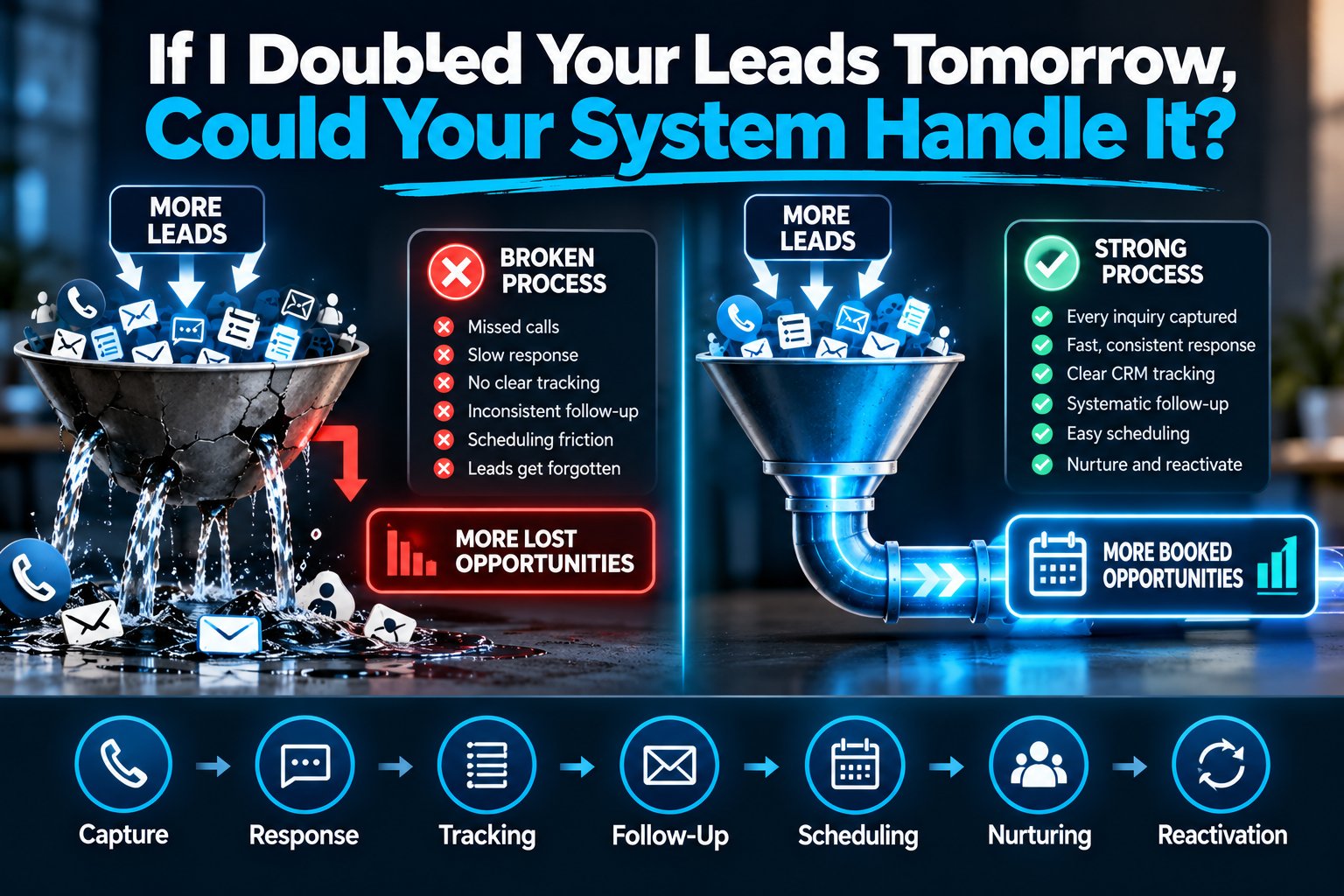
Capture → Response → Tracking → Follow-Up → Scheduling → Nurturing → Reactivation
You want to know whether new inquiries are captured reliably, responded to quickly, visible to the team, followed up consistently, easy to schedule, and revisited when the timing is not right today.
That is your lead-conversion infrastructure.
It does not have to be complicated.
It does have to work.
First, Ask the Question Most Businesses Skip
Here’s the question I would ask before increasing lead volume:
If I doubled your leads tomorrow, would your current process handle them?
Think about that literally.
If twice as many people called, filled out forms, requested estimates, started chats, or asked to schedule:
Would your team respond twice as effectively?
Or would you simply create:
- more missed calls
- more unread form submissions
- more leads waiting for a response
- more estimates nobody follows up on
- more scheduling back-and-forth
- more prospects disappearing into inboxes
- more opportunities nobody revisits
If doubling lead volume would mostly create twice as much chaos, you probably do not have a lead-generation problem first.
You have a conversion-capacity problem.
That is what needs to be fixed.
Run a Lead Stress Test
You do not need a complicated audit to find obvious leaks.
Follow one hypothetical lead from the moment they raise their hand.
Then ask what happens next.
Can You Reliably Capture Every Inquiry?
Start with the basics.
Where do leads actually come from?
For many businesses, the answer is some combination of:
- phone calls
- website forms
- online chat
- text messages
- Google Business Profile
- Google Ads
- social media
- referrals
- appointment requests
- direct email
Now ask:
Where do all of those inquiries go?
If the answer is:
“Some go to my email, some go to my office manager, some come to my cell phone, some go into the website, and I think the chat notifications go somewhere else…”
you have already found a problem.
Lead capture is not just about having a contact form.
It is about making sure an opportunity does not disappear because it entered through the wrong door.
This is especially important with phone calls.
A missed call is not just a missed call.
It may be a customer who is already moving down a list of businesses and calling the next one.
That is why tools such as missed-call text back can be useful in the right situation.
The goal is not to automate everything.
The goal is to make sure a real opportunity is not silently lost.
How Fast Do You Respond?
Once the lead is captured, response becomes the next potential leak.
Most businesses know they should respond quickly.
The problem is that “quickly” often depends on what else is happening that day.
Someone is driving.
Someone is on a job.
Someone is with another customer.
The office is busy.
The inquiry comes in after hours.
The notification gets buried.
Then a few hours pass.
Maybe a day.
By then, the person who was ready to talk may have already found someone else.
This is where speed to lead matters.
The point is not that every business needs to answer every inquiry in 30 seconds.
The point is that response time should not be accidental.
There should be a clear process for what happens when someone raises their hand.
That can include human response, automation, or both.
But it should be deliberate.
Can You See Every Active Opportunity?
This is one of the biggest differences between a business that has leads and a business that has a system.
Can you look somewhere right now and see:
- every new lead
- who has been contacted
- who has not
- who is waiting for an estimate
- who needs follow-up
- who has scheduled
- who is undecided
- who has gone cold
- who should be contacted again later
If not, opportunities are probably being managed through memory.
And memory is not a CRM.
Email is not a pipeline.
A spreadsheet can work for a while, but once lead volume grows, it becomes easier for things to fall through the cracks.
A CRM pipeline gives a business visibility into what stage each opportunity is in and what needs to happen next.
That does not mean every small business needs a massive software setup.
It means someone should be able to answer:
What is happening with this lead?
without searching through three inboxes and a text thread.
What Happens When the Lead Does Not Respond?
This is where a lot of businesses quietly lose money.
Someone fills out a form.
You call once.
No answer.
Maybe you leave a voicemail.
Then everybody gets busy.
The lead disappears.
That is not really a follow-up process.
That is a single attempt.
People miss calls.
People forget to reply.
People submit forms while they are at work.
People get distracted.
People intend to respond and do not.
A lack of response does not always mean lack of interest.
This is why the number of follow-up attempts matters, but the bigger issue is consistency.
We have a deeper guide on how many times you should follow up with a lead, but the principle here is simple:
Follow-up should not depend entirely on someone remembering to do it.
The process should make it obvious:
- who needs another touch
- when that touch should happen
- what was already said
- what the next step is
Automation can help with consistency.
It should not make communication sound robotic.
The goal is to support good follow-up, not replace judgment.
What Happens After You Send the Estimate?
This deserves its own attention because so many service businesses put enormous effort into getting to the estimate stage.
The customer calls.
You respond.
You schedule.
Someone goes out.
You inspect the project.
You build the proposal.
You send the estimate.
Then what?
For a surprising number of businesses, the answer is:
Wait.
Maybe the customer responds.
Maybe they do not.
Maybe someone remembers to follow up next week.
Maybe the estimate gets buried under newer opportunities.
That is expensive.
Not because every estimate should turn into a sale.
It should not.
But because the business already invested time, labor, travel, attention, and marketing cost to get the prospect that far.
If that opportunity is a good fit, it deserves a real follow-up process.
That is exactly why we have a separate guide on how to follow up after sending an estimate without sounding pushy.
The goal is not to pressure people.
The goal is to stop treating silence like a final answer.
Is Scheduling Making It Harder to Buy From You?
Sometimes the prospect is ready.
The business still creates friction.
“Tuesday?”
“No, Tuesday doesn’t work.”
“How about Thursday?”
“I can do Thursday afternoon.”
“We only have morning.”
And now you are six messages deep into something that could have taken 30 seconds.
That does not mean every business needs fully automated online booking.
Some jobs require qualification first.
Some appointments need manual coordination.
But if a customer is ready to take the next step, the process should not be harder than necessary.
Good scheduling usually means:
- clear availability
- simple next steps
- confirmation
- reminders when appropriate
- fewer unnecessary back-and-forth messages
The easier it is to move from “I’m interested” to “we’re scheduled,” the less opportunity there is for momentum to disappear.
What Happens to People Who Are Interested but Not Ready Today?
Not every good lead is ready immediately.
A homeowner may be planning a project three months from now.
A commercial prospect may need internal approval.
Someone may be collecting bids.
Someone may like your company but simply not be ready to make the decision.
The problem is when every prospect who does not buy today gets treated like a dead lead.
That is where nurturing matters.
Nurturing does not mean blasting people with endless marketing messages.
It means staying appropriately visible so the business is not forgotten when the timing changes.
Sometimes that is a helpful follow-up.
Sometimes it is educational content.
Sometimes it is a simple reminder.
Sometimes it is nothing more than scheduling the right future contact.
The important thing is that “not now” should not automatically become “never.”
What About the Leads You Already Forgot?
This is the part businesses often ignore because old leads do not feel as exciting as new ones.
But look at what may already exist inside your business:
- old form submissions
- old estimate requests
- previous quotes
- prospects who stopped responding
- jobs that were delayed
- people who said “call me in a few months”
- past opportunities that were never officially closed
Some of those people will never buy.
Some may no longer be relevant.
But some may still have the same problem that caused them to contact you in the first place.
That is why reactivating old leads can be valuable.
You already paid something to generate many of those opportunities.
Time.
Advertising.
SEO.
Referral effort.
Labor.
Attention.
Before assuming all growth has to come from brand-new leads, make sure there is not usable opportunity sitting in your own database.
This Is Where Businesses Confuse Marketing With Conversion
Marketing creates attention and interest.
Conversion turns that interest into real business opportunities.
Those are related jobs.
They are not the same job.
A contractor could have excellent Google Ads and still lose leads because nobody answers quickly.
A service business could rank well in Google and still have estimates sitting untouched.
A company could have a beautiful website and still rely on someone manually remembering who needs follow-up.
That does not mean the marketing failed.
It means the system after the marketing is weak.
This distinction matters because otherwise the natural reaction is always:
More traffic. More ads. More leads.
When what the business may actually need is:
Better capture. Better response. Better follow-up. Better visibility. Better scheduling.
That is a very different problem.
Better Systems Make Marketing More Valuable
Suppose a contractor generates leads from:
- Google Ads
- organic search
- Google Business Profile
- referrals
- repeat customers
The marketing is doing its job.
But then:
Some calls are missed.
Website forms get answered the next morning.
Nobody is sure who followed up with which estimate.
Scheduling requires several messages.
Old leads are never revisited.
The obvious answer might be:
“We need more leads.”
But adding another lead source does not fix any of those issues.
It just feeds more opportunities into the same process.
The better move is to improve the process first.
Then, when the business does increase marketing, every new opportunity enters a system that is more capable of handling it.
That is how better lead conversion makes existing marketing more valuable.
Not because every lead suddenly becomes a customer.
But because fewer legitimate opportunities are lost for preventable reasons.
Automation Helps Most When the Process Is Already Clear
There is a temptation to look at everything we just covered and say:
“Great. Let’s automate all of it.”
Not so fast.
A bad process automated is still a bad process.
If nobody knows who owns a lead, software does not solve the management problem.
If the sales message is poor, automated follow-up can just deliver poor communication more consistently.
If the offer is weak, AI does not make people want it.
If the leads are unqualified, more automation does not magically make them better prospects.
Start with the process.
Define:
- what happens when a lead comes in
- who owns it
- how quickly it should be acknowledged
- when follow-up happens
- how opportunities are tracked
- how appointments are scheduled
- what happens when someone is not ready
- what happens to older opportunities
Then use technology to make that process more consistent.
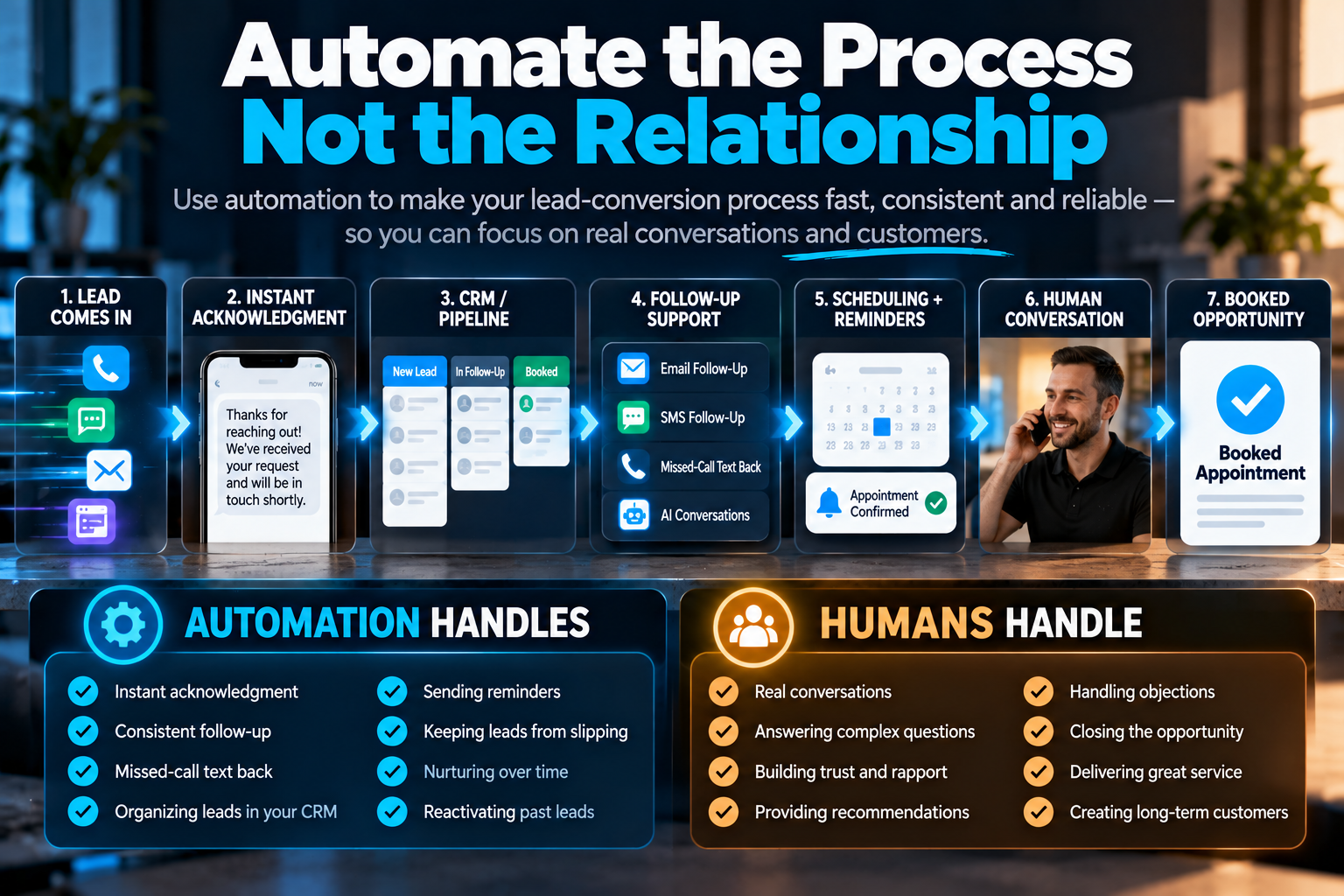
That is where automation becomes useful.
And that is how we think about AI at Boost Local Biz.
Not as the product.
As a tool that helps a better business process run more reliably.
This Is the Thinking Behind the Booked Calendar System™
The Booked Calendar System™ is built around a simple idea:
A lead should not have to survive a maze of disconnected tools, missed notifications, forgotten follow-ups, and manual handoffs just to become an appointment.
The system connects the pieces around the opportunity:
Lead Capture → Response → Follow-Up → CRM Visibility → Scheduling → Reminders → Nurturing → Reactivation
The point is not to pile more software onto a business.
The point is to create a more reliable path from marketing-generated interest to an actual conversation or appointment.
Because generating the lead is only the beginning.
What happens next is where a lot of the money is made—or lost.
So, Do You Need More Leads?
Maybe.
There are businesses that genuinely need more visibility, more traffic, and more qualified opportunities.
But before you spend more, make sure you can answer these questions:
Can we see every new lead?
Do we respond consistently?
Do we know who needs follow-up?
Can we track every active opportunity?
Do we make scheduling easy?
Do we follow up on estimates?
Do we nurture people who are not ready yet?
Do we ever revisit old opportunities?
If the answer to several of those is no, fix that first.
Then increase lead generation.
Because when the system behind your marketing is working, spending more to create qualified opportunities makes a lot more sense.
See Where Your Lead Conversion Process Is Breaking
If you are already generating inquiries but too many opportunities are slipping away between first contact and booked appointment, we can help you identify where the process is breaking. We’ll look at how leads are captured, how quickly they are acknowledged, how follow-up is handled, how opportunities are tracked, and where better systems may help you convert more of the demand you already have.