
A new lead comes in.
How long does it take your business to do something about it?
Five minutes?
An hour?
Tomorrow morning?
Whenever somebody notices the email?
That gap is what marketers and sales teams usually mean when they talk about speed to lead.
Speed to lead is the amount of time between a prospect expressing interest in a business and the business responding to that inquiry.
The basic idea is simple: when someone has just called, submitted a form or started a conversation, their interest is active right now.
Leaving that opportunity sitting unnecessarily isn't ideal.
But there's more nuance here than the internet's favorite version of the advice:
Respond within five minutes or your lead is basically dead.
That's catchy.
It's also an oversimplification.
Fast response matters. But what counts as a response, what should happen immediately, and when a human needs to get involved matter too.
Let's unpack it.
What Does Speed to Lead Actually Measure?
At its simplest:
Lead arrives → business responds
The time between those events is your lead response time.
But even that needs a definition.
Does an automated confirmation count as a response?
What about a text?
An AI conversation?
A salesperson calling?
A receptionist answering the phone?
Those aren't necessarily equivalent.
That's why I prefer separating four things:
Acknowledgment
Confirms that the inquiry was received.
Response
Provides useful information or an appropriate next action.
Conversation
Creates two-way communication with the prospect.
Human handoff
Brings a person into the process when judgment, expertise or relationship-building is needed.
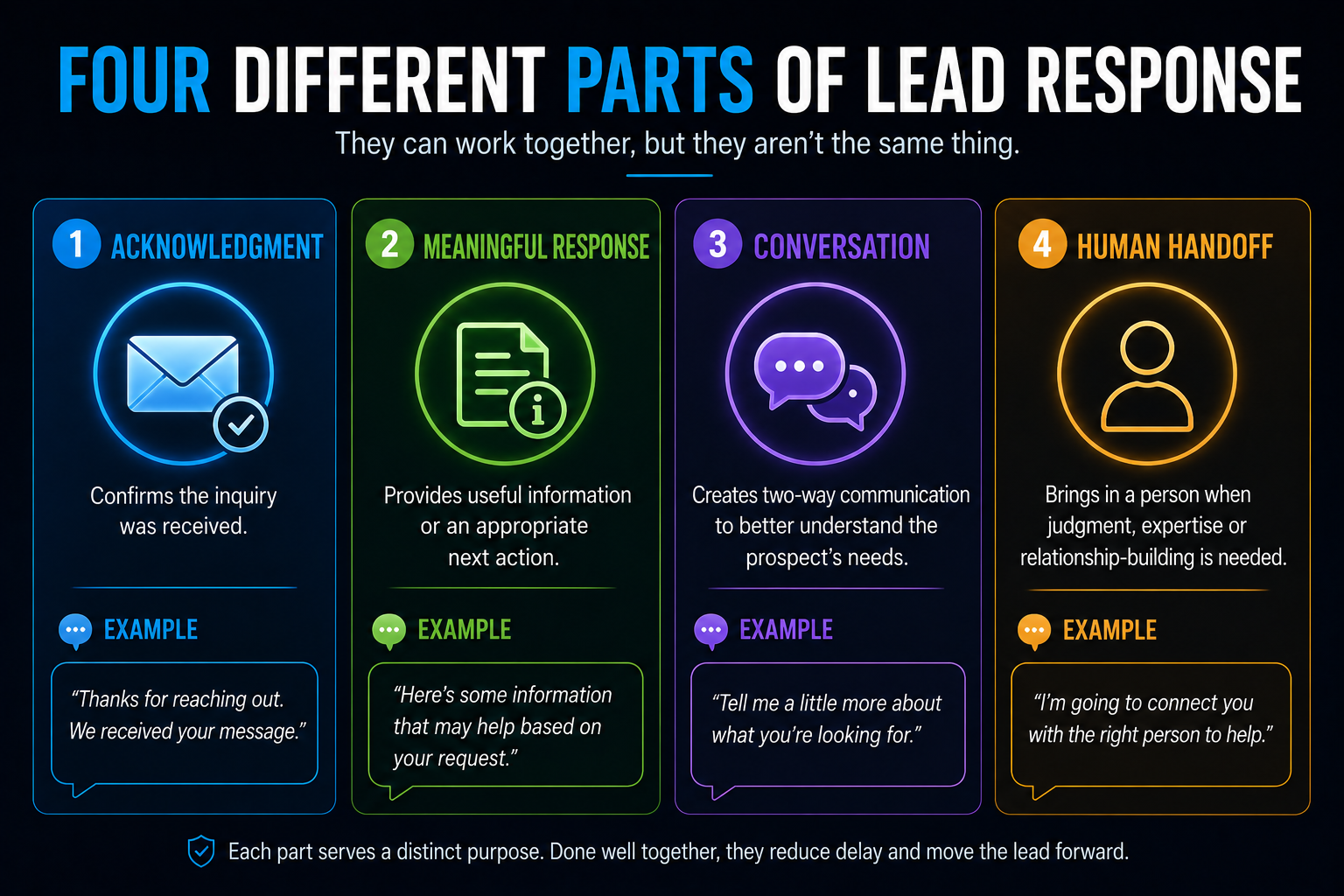
A good lead-response system may use all four.
They just don't have to happen simultaneously.
Why Lead Response Time Matters
Think about what someone is doing when they contact a service business.
They're probably trying to solve something.
Maybe their AC stopped working.
Their roof is leaking.
They're planning a pool remodel.
They need a contractor.
They want an estimate.
They've reached the point where browsing turned into action.
That's a useful moment.
If the business responds while the prospect is still engaged with the problem, starting a conversation may be easier than trying to recreate that momentum much later.
There is older research supporting the general importance of faster response.
But this is also where marketing statistics tend to get abused.
What the Famous "Five-Minute Rule" Actually Says
If you've researched lead response time, you've probably encountered some version of this claim:
Respond within five minutes and you're 21 times more likely to qualify the lead.
There is real research behind that number.
The widely cited figure comes from an older Lead Response Management Study associated with InsideSales.com and research led by James Oldroyd, who was affiliated with MIT Sloan.
The study examined web-generated leads and reported that the odds of qualifying a lead when calling within five minutes versus waiting 30 minutes were dramatically higher. It also reported a sharp decline in the odds of making contact as response time increased.
That's useful evidence.
But notice what I didn't say:
Responding within five minutes gives you 21 times more sales.
That's not what the research established.
The study looked at outcomes such as contact and qualification, not a universal 21× increase in closed revenue.
It was also observational research involving a limited set of companies and dates back many years.
So I wouldn't build your financial forecast around a 21× multiplier.
The practical lesson is much simpler:
Long, unnecessary delays can make it harder to connect with someone who just expressed interest.
That's useful without turning an old statistic into a law of physics.
What About the Harvard Business Review Research?
Another frequently cited piece of lead-response research appeared in Harvard Business Review in 2011.
That analysis looked at how 2,241 U.S. companies responded to web-generated leads and found that many businesses were surprisingly slow to respond.
It also found a strong relationship between faster contact and the likelihood of qualifying a lead.
That research reinforced the broader speed-to-lead principle.
But there's an important citation detail:
The famous 21× five-minute-versus-30-minute statistic does not come from the HBR company-response audit.
Those studies are often blended together online as though they're one piece of research.
They're not.
Why does that matter?
Because if we're going to use statistics to tell business owners how to operate, we should at least know where the statistics came from.
Is Five Minutes the Magic Number?
I wouldn't treat it that way.
The older research suggests that the earliest response windows can matter considerably.
That doesn't mean minute 4:59 is fantastic and minute 5:01 is a disaster.
Businesses aren't controlled experiments.
Lead sources differ.
Industries differ.
Customer expectations differ.
A homeowner requesting emergency plumbing help may behave differently from someone planning a six-figure renovation six months from now.
The better principle is:
Respond as quickly as reasonably possible without sacrificing the appropriateness or quality of the response.
And when an immediate human response isn't realistic, build a system that prevents the opportunity from simply sitting there unnoticed.
Fast Acknowledgment Is Not the Same as a Complete Response
This distinction is important.
Suppose someone submits a request through your website at 8:43 PM.
Your office is closed.
You could have the system immediately say:
Thanks for reaching out. We've received your request.
That's acknowledgment.
Maybe the system can also gather basic information or provide appropriate scheduling options.
That's useful.
But you don't need to pretend that an automated message is the same thing as a contractor personally evaluating the project.
Likewise, you don't need to wake an estimator up at 8:44 PM because somebody requested a patio quote.
The objective is to remove unnecessary delay.
Not human sleep.
What Should Happen Immediately After a Lead Comes In?
For many service businesses, a basic process might look like this. We cover the specifics of how fast you should respond to different types of leads in a separate guide.
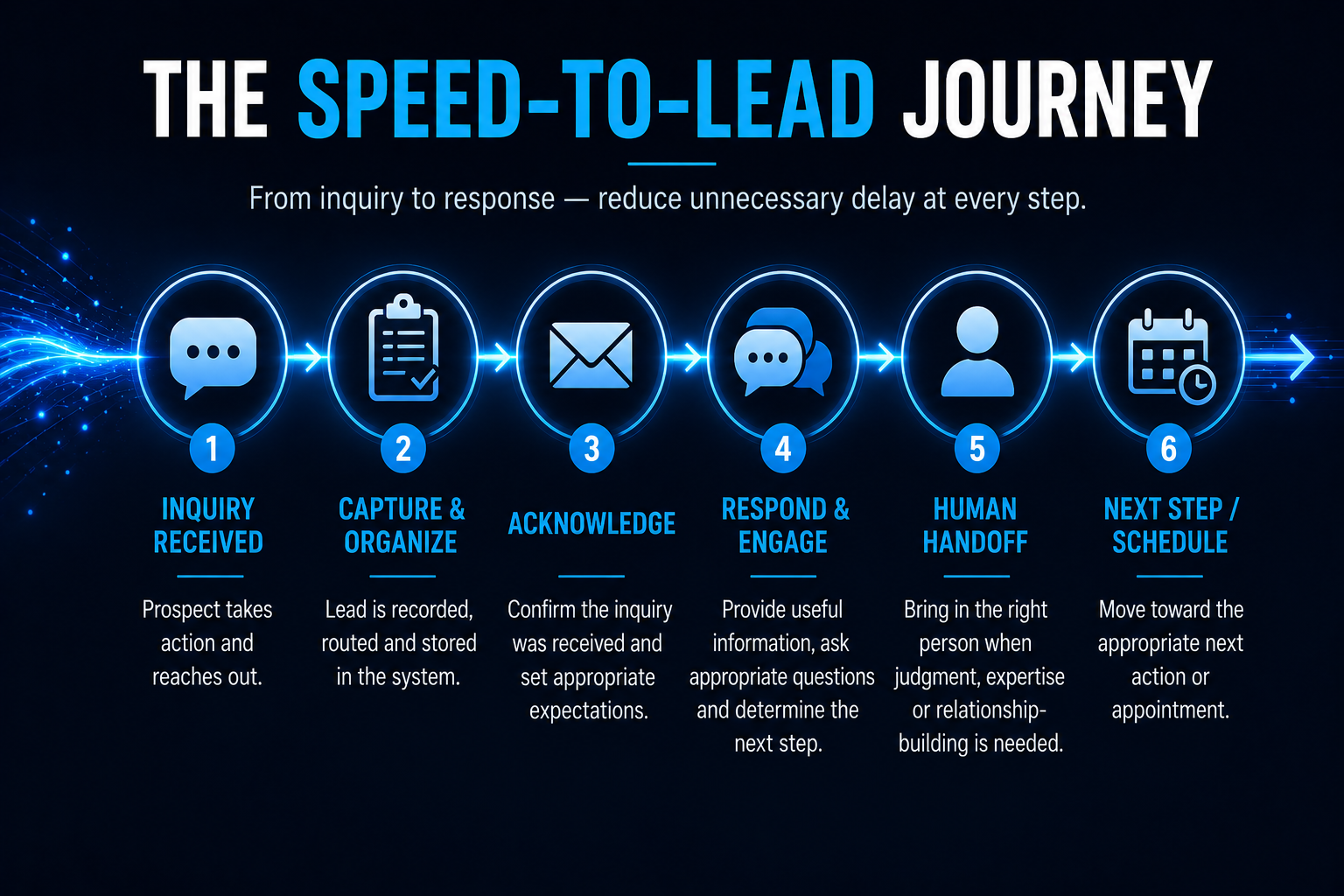
Inquiry received
↓
Lead captured and organized
↓
Immediate acknowledgment
↓
Appropriate next action
↓
Conversation or follow-up
↓
Human involvement where needed
↓
Scheduling when appropriate
The details depend on the business.
An emergency service company may prioritize a phone conversation immediately.
A remodeling company may collect project information first.
A medical or professional service may have additional privacy, compliance or qualification requirements.
There isn't one universal workflow.
That's why the broader lead conversion system matters more than obsessing over one response-time benchmark.
Speed is one component of the system.
Website Leads and Speed to Lead
Website forms create an interesting problem.
They're available 24 hours a day.
Your employees probably aren't.
Someone can submit a form:
- during lunch
- while your team is on a job
- at 6:30 AM
- at 10:17 PM
- on Sunday afternoon
The website doesn't care what your office hours are.
That's one reason we think an AI-powered website should be able to connect into the business systems behind it.
Instead of:
Form → inbox → wait
you can create:
Form → CRM → acknowledgment → appropriate follow-up → staff notification
AI may participate if there's a useful reason for it.
But you don't need AI just to move information from a form into a CRM.
Sometimes plain old automation is exactly the right tool.
What About After-Hours Leads?
After-hours inquiries are where lead-response systems become especially useful.
The wrong lesson from speed-to-lead research is:
Your employees need to respond personally around the clock.
No.
The better question is:
What useful things can happen before a person becomes available?
Depending on the business, that could include:
- confirming the inquiry was received
- collecting basic project information
- answering straightforward questions
- offering scheduling options
- providing appropriate next-step information
- organizing the lead in the CRM
- notifying the right employee
- beginning a reasonable follow-up process
Then a person can take over when appropriate.
That's a much more practical version of "instant response" for a service business.
Missed Calls Are a Speed-to-Lead Problem Too
Forms get most of the attention in speed-to-lead discussions.
But local service businesses live on the phone.
And phones get missed.
The owner is on a ladder.
The receptionist is helping another customer.
The crew is working.
Everyone is driving between jobs.
A missed call doesn't automatically mean the opportunity is gone.
But it does create another response-time gap.
A missed-call text back process might trigger an appropriate text acknowledgment letting the caller know the business received the call and giving them another way to continue the conversation.
That doesn't replace calling them back.
It creates a bridge.
Instead of:
Missed call → silence
you have:
Missed call → acknowledgment → continued communication → human follow-up
That's a small systems change with a very understandable purpose.
Where AI Can Help With Lead Response
AI becomes useful when the response requires more than a fixed trigger but still doesn't necessarily require a human immediately.
For example, AI may be able to help:
- answer straightforward questions
- gather basic information
- understand what service someone is asking about
- help route an inquiry
- provide scheduling options
- continue simple conversations
That can be especially useful outside normal business hours.
But the goal isn't to keep the human out.
It's to keep the opportunity moving appropriately until human involvement adds more value.
Where Humans Should Take Over
There are plenty of situations where the smartest automation is:
Get a person involved.
For example:
- complicated project questions
- unusual situations
- technical expertise
- sensitive conversations
- negotiation
- detailed pricing discussions
- relationship building
- high-value sales conversations
Good automation doesn't prove how clever it is by refusing to hand over the conversation.
It knows its job.
Sometimes its job is simply to get the right person involved faster.
Speed Without Follow-Up Is Still a Broken Process
Imagine this:
A prospect submits a form.
Your system responds in 12 seconds.
Fantastic.
Then the prospect doesn't answer.
Nothing else happens.
Three days later, someone realizes the lead went quiet.
Congratulations.
You had world-class speed to lead for approximately 12 seconds.
The first response matters.
What happens after the first response matters too.
That's why speed to lead should live inside a broader follow-up process.
If the prospect doesn't respond, what happens?
If they say they're interested but aren't ready to schedule, what happens?
If they schedule, what happens next?
If they miss the appointment, what happens?
Response speed handles the beginning of the opportunity.
Follow-up helps manage what happens afterward.
Don't Confuse Fast With Aggressive
There is also such a thing as bad follow-up delivered very efficiently.
A prospect submits one form and suddenly receives:
- three texts
- two emails
- four calls
- a voicemail
- and possibly a carrier pigeon
before they've finished closing the browser tab.
That's not the goal.
Fast response should reduce friction.
It shouldn't create new friction.
The communication should make sense for the business, lead source and customer's expectations.
Technology makes it possible to communicate very quickly.
That doesn't mean every available communication should fire simultaneously.
Use some judgment.
How to Measure Your Own Speed to Lead
Published research is useful.
Your own data is better for understanding your own business.
Start with something simple.
Track:
Inquiry time
When did the lead actually enter the business?
First acknowledgment
When did the prospect first receive confirmation?
First meaningful response
When did useful communication actually begin?
First human response
When did a person become involved?
Those are different metrics.
You may discover that website leads receive an acknowledgment immediately but wait too long for human follow-up.
Or calls are handled quickly during office hours but after-hours inquiries sit untouched until the next afternoon.
Or the real problem isn't the first response at all.
It's the second one.
That's why measuring your actual process is more useful than worshipping an industry benchmark.
A Simple Speed-to-Lead Audit
Take the last 10 or 20 legitimate inquiries your business received.
For each one, ask:
- When did the inquiry arrive?
- When was it acknowledged?
- When did meaningful communication begin?
- When did a human get involved?
- Was follow-up required?
- Did that follow-up happen?
- Was the next step clear?
- Where did the conversation get stuck?
You're not looking for a perfect score.
You're looking for patterns.
Maybe daytime calls are excellent.
Maybe website forms are the problem.
Maybe evenings are the problem.
Maybe weekends are the problem.
Maybe your team responds quickly but doesn't follow up consistently.
Fix the actual bottleneck.
How Speed to Lead Fits Into a Lead Conversion System
Speed to lead is not the entire conversion system.
It's one part of it.
A broader system may include:
Lead capture → acknowledgment → response → conversation → follow-up → qualification → scheduling → reminders → human handoff
That's why simply telling employees:
Respond faster!
isn't much of a strategy.
What happens when they're busy?
What happens after hours?
What happens when the prospect doesn't answer?
What happens when the person needs information before scheduling?
What happens when automation reaches a question it shouldn't answer?
Those are systems questions.
And systems are more reliable than motivational speeches.
How Boost Local Biz Approaches Lead Response
At Boost Local Biz, we look at response time as part of the larger path between marketing and a booked opportunity.
That's one of the reasons Booked Calendar System™ isn't simply an autoresponder.
The system can connect pieces such as:
- lead capture
- acknowledgment
- automated follow-up
- AI-assisted conversations where appropriate
- CRM organization
- missed-call response
- scheduling
- reminders
- staff notifications
- human handoff
The exact setup should depend on how the business actually operates.
An HVAC company shouldn't necessarily respond like a luxury remodeler.
A contractor shouldn't necessarily respond like an orthodontist.
The objective is to remove unnecessary gaps while keeping the customer experience appropriate.
Faster Isn't the Goal. Better Response Is.
If you take one idea from this article, make it this:
Speed matters because unnecessary delay creates friction.
But the solution isn't simply making everything happen faster.
It's designing a better response process.
Acknowledge the inquiry.
Organize it.
Start the appropriate conversation.
Follow up when necessary.
Bring in a person when needed.
Make the next step clear.
That's a much stronger system than chasing one magic response-time number.
Want to Improve How Your Business Responds to Leads?
If your business is already generating calls, website forms or inquiries but response and follow-up still depend heavily on who's available at that moment, that's worth fixing.
Booked Calendar System™ is designed to connect lead response, follow-up, CRM organization, conversations and scheduling so opportunities have a clearer path forward.
Boost Local Biz can help you evaluate:
- where response delays happen
- what should happen automatically
- where AI may actually help
- where humans should take over
- how follow-up should work
- how prospects reach the next appropriate step
The goal isn't to respond faster just so you can brag about response time.
It's to build a process that handles opportunities better.
Explore the Booked Calendar System™ and see where your current lead-response process may be slowing down.