Getting an appointment onto the calendar feels like a win.
And it is.
But it isn't the finish line.
The prospect still has to remember the appointment, remain interested, understand what happens next, and actually show up.
That's where service businesses can lose opportunities they already worked to create.
The obvious response is usually:
Send appointment reminders.
That's part of the answer.
But reducing no-shows isn't simply a reminder problem.
It's an appointment-system problem.
The experience starts before the reminder is ever sent:
Inquiry → Response → Follow-Up → Booking → Confirmation → Reminder → Show → Opportunity
Friction anywhere along that path can make it easier for an appointment to fall apart.
So instead of asking only, “How many reminder texts should we send?” let's look at the entire process.
Why Do Prospects No-Show?
There isn't one universal reason.
Someone may:
- forget
- schedule too far in advance
- lose interest
- become busy
- have a conflict
- misunderstand the appointment
- forget why they booked it
- have trouble rescheduling
- decide they aren't ready
- book with someone else
- never have been especially committed in the first place
Sometimes the problem is entirely outside the business's control.
You're never going to eliminate every no-show.
The goal is to reduce the avoidable ones while making it easier for people to communicate when plans change.
That distinction matters.
A prospect who tells you they need another time is very different from someone who simply disappears.
No-Show vs. Cancellation vs. Reschedule
Before trying to improve appointment attendance, define what you're measuring.
No-Show
The scheduled appointment time arrives and the prospect doesn't attend or appropriately respond.
Cancellation
The prospect communicates that they can't or won't attend the scheduled appointment.
Reschedule
The prospect still intends to move forward but changes the appointment to another time.
Those outcomes shouldn't automatically trigger the same workflow.
A no-show may need a recovery sequence.
A cancellation may need different follow-up depending on why the person cancelled.
A reschedule should update the calendar and stop reminders associated with the original appointment.
That sounds obvious.
Automation doesn't always behave that way unless someone designs it to.
If a prospect moves Tuesday's appointment to Thursday and your system still sends:
Reminder: Your appointment is tomorrow!
on Monday night, you've created confusion instead of reducing it.
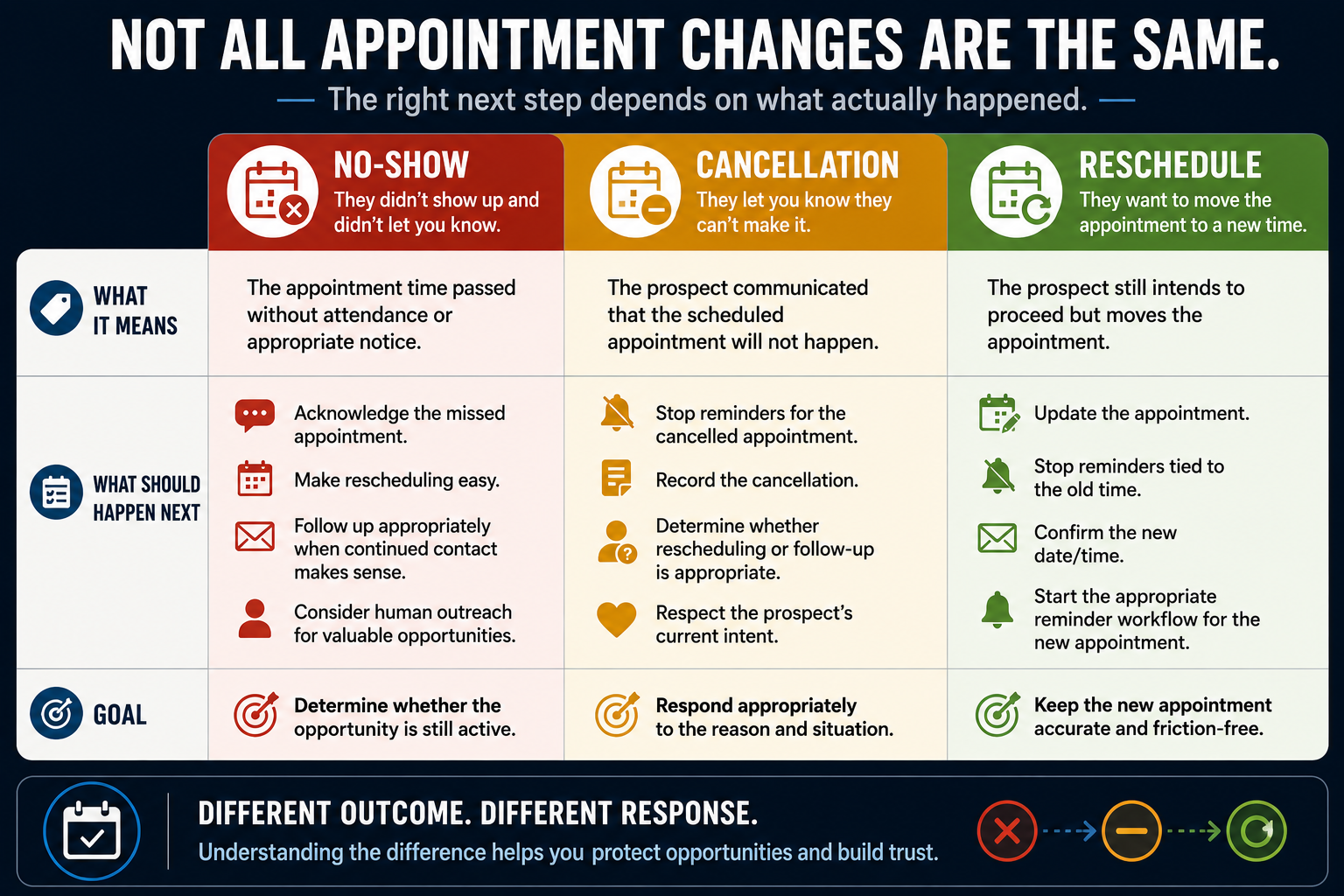
Good automation should react to what actually happened.
With that foundation in place, here are 10 practical ways service businesses can reduce avoidable appointment no-shows.
1. Shorten the Time Between Inquiry and Appointment When Possible
Someone contacting your business today is showing intent today.
That intent may not remain equally strong two weeks from now.
If the business takes three days to respond and then the first available appointment is another ten days away, a lot can happen before that conversation occurs.
The prospect may:
- contact competitors
- solve the problem another way
- lose urgency
- forget why they reached out
- become distracted by something else
This is one reason speed to lead matters beyond simply being the first company to respond.
Faster response can sometimes create an opportunity to schedule while the prospect's interest is still high.
There is also research suggesting that longer scheduling lead times can be associated with higher no-show risk.
A systematic review of appointment no-show research identified longer lead time between scheduling and the appointment as one of the factors frequently associated with nonattendance.
Most of that research comes from healthcare settings, so it shouldn't be translated into a universal percentage for every service business.
But the practical principle makes sense:
When an appropriate appointment can happen sooner, unnecessarily pushing it far into the future can create more opportunity for intent to decay.
That doesn't mean cramming every prospect onto tomorrow's calendar.
It means avoiding unnecessary delay.
2. Confirm the Appointment Immediately
Once someone books, remove ambiguity.
They should know the appointment exists.
A useful confirmation might include:
- date
- time
- time zone when relevant
- location or meeting method
- what the appointment is for
- who they'll be meeting with, when useful
- anything they should prepare
- how to cancel or reschedule
The exact information depends on the service.
A residential estimate might need an address and arrival window.
A virtual consultation might need a meeting link.
A commercial discovery call may need a calendar invite and a brief explanation of what will be discussed.
The principle is the same:
Don't make the prospect wonder whether the booking actually went through.
Immediate confirmation also creates another useful touchpoint while the appointment is still fresh in the person's mind.
3. Tell the Prospect Exactly What to Expect
Uncertainty creates friction.
Imagine booking a consultation and having no idea:
- how long it will take
- whether it's a phone call or video meeting
- whether someone is coming to your property
- whether you need documents
- whether a spouse or decision-maker should attend
- whether you're going to be pressured into buying something
People are more comfortable showing up when they understand what they're showing up for.
Set expectations.
For example:
We'll spend about 20 minutes learning about your project, answering initial questions, and determining whether the next step makes sense.
Or:
Our estimator will meet you at the property, review the project area, take measurements, and discuss your options. Please allow approximately 45 minutes.
Those are hypothetical examples, not scripts every business should copy.
The point is clarity.
An appointment shouldn't feel like a mysterious box on someone's calendar.
4. Send Reminders Before the Appointment
People forget things.
Appointment reminders exist for a reason.
Research in healthcare settings consistently suggests that reminder systems can improve attendance compared with providing no reminder.
Systematic reviews and meta-analyses have found benefits from SMS and other electronic appointment reminders.
That evidence does not mean a contractor, marketing consultant, med spa, landscaper, or other service business should expect the exact same improvement reported in a medical setting.
Different customers, appointments, incentives, and buying processes can produce different results.
But the broader takeaway is reasonable:
A useful reminder can reduce the chance that an otherwise interested person simply forgets.
A reminder might include:
- appointment date and time
- location or meeting link
- business name
- short description of the appointment
- reschedule/cancel option
- way to ask a question
Keep it useful.
The purpose isn't to advertise again.
It's to help the appointment happen.
If you want examples of what those messages can actually say, see our appointment reminder text message examples for service businesses.
5. Use Multiple Reminders Strategically—Not Relentlessly
If one reminder can help, should you send six?
No.
More automation is not automatically better automation.
Research in some appointment settings suggests that additional reminders can provide incremental benefits compared with a single reminder.
For example, a large randomized study within Kaiser Permanente found that an additional reminder reduced no-shows further among appointments identified as having higher no-show risk.
Again, that's healthcare evidence.
It doesn't establish a universal reminder cadence for every service business.
The right timing depends on the situation.
A business might reasonably test communication around:
- the moment the appointment is booked
- some period before the appointment
- closer to the scheduled time when useful
But there is no magic sequence that belongs on every calendar.
Consider:
- how far in advance people normally book
- whether the appointment is virtual or in person
- whether travel is involved
- how important preparation is
- how frequently the prospect has already heard from you
- whether the person has confirmed
- whether the appointment has changed
A person who booked yesterday for tomorrow may need a different communication pattern from someone who scheduled three weeks ago.
Use reminders to reduce forgetting and uncertainty—not to make the prospect regret giving you their phone number.
6. Make Cancellation and Rescheduling Ridiculously Easy
This is one of the most overlooked ways to improve appointment operations.
If someone can't attend, what would you rather have?
A silent no-show?
Or:
Something came up. Can we move this to Thursday?
Obviously the second.
Research on appointment reminders has found that reminders can also help prompt people to cancel or rebook appointments they can't attend, which gives the organization an opportunity to adjust rather than simply discovering the absence at appointment time.
But that only works well when communicating the change is easy.
Depending on the business, that might mean:
- a rescheduling link
- a cancellation link
- replying directly to the reminder
- texting the business
- calling
- interacting with an assistant that can update the appointment
The exact mechanism matters less than the principle:
Make rescheduling easier than disappearing.
And when someone does reschedule, the system needs to know.
Old reminders should stop.
The new appointment should become the active appointment.
Anything else creates confusion.
7. Give the Prospect a Reason to Remain Engaged
Reminders answer:
When is my appointment?
Sometimes it also helps to reinforce:
Why did I book this?
That doesn't mean turning every reminder into a sales pitch.
It might simply mean reminding the prospect what the appointment will help them accomplish.
For example:
Tomorrow we'll review your current setup, identify where inquiries are getting stuck, and determine which improvements would make the biggest difference.
Or:
Your estimate is tomorrow at 2:00 PM. We'll inspect the project area, discuss material options, and answer any questions you have.
Again, hypothetical examples.
The goal is to preserve context and perceived value.
This becomes more important when there is a longer gap between booking and the actual appointment.
If someone scheduled ten days ago, a useful reminder can reconnect the appointment to the reason they cared in the first place.
8. Keep the Booking Experience Simple
No-show reduction begins before the appointment exists.
If scheduling itself is confusing, slow, or disconnected, you may be creating weak commitments from the beginning.
The right booking experience depends on the business.
Some visitors may need to complete a form first.
Others may benefit from a conversation.
High-intent prospects may be ready to schedule directly.
We've covered those differences in Website Forms vs. Chat vs. Online Scheduling.
Whatever path you use, avoid unnecessary friction.
That might mean:
- showing useful appointment availability
- keeping required fields reasonable
- making mobile scheduling easy
- clearly explaining what is being booked
- preventing duplicate appointments
- using the correct time zone
- confirming successful booking
- avoiding unnecessary back-and-forth
The easier it is for the right person to intentionally choose an appropriate appointment, the cleaner the rest of the process becomes.
9. Know When Automation Should Hand Off to a Human
Automation is excellent at predictable tasks.
Confirmations.
Reminders.
Routing.
Status updates.
Basic questions.
Calendar changes when the workflow supports them.
But prospects don't always behave predictably.
Someone might reply:
I need to move the appointment, but I'm not sure which day works because my contractor hasn't finished the electrical work yet.
Or:
Before we meet, can you tell me whether you handle multi-location projects across three states?
Or simply:
I'm confused.
That's not the moment for an automation to stubbornly continue firing canned messages.
A well-designed system should know when the situation needs a person.
Human involvement may be appropriate when there are:
- complex questions
- unusual scheduling issues
- objections
- confusion
- frustration
- high-value opportunities
- situations the automation can't confidently interpret
AI can make automated conversations more flexible, but AI still shouldn't be treated as magic.
The goal is not to automate every interaction.
The goal is to automate what should be automated and make human intervention easier when it matters.
That's the same principle behind effective automated lead follow-up.
10. Track No-Shows, Cancellations and Reschedules Separately
If you don't distinguish appointment outcomes, you won't know what problem you're solving.
Imagine a business schedules 100 appointments.
Of those:
- 10 no-show
- 15 cancel in advance
- 12 reschedule
Calling all 37 of those “failed appointments” would hide important information.
A reschedule may still become a perfectly good opportunity.
A cancellation communicated in advance gives the business information and potentially frees calendar capacity.
A true no-show creates a different operational problem.
Track them separately.
Useful appointment metrics can include:
- appointments booked
- appointments confirmed
- appointments attended
- no-shows
- cancellations
- reschedules
- rescheduled appointments that eventually attend
- appointments that become qualified opportunities
- qualified opportunities that become customers
You don't need a ridiculous dashboard with 47 widgets.
You need enough visibility to answer:
Where are appointments actually breaking down?
That tells you what to improve.
What Should Happen After a No-Show?
A no-show doesn't always mean:
Dead lead. Delete.
Something may have happened.
They may have forgotten.
They may still be interested.
They may have had an emergency.
Or they may have moved on.
The appropriate response depends on the business and the situation.
A simple recovery process might:
- acknowledge that the appointment was missed
- provide an easy way to reschedule
- offer help if something changed
- follow up appropriately if there is still reasonable intent
- eventually stop when continued contact no longer makes sense
This is where automated lead follow-up can help, provided the workflow responds to behavior instead of endlessly sending the same message.
For a high-value opportunity, human outreach may be warranted quickly.
For a low-intent appointment, a lighter automated recovery sequence may make more sense.
There is no universal rule.
The important thing is that no-show recovery should be intentional rather than accidental.
Don't Confuse More Messages With Better Follow-Up
This deserves its own section.
Automation makes sending messages easy.
That doesn't mean every message should be sent.
A bad system might send:
- confirmation email
- confirmation text
- nurture email
- nurture text
- 72-hour reminder
- 48-hour reminder
- 24-hour reminder
- morning-of reminder
- one-hour reminder
- “Are you coming?” text
Congratulations.
You've reduced the chance they'll forget you.
You've also increased the chance they'll block you.
The goal is not maximum communication.
It's appropriate communication.
Every message should have a reason to exist.
Ask:
- Does this reduce uncertainty?
- Does this help the prospect prepare?
- Does this prevent forgetting?
- Does this make changing the appointment easier?
- Does this answer something useful?
- Does this move the opportunity forward?
If the answer is no, the message may not be helping.
Appointment Automation Should React to What Happens
This is where appointment automation becomes more than scheduled reminders.
Consider four scenarios.
Scenario 1: The Prospect Confirms
Great.
Keep the appointment active and continue only the communication that still makes sense.
Scenario 2: The Prospect Reschedules
Update the appointment.
Stop reminders associated with the old time.
Begin the appropriate workflow for the new appointment.
Scenario 3: The Prospect Cancels
Stop telling them about an appointment that no longer exists.
Depending on the reason and business, determine whether follow-up is appropriate.
Scenario 4: The Prospect Asks a Question
Answer it when the system can do so reliably.
Otherwise, route the conversation to a human.
That's why lead routing isn't only about assigning new leads to salespeople.
Routing logic can also help determine what happens when an existing opportunity changes state or requires a different type of attention.
Automation should respond to reality.
If reality changes and the automation doesn't, you've built a sequence—not a system.
A Booked Calendar Is Part of a Larger Conversion System
Scheduling software can put an appointment on a calendar, and the reminders, confirmations and follow-up workflows around it are really just one slice of the broader practical AI automation a service business can build.
That's useful.
But the calendar itself doesn't necessarily handle everything surrounding the appointment.
A broader lead conversion system can connect the stages around it:
Inquiry → Response → Follow-Up → Booking → Confirmation → Reminder → Show → Opportunity
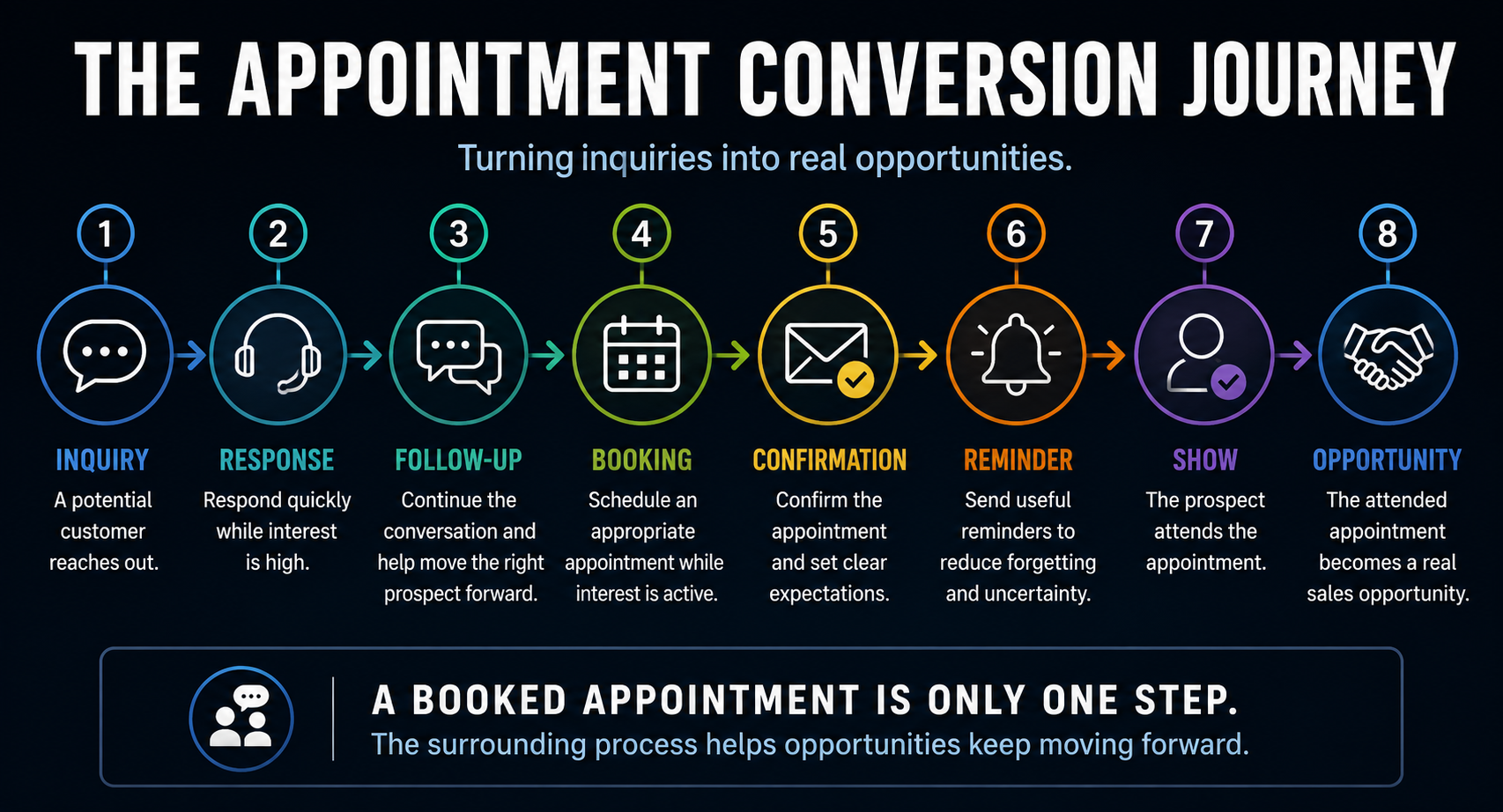
That's the thinking behind the Booked Calendar System™.
It isn't simply about giving someone a calendar link.
The objective is to create a connected process that helps legitimate opportunities move forward.
That can involve:
- immediate response
- lead capture
- CRM
- routing
- automated follow-up
- AI-assisted conversations
- scheduling
- confirmations
- reminders
- rescheduling
- human handoffs
- no-show recovery
Not every business needs every component.
And not every interaction should be automated.
The system should match the actual customer journey.
The Goal Isn't a Full Calendar
A calendar filled with appointments looks impressive.
Until half the people don't show.
Or the wrong people are booking.
Or appointments aren't being followed up with.
Or nobody knows which appointments turned into business.
The goal isn't simply:
More bookings.
It's:
More legitimate opportunities successfully reaching the next stage.
That's a different mindset.
It connects directly to a larger principle we've discussed throughout the Boost Local Biz content library:
Businesses don't always need more leads.
Sometimes they need a better system for converting the opportunities they already have.
If your business is already generating inquiries and appointments, reducing avoidable no-shows may be one of the places worth looking before spending more money generating additional traffic.
Want a Better System Between Inquiry and Appointment?
The Booked Calendar System™ is designed around what happens between someone raising their hand and a real opportunity reaching your calendar and moving forward.
Depending on the business, that can include immediate response, CRM capture, automated follow-up, AI-assisted conversations, routing, scheduling, confirmations, reminders, rescheduling, and appropriate human handoffs.
The goal isn't to automate people.
It's to remove unnecessary friction from the process.
Explore the Booked Calendar System™.