A potential customer fills out your contact form at 7:42 p.m.
What happens next?
If the answer is, "We'll see it tomorrow morning," there's a good chance that person isn't sitting around patiently waiting for your business to open.
They may keep searching.
They may submit another form.
They may call someone else.
And by the time you respond, the conversation may already be happening with a competitor.
So, how fast should you respond to a new lead?
A new lead should ideally receive an immediate acknowledgment, followed by meaningful engagement as quickly as practical. For high-intent service-business inquiries, minutes are generally better than hours.
That doesn't mean an employee needs to abandon a jobsite every time a form comes in.
It means your leads shouldn't disappear into a digital waiting room until somebody happens to check the inbox.
There's an important difference.
Why Lead Response Time Matters
A new inquiry represents a moment of intent.
Someone has decided they need something badly enough to call, send a message, request a quote, start a chat, or schedule an appointment.
That moment doesn't last forever.
Research published in Harvard Business Review examined how businesses handled online sales inquiries and found a substantial relationship between response time and the likelihood of qualifying a lead. Companies attempting contact within an hour were nearly seven times as likely to qualify a lead as those waiting even an hour longer.
The research is older, and it shouldn't be stretched into a universal rule for every service business in every situation.
But the underlying business reality hasn't become less relevant:
Interest has a shelf life.
Someone looking for an emergency plumber has an obvious reason to keep calling.
But even lower-urgency prospects often compare multiple businesses. A homeowner thinking about landscaping, remodeling, roofing, pool work, legal services, cleaning, or another service can easily contact several companies in one sitting.
Being first doesn't guarantee you'll win the business.
Being absent from the conversation certainly doesn't help.
Is Five Minutes Really the Magic Number?
You've probably seen some version of this statistic:
"You have to respond to a lead within five minutes."
There's real research behind the idea.
Lead-response research associated with InsideSales and James Oldroyd found much higher odds of contacting and qualifying web-generated leads when contact was attempted within five minutes rather than waiting 30 minutes.
But here's where marketing advice tends to get stupid.
Five minutes isn't a magical cliff where a lead is fantastic at 4:59 and worthless at 5:01.
The studies examined particular kinds of web-generated sales leads under particular conditions. They weren't testing every roofing estimate, landscaping request, dental inquiry, contractor lead, attorney consultation, or missed phone call in America.
So I wouldn't build your entire lead-response strategy around worshipping the five-minute mark.
The better principle is simpler:
When someone raises their hand, reduce the amount of time they spend wondering whether anybody noticed.
Five minutes is great.
One minute can be better.
Ten minutes can still be excellent.
Two hours might be perfectly recoverable.
The point is to stop allowing response time to be determined by when somebody happens to notice an email.
Immediate Acknowledgment Is Not the Same as an Immediate Human Response
This distinction matters.
When I say businesses should respond immediately, I don't mean every new lead requires an employee to personally call within 30 seconds.
That's unrealistic for a lot of service businesses.
Your team might be:
- on a roof
- driving
- meeting with a customer
- operating equipment
- working inside someone's home
- handling another call
- closed for the evening
The better system separates acknowledgment from human involvement.
A lead comes in.
The system confirms the inquiry was received.
Then, depending on the situation, it can start a conversation, collect additional information, route the lead, notify the right person, offer scheduling, or prepare the opportunity for human follow-up.
The human enters when the human is actually needed.
That's very different from trying to automate the entire sales process.
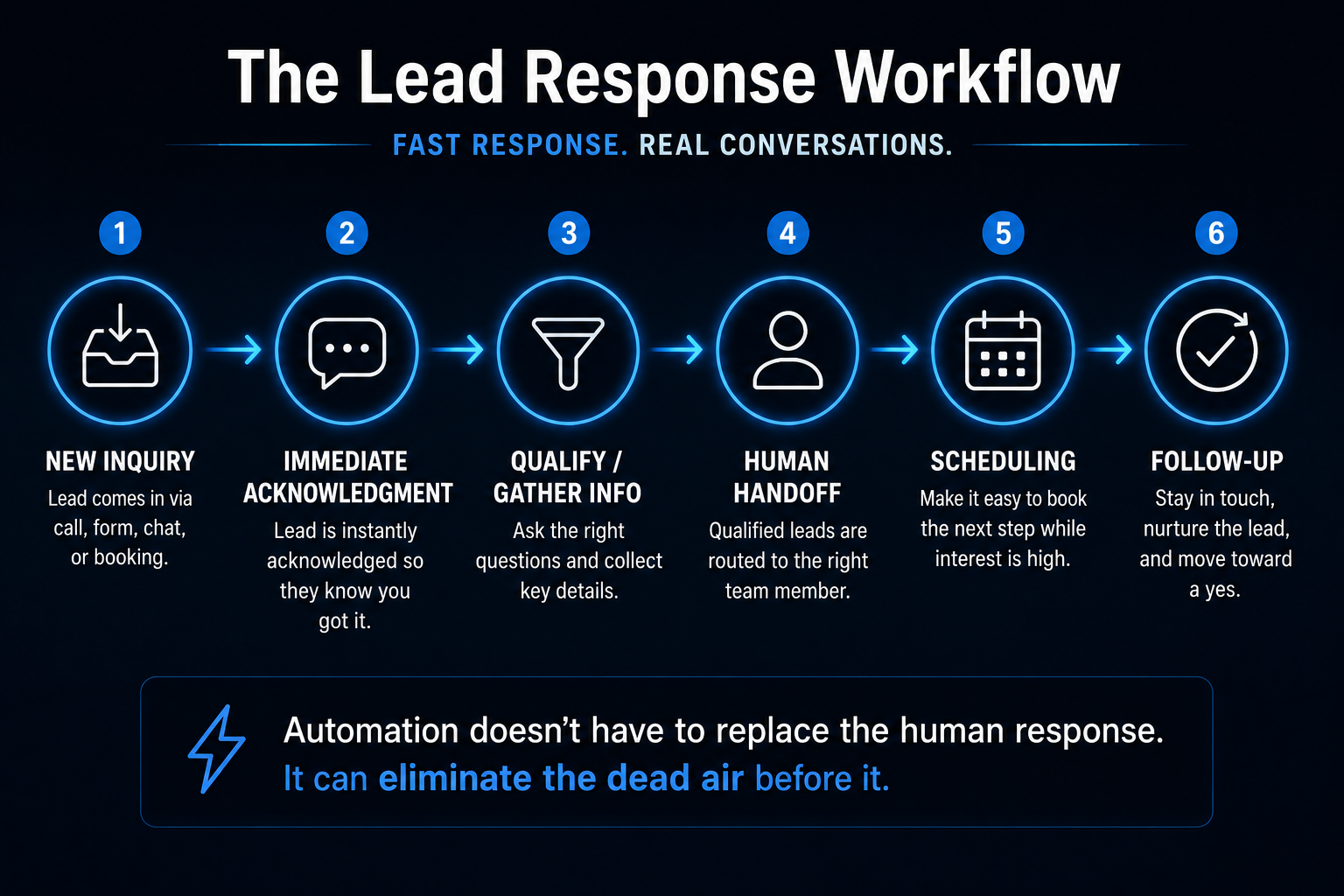
A better lead-response sequence looks something like this:
Inquiry → Immediate Acknowledgment → Conversation or Qualification → Human Handoff When Needed → Scheduling → Follow-Up
Automation handles the predictable parts.
People handle the parts requiring judgment, expertise, persuasion, diagnosis, or an actual relationship.
That combination is usually much more practical than choosing between "everything manual" and "let AI run the company."
Customers Are Starting to Expect Faster Responses
This isn't only about old sales research.
Customer expectations are moving in the same direction.
Jobber's 2026 Home Service Trends Report, based on a survey of 1,050 U.S. home-service business owners and additional platform data, reports that more than 55% of customers expect a response within an hour, while 28% expect an immediate response.
The same report found that only 20% of home-service businesses said they respond to leads within an hour.
That's a pretty interesting gap.
Customers increasingly expect responsiveness.
A lot of businesses still operate on:
"I'll get back to them when I get a chance."
That creates an opportunity for businesses that build response into the system instead of relying entirely on memory.
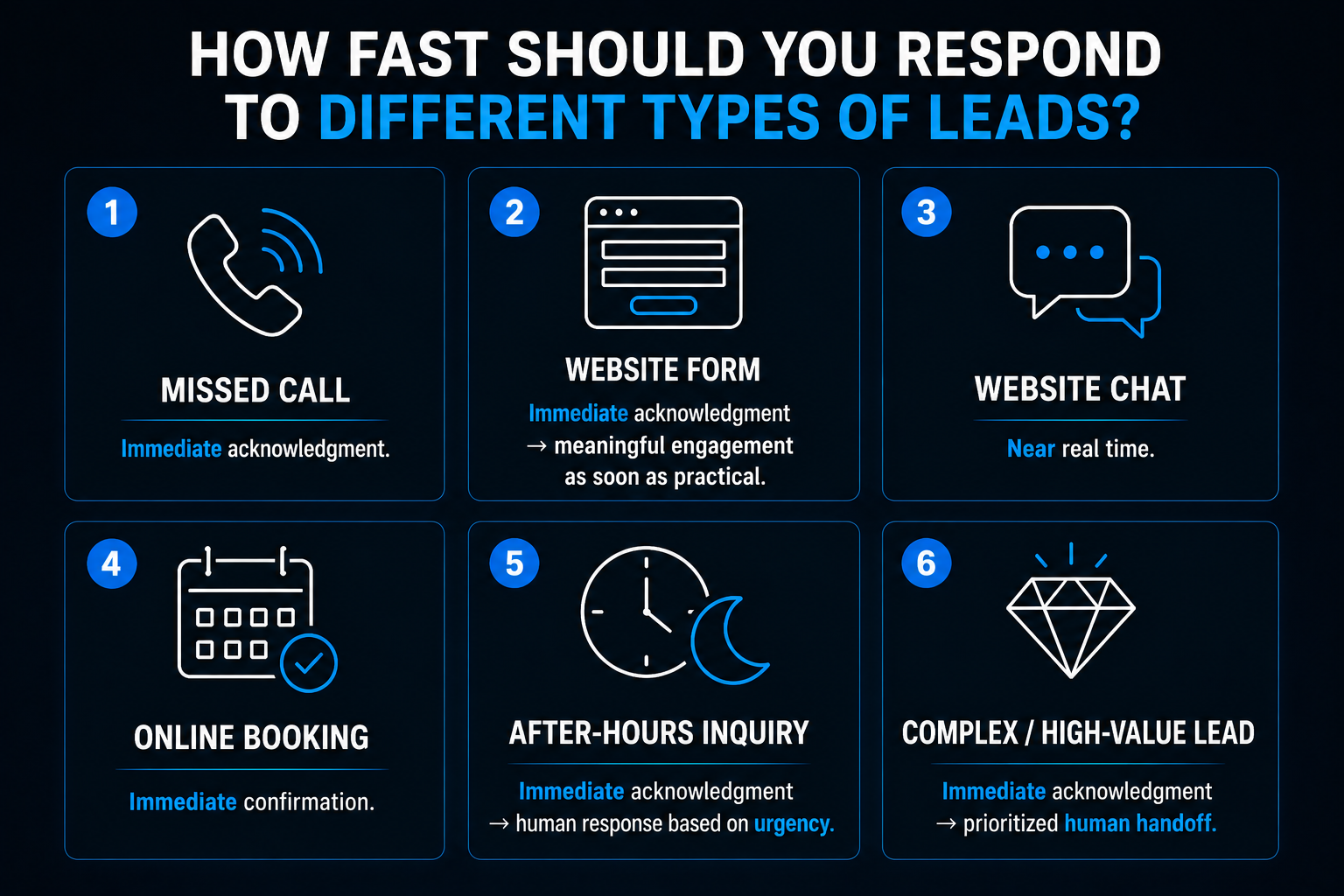
How Fast Should You Respond to Different Types of Leads?
Not every inquiry should be handled identically.
A missed phone call from someone with water pouring through their ceiling is different from a website form asking about a kitchen remodel six months from now.
Here's a more useful way to think about it.
Missed Phone Calls
Acknowledgment: Ideally immediate.
A missed caller should quickly know that the business received the attempt to contact them.
A simple missed-call text can open the conversation:
Sorry we missed your call. How can we help?
That gives the person a way to continue without repeatedly calling or immediately moving to another company.
For urgent service categories, this can be especially valuable.
Website Forms
Acknowledgment: Immediate.
Meaningful response: As soon as practical.
The classic "Thanks, we'll be in touch" confirmation page is better than nothing, but it doesn't necessarily move the opportunity forward.
A stronger process might confirm receipt by text or email and, where appropriate, ask the next logical question.
If someone requests a roofing estimate, for example, the system might acknowledge the request while the team is still on a job.
The salesperson can then enter an already-active conversation instead of starting cold several hours later.
Website Chat
Response: Near real time.
The entire expectation of chat is immediacy.
If your "live chat" takes six hours to answer, you've basically invented email with a speech bubble.
Chat can be handled by a person, AI, or a combination of both, depending on the complexity of the business.
The goal isn't to fool someone into believing they're talking to a human.
The goal is to help them make progress.
Online Scheduling
Confirmation: Immediate.
Someone who books should immediately receive confirmation that the appointment was successfully scheduled.
From there, reminders and follow-up should happen automatically according to the appointment workflow.
We've covered that process in more detail in our guide to reducing appointment no-shows.
After-Hours Inquiries
Acknowledgment: Immediate when possible.
Human response: According to urgency and business rules.
This is where automation becomes particularly useful.
You don't necessarily need someone answering ordinary inquiries at 11:30 p.m.
But you also don't need to leave the customer staring into the void.
A system can acknowledge the inquiry, collect useful information, potentially offer scheduling, and let the customer know what happens next.
Then the appropriate person can take over.
The Bigger Problem May Not Be Slow Response. It May Be No Response.
This is where the conversation gets uncomfortable.
A recent independent field study tested inquiry handling at 273 U.S. owner-operated service businesses across trades, commercial cleaning, dental and aesthetics, family law, and mortgage and lending.
Of the 211 inquiries the researchers could verify were successfully delivered, only 29.9% received any response within 72 hours.
The median first response among timed responders was 5.1 hours.
For responses classified as coming from a person, the median increased to 8.8 hours.
There are important limitations here. It was one inquiry per business, sector samples were relatively small, and the study measured response—not whether the inquiry ultimately became a customer.
So I wouldn't treat those numbers as a universal benchmark.
But one finding is particularly relevant.
Almost all of the responses arriving within five minutes were automated acknowledgments.
Automation doesn't have to replace the human response. It can eliminate the dead air before it.
What Should an Automated First Response Actually Do?
This is where bad automation can become almost as useless as no automation.
A generic message saying:
Thank you for contacting ABC Company. Your inquiry is very important to us.
...is technically fast.
It also sounds like it escaped from a fax machine in 1998.
A useful first response should do one or more things:
- confirm that the inquiry was received
- identify the business clearly
- acknowledge what the person is asking about
- set expectations for what happens next
- ask a useful follow-up question
- offer an appropriate scheduling option
- allow the person to continue the conversation
- alert the right team member when human involvement is needed
The objective isn't merely to make your response-time dashboard look impressive.
It's to keep the opportunity moving.
Speed Without Context Isn't Much Better
There is another trap here.
Businesses hear "respond faster" and build an automation that fires the same aggressive sequence at everybody.
That's not good lead management either.
Imagine requesting information about a major home renovation and receiving this 14 seconds later:
HEY JOHN!!! 🔥🔥 READY TO BOOK YOUR PROJECT??? CLICK HERE NOW!!!
Technically?
Excellent response time.
Strategically?
Calm down, champ.
A response needs to fit the inquiry.
Urgent service leads may need immediate escalation.
Quote requests may need additional information.
Longer sales-cycle services may benefit from acknowledgment followed by thoughtful human contact.
Existing customers may need to be routed completely differently from new prospects.
Speed matters, but speed plus context is better.
How to Build a Faster Lead-Response Process
You don't need a giant technology stack to improve this.
Start by mapping what currently happens.
1. Identify Every Place Leads Enter
That may include:
- phone calls
- website forms
- website chat
- Google Business Profile
- advertising campaigns
- social messages
- online scheduling
- referral forms
- third-party lead platforms
If leads enter through six channels but your team reliably checks three, you don't really have six lead channels.
You have three channels and three leaks.
2. Centralize the Opportunities
Whenever practical, bring inquiries into one CRM or central inbox.
That makes it easier to see:
- who the lead is
- where they came from
- what they asked about
- whether someone responded
- who owns the opportunity
- what should happen next
This is one of the reasons lead routing matters so much once inquiry volume starts increasing.
3. Automate the Immediate Acknowledgment
Don't wait for a human to manually send the first "we got it" message if the system can handle that reliably.
Use the channel that makes sense.
That could be SMS, email, chat, or a combination depending on how the inquiry arrived and what the person consented to receive.
For missed phone calls, a missed-call text-back process can help open the conversation immediately.
4. Decide When a Human Should Take Over
Automation should have boundaries.
Define situations requiring a person.
For example:
- complex pricing questions
- unusual project requirements
- complaints
- high-value opportunities
- technical questions
- sensitive situations
- leads explicitly requesting a call
Good automation should make human involvement more effective, not eliminate it for the sake of saying everything uses AI.
5. Make Scheduling Easy
When the logical next step is an appointment, estimate, consultation, or call, don't create unnecessary friction.
If appropriate, let the prospect see available times and schedule.
That's much easier than:
What works for you?
Tuesday.
Morning or afternoon?
Afternoon.
How about 3:30?
Can't.
Congratulations. You've recreated 2006.
6. Keep Following Up
Fast initial response doesn't solve everything.
Some people won't answer immediately.
They get busy.
They forget.
They submit an inquiry while researching and aren't ready yet.
That's where automated lead follow-up becomes useful.
A good system continues the conversation without requiring someone to remember every lead manually.
Measure Your Actual Response Time
Here's a useful exercise:
Become your own lead.
Don't ask your staff what normally happens.
Test it.
Submit a website form.
Call and don't leave a voicemail.
Start a chat.
Send an inquiry after business hours.
Then watch what happens.
Ask:
- Did the inquiry actually arrive?
- How quickly was it acknowledged?
- Did anyone receive an alert?
- Did a human follow up?
- Could the prospect reply?
- Was the conversation stored somewhere?
- Was scheduling offered when appropriate?
- What happened if the prospect didn't respond?
You may discover your biggest marketing problem isn't traffic.
It's what happens after the traffic raises its hand.
Fast Response Is Only One Part of Lead Conversion
Responding quickly matters.
But speed alone doesn't create a good lead conversion system.
The opportunity still needs to be:
captured → acknowledged → routed → engaged → followed up → scheduled → tracked
That's the larger idea behind the Booked Calendar System™.
The goal isn't to bombard leads with automation.
It's to remove the gaps between someone showing interest and your business getting a legitimate opportunity to speak with them.
Sometimes that means AI.
Sometimes it means a simple text.
Sometimes it means routing the lead to the right salesperson.
Sometimes it means getting a human on the phone immediately.
The technology isn't the strategy.
Keeping good opportunities from quietly disappearing is the strategy.
Don't Let Response Time Be an Accident
Most businesses don't deliberately decide:
We're going to wait six hours before responding to new opportunities.
It just happens.
Someone is busy.
An email gets buried.
A call gets missed.
A form notification goes to the wrong person.
Friday evening becomes Monday morning.
And money quietly leaks through the cracks.
You don't need to turn your company into a 24/7 call center to fix that.
You need a system that notices when somebody raises their hand and makes sure something appropriate happens next.
That's the difference between collecting leads and actually working them.
If your business is already generating inquiries but too many are sitting unanswered, getting lost between channels, or going cold before anyone follows up, the next step may not be more advertising.
It may be fixing what happens after the lead comes in.
Explore the Booked Calendar System™ and see where your current lead-response process may be slowing down.