A new lead comes in. You respond.
Nothing.
So you try again.
Still nothing.
Now comes the question almost every business eventually asks: How many times should you follow up before you stop?
There isn't one ideal number of follow-ups for every lead or every business.
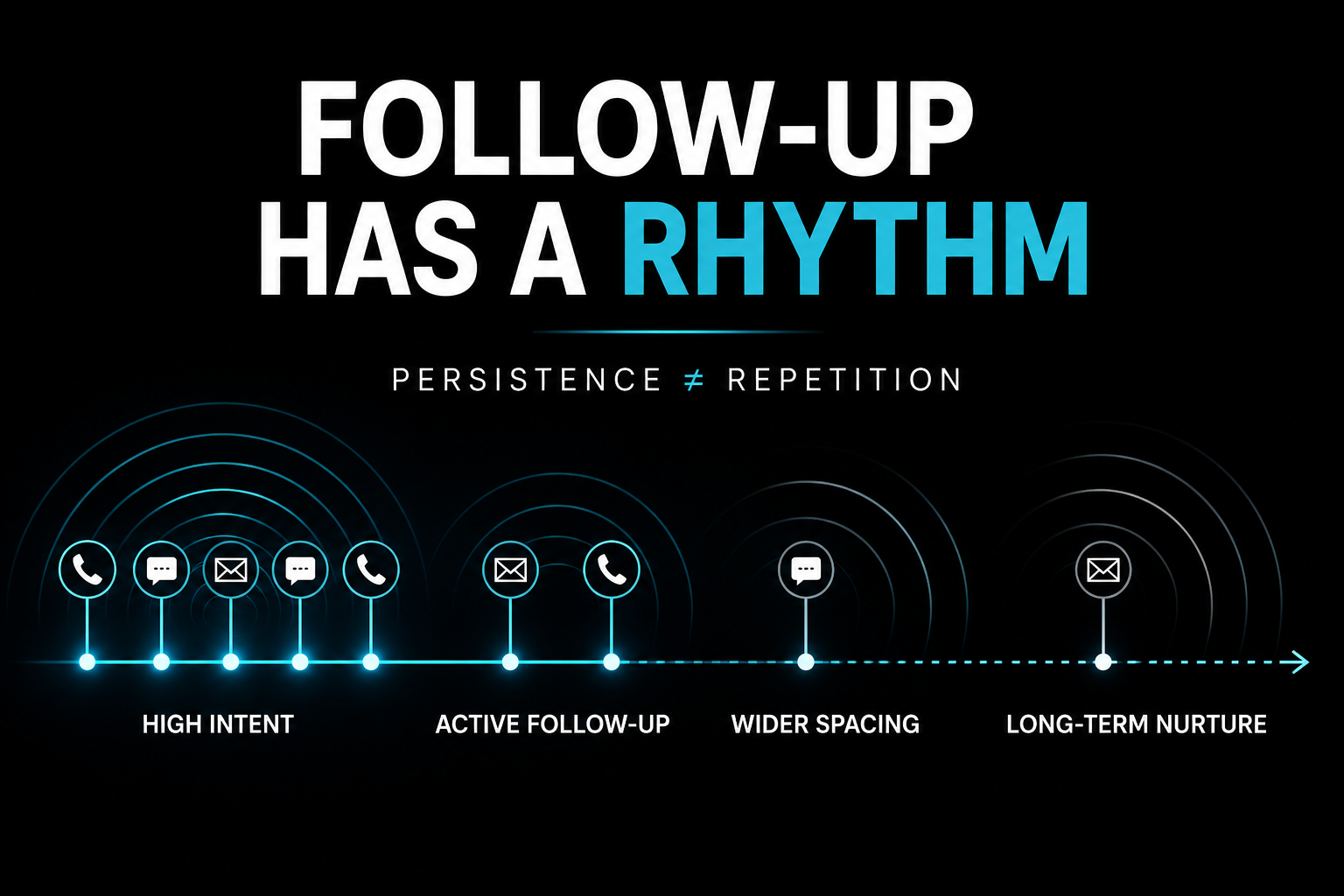
A better approach is to follow up more actively while the person's intent is fresh, gradually widen the spacing over time, and adjust the sequence based on the lead's behavior, the service you're selling, the buying cycle, and the communication channels available to you.
Most importantly, don't confuse silence with rejection.
Someone who hasn't answered you isn't necessarily someone who doesn't want what you sell.
There Is No Magic Follow-Up Number
Search for advice about sales follow-up and you'll find plenty of precise-sounding answers.
Follow up five times.
Try eight touches.
Never give up before the twelfth attempt.
Some of those recommendations may work perfectly well in a particular sales environment. The problem is treating one number as a universal rule.
Research from InsideSales examining more than 14,000 sales cadences across nearly 9,000 companies found that an effective cadence involves more than simply counting attempts. The researchers identified attempts, communication media, duration, spacing, and content as separate components of a cadence. They also concluded that there wasn't a one-size-fits-all cadence and that inbound and outbound leads should be treated differently.
That distinction matters.
Someone who just filled out a form asking for an estimate is different from someone your sales team cold-called.
And even among inbound leads, circumstances can be completely different.
A homeowner with water pouring through the ceiling doesn't have the same buying timeline as someone considering a kitchen remodel next spring.
The right question isn't simply "How many times should I follow up?"
It's:
How should I follow up with this type of lead, at this stage, based on what I know about their intent?
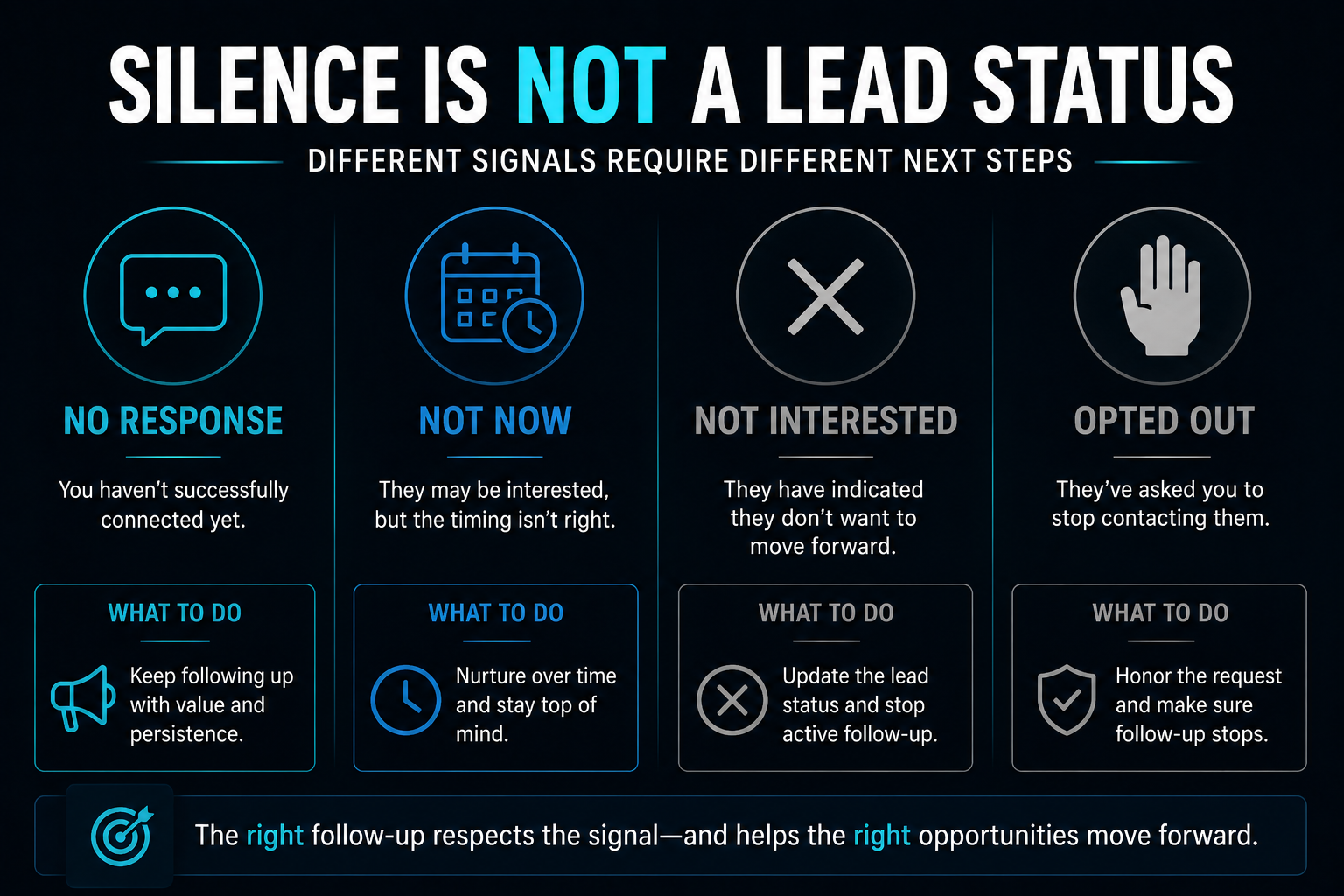
Silence Is Not a Lead Status
This is where a lot of businesses get follow-up wrong.
They make a call.
The prospect doesn't answer.
They send an email.
No response.
The lead gets mentally moved into the not interested bucket.
But you don't actually know that.
There is an important difference between:
No response
You haven't successfully connected with the person.
Not now
They may be interested, but the timing isn't right.
Not interested
They have actually indicated that they don't want to move forward.
Opted out
They've told you to stop contacting them through a channel covered by that request.
Those aren't four versions of the same thing.
They're four different situations that should trigger different next steps.
A lead who says, "We're probably doing the project after the holidays," may belong in longer-term follow-up.
Someone who says, "We hired another contractor," probably doesn't need another estimate reminder Thursday morning.
And someone who tells you to stop contacting them needs to be treated accordingly.
No response, not now, no, and stop are not interchangeable.
That's one reason a good CRM and follow-up process needs actual lead statuses rather than one giant pile labeled didn't close.
Follow-Up Should Change as Intent Cools
The period immediately after an inquiry deserves special attention because the prospect has just taken action.
They called.
They submitted a form.
They started a chat.
They requested an estimate.
They booked something.
That's why responding quickly to a new lead matters in the first place.
But follow-up shouldn't remain equally aggressive forever.
A useful way to think about it is in stages.
Immediate Window: Respond While Intent Is Fresh
The first priority is acknowledgment and engagement.
Let the person know the inquiry was received and make it easy to continue the conversation.
If they don't respond to the first attempt, that doesn't mean the opportunity disappeared.
It means you haven't connected yet.
First Few Days: Stay Consistent
This is where additional attempts can make sense.
Depending on the business and the lead's preferences, that might involve an appropriate combination of phone, SMS, and email rather than repeatedly hammering the same channel.
Historical InsideSales data illustrates why counting attempts alone can be misleading. In its analysis, salespeople reported making far more touches than the behavioral data showed they actually made. Across the analyzed cadences, leads received about four attempts on average, while a substantial share received either no contact or only one attempt.
That doesn't prove four attempts is the answer.
It demonstrates something more useful:
What a business thinks its follow-up process looks like and what actually happens can be very different.
Following Weeks: Widen the Spacing
If the lead hasn't engaged, repeating the same high-frequency sequence indefinitely is unlikely to improve the experience.
Spacing should generally widen.
The message should probably change too.
Maybe the question becomes whether the project is still on their radar.
Maybe you provide something useful.
Maybe you give them an easy way to schedule when they're ready.
The objective shifts from get an answer immediately toward stay relevant without becoming annoying.
Longer Term: Nurture Instead of Chase
Some opportunities aren't dead.
They're early.
This is particularly important for businesses with longer consideration periods or higher-ticket services.
A homeowner might inquire about a remodel months before they're ready to sign a contract.
A commercial prospect may have a project that hasn't been funded yet.
A previous estimate may suddenly become relevant again six months later.
Those leads don't necessarily belong in an aggressive sales sequence.
They may belong in longer-term nurture or reactivation.
Different Leads Deserve Different Follow-Up
This is another reason universal follow-up schedules fall apart.
Consider these inquiries:
- Someone calls an HVAC company because their air conditioner stopped working.
- A homeowner requests an estimate for a $100,000 renovation.
- Someone books an appointment and doesn't show.
- A prospect asks for pricing but says the project is six months away.
- Someone calls, reaches voicemail, and hangs up.
- A former customer hasn't used the company in three years.
Should every one of those people receive the same seven-message sequence?
Of course not.
Intent, urgency, value, context, and buying cycle should influence the cadence.
A missed caller may benefit from an immediate missed-call text back.
Someone who already scheduled but failed to show has a different problem entirely. That's where an appointment reminder and no-show strategy becomes more relevant.
A high-value prospect who requested a detailed proposal may deserve prioritized human follow-up instead of being dropped into the same automation as every basic website inquiry — which is exactly why estimate follow-up deserves its own approach.
Good automation recognizes differences.
Bad automation just sends messages on schedule.
Don't Send the Same Message Seven Times
Persistence doesn't require repetition.
If every follow-up is some variation of:
Just checking in.
Circling back.
Wanted to follow up again.
Bumping this to the top of your inbox.
...the problem isn't necessarily the number of follow-ups.
It's that none of them gives the prospect a new reason to respond.
A follow-up can instead:
- answer a common question
- clarify what happens next
- offer an easier scheduling option
- ask about timing
- provide information relevant to the service
- address a likely concern
- make it easy to say "not right now"
- give the person a simple way to restart the conversation
The goal isn't to prove how persistent your CRM can be.
It's to make the next step easier.
Use More Than One Channel — Carefully
Different people respond differently.
One person ignores email but answers texts.
Another doesn't want to text with a contractor and would rather talk on the phone.
Someone else may be working all day and prefer to schedule online without speaking to anyone yet.
A follow-up system can account for that.
Phone, email, SMS, website chat, and online scheduling can all play different roles depending on the situation.
But having automation capable of contacting someone through multiple channels doesn't mean you should indiscriminately use all of them.
Consent, communication preferences, and applicable laws matter.
For example, current FCC rules provide consumers with the ability to revoke consent for covered robocalls and robotexts through reasonable methods, including recognized opt-out language in reply texts. Businesses using automated calling or texting should understand the rules that apply to their particular communications rather than assuming an inquiry creates unlimited permission to contact someone forever.
Commercial email has its own requirements as well. The FTC's CAN-SPAM guidance requires covered commercial email senders to provide an opt-out method and honor qualifying opt-out requests.
This isn't legal advice, and the exact requirements depend on how and why you're contacting someone.
The practical rule is simpler:
Automation is not permission to ignore someone's request to stop.
When Should You Stop Following Up?
Instead of picking an arbitrary attempt number, establish conditions that change or stop the sequence.
They Explicitly Decline
If someone tells you they've chosen another company or they're no longer interested, update the lead status.
Don't make them reject you seven more times because the automation hasn't gotten the memo.
They Opt Out or Ask You to Stop
Honor the request and make sure your systems can actually recognize it.
An automated follow-up system that can't stop when it's supposed to isn't sophisticated.
It's dangerous.
They're Not Qualified
Sometimes the follow-up process reveals that the opportunity isn't a fit.
Wrong service.
Wrong geography.
Wrong budget.
Wrong project.
That's useful information.
The objective isn't to schedule every lead. It's to move the right opportunities forward.
The Opportunity No Longer Exists
Projects get canceled.
People move.
Budgets change.
Problems get solved another way.
Your CRM should have a way to represent reality.
Active Follow-Up Has Run Its Course
This is different from declaring the lead permanently dead.
A prospect who hasn't responded after an appropriate active sequence might move into longer-term nurture rather than continuing to receive frequent contact.
And if something later signals renewed intent?
Move them back.
Automation Should Remember What Happened
This is where automated lead follow-up becomes much more valuable than a collection of scheduled messages.
A good follow-up system should be able to keep track of things like:
- where the lead came from
- when they first inquired
- whether anyone has responded
- what attempts have already been made
- whether the prospect replied
- where they are in the pipeline
- whether an appointment was booked
- whether a human needs to step in
- whether follow-up should pause or stop
- whether the opportunity should be nurtured for later
That is a very different philosophy from:
Send text → wait → send email → wait → send text until somebody answers.
Automation doesn't need to replace the person responsible for closing the opportunity.
It should make it harder for that person to forget the opportunity exists.
That's part of the thinking behind a broader lead conversion system.
Your Own Data Should Eventually Answer the Question
Industry benchmarks are useful starting points.
Your own conversion data is better.
Once a business consistently tracks its follow-up, it can start answering questions such as:
Which attempt gets the most responses?
How many leads book after the first attempt versus later attempts?
Does SMS outperform email for certain lead sources?
How long does it usually take a qualified prospect to respond?
Which services require longer nurture?
At what point does additional active follow-up stop producing meaningful results?
Do leads from Google Ads behave differently from referrals or organic search?
That's when follow-up stops being a generic internet best practice and becomes an actual business process.
You might discover that three well-timed touches are enough for one type of inquiry.
Another category might consistently produce opportunities after the sixth interaction.
High-ticket prospects might disappear for two months and suddenly return.
The goal isn't to find the internet's magic number. It's to learn what happens to your leads.
Follow Up Until You Know What Should Happen Next
So, how many times should you follow up with a lead?
Enough to give a legitimate opportunity a reasonable chance to become a conversation—but not according to an arbitrary number that ignores context.
Respond quickly.
Stay persistent while intent is fresh.
Use appropriate channels.
Change the message instead of repeating it.
Widen the spacing as time passes.
Recognize the difference between silence and rejection.
Move longer-term opportunities into nurture.
Stop when the prospect clearly tells you to stop.
And track what actually works.
Because the real failure usually isn't that a business stopped after attempt five instead of attempt seven.
It's that nobody knows which leads need attention, who followed up, what happened, or what should happen next.
That's the problem a good system is supposed to solve.
Explore the Booked Calendar System™ and see where your current follow-up process may be letting opportunities disappear.