A new lead comes in.
They ask a question. Request information. Maybe they want an estimate.
You respond.
And then they say something like:
“Thanks. I need to think about it.”
Now what?
For a lot of service businesses, one of two things happens.
Someone keeps following up aggressively until the prospect stops responding.
Or everybody gets busy, the lead disappears into the CRM, and nobody contacts them again.
There is a useful middle ground.
It’s called lead nurturing.
What Is Lead Nurturing?
Lead nurturing is the process of staying appropriately connected with a legitimate prospect who has shown interest in your business but isn’t ready to take the next step yet.
The goal isn’t to pressure someone into buying before they’re ready.
It’s to maintain the relationship, provide useful information when appropriate, respond to changes in interest, and make it easy for the prospect to move forward when the timing is right.
Salesforce describes lead nurturing more broadly as building relationships with prospects and helping them advance through the sales process.
For a service business, that often looks much less like an elaborate marketing funnel.
It might simply mean making sure a legitimate opportunity doesn’t disappear because the customer wasn’t ready on Tuesday.
Not Every Lead Needs Nurturing
This is where lead nurturing gets misunderstood.
A new lead doesn’t automatically belong in a six-month email campaign.
Different leads need different next steps.
A lead asking whether you can come tomorrow may need an immediate response.
A lead who isn’t sure whether your service is right for them may need qualification.
A lead ready to move forward may need a scheduling link or a phone call.
A bad-fit lead may need nothing further.
A lead that disappeared six months ago may belong in a reactivation campaign.
And then there is another category:
The opportunity is legitimate, but the customer simply isn’t ready yet.
That’s where nurturing becomes useful.
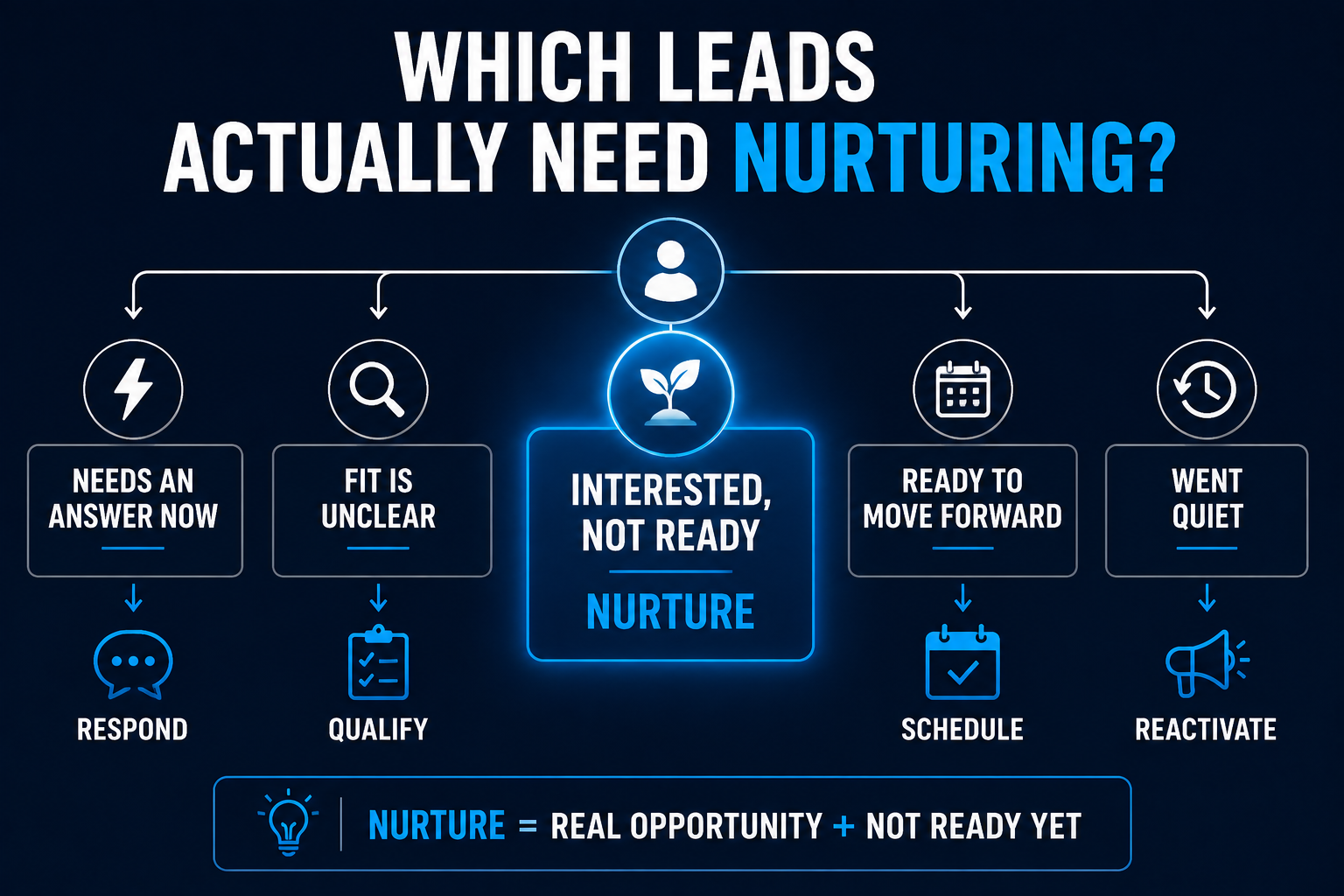
This distinction matters because good lead management isn’t about putting every contact through the same sequence.
It’s about determining what should happen next for this particular opportunity.
Our guide to lead qualification goes deeper into determining fit and readiness.
Lead Nurturing vs. Lead Follow-Up
Lead nurturing and lead follow-up overlap, but they aren’t exactly the same thing.
Follow-up is the broader act of reconnecting with a lead after an interaction or lack of response.
Nurturing usually becomes relevant when the relationship needs to continue over a longer period because the prospect has genuine interest but isn’t ready to act.
Imagine a homeowner requests information about a major remodeling project.
You respond quickly.
They have a real project and appear to be a good fit, but they’re still several months away from starting.
Sending:
“Just following up. Ready to get started?”
every three days isn’t nurturing.
It’s repetition.
A better approach might be to record the expected timeline, provide useful information when relevant, check in at sensible intervals, and increase attention as the customer’s expected decision window approaches.
That’s why automated lead follow-up and lead nurturing can work together without being the same thing.
Follow-up keeps the conversation from dying.
Nurturing helps maintain the opportunity when the buying decision takes time.
Lead Nurturing vs. Lead Reactivation
There’s another important distinction.
Lead nurturing generally works with an opportunity that is still active or potentially active.
Lead reactivation attempts to restart a relationship that has already gone dormant.
Suppose a prospect tells you:
“We’re interested, but we’re probably waiting until after the holidays.”
That’s a nurturing opportunity.
If the same prospect hasn’t engaged with your business in eight months and nobody knows whether the project still exists, that’s closer to reactivation.
The difference isn’t determined by an exact number of days.
It’s about the state of the relationship.
Our guide to reactivating old leads covers that second situation in more detail.
Why Lead Nurturing Matters for Service Businesses
A service business doesn’t always sell something that can be purchased immediately with one click.
Customers may need to:
- compare providers
- talk with a spouse or business partner
- wait for a project date
- arrange financing or budget
- get additional information
- finish another project first
- receive internal approval
- decide whether the problem is urgent enough to solve
- wait until circumstances change
None of those automatically mean the lead is bad.
They may simply mean the buying timeline and the business’s preferred timeline aren’t the same.
Without a nurturing process, those opportunities often depend on somebody remembering:
“Didn’t we talk to that guy a few months ago?”
That’s not much of a system.
What Does Lead Nurturing Actually Look Like?
Lead nurturing doesn’t have to mean sending a newsletter every Thursday until the end of time.
For service businesses, it can be surprisingly practical.
1. Record Why the Lead Isn’t Ready
Before deciding how to nurture someone, understand why you’re nurturing them.
There is a major difference between:
“Call me next month.”
and:
“I’m not sure yet.”
and:
“We’re planning the project for next spring.”
Those situations shouldn’t necessarily trigger the same workflow.
A useful CRM should preserve that context rather than reducing every prospect to OPEN LEAD.
2. Establish the Appropriate Next Step
Sometimes the customer tells you exactly what to do.
“Check back with me in October.”
Great.
You don’t need artificial intelligence to solve that mystery.
Create the appropriate task or automation and follow up in October.
Other situations require more judgment.
The next step might be:
- send requested information
- answer a question
- schedule a future follow-up
- provide a useful resource
- wait for a specific milestone
- move the lead into a longer-term nurture sequence
- alert a salesperson when engagement increases
The goal isn’t more touches.
The goal is the right next action.
3. Keep the Context
One of the fastest ways to make nurturing feel robotic is to forget everything the customer already told you. I cover how to automate lead follow-up without sounding robotic in more detail separately.
Imagine telling a contractor:
“We’re waiting until January because we’re traveling for the next two months.”
Then receiving:
“Hi Sarah! Just checking whether you’re ready to get started!”
four days later.
Technically, the business followed up.
Practically, it demonstrated that nobody was listening.
A useful nurturing system should preserve important context whenever possible.
What Should You Send During Lead Nurturing?
There isn’t one universal nurture message.
What makes sense depends on why the prospect hasn’t moved forward.
Sometimes the best message is a simple personal check-in:
Hi Mark, you mentioned you’d have a better idea about the project after your meeting this week. Just checking in to see where things stand. Happy to answer any questions.
Sometimes useful information makes more sense:
Hi Lisa, you mentioned you were still comparing the two options we discussed. Here’s the information I referenced that explains the main differences. Let me know if you’d like to talk through either one.
Sometimes timing is the entire reason:
Hi David, when we spoke in June you mentioned September might be a better time to revisit the project. I wanted to check back as promised. Is this still something you’re considering?
Notice what these messages don’t sound like:
JUST FOLLOWING UP AGAIN!!!
The best nurture message usually has a reason for existing.
A Simple Lead Nurturing Workflow
A practical service-business nurture workflow might look like this:
Inquiry → Response → Qualification → Not ready yet → Reason recorded → Appropriate nurture → Buying signal → Conversation or appointment
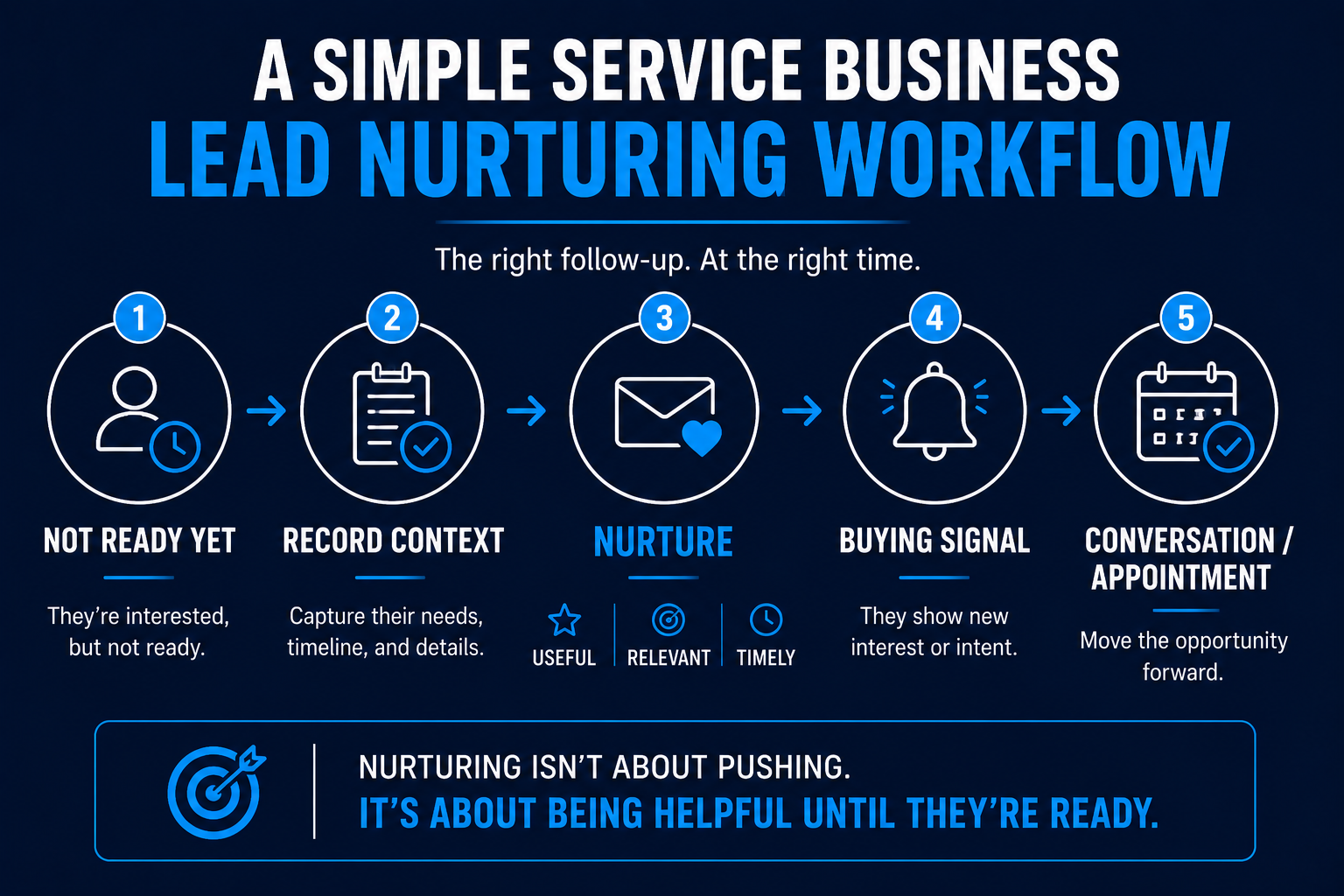
The important part isn’t the arrows.
It’s what happens at the decision points.
If the lead becomes ready, nurturing should stop and the business should move the opportunity forward.
If the lead asks a question, the system should deal with the question.
If the customer requests a later follow-up, the timing should change.
If the opportunity becomes inactive for a long enough period, it may eventually move into reactivation instead.
That’s much more useful than sending the same predetermined message regardless of what the customer does.
Where Does a CRM Fit Into Lead Nurturing?
A CRM gives the nurturing process memory.
Without one, useful information can end up scattered across:
- somebody’s inbox
- text messages
- handwritten notes
- a spreadsheet
- someone’s memory
- nowhere at all
A CRM can maintain the contact record, conversation history, lead status, expected timing, assigned person, next task, and previous interactions.
That doesn’t mean buying CRM software magically creates a nurturing strategy.
It means the CRM can provide the infrastructure for one.
If you’re unfamiliar with how opportunities move through a CRM, our guide to CRM pipelines explains the basics.
Can Lead Nurturing Be Automated?
Absolutely.
But automating bad nurturing just lets you annoy people more efficiently.
Automation works best when the business first understands the process it wants to automate.
For example, automation might:
- schedule a future follow-up
- send an appropriate SMS or email
- move a lead between pipeline stages
- create a task for a salesperson
- trigger a sequence based on lead status
- stop a sequence when someone replies
- notify the team when a prospect re-engages
- schedule an appointment when the prospect becomes ready
These are useful because they reduce the chance that opportunities get forgotten.
The automation should support the relationship rather than becoming the relationship.
Where Can AI Help With Lead Nurturing?
AI becomes useful when the workflow requires some interpretation.
Traditional automation is very good at:
If X happens, do Y.
AI can potentially help when the system needs to understand:
What does this person appear to be saying, and what should happen next?
For example, AI may help:
- interpret a customer’s reply
- identify intent
- answer common questions using approved business information
- summarize previous conversations
- personalize a message using known context
- identify when a prospect appears ready to schedule
- route an unusual conversation to a human
That last one matters.
A good AI-powered process needs to know when not to keep automating.
As we discussed in our guide to practical AI automation ideas for small businesses, use AI where interpretation helps and ordinary automation where ordinary automation works.
When Should a Human Take Over?
Automation is particularly useful for consistency.
Humans are particularly useful when judgment, nuance, empathy, negotiation, or an unusual situation matters.
A human should probably become involved when:
- the prospect asks something the system can’t answer reliably
- pricing or scope requires judgment
- the customer is frustrated
- the conversation becomes unusual or sensitive
- a high-value opportunity needs personal attention
- the lead explicitly asks to speak with someone
- the system isn’t confident about the appropriate next step
The goal isn’t to automate every conversation.
It’s to make sure important conversations actually happen.
How Often Should You Nurture a Lead?
There is no universal schedule that works for every service, buying cycle, lead source, and customer.
A prospect considering emergency plumbing doesn’t have the same timeline as someone planning a custom home.
Context should influence cadence.
A customer who says:
“Call me Friday.”
has given you a pretty good follow-up schedule.
Someone planning a project six months away probably doesn’t need a text every two days.
Someone who suddenly returns to your website, replies to a message, or asks a new question may deserve more immediate attention.
The better question isn’t:
How many nurture messages should we send?
It’s:
What does this opportunity need next?
For the broader question of follow-up frequency, see how many times you should follow up with a lead.
Lead Nurturing Should Change When the Lead Changes
This may be the most important part.
A lead nurturing system shouldn’t blindly continue because somebody originally configured it to send eight messages.
The prospect’s behavior should matter.
If someone books an appointment, stop asking whether they’d like to schedule.
If someone says they’re waiting until December, adjust the timing.
If someone says no, respect the answer.
If someone asks a question, answer the question.
If someone becomes highly engaged, don’t hide behind automation when a real conversation would be better.
The workflow should respond to the lead—not force the lead to conform to the workflow.
That’s the difference between useful automation and automation theater.
How Lead Nurturing Fits Into a Lead Conversion System
Lead nurturing is only one part of what happens after someone becomes an opportunity.
A more complete process may include:
Lead captured → Immediate response → Qualification → Routing → Conversation → Nurturing when needed → Scheduling → Reminders → Follow-up → Outcome
Not every lead travels through every step.
That’s the point.
A good lead conversion system helps determine what should happen next instead of treating every inquiry identically.
This is also where the thinking behind the Booked Calendar System™ becomes useful.
The objective isn’t simply to generate activity inside a CRM.
It’s to connect marketing and incoming opportunities to actual conversations and appointments while preventing good opportunities from quietly disappearing in between.
A Simple Lead Nurturing Checklist
Before building a nurture campaign, answer these questions:
- Which leads actually belong in nurturing?
- Why aren’t they ready?
- What information should we preserve?
- What should trigger the next contact?
- Which messages can be automated?
- Which situations require a person?
- What should happen when the lead replies?
- What stops the nurture sequence?
- When does a dormant lead move into reactivation?
- What action indicates the lead is ready to move forward?
If those answers aren’t clear, adding more software probably won’t fix the problem.
Fix the process first.
Then automate the parts that deserve to be automated.
The Goal Isn’t to Keep Following Up Forever
Lead nurturing isn’t successful because a business sent 17 emails.
It’s successful when a legitimate opportunity receives the right attention at the right time without requiring someone on the team to remember every future conversation manually.
Sometimes that means automation.
Sometimes it means AI.
Sometimes it means a salesperson making a phone call because the CRM says:
Call this person today.
The technology matters less than the process behind it.
Know which opportunities are worth nurturing.
Remember why they aren’t ready.
Stay useful without becoming annoying.
And when the customer is ready to move forward, make the next step easy.