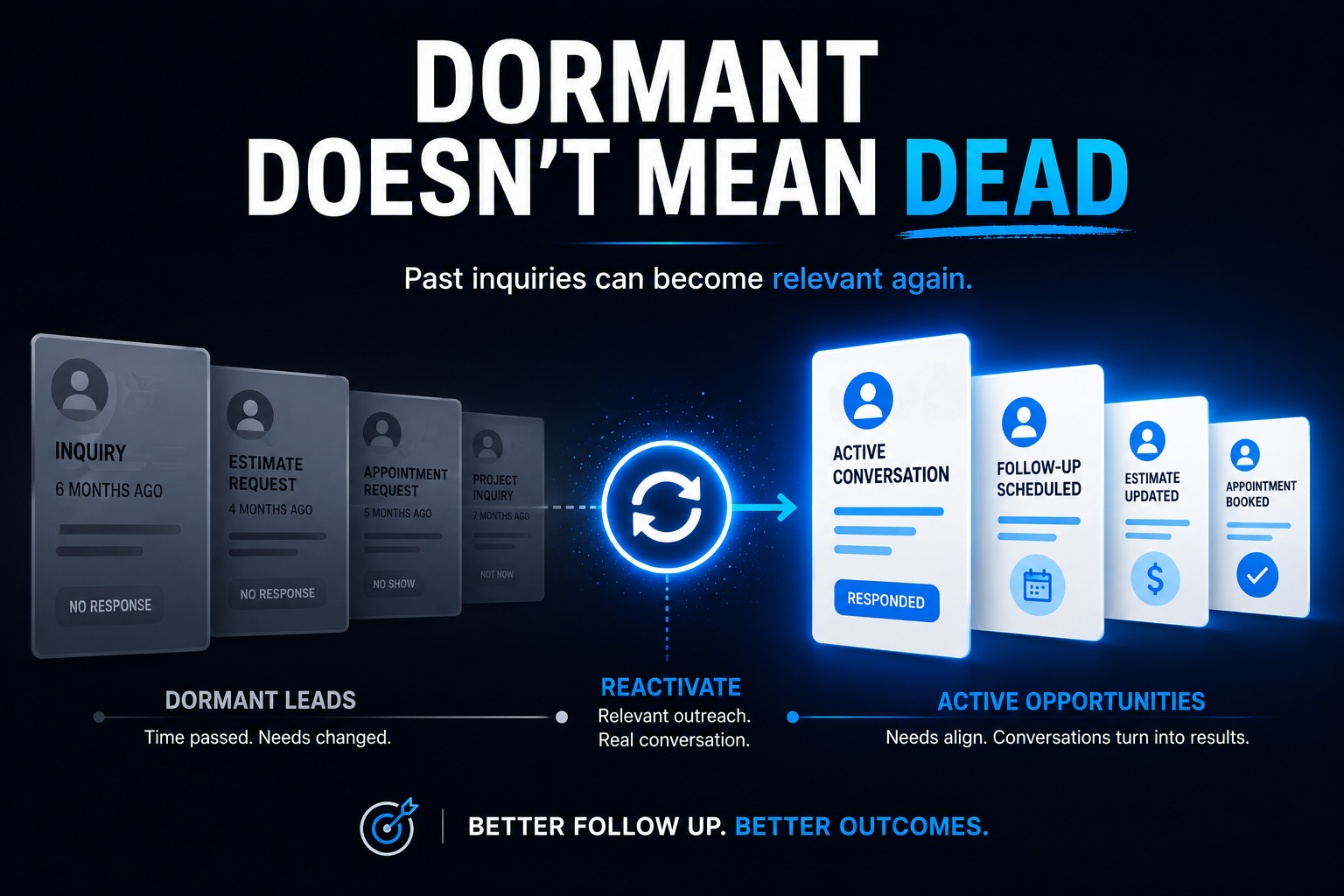
Most businesses spend a lot more time thinking about the next lead than the ones already sitting in their database.
Someone requested an estimate six months ago.
Another person filled out a form, exchanged a couple of messages, and disappeared.
Someone else scheduled an appointment but never showed.
There may be dozens, hundreds, or even thousands of variations of that story sitting inside a CRM, inbox, spreadsheet, or old contact list.
Some of those opportunities are genuinely gone.
Some aren't.
Lead reactivation is the process of identifying dormant opportunities that may still be relevant and giving them a sensible reason to restart the conversation.
Done well, it can turn an overlooked database into another source of opportunities.
Done badly, it looks like a business found an old spreadsheet and decided to spam everyone on it.
There's a big difference.
What Is Lead Reactivation?
Lead reactivation is the process of reconnecting with a previous prospect who showed interest in a business but did not become a customer, with the goal of determining whether the opportunity is relevant again.
That could include someone who:
- requested an estimate but never moved forward
- filled out a website form and stopped responding
- called about a service but never booked
- received a proposal that stalled
- postponed a project
- scheduled an appointment but did not show
- said the timing wasn't right
- had a legitimate inquiry that simply fell through the cracks
These aren't the same as brand-new leads.
The business already has some history with them.
And that history matters.
Old Does Not Mean Dead
One of the easiest mistakes in lead management is treating silence as a permanent decision.
A homeowner who didn't replace their windows last spring may still need windows.
A business that postponed a renovation may have funding now.
A landscaping prospect may have waited until a different season.
Someone who disappeared after an estimate may have been comparing options, dealing with another priority, or simply not ready to make the decision.
None of this means every old lead is secretly waiting to buy.
It means "didn't buy then" and "will never buy" are two different things.
That's an important distinction for businesses continually spending money to generate new inquiries.
As we discussed in Why Getting More Leads Isn't Always the Answer, more lead generation doesn't fix opportunities that are already leaking out of the system.
Sometimes the better question is:
What happened to the opportunities we already had?
Which Old Leads Are Worth Reactivating?
Not every record in a database deserves another campaign.
Start with context.
A lead who requested a detailed estimate three months ago is very different from a seven-year-old contact with no useful notes and questionable consent history.
Useful reactivation segments can include:
Stalled Estimates and Proposals
These are often among the most obvious opportunities to review because the prospect made it relatively far into the buying process.
Instead of:
Just checking in on the estimate we sent.
The better question is whether anything has changed since the original conversation.
Did the project get postponed?
Did the scope change?
Did they hire someone else?
Is it still something they're considering?
You're trying to discover the current status, not pretend the last six months didn't happen.
"Not Now" Leads
These should never have been treated as lost in the first place.
If someone said:
- call me after the holidays
- we're waiting until summer
- I need to discuss it with my spouse
- we're waiting on financing
- check back when the lease is up
that is useful information.
A good CRM should preserve it.
A better system should create the appropriate follow-up instead of relying on somebody to remember it four months later.
Leads That Stopped Responding
These require more judgment.
As covered in How Many Times Should You Follow Up With a Lead?, silence is not a useful lead status by itself.
Some nonresponsive leads were never serious.
Others got busy.
Others solved the problem somewhere else.
And some may still be open to the conversation.
Reactivation gives the business a chance to find out which is which.
Missed or Cancelled Appointments
A missed appointment doesn't necessarily mean the opportunity disappeared.
Before throwing these contacts into a generic reactivation campaign, though, they should usually have their own recovery process.
That's why reducing appointment no-shows and recovering dormant leads are related but different problems.
Leads With a Real Reason to Reconnect
Sometimes the strongest reactivation isn't based on age at all.
It's based on relevance.
Maybe a seasonal service is approaching.
Maybe the business now offers something the prospect originally asked about.
Maybe the prospect specifically requested a later follow-up.
Maybe an old estimate needs to be refreshed.
A relevant reason to reconnect is usually stronger than "we haven't talked in 180 days."
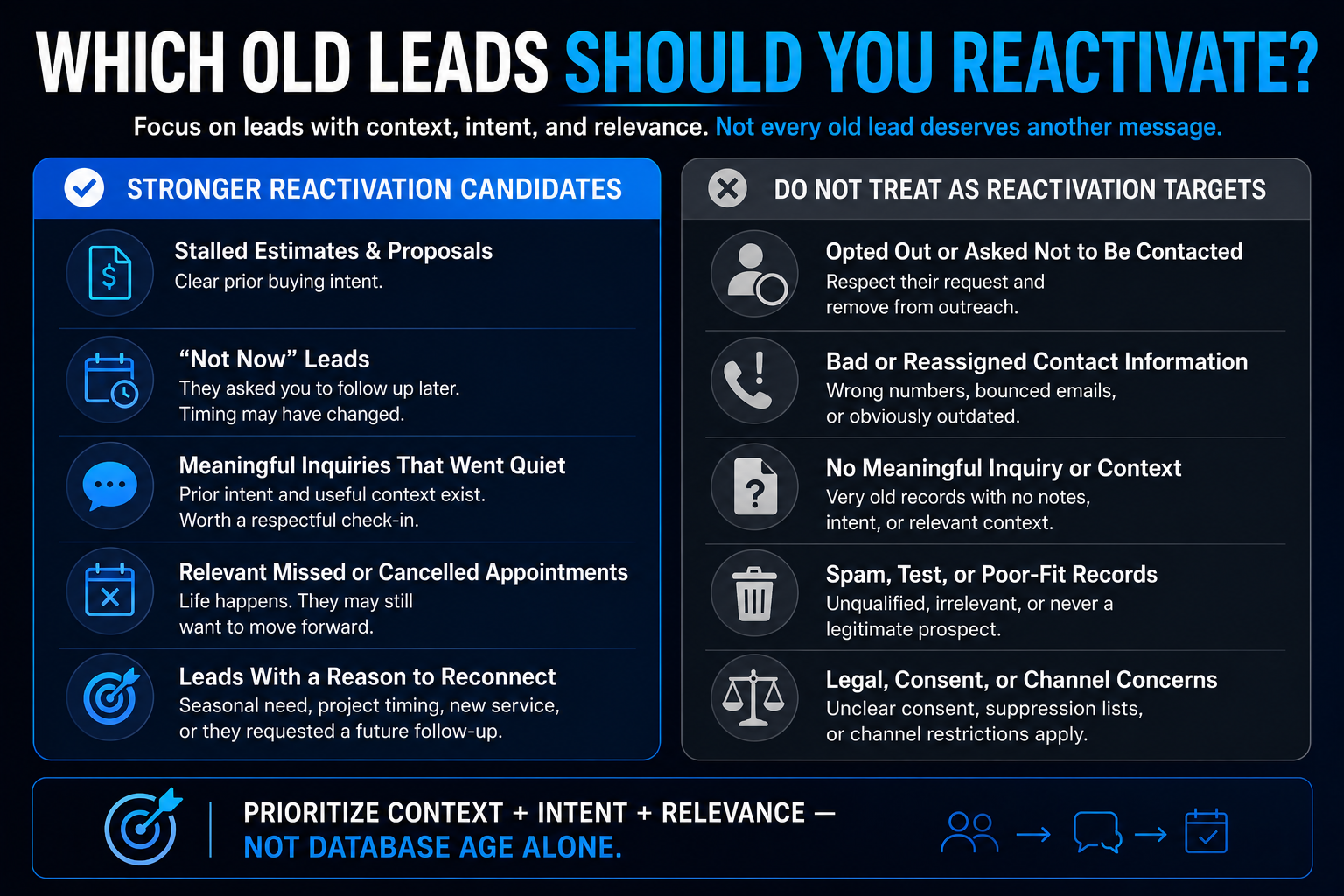
Who Should You Not Reactivate?
This part matters just as much.
A database should not be treated as one giant marketing list.
Before outreach, remove or suppress contacts who should not receive it.
That can include people who:
- explicitly opted out
- asked not to be contacted
- clearly said they were not interested
- are on an applicable suppression list
- have bad or reassigned contact information
- were never a legitimate prospect
- have no meaningful connection to the campaign
- cannot appropriately be contacted through the intended channel
The details depend on the channel, how the contact information was obtained, the type of message, applicable law, and other circumstances.
For example, the FCC has rules governing consent and revocation for certain automated calls and text messages, including recognizing reasonable methods for consumers to revoke consent. The FTC's CAN-SPAM guidance similarly requires businesses sending commercial email to provide a way to opt out and honor qualifying opt-out requests within 10 business days.
The point isn't to turn the business owner into a telecommunications attorney.
It's simpler than that:
"They're in our CRM" is not a sufficient reactivation strategy.
Use the data responsibly.
Segment Before You Send
One generic message to every old lead is easy.
It's also usually a sign that nobody thought very hard about the campaign.
Consider these two contacts:
Lead A: Requested a $15,000 project estimate four months ago and said the timing wasn't right.
Lead B: Filled out a vague contact form three years ago and never replied to anything.
They should not receive the same message.
Before reactivation, useful segmentation might include:
| Segment | Useful Context |
|---|---|
| Old estimates | Service, estimate date, project status |
| Not-now leads | Original reason for delay, requested follow-up timing |
| Stalled inquiries | Last meaningful interaction, service requested |
| No-shows | Appointment type, date, whether rescheduling was attempted |
| Seasonal opportunities | Service requested, relevant season or timing |
| Long-dormant leads | Data quality, consent history, original source and context |
You don't need 47 micro-segments.
You need enough context to avoid sounding clueless.
What Should You Say to an Old Lead?
Usually, less than you think.
A reactivation message doesn't need to explain your entire company, introduce six services, offer three discounts, and announce that artificial intelligence has transformed your business.
The contact already knows who you are—or at least knew at one point.
The job is to reopen the conversation.
A simple structure works well:
Context → reason for reaching out → easy question
For example:
Hi Sarah, you had reached out to us a few months ago about replacing your patio pavers. I wanted to see whether that's still something you're considering or if the project is on hold for now.
Or:
Hi Mike, when we last spoke you were thinking about waiting until fall to move forward with the project. Since we're getting closer, I wanted to see if you'd like to revisit it.
Notice what's missing.
No fake urgency.
No essay.
No "JUST CHECKING IN!!!"
No pretending the previous conversation never happened.
Give People an Easy Way to Say No
This sounds counterintuitive when the goal is generating opportunities.
It isn't.
One of the most useful outcomes of reactivation is learning that an opportunity is actually dead.
If someone says:
We already completed the project.
Great.
Update the record.
If they say:
We're not interested anymore.
Also useful.
Update the record.
If they ask you not to contact them again, honor that request and update the appropriate suppression or communication settings.
A clean no is more useful than another year of "maybe."
Don't Restart the Entire Follow-Up Sequence
Suppose an old lead replies:
Yeah, we're actually thinking about doing this again.
What happens next?
This is where reactivation becomes a lead-conversion problem again.
The contact shouldn't automatically receive seven generic nurture messages because they clicked some invisible trigger.
They've responded.
The system should recognize that the situation changed.
Depending on the business, the next step might be:
- assign the opportunity to a salesperson
- ask a qualifying question
- schedule a consultation
- update the estimate
- reopen the opportunity in the pipeline
- send the appropriate booking link
- create a task for a human follow-up
That's the difference between sending messages and having a lead conversion system.
Where Automation Actually Helps
Reactivation is a good use case for automation because databases become difficult to work manually at scale.
But automation should handle the repetitive parts—not erase the context.
It can help:
- identify leads in appropriate pipeline stages
- segment contacts based on known information
- schedule outreach at sensible intervals
- send approved messages through appropriate channels
- detect and route replies
- stop sequences when someone responds
- create tasks for staff
- update opportunity stages
- schedule appointments
- preserve communication history
This is closely related to automated lead follow-up, but the starting point is different.
Normal follow-up begins while an opportunity is active.
Reactivation begins after that opportunity has gone dormant.
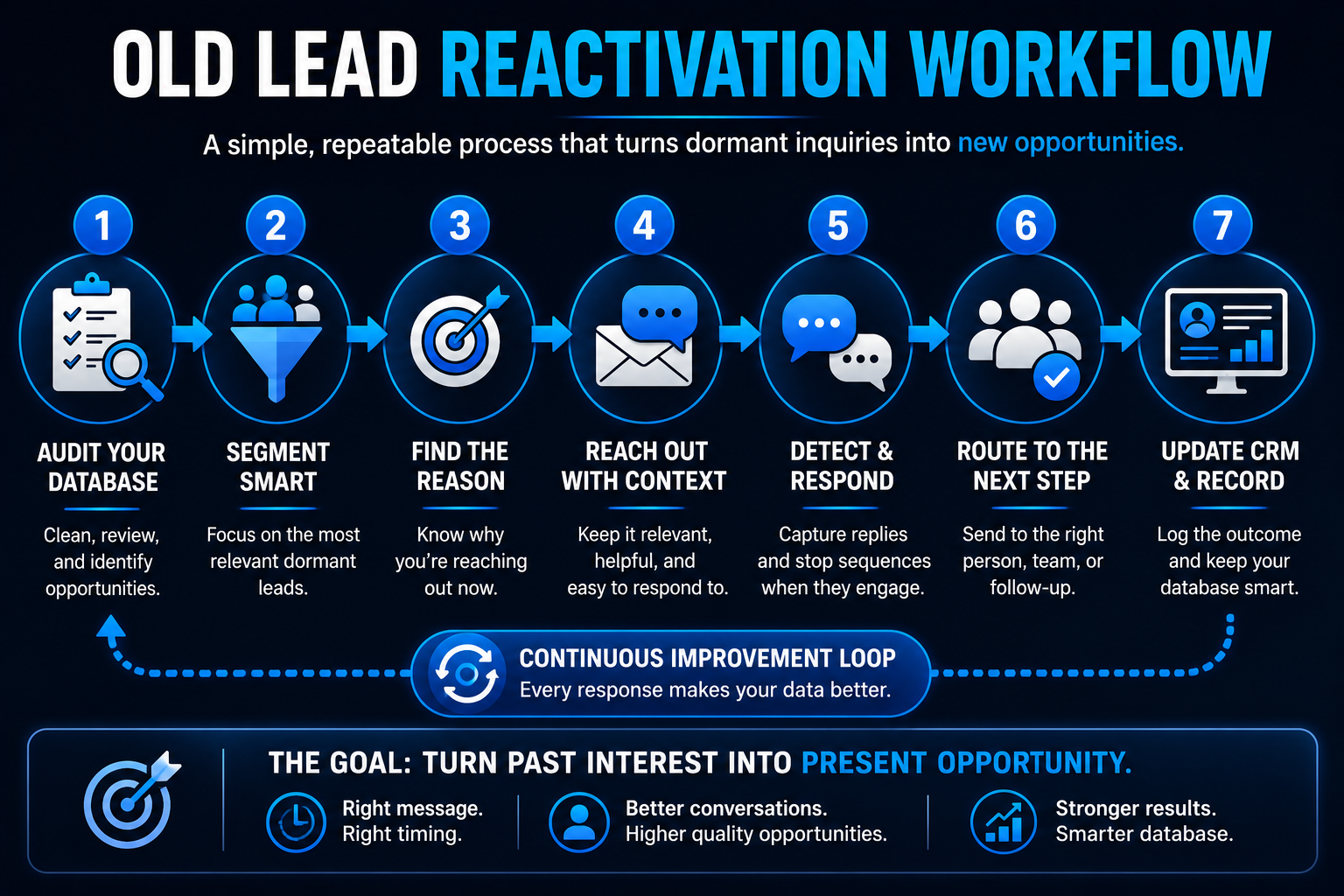
A Simple Old-Lead Reactivation Workflow
You do not need to unleash an AI agent on 10,000 contacts Monday morning.
Start smaller.
1. Audit the Database
Find out what you actually have.
Look at:
- pipeline stages
- lead age
- original source
- service requested
- last contact
- estimate or proposal status
- notes
- consent and communication status
- obvious bad data
The first discovery may be that the database itself needs cleanup.
That's useful information.
2. Choose One High-Quality Segment
Don't start with "everyone who hasn't purchased."
Start with something you can understand.
For example:
People who requested an estimate for a specific service within the last 6–12 months but never booked.
Now you can build outreach around an actual situation.
3. Decide Why You're Reaching Out
"We have your phone number" isn't a reason.
Maybe you're following up because:
- the prospect postponed the decision
- their estimate is getting old
- the relevant season is approaching
- they requested future contact
- you want to confirm whether the project is still active
The reason should make sense from the recipient's perspective.
4. Use the Context You Already Have
If you know what service they wanted, use it.
If they asked you to reconnect in August, don't act surprised that August arrived.
If they already received an estimate, don't ask what they're interested in as though you've never met.
CRM data becomes valuable when it improves the conversation—not merely because it exists.
5. Make Responding Easy
The goal of the first message usually isn't to close the sale.
It's to restart dialogue.
A simple question can be enough:
Is this still something you're considering?
That gives you something far more useful than an "open rate."
It gives you intent.
6. Route Positive Responses Immediately
A reactivation campaign can work perfectly and still fail operationally.
If someone replies:
Yes, I'd like to revisit this.
and nobody responds until Thursday, you've recreated the exact conversion problem the campaign was supposed to solve.
Positive replies need a destination.
That may be a person, inbox, pipeline, qualification workflow, or calendar depending on the business.
7. Record What Happened
Every response should make the database smarter.
Still interested.
Not now.
Already hired someone.
Wrong number.
Do not contact.
Booked.
Not qualified.
That information should change what happens next.
Otherwise you'll run another "reactivation campaign" six months later and ask the same people the same questions.
Reactivation Should Improve the Database Even When It Doesn't Produce a Sale
This is one of the overlooked benefits.
A good campaign doesn't just recover opportunities.
It improves the quality of the underlying system.
You learn:
- which opportunities are still alive
- which records are outdated
- why certain projects stalled
- which services still have demand
- which leads should move into long-term nurture
- which contacts should be suppressed
- which opportunities need human attention
In other words, the CRM becomes less of a storage locker and more of an operating system.
That's valuable even before you count appointments.
What Should You Measure?
Don't judge reactivation solely by how many messages were sent.
Useful metrics include:
- contacts eligible for outreach
- successful deliveries
- response rate
- positive responses
- negative responses
- opt-outs
- qualified opportunities reopened
- appointments booked
- estimates or proposals reopened
- opportunities won
- revenue from reactivated opportunities
The numbers should also be viewed by segment.
If recent stalled estimates produce useful conversations while ancient low-context leads produce mostly opt-outs, that's telling you something.
Use it.
Where the Booked Calendar System™ Fits
Lead reactivation isn't a separate universe from lead conversion.
It's another entry point into it.
A dormant lead becomes interesting again.
Someone responds.
The opportunity needs to be recognized, routed, followed up with, qualified, scheduled, and tracked.
That's exactly why BLB thinks about lead conversion as a connected system rather than a collection of isolated marketing tools.
The Booked Calendar System™ is designed around that broader idea: opportunities should have a clear path from interest to conversation to appointment instead of depending on someone remembering what to do next.
Reactivation simply gives some older opportunities another chance to enter that path.