I've been using HighLevel for about two and a half years.
I originally found it the same way a lot of people probably do now: I started seeing videos about using automation to solve problems for small businesses and service businesses.
The idea made sense to me.
Businesses were already dealing with missed calls, leads that didn't get followed up with, scattered customer information, manual tasks, appointment scheduling, reviews, and a dozen different pieces of software that didn't always talk to each other.
HighLevel looked like a way to bring a lot of that together.
So I signed up.
I've been on the $497 Agency Pro plan for essentially my entire time using it, and today multiple parts of my own business and client systems run through HighLevel.
And after two and a half years, my opinion is pretty straightforward:
I'm a big fan of HighLevel. I would choose it again. But I also think it's very easy to misunderstand what you're actually buying.
HighLevel gives you a huge toolbox. It doesn't give you a business just because you opened the toolbox.
Disclosure: This article contains affiliate links. If you sign up for HighLevel through one of my links, Boost Local Biz may earn a commission at no additional cost to you. I'm recommending a platform I actually use and pay for.
My GoHighLevel Review in 30 Seconds
If you don't want to read the entire review, here's my take.
HighLevel is one of the best values I've found for running an automation-focused agency because of how many tools it puts in one place.
I use it for CRM, workflows, calendars, forms, email, SMS, missed-call text back, chatbots, reputation management, AI tools, client systems, and more.
What I like most:
- A huge portion of what I need is under one roof.
- I can build systems for multiple clients without stitching together a ridiculous number of separate platforms.
- The white-label and reselling capabilities create legitimate recurring-revenue opportunities.
- HighLevel keeps investing heavily in the platform.
- I'm particularly impressed with the direction of its AI tools and AI Studio.
What I don't like:
- There is a lot under the hood.
- Features and interfaces can change quickly.
- Keeping up with everything HighLevel adds can become a job of its own.
- Occasionally something that was working needs to be reconnected, adjusted, or rewired.
- Even after 2.5 years, there are parts of the platform I don't use to their full capability.
That last point isn't necessarily a criticism.
It's also an indication of just how much is in the platform.
What Is GoHighLevel?
GoHighLevel, generally branded today as HighLevel, is an all-in-one sales, marketing, CRM, automation, and client-management platform.
Trying to compare it to one piece of software can be difficult because it overlaps with a lot of categories.
Depending on how you use it, HighLevel can handle CRM and pipelines, marketing automation, forms, calendars, email, SMS, calling, websites and funnels, reputation management, conversations, payments, AI tools, and more.
For agencies, there's another important layer: you can manage multiple client sub-accounts and, depending on your plan and setup, resell or white-label parts of the platform.
That's a major reason I use it.
HighLevel isn't just one tool in my stack. In many cases, it is the stack connecting the other pieces together.
If you want a broader walkthrough of everything the platform can do before reading my firsthand experience, start with my complete guide to GoHighLevel.
If you're completely new to this business model, my guide on how to start an AI automation agency explains the larger opportunity without assuming HighLevel is the only way to do it.
How I Actually Use HighLevel
I don't use every feature HighLevel offers.
I don't think many people do.
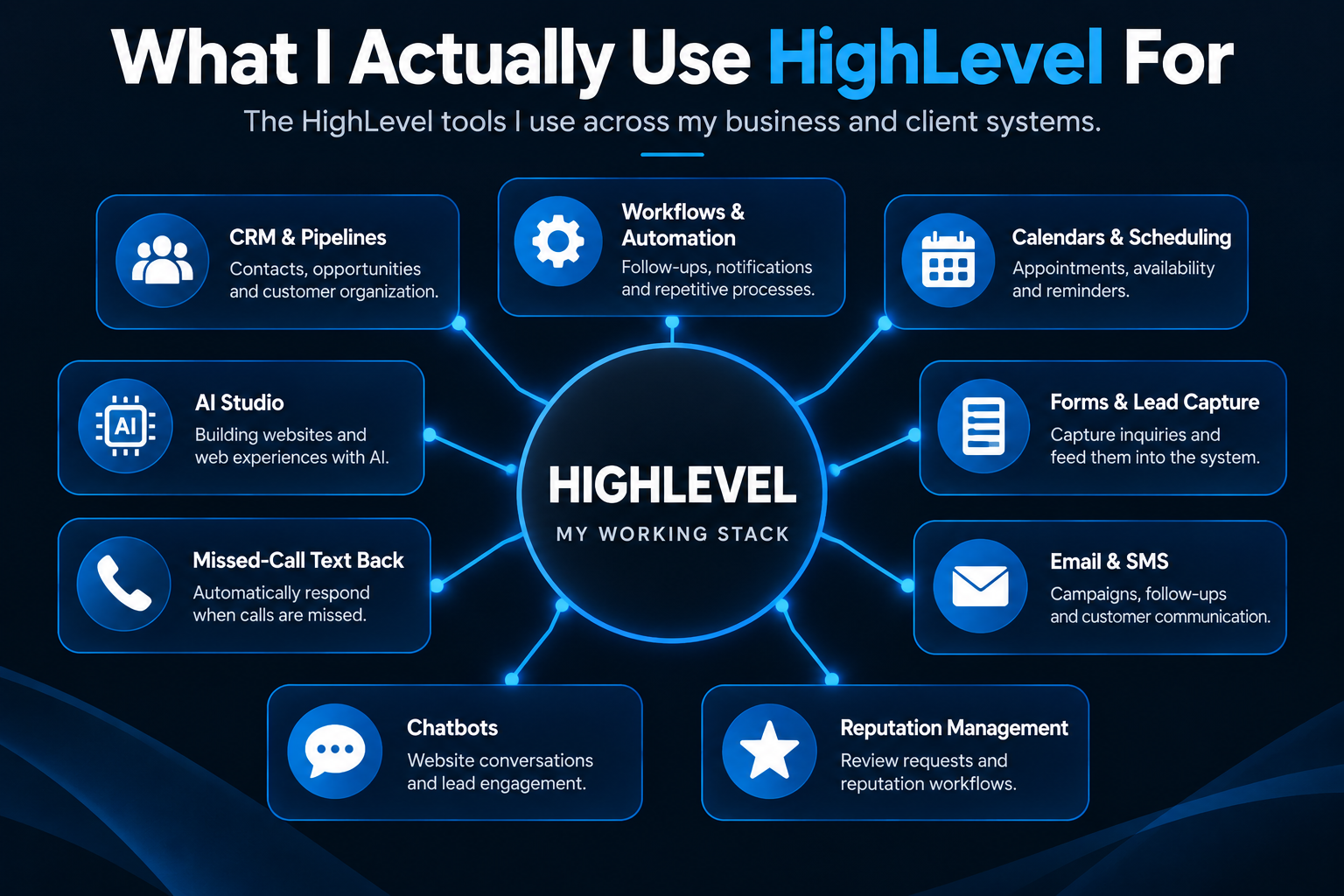
My regular use has included:
- CRM and contact management
- Pipelines
- Workflows and automation
- Calendars and appointment scheduling
- Forms
- SMS
- Missed-call text back
- Chatbots
- Reputation management
- Client sub-accounts
- Landing pages and connected lead experiences
- AI tools
- AI Studio
The important part isn't the list.
It's what happens when these pieces work together.
A form submission can create or update a contact. That contact can enter a pipeline. A workflow can respond immediately. A conversation can continue through SMS or another channel. An appointment can be booked. Reminders can go out automatically. The team can see what's happening without hunting through five different platforms.
That's the part of HighLevel I find valuable.
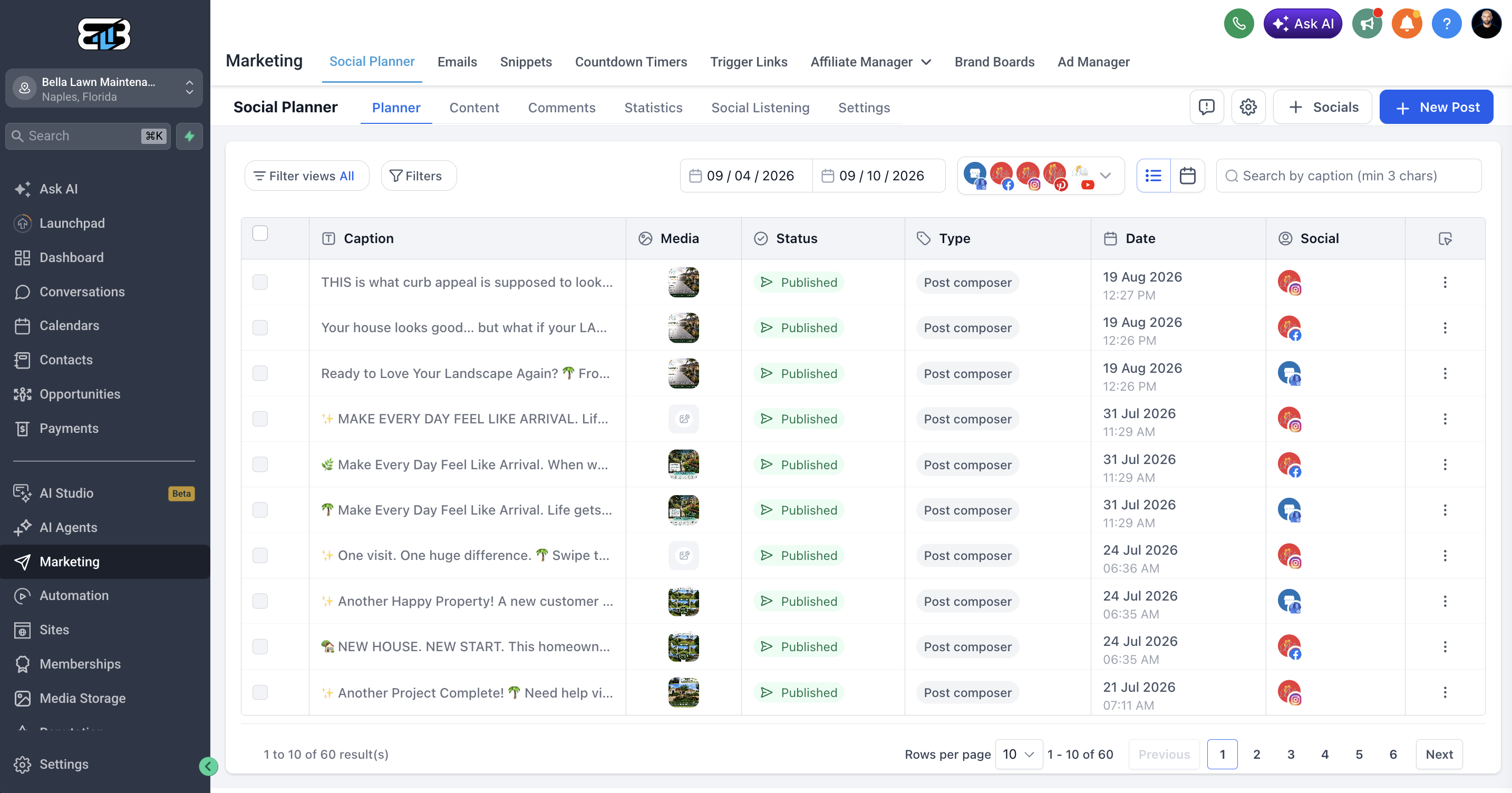
One of the first things I ever did with HighLevel was automate website form responses for Bella Lawn Maintenance, a landscaping business I've worked with for years.
When someone submitted a form on the website, the system automatically sent both an email and a text message in response.
It wasn't some elaborate AI system. It was a straightforward automation that addressed a real business need: making sure an inquiry triggered a response without someone having to manually send that first message.
That's still how I approach automation today. Start with a practical problem, make the process work, and only add complexity when there's a reason for it.
I've written separately about concepts like CRM pipelines, automated lead follow-up, and missed-call text back because those systems matter whether you use HighLevel or another platform.
HighLevel simply gives me a place to implement a lot of them.
What I Like Most About HighLevel
1. So Much of What I Need Is in One Place
This is still the biggest benefit for me.
Before platforms like HighLevel, it was normal to have one tool for email, another for SMS, another CRM, another calendar, another form builder, another autoresponder, another website or landing-page system, and something else connecting everything.
I've used plenty of different software over the years.
Having so much of this under one roof makes it easier to build systems where the pieces are supposed to work together.
That doesn't mean you will never need another piece of software.
It means you can eliminate a lot of unnecessary fragmentation.
2. I Can Resell and White-Label the Platform
This matters much more to an agency than it does to the average small-business owner.
HighLevel gives agencies the ability to turn software and systems into part of what they sell.
Instead of only charging once to build an automation, you can potentially create ongoing value around CRM access, communication tools, automation, reputation management, AI functionality, support, and other services.
That's one of the reasons HighLevel fits so naturally into the recurring-revenue side of an automation business.
I've covered that broader model in my guide to creating recurring revenue with AI automation services.
The important distinction is that you still need to create something businesses find valuable.
White-labeling software does not magically make it valuable.
3. You Can Build Very Different Businesses With the Same Platform
Another thing I really like about HighLevel is that you don't have to build the same type of business everyone else is building.
There are enough different capabilities under one roof that you could build an entire offer around only a small part of the platform.
You could build a website business around AI Studio.
You could focus on CRM implementation and automation.
You could build systems around lead follow-up and appointment booking.
You could create a reputation-management service.
You could build an offer around conversational AI or chatbots.
Voice AI could potentially become the foundation of an AI receptionist or voice-automation offer.
Or you can combine several of those pieces into a much more complete system.
That's one of the things I didn't fully appreciate when I first signed up.
HighLevel isn't really one business model. It's infrastructure you can use to support a lot of different business models.
But there's an important distinction.
Having access to all of those tools doesn't automatically give you a business.
You still have to decide what problem you're solving, who you're solving it for, how you're packaging the solution, and how you're going to get customers.
That's why I think there's a big difference between buying HighLevel and actually building a business with HighLevel.
4. HighLevel Keeps Getting Better
This is both something I love about HighLevel and, occasionally, something that drives me nuts.
There is clearly a lot of development effort going into the platform.
I've watched features improve and entirely new capabilities appear during the time I've used it.
I would rather use a platform aggressively trying to improve than one that barely changes.
But there is another side to that, which I'll get into shortly.
5. I'm a Big Fan of HighLevel's AI Direction
This has become one of the more interesting parts of HighLevel for me.
The platform has been adding AI capabilities across conversations, reviews, content, agents, and other areas.
But one product deserves a specific distinction.
HighLevel AI Studio Is One of My Favorite Additions
I want to be very clear about something here because the terminology can get confusing.
I'm not talking about HighLevel's traditional website builder.
I do not use the traditional HighLevel website builder to build my sites.
Historically, that was actually one of the areas of the platform I liked least. I found the traditional builder clunky, and I wasn't particularly impressed with the websites I could produce with it.
AI Studio is different.
HighLevel describes AI Studio as an AI-powered creation workspace that can build websites, landing pages, and interactive experiences using natural-language prompts.
I've spent a lot of time with AI Studio, I'm a huge fan of it, and I have quite a bit of actual work to show for what I've been able to build with it.
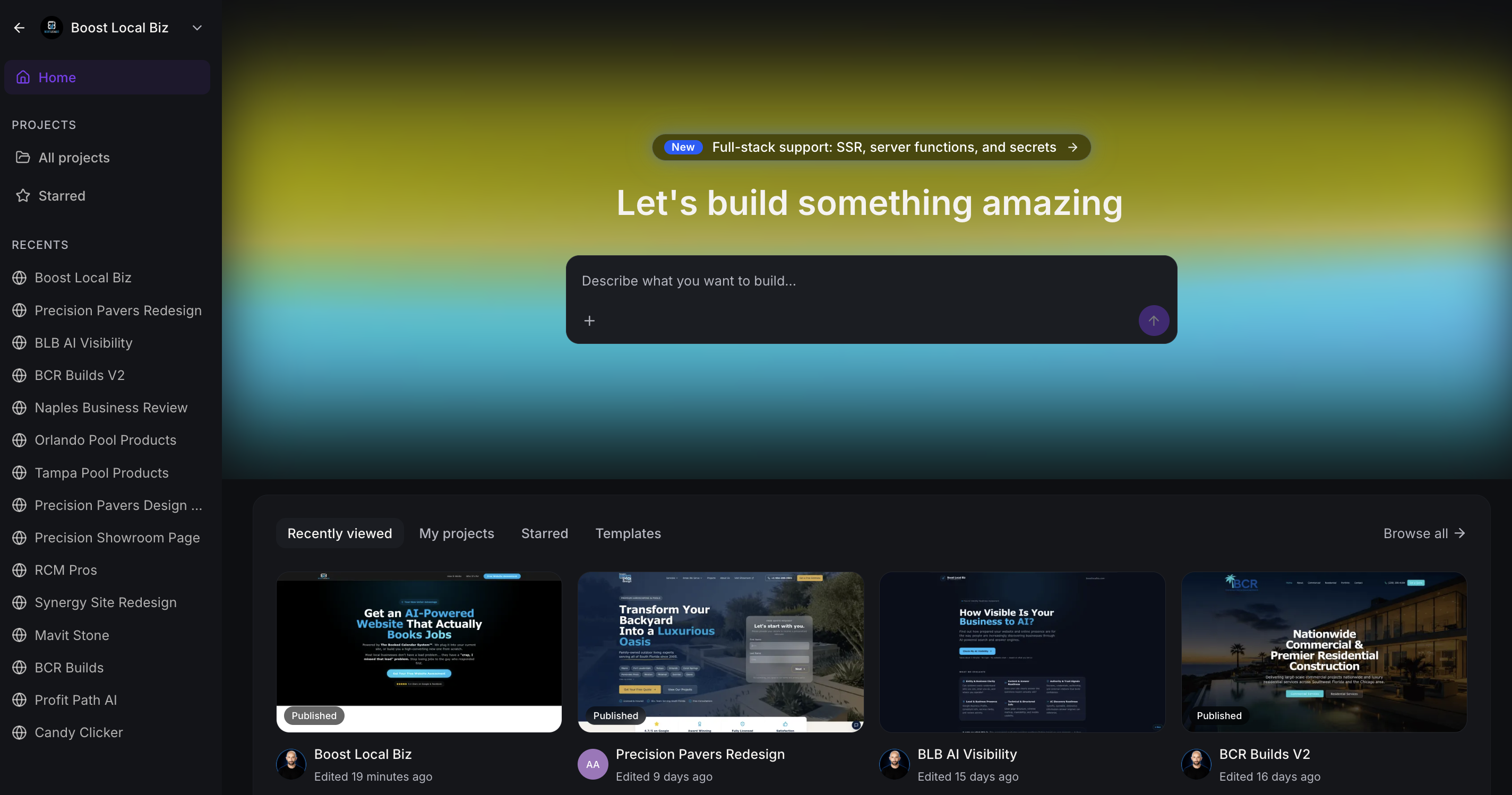
For me, that's one of the best examples of why my opinion of HighLevel has become more positive over time.
I'm not going to turn this review into a full AI Studio tutorial because it deserves its own article.
But it has become one of the HighLevel products I'm most excited about.
Want to Try HighLevel Yourself?
I've used the $497 Agency Pro plan throughout my time with HighLevel because it fits what I'm building as an agency. That doesn't mean you automatically need the same plan. Choose based on what you're actually trying to build rather than paying for features you don't need yet.
Start Your HighLevel TrialWhat I Don't Like About HighLevel
This wouldn't be much of a review if I pretended everything was perfect.
It isn't.
There Is Almost Too Much Going On
HighLevel's biggest strength creates one of its biggest problems.
There is a ton under the hood.
Even though I came into HighLevel already familiar with website software, autoresponders, workflows, digital marketing tools, and automation concepts, there was still a learning curve.
There are still areas that are somewhat gray for me simply because there is so much to learn.
For someone completely new to this world, that learning curve can be considerably steeper.
I Also Outsourced Some of the Setup
Almost immediately after signing up for HighLevel, I hired someone to help me set up a lot of the backend.
I think that's important to mention in a review like this.
I already had experience with websites, autoresponders, workflows, digital marketing, and similar tools. But HighLevel still had a learning curve because there was simply so much under the hood.
Instead of deciding I needed to master every part of the platform before I could use it, I got help with some of the initial setup and focused on learning the parts that mattered most to what I was actually trying to build.
Even after roughly 2.5 years, there are still parts of HighLevel I'm not using to their full capability.
That doesn't necessarily bother me.
If anything, it's one of the reasons I don't feel like I've outgrown the platform.
There are still parts of it I haven't grown into yet.
You also don't necessarily have to become an expert in every corner of HighLevel yourself. Depending on what you're building, it may make more sense to learn the parts you actually need and outsource or get help with the rest.
HighLevel Changes a Lot
The company continually adds and improves things.
Good.
But that also means menus move, capabilities change, new features appear, and the way you previously did something isn't necessarily the way you'll do it forever.
It can be difficult to keep up.
There have also been times when something gets disconnected or needs to be adjusted or rewired.
When you're managing systems for multiple clients, that's not something you can ignore.
The lesson I've learned isn't that automation means "set it and forget it."
It's that good automation still needs someone responsible for it.
I Don't Use Everything I'm Paying For
HighLevel has features I thought I would use more than I currently do.
Voice AI is a good example.
I've been interested in it and expected I'd use it more by now, but I haven't actually deployed it enough to give you a meaningful firsthand review.
So I'm not going to pretend I can.
There are other parts of HighLevel where I know there's more capability than I'm currently taking advantage of.
That's probably my biggest version of:
"I love HighLevel, but…"
I know I'm still not using everything it can do.
Does HighLevel Replace Every Other Software Tool?
Not necessarily.
But I'm also not sitting here with a list of major functions where I think, "HighLevel is terrible at this; you absolutely need something else."
For the jobs I rely on it for, I've been happy with the capability.
That's different from claiming HighLevel is objectively the best individual CRM, email platform, website platform, automation platform, calendar, reputation tool, AI platform, and communications system on Earth.
That's an impossible standard.
The advantage is the combination.
Ten specialized tools might individually win ten different feature comparisons.
But then you have ten tools.
Ten logins.
Ten bills.
Ten sets of integrations.
Ten places something can break.
Integration has value too.
What Do My Clients Actually Care About?
This is where agency owners can get distracted.
Clients generally don't care that you can name 75 HighLevel features.
They care about what changes for their business.
In my experience, the things that matter are much simpler:
Can we keep things organized?
Can leads and customers get followed up with quickly?
Can we automate repetitive tasks?
Can everything be easier to manage?
Can the system help the business close more opportunities with less manual work?
That's the value.
Nobody buys a workflow because workflows are exciting.
They buy what the workflow accomplishes.
That's also why I don't think an automation agency should lead by selling technology. Packaging AI automation services around actual business problems is much more compelling than dumping a software feature list in front of someone.
Is HighLevel Better for Agencies or Small Businesses?
HighLevel can be used by both.
But if you ask me where it makes the most sense, my answer is agencies.
A typical small-business owner is already running a business.
They have customers, employees, estimates, operations, payroll, jobs, inventory, fires to put out, and everything else that comes with owning a company.
Most aren't going to spend their nights learning every corner of HighLevel.
And they shouldn't have to.
That's part of the agency opportunity.
The agency understands the technology and builds the system.
The business gets the outcome without needing to become an expert in the software underneath it.
Who Should Use HighLevel?
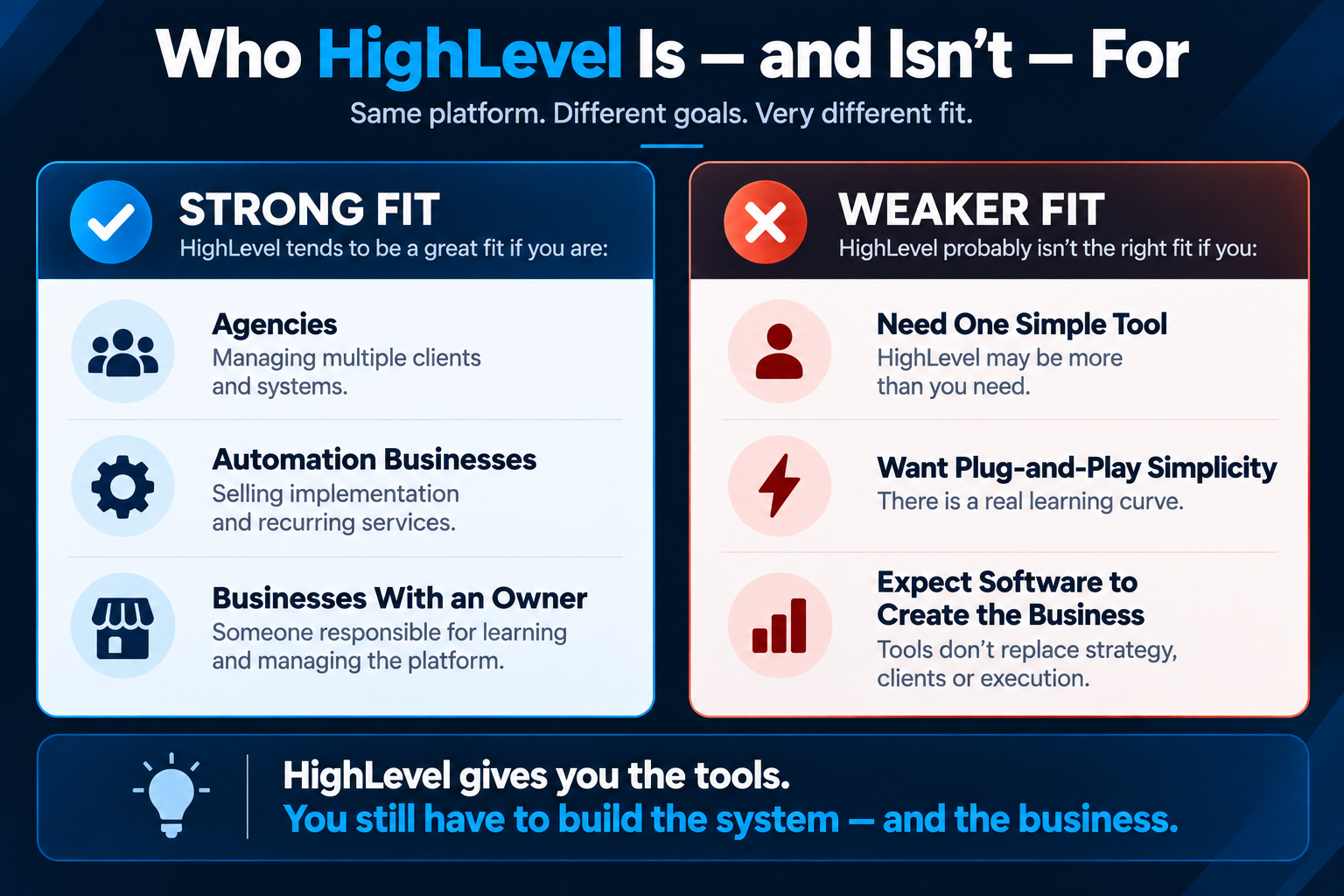
I think HighLevel makes the most sense for:
- Marketing and automation agencies
- Entrepreneurs building productized automation services
- Agencies managing multiple client accounts
- Consultants implementing lead-conversion systems
- Businesses with someone internally who can actually own the platform
- People who want to consolidate multiple marketing, CRM, communication, and automation functions
- Entrepreneurs interested in creating recurring revenue around software-enabled services
It can be an especially good fit when you're trying to build repeatable systems instead of reinventing your delivery for every customer.
Who Should NOT Buy HighLevel?
First, I wouldn't tell every small-business owner to go sign up for HighLevel and figure it out.
If you need one simple tool for one simple job, buying an enormous platform may create more complexity than it removes.
More importantly, I wouldn't recommend HighLevel to someone who thinks buying the software means they now have an AI automation agency.
It doesn't.
If you saw somebody on TikTok saying you can buy HighLevel today, sell an AI service tomorrow, and immediately start making ridiculous amounts of money, that's not a business plan.
HighLevel gives you tools.
You still have to understand:
- What businesses will pay you to solve
- How to build the solution
- How to communicate its value
- How to get clients
- How to onboard them
- How to support what you've built
- How to keep improving
If you're not willing to treat it like a real business, I wouldn't spend the money.
How Much Does HighLevel Cost?
At the time I'm writing this, HighLevel's public monthly plans are:
| Plan | Current Monthly Price | Best Fit |
|---|---|---|
| Starter | $97 | Smaller businesses, solo marketers, or getting started |
| Unlimited | $297 | Growing agencies needing unlimited sub-accounts |
| Agency Pro | $497 | Agencies wanting SaaS Mode and deeper reselling capabilities |
I've personally been on the $497 plan throughout my time using HighLevel.
For what I get from it, I think it's an incredible value.
I can manage multiple client systems and use a huge collection of tools without paying a separate base subscription for every individual function.
But there's an important caveat.
Your HighLevel Subscription Isn't Necessarily Your Total HighLevel Bill
Certain services and usage can cost extra.
Depending on what you use, that can include phone/SMS, email-related services, AI usage or AI plans, premium workflow features, listings, dedicated IPs, and other optional services.
For example, HighLevel currently lists AI Employee Growth at $50 per month per enabled sub-account and AI Employee Unlimited at $97 per month per enabled sub-account. HighLevel also notes that phone charges can still apply even when certain Voice AI usage is included.
Pricing in this area changes, especially around AI, so always check HighLevel's current pricing and in-app billing before making decisions.
I cover that in detail in my guide to GoHighLevel pricing and additional costs, because "What does HighLevel actually cost once I'm using it?" is a different question from the basic subscription price.
And if you're trying to decide which GoHighLevel plan makes sense for your situation, I broke that down separately in my Starter vs. Unlimited vs. Agency Pro comparison.
See If HighLevel Fits What You're Building
If you're building an agency, selling automation, or want to consolidate more of your client systems into one platform, HighLevel is worth taking a serious look at.
Try HighLevelThis is an affiliate link. I may earn a commission if you become a customer, at no additional cost to you.
What Would Happen If HighLevel Disappeared Tomorrow?
This is one of the easiest ways for me to evaluate how important a piece of software actually is.
If HighLevel disappeared tomorrow, replacing it would be a pain in the ass.
Not because of one killer feature.
Because of all the connected pieces.
I have client systems involving things like:
- Forms
- Landing pages
- Follow-up sequences
- Workflows
- Notifications
- Reminders
- Calendars
- CRM records
- Communications
- Reputation systems
- Automations
I'd have to replace the individual functions and recreate the connections between them.
That's where the real switching cost is.
It's not just replacing software.
It's rebuilding systems.
Would I Choose HighLevel Again?
Yes.
Knowing everything I know after approximately two and a half years, I would still choose HighLevel.
That's probably the simplest verdict I can give you.
It's not perfect.
There's a learning curve.
It changes constantly.
There are occasionally things that need to be fixed or reconnected.
There are entire areas of the platform I haven't fully explored.
And buying it will not magically create a successful agency for you.
But the amount of capability I get for what I pay is difficult for me to argue with.
HighLevel has become deeply connected to how I build and manage systems for my business and clients.
And interestingly, after two and a half years, I don't feel like I've outgrown it.
There are still parts of HighLevel I haven't grown into yet.
For me, that's a pretty strong endorsement.
Ready to Try HighLevel?
I've used HighLevel for about 2.5 years, I've paid for the $497 Agency Pro plan throughout that time, and knowing what I know today, I'd still choose it. If what I've described sounds like the kind of platform you're looking for, you can try it through my link.
Start Your HighLevel TrialIf you sign up through this link, Boost Local Biz may earn a commission at no additional cost to you.
Not Ready for HighLevel Yet?
If you're more interested in understanding how an AI automation business actually works before choosing your software, start with my 48-Hour AI Cashflow Stack.
It walks through the business model and helps you think about the problems you can solve, what you can sell, and how the pieces fit together without pretending software alone creates a business.