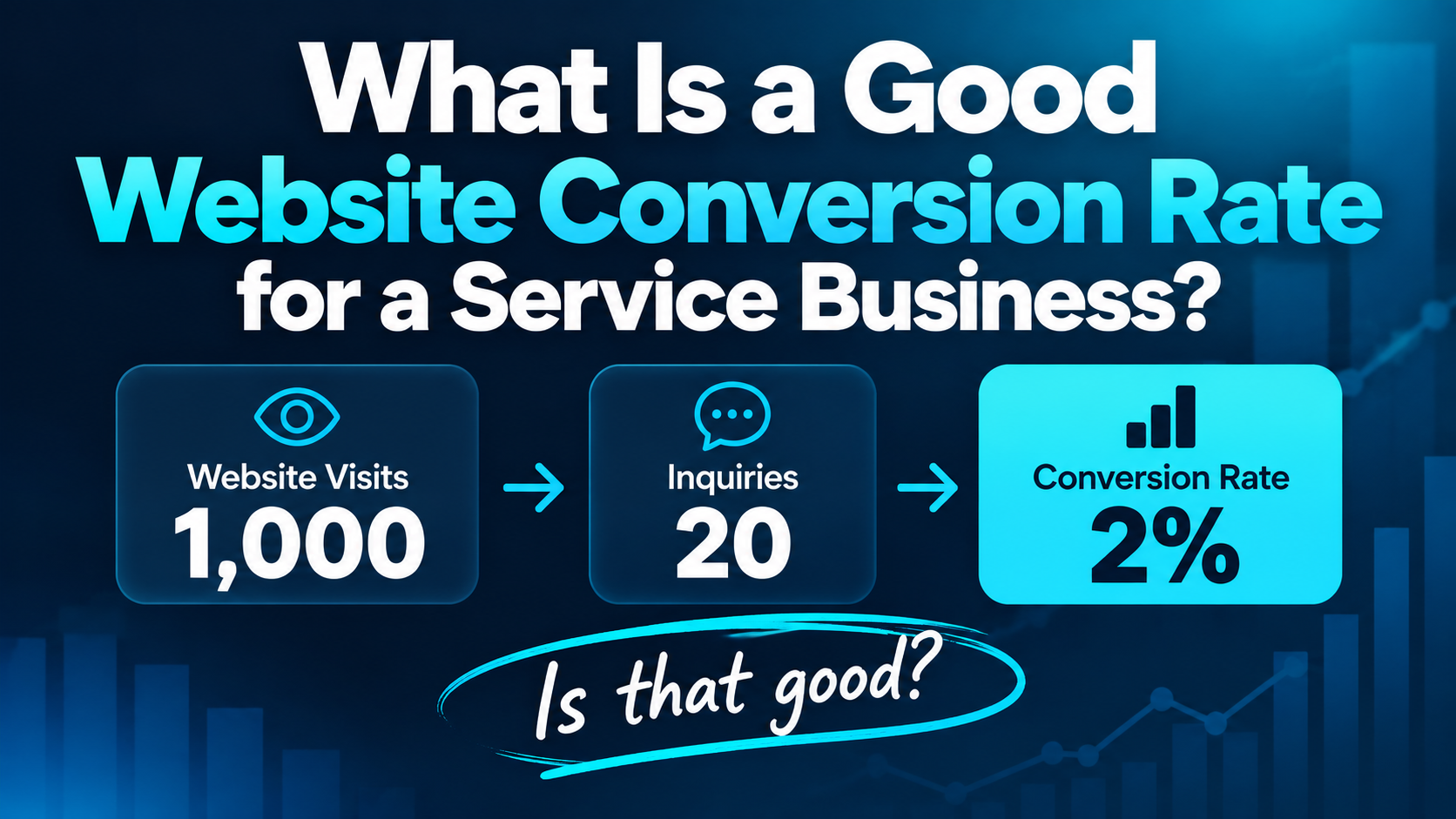
Your website had 1,000 visits last month and generated 20 inquiries.
Is that good?
You could search for an average website conversion rate, compare your 2% against a number from an industry report, and decide your website needs work.
But that skips a few important questions.
Were those 20 inquiries legitimate potential customers? Did they come from people in your service area? Were they looking for services you actually provide? How many became conversations, estimates, or appointments?
And what were the other 980 visits? Local homeowners researching a project? Existing customers looking for your phone number? People reading a blog article from another state?
A good website conversion rate for a service business is one that produces enough qualified opportunities to support the business—not simply one that beats a generic industry average.
Benchmarks can provide context. Your own traffic, inquiry quality, booking results, and business goals tell you much more.
What Is a Website Conversion Rate?
A website conversion rate measures the percentage of visits or visitors that complete a defined action.
For a service business, that action might be:
- Submitting a contact form
- Calling from the website
- Starting a meaningful chat conversation
- Requesting an estimate
- Booking a consultation or service appointment
The calculation depends on what you're counting.
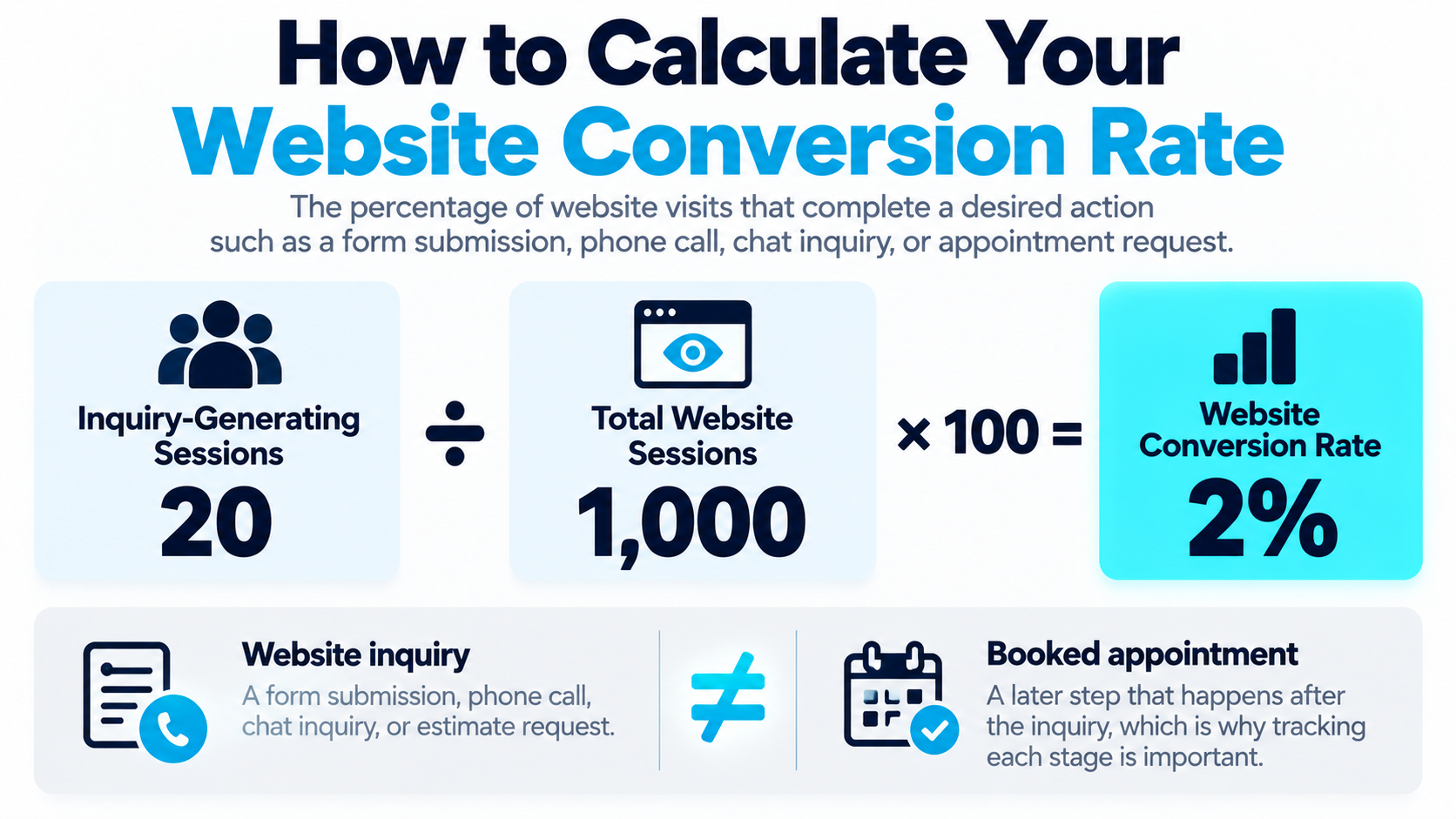
If you're measuring inquiry-generating sessions, a straightforward formula is:
Website inquiry conversion rate = Sessions that generated an inquiry ÷ Total sessions × 100
For example:
1,000 website sessions
20 sessions that generated at least one inquiry
20 ÷ 1,000 × 100 = 2%
That tells you the percentage of sessions that produced an inquiry.
It does not tell you whether those inquiries were qualified, whether anyone responded, or whether the business booked a job.
Be consistent about visits, visitors, and conversions
A session and a visitor are not the same thing. One person can visit your website multiple times.
Likewise, one visitor can submit a form and call, creating two tracked actions from one person.
You can measure conversion events, sessions with a conversion, or users who converted. Those are different metrics, so don't switch between them when comparing periods.
Google Analytics 4 calls important business actions key events. Google explains that you can mark relevant events as key events and use them to evaluate performance. Google's key-event documentation is useful when setting up measurement.
For a local service business, I would rather see a clearly defined, consistently measured inquiry rate than a dashboard displaying a large “conversion rate” nobody can explain.
So, What Is a Good Conversion Rate for a Service Business Website?
There is no single percentage that reliably defines a good conversion rate for every service-business website — and a healthy-looking traffic number doesn't guarantee leads either.
A roofing company receiving emergency repair inquiries, a pool builder attracting people researching a six-figure project, and a commercial contractor with a long sales cycle should not expect identical visitor behavior.
The conversion action matters, too.
A visitor clicking a phone number is different from a person submitting a detailed estimate request. A booked consultation is a further step. A signed contract is another outcome entirely.
What do published benchmarks say?
Unbounce's 2024 Conversion Benchmark Report analyzed more than 41,000 landing pages, 464 million visitors, and 57 million conversions. It reported:
| Sample | Median landing-page conversion rate |
|---|---|
| All industries in the report | 6.6% |
| Commercial and professional services | 6.1% |
The commercial and professional services breakdown also notes meaningful variation between types of services, including repair and maintenance versus home renovation.
These are useful reference points, but they need context.
They are landing-page benchmarks from Unbounce's 2024 sample—not a universal target for every page on a local business website in 2026.
A focused landing page built around one advertising campaign and one action is not the same thing as an entire website containing a homepage, service pages, project galleries, blog articles, and contact information.
The report also measures conversion events without establishing the revenue value of every event.
If someone tells you that every service-business website should convert at 5%, 10%, or any other fixed number, ask what kind of website, what traffic, and what conversion action they're talking about.
Without those details, the number doesn't mean much.
Why Two Service Businesses Can Have Very Different Conversion Rates
Imagine two hypothetical businesses.
Business A provides urgent repair services. Someone has an immediate problem, searches for a nearby provider, and wants to speak with someone now.
Business B builds custom outdoor living spaces. A homeowner might compare ideas, explore galleries, research costs, discuss the project with a spouse, and return several times before requesting an estimate.
Business A may generate inquiries earlier in the visit.
Business B may need to earn attention over several visits before a prospect is ready.
That doesn't automatically make Business A's website more effective.
The businesses serve different needs and buying timelines.
Other factors can change the number substantially:
| Factor | Why it matters |
|---|---|
| Traffic source | Someone searching for a local service may behave differently from someone arriving through a broad social post. |
| Search intent | “Emergency AC repair near me” and “How long does an AC unit last?” are different visits. |
| Service type | Urgent repairs and planned renovations involve different decisions. |
| Geographic fit | Visitors outside your service area may never become customers. |
| Offer | “Request an estimate” and “Download a guide” ask for different commitments. |
| Device | A phone call may be easier on mobile, while a complex form may be harder to complete. |
| Website page | A service page and an educational blog article have different jobs. |
This is why an overall website conversion rate should be the beginning of your analysis, not the final verdict.
The Three Conversion Rates I Would Actually Watch
For a service business, I would separate three stages instead of putting every action into one number.
1. Website inquiry rate
Inquiry-generating sessions ÷ website sessions × 100
This helps answer:
Is the website turning visits into contact opportunities?
Track relevant actions such as calls, estimate requests, forms, and meaningful chat inquiries. Exclude routine interactions that don't represent a potential customer.
2. Inquiry-to-booking rate
Booked appointments ÷ inquiries × 100
This helps answer:
What happens after someone contacts the business?
A website can generate inquiries successfully while the business loses opportunities through missed calls, slow response, unclear scheduling, or inconsistent follow-up.
3. Qualified-opportunity-to-booking rate
Appointments booked from qualified opportunities ÷ qualified opportunities × 100
This helps answer:
Are legitimate prospects making it onto the calendar?
It also prevents low-fit inquiries from distorting your view of the sales process.
These rates should use clearly defined counts and consistent reporting periods. If an inquiry arrives near the end of the month and books in the next month, account for that timing rather than assuming it was lost.
Our guide on tracking leads from first inquiry to booked appointment walks through the full process.
A Hypothetical Example: The Higher-Conversion Website Isn't Always Producing More Business
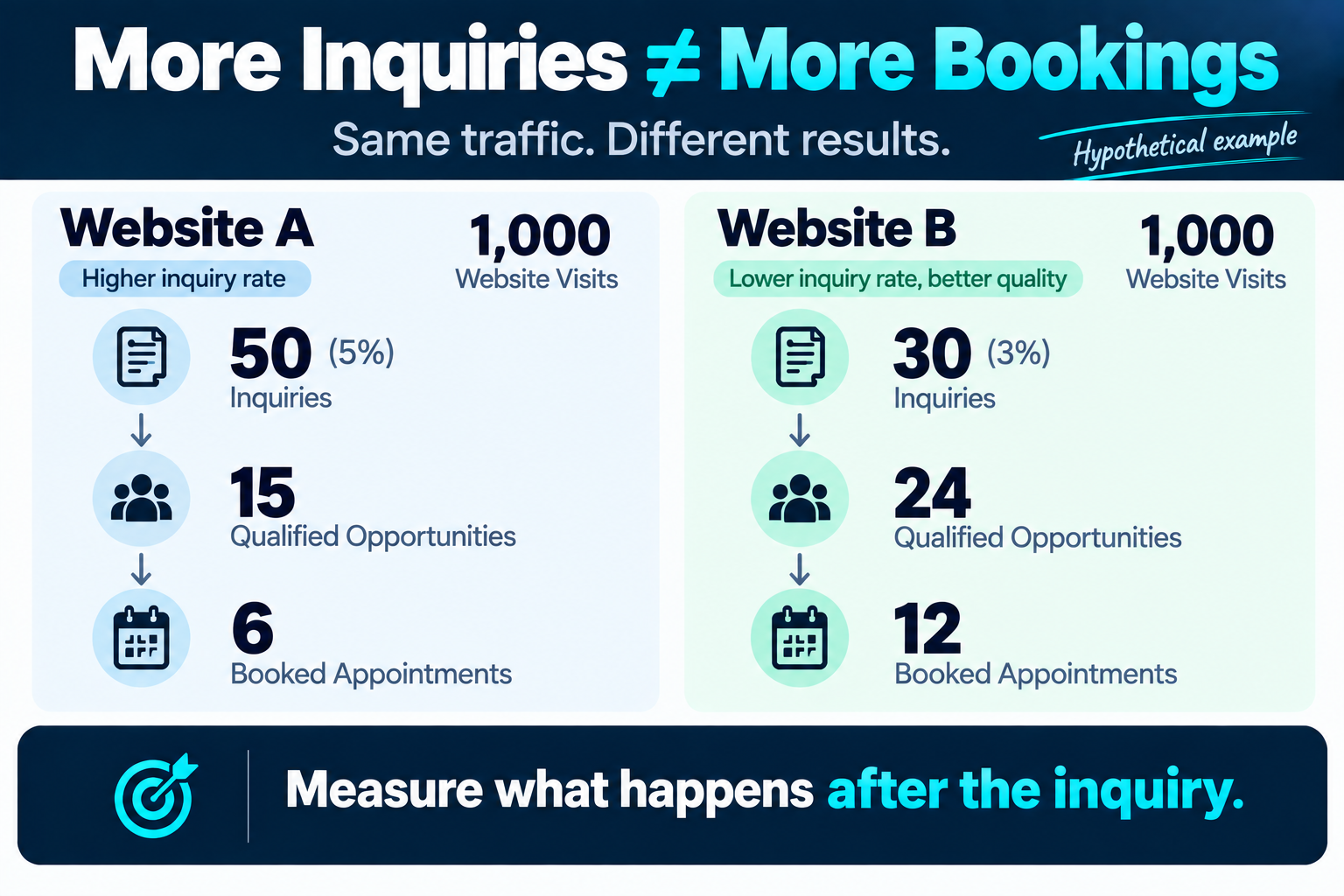
Consider two hypothetical service-business websites receiving the same number of sessions.
| Metric | Website A | Website B |
|---|---|---|
| Website sessions | 1,000 | 1,000 |
| Inquiries | 50 | 30 |
| Website inquiry rate | 5% | 3% |
| Qualified opportunities | 15 | 24 |
| Appointments booked | 6 | 12 |
If you only look at website inquiry rate, Website A appears to be doing better.
It generated 50 inquiries from 1,000 sessions.
But Website B generated fewer inquiries and twice as many booked appointments in this hypothetical example.
That doesn't prove Website B would produce more revenue. We would still need to know appointment quality, close rates, job value, and actual sales outcomes.
It does show why optimizing only for more form submissions can lead you in the wrong direction.
A website should make it easier for the right people to take the right next step—not simply persuade more people to click something.
How to Tell Whether Your Website's Conversion Rate Needs Work
Start with the problem you're actually seeing.
A low overall rate can have several explanations, and each points toward a different next step.
People visit but don't contact you
Look at the pages attracting those visits.
If a high-intent service page receives relevant local traffic but generates little contact activity, examine:
- Does the page clearly explain the service?
- Can visitors tell whether you serve their area?
- Is the next step obvious?
- Is the phone number easy to find and use?
- Does the page provide enough evidence to trust the business?
- Is the contact process unnecessarily difficult?
For a deeper look at these elements, see what makes a service-business website convert.
People start forms but don't complete them
Review the form itself.
Are you asking for information the business doesn't need yet? Does it work on a phone? Is there an error message? Does the visitor know what happens after submitting?
Sometimes the issue isn't the offer or the traffic. It's friction at the point of contact.
People call, but you can't tell what happened
A click-to-call event is not proof that someone had a conversation with your business.
If phone inquiries are important, you need a way to distinguish a phone-number click, a connected call, a missed call, and an actual potential customer.
Otherwise, you may be counting website conversions that never become handled opportunities.
The website generates inquiries, but appointments stay low
Now you're looking beyond the website.
Check response time, missed calls, ownership, follow-up, qualification, and scheduling.
A redesign will not fix a business that routinely fails to respond to interested prospects.
That's where the website and the lead-conversion system need to work together.
How to Improve a Service-Business Website Conversion Rate
There is no universal sequence of fixes, but I would work through these areas before assuming the website needs to be rebuilt.
Make the offer clear before making the page clever
A visitor should quickly understand what you do, who you help, where you work, and what to do next.
“Transforming Experiences Through Innovation” may sound polished, but it doesn't tell a homeowner whether you install impact windows in their county.
Clarity usually deserves attention before animation, visual effects, or another round of headline brainstorming.
Match the page to the visitor's intent
Someone researching pool resurfacing costs may need a different next step from someone ready to schedule an estimate.
A service page should address the actual service. A pricing guide should help readers understand costs. A contact page should make contacting the business straightforward.
Don't force every visitor into the same interaction.
Give people an appropriate way to contact you
Calls, forms, chat, and scheduling each serve different preferences and situations.
A customer with an urgent issue may want to call. Someone planning a project may prefer to submit details. A visitor with a quick question may use chat.
The point isn't to add every widget available.
It's to offer contact paths that fit the business and the customer's next step.
Our comparison of website forms, chat, and online scheduling explains where each can help.
Make mobile contact easy
Check the website on an actual phone.
Can someone read the service information without pinching and zooming? Is the call button easy to use? Can they complete the form? Does a pop-up cover the main CTA?
Don't assume a page works on mobile just because it technically fits a small screen.
Use proof that helps a customer make a decision
Relevant project photos, clear service details, authentic reviews, service-area information, and an understandable process can answer questions that otherwise stop someone from contacting you.
Use genuine evidence. Don't invent testimonials, results, or project examples to make a page look established.
Connect the inquiry to a response process
A successful form submission should not end at “Thanks, we'll be in touch.”
Decide who receives it, how quickly the prospect should hear back, and what happens if the first response doesn't lead to a conversation.
This is part of what makes an AI-powered website useful: it can connect contact points with appropriate response, CRM, follow-up, and scheduling systems instead of acting like a digital brochure.
AI can help support those interactions. It does not remove the need for a clear process or human involvement where appropriate.
How to Measure Conversion Rate Without Fooling Yourself
Before making changes, make sure the measurement is reliable.
For a service business, I would start with this checklist:
- Choose the primary conversion action. Is it an inquiry, estimate request, or confirmed booking?
- Define the denominator. Are you using sessions or users?
- Test the tracking. Submit a test form, click the phone link, and verify that the appropriate events appear.
- Avoid double counting. One person may call and submit a form.
- Separate meaningful inquiries from low-value actions. A page scroll or button click is not automatically a sales opportunity.
- Review relevant segments. Compare service pages, traffic sources, devices, and local versus nonlocal traffic where your data allows.
- Connect website actions to actual outcomes. Check which inquiries become conversations, qualified opportunities, and bookings.
Google's documentation explains how to report on key events in GA4.
If you're also running ads, remember that Google Ads defines conversion rate around conversions per eligible ad interaction. That is not automatically the same as the session-based website inquiry rate we've used in this article.
Don't compare those numbers as though they have identical definitions.
When Should You Redesign Instead of Optimize?
Not every weak conversion rate calls for a new website.
If your site is structurally sound, the service pages are relevant, and contact tracking works, you may be able to improve performance by fixing specific problems.
A larger rebuild becomes more reasonable when the underlying website makes those improvements difficult—for example, when mobile usability is poor across the site, important service information is hard to organize, contact paths are unreliable, or the platform limits the integrations the business needs.
The decision should follow a diagnosis, not frustration with the current design.
Our website redesign checklist for service businesses can help you decide what to fix before rebuilding.
The Bottom Line
A website conversion rate is useful when you know exactly what it measures.
Published benchmarks can give you context, but they cannot tell you whether your particular website is producing enough qualified opportunities for your business.
Track inquiries. Check their quality. Follow them through conversations and bookings. Look at the pages and traffic sources bringing in the right people. Fix the actual bottleneck.
The goal isn't to win a conversion-rate contest. It's to turn relevant website traffic into real business opportunities.
Is Your Website Turning the Right Visitors Into Opportunities?
If your website receives traffic but you're unsure whether it's producing enough meaningful inquiries—or whether the contact process is costing you opportunities—a Free Website Assessment is a practical place to start.
We'll focus on how your website communicates your services, helps visitors take the next step, and connects inquiries to the rest of your business.