If your business misses calls because everyone is busy, on a job, helping another customer, or simply done working for the day, you have more options than you used to.
You can send those calls to a traditional answering service staffed by people.
Or you can use an AI receptionist that can answer the phone, talk with callers, collect information, answer common questions, and potentially take actions such as scheduling an appointment.
So which is better?
An AI receptionist is usually better for structured, repeatable conversations that can follow clear business rules. A human answering service has an advantage when calls routinely require judgment, empathy, improvisation, or sensitive conversations.
For some businesses, the best answer is neither one by itself.
The mistake is choosing based only on who answers the phone.
A better question is:
What needs to happen before that caller hangs up?
What Is an AI Receptionist?
An AI receptionist is a voice-based AI system that can answer incoming calls and hold a conversation with the caller.
Depending on how it is configured and integrated with the rest of the business, it may be able to:
- answer common questions
- collect contact information
- determine why someone is calling
- qualify a potential customer
- schedule an appointment
- transfer certain calls
- route requests
- record call details
- update a CRM
- trigger follow-up after the conversation
That last part matters.
The value of an AI receptionist isn't simply that a computer can say, “Thanks for calling.”
It's what the system can reliably accomplish during and after the call.
What Is an Answering Service?
A traditional answering service uses human operators to answer calls on behalf of another business.
The operator might answer using your business name, follow an approved script, collect information, take a message, transfer a caller, or follow other instructions you've provided.
Some answering services offer considerably more than basic message taking. Depending on the provider, they may also perform intake, schedule appointments, handle dispatch procedures, or integrate with business systems.
So it would be inaccurate to say:
Answering service = takes messages. AI receptionist = does everything else.
The real distinction is the operating model.
One puts a human operator on the call.
The other uses AI to conduct the conversation and execute predefined workflows.
AI Receptionist vs. Answering Service: Quick Comparison
| AI Receptionist | Human Answering Service | |
|---|---|---|
| Who answers? | AI voice system | Human operator |
| Routine FAQs | Strong when properly configured | Strong when operators have good information |
| Structured intake | Strong | Strong |
| Lead qualification | Can follow consistent qualification logic | Can follow scripts and instructions |
| Appointment scheduling | Can schedule directly when integrated | Available from some providers |
| Simultaneous calls | Software can often handle multiple calls concurrently | Depends on staffing and provider capacity |
| Consistency | Highly repeatable | Can vary between operators |
| Complex judgment | More limited | Human advantage |
| Sensitive conversations | May require escalation | Human advantage |
| CRM and automation | Can be deeply integrated | Depends heavily on provider |
| Unexpected situations | Can struggle outside configured boundaries | Humans can improvise |
| 24/7 coverage | Can operate continuously | Available from many services, depending on plan |
| Best suited for | Structured and repeatable conversations | Nuanced and judgment-heavy conversations |
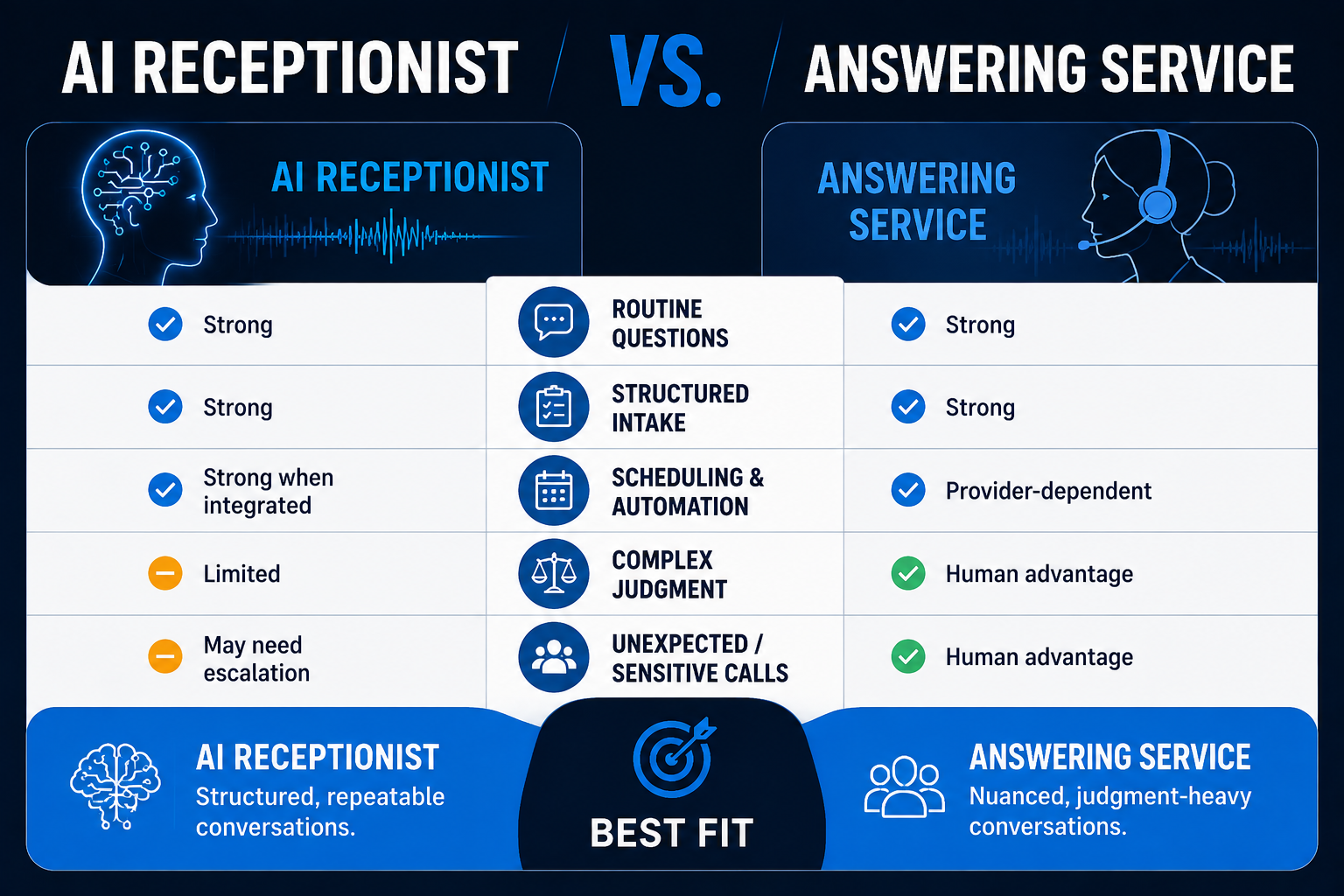
Neither column wins every row.
That's the point.
Don't Compare the Technology. Map the Call.
Imagine someone calls an HVAC company at 7:15 p.m.
“My AC stopped working. Do you service North Naples, and can someone come tomorrow?”
What needs to happen?
The business may need to:
- answer immediately
- determine where the customer is located
- determine what service they need
- answer basic service questions
- determine urgency
- collect the customer's information
- check scheduling availability
- book or route the opportunity
- record what happened
- trigger whatever should happen next
Now the comparison becomes much more useful.
Can your answering service accomplish those steps?
Can your AI receptionist?
Which steps require a human?
Which ones can safely be automated?
That's the buying decision.
Not whether AI sounds futuristic.
Not whether a human voice feels more traditional.
What needs to happen with the call?
Where an AI Receptionist Has the Advantage
AI receptionists tend to be strongest when conversations are predictable enough to turn into clear workflows.
1. Repetitive questions
Service businesses hear many of the same questions:
“Do you service my area?”
“Are you open Saturday?”
“Do you offer this service?”
“Can I schedule an appointment?”
“What happens next?”
When the approved answers are known, AI can handle those conversations consistently.
2. Structured lead qualification
An AI receptionist can ask predetermined questions based on the caller's answers.
A contractor might need to know:
- service needed
- location
- property type
- project timing
- basic scope
- preferred appointment time
This can connect naturally with a broader lead qualification process.
The goal isn't to interrogate callers.
It's to collect enough useful information to determine the appropriate next step.
3. Immediate availability
AI doesn't need to finish one call before software can potentially handle another.
That can matter when several calls arrive during a busy period or when nobody inside the business is available.
And because response speed matters when a new lead comes in, answering the initial call can eliminate an unnecessary delay before the conversation even starts.
4. Connecting the call to other systems
This is one of the bigger opportunities.
A properly integrated AI receptionist may be able to turn a conversation into an action:
Caller → conversation → qualification → appointment → CRM update → confirmation/follow-up
That is very different from simply producing a message that someone still has to deal with later.
Where a Human Answering Service Has the Advantage
AI is not automatically the right choice just because the technology has improved.
Humans still have significant advantages in certain conversations.
Complex or unpredictable calls
Not every customer follows the script.
Some callers explain unusual situations, change topics, provide incomplete information, or need someone to interpret what they're actually asking.
A trained human can often navigate ambiguity more naturally.
Emotional conversations
Think about someone calling after significant property damage, a difficult legal situation, a medical concern, or another stressful event.
That isn't necessarily where you want automation trying to maximize efficiency.
A human can recognize tone, slow the conversation down, show empathy, and exercise judgment.
Situations requiring discretion
Some businesses receive calls where the correct response depends on context rather than a decision tree.
A human operator may be the safer choice when getting the nuance wrong has meaningful consequences.
Highly variable conversations
The less predictable the call, the harder it becomes to build reliable automation around it.
AI can be excellent inside well-designed boundaries.
It should not be treated as magic outside them.
The Biggest AI Receptionist Mistake: Automating Too Much
A bad AI receptionist can be worse than voicemail.
At least voicemail doesn't trap someone in a frustrating conversation.
If the AI doesn't know the answer, misunderstands the request, or encounters something outside its boundaries, there needs to be a sensible escape route.
That could mean:
AI → live transfer
or:
AI → collect information → notify human
or:
AI → schedule human callback
Good automation includes knowing when not to automate.
The Biggest Answering Service Mistake: Stopping at the Message
Human answering doesn't automatically mean good lead conversion.
Imagine this:
New caller: Sarah
Needs: Pool remodeling estimate
Message: “Please call back.”
Technically, the phone was answered.
Operationally, the opportunity is still waiting.
Someone inside the business has to notice the message, call Sarah, reach her, figure out what she needs, qualify the opportunity, and determine the next step.
That may be perfectly acceptable if the business has a disciplined process for doing it.
But if messages sit for hours, the answering service solved the phone-answering problem without solving the lead-response problem.
That's an important distinction.
What About Missed-Call Text Back?
There is also a simpler option that gets overlooked in AI-versus-human comparisons.
Maybe you don't need anyone else to conduct the entire conversation.
Maybe you simply need to make sure a missed caller gets an immediate response.
A missed-call text-back system can automatically send a message when the business doesn't answer.
For example:
“Sorry we missed your call. This is ABC Plumbing. How can we help?”
Now the conversation can continue by text while someone becomes available.
For a small business that misses relatively few calls and already follows up well, this may be enough.
You don't need a tank when the job calls for a screwdriver.
Could a Hybrid System Be Better?
Absolutely.
The decision doesn't have to be:
AI OR human.
It can be:
AI AND human, each handling the work they're better suited for.
For example:
Incoming call → AI answers → routine request handled automatically
while:
Incoming call → AI detects complex or sensitive situation → human takes over
Or a business could reverse the arrangement and use its internal team during normal hours while AI handles overflow and after-hours calls.
The right architecture depends on the actual call mix.
What Should Happen During and After the Call?
This is the question I'd ask before shopping for either solution.
Start with the desired outcome.
A useful call-handling system may need to:
ANSWER → UNDERSTAND → QUALIFY → ANSWER / SCHEDULE / ROUTE → RECORD → FOLLOW UP
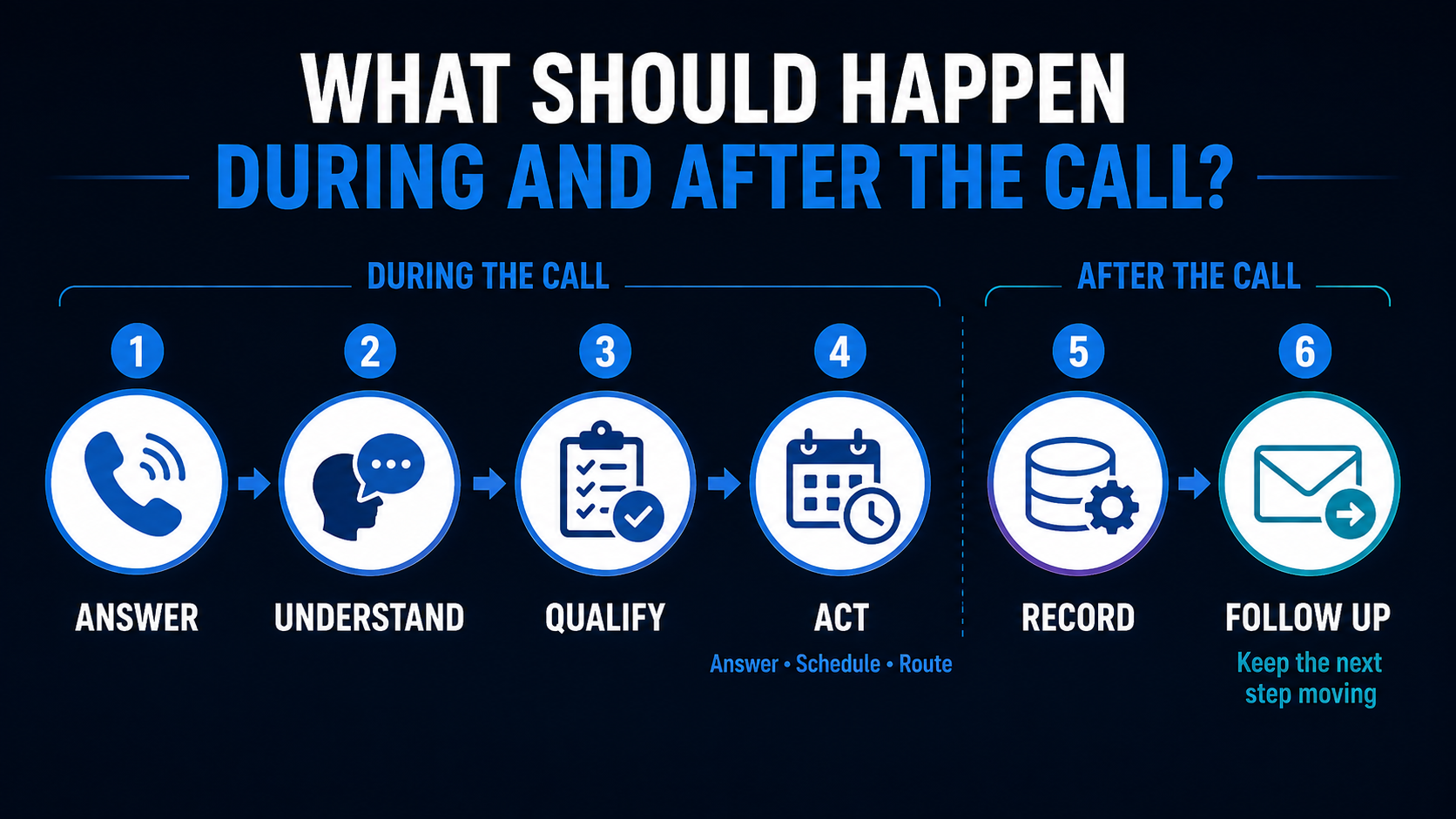
Notice that only the first step is “answer.”
That's why evaluating these systems purely on whether someone picks up misses most of the business problem.
If the caller is a new opportunity, information collected during the conversation may need to enter a CRM pipeline.
If they book, they may need confirmation and reminders.
If they aren't ready, they may need appropriate follow-up.
If the call is urgent, someone may need to be alerted immediately.
The phone conversation is one part of the workflow.
How Should You Compare Costs?
Don't compare headline monthly prices alone.
Ask what you're actually paying for.
With an answering service, understand things such as:
- included calls or minutes
- overage charges
- after-hours coverage
- transfers
- appointment scheduling
- additional services
- setup or customization
- how billing changes as call volume grows
With an AI receptionist, evaluate:
- included usage
- additional usage charges
- setup
- integrations
- phone or telephony costs
- calendar access
- CRM connectivity
- customization
- maintenance
- human escalation
- what happens when the AI can't handle a call
Pricing models vary enough that a cheap-looking plan can become expensive for the wrong call pattern — and a more expensive solution can be worthwhile if it removes meaningful work or converts more legitimate opportunities.
Compare the complete workflow, not just the monthly subscription.
Questions to Ask Before Choosing Either One
Before buying anything, pull a sample of your real incoming calls.
Then ask:
- Why are people calling?
- How many calls are repetitive?
- How many require real judgment?
- How often do you miss calls?
- What happens after hours?
- Do callers typically need information, scheduling, or both?
- What information needs to be collected?
- Which calls should be transferred immediately?
- Which conversations should always involve a human?
- What should be entered into your CRM?
- What should happen after the call ends?
That exercise will tell you more than a feature comparison page.
Which Is Better for a Small Business?
Here's the simplest way I would make the decision.
Choose an AI receptionist when:
Your calls are mostly structured and repeatable, and you want the system to do more than take messages.
This can work particularly well when callers commonly need FAQs answered, basic qualification, scheduling, routing, or another predictable next step.
Choose a human answering service when:
Your calls frequently require empathy, judgment, improvisation, or nuanced conversations.
The human element may matter more than deeper automation.
Consider a hybrid when:
Most calls can follow a predictable process, but a meaningful percentage need human intervention.
Let automation handle what automation handles well.
Give people the conversations people handle better.
Consider a simpler system when:
Your call volume doesn't justify either option and your team already handles follow-up effectively.
Immediate text response plus a disciplined human process may solve the actual problem with less complexity.
The Real Goal Isn't to Answer More Calls
It's easy to evaluate phone systems using a metric like calls answered.
But an answered call isn't necessarily a successful call.
For a service business, better questions might be:
- Was the caller helped?
- Did we understand why they called?
- Did we capture the opportunity?
- Did we determine the appropriate next step?
- Was an appointment scheduled when appropriate?
- Did the right person receive the information?
- Did follow-up happen?
That's the larger principle behind a lead conversion system.
The phone isn't isolated from the rest of the customer journey.
It is another place where an opportunity can either move forward or stall.
For more on where AI fits across the business, see these practical AI automation ideas for small businesses.