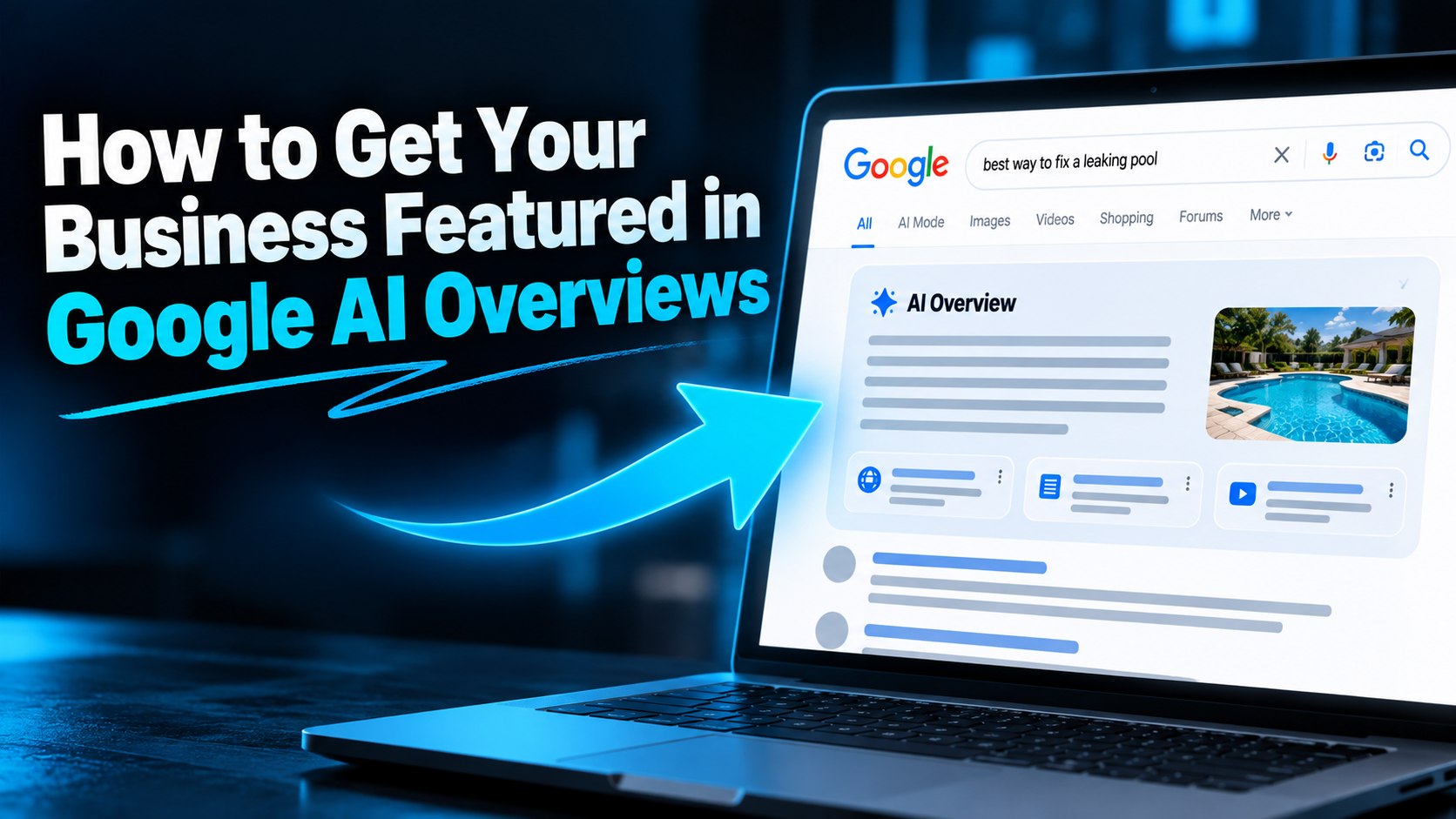
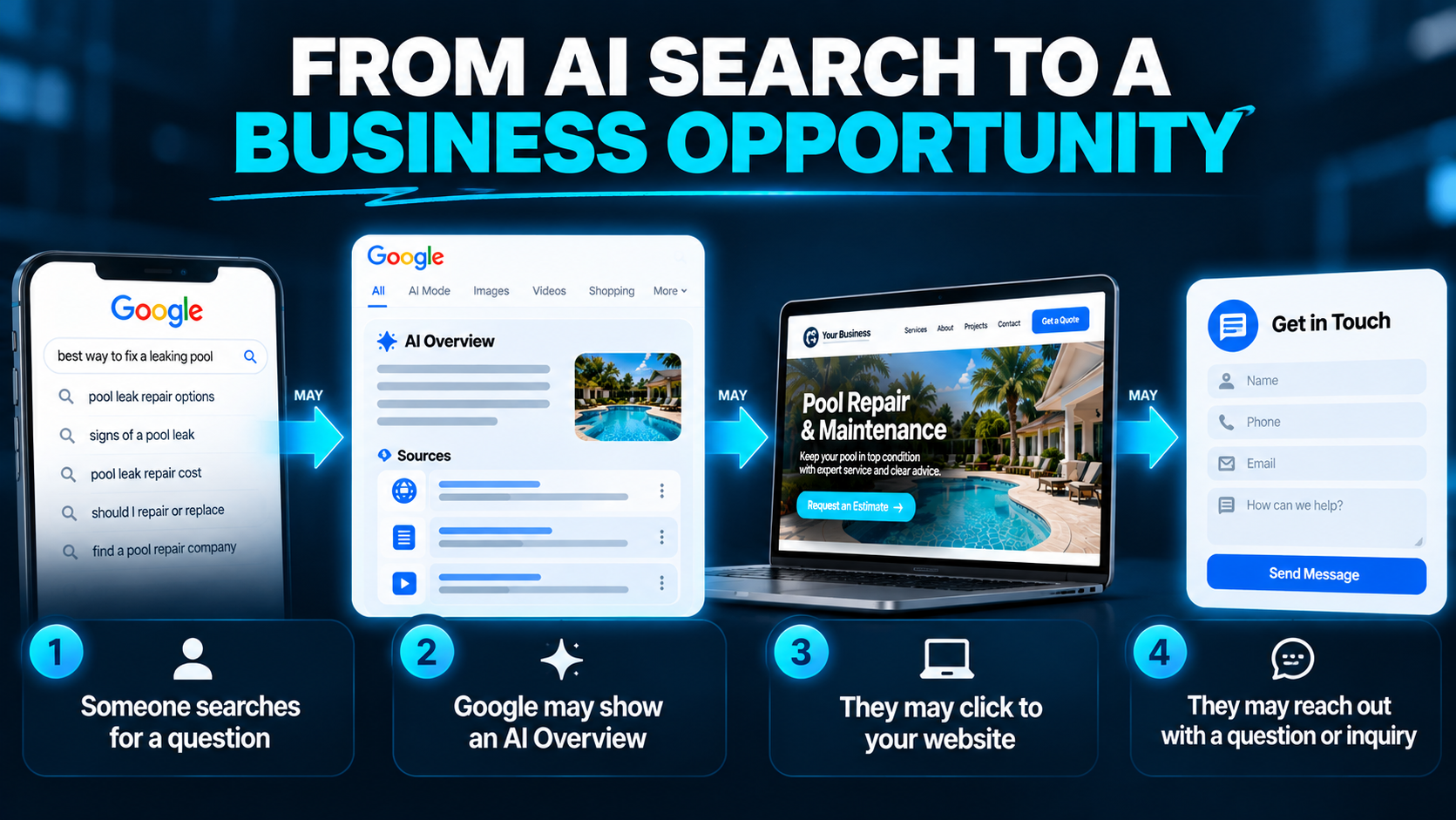
A homeowner searches Google for the best way to fix a recurring drainage problem. Instead of scrolling through ten websites, they get an AI-generated explanation that discusses possible causes, repair options, and when to call a professional.
Somewhere in that answer, Google may link to a landscaping company, drainage specialist, or contractor whose website helps answer the question.
That company has an opportunity to get discovered before the homeowner ever searches for a business by name.
This is one reason Google AI Overviews matter for local businesses. They can introduce a company to someone who is still researching a problem, comparing options, or figuring out what kind of professional they need.
But there's an important distinction: you cannot submit your business to Google AI Overviews or guarantee that Google will feature it.
What you can do is make your business easier to find, understand, and consider as a relevant source.
Here's how.
What are Google AI Overviews?
Google AI Overviews are AI-generated summaries that appear in some Google Search results. They help people understand a topic or answer a question and may include links to websites that provide supporting information.
They don't appear for every search. Google determines when an AI Overview would add something useful to the regular results.
For a local business, the opportunity is broader than showing up when someone searches for “landscaper near me” or “roof repair Naples.”
A potential customer might search for:
- Why does my pool keep losing water?
- Is it better to repair or replace an aging HVAC system?
- How much does it cost to install impact windows?
- What causes pavers to sink after installation?
- What should I ask before hiring a commercial contractor?
Those questions can come well before someone is ready to request a quote.
A useful business website can help answer them—and introduce the company behind the advice.
Google's official explanation of AI Overviews and AI Mode is available in its AI features and your website documentation.
Can a local business actually appear in Google AI Overviews?
Yes. A local business website can be eligible to appear as a supporting link when its content is relevant to the search.
That doesn't mean every business will appear, every query will produce an AI Overview, or every mention will lead to a click.
It also doesn't mean that ranking first in traditional search automatically makes your business the source Google uses in an AI-generated answer.
Google says its AI search features can surface relevant links that help people explore a topic. The exact responses and supporting links can vary.
The useful question for a business owner isn't, “How do I force Google to recommend me?”
It's:
“Does my website give Google—and the customer—a clear reason to consider my business relevant to this question?”
That is something you can work on.
How does Google decide which websites to feature?
Google has not published a complete formula for selecting supporting links in AI Overviews.
It has, however, made several important things clear.
To be eligible as a supporting link, a page must be indexed and eligible to appear in Google Search with a snippet. Google also says there are no additional technical requirements or special AI-specific optimizations necessary for AI Overviews.
Its guidance continues to emphasize helpful, original content, technical accessibility, and a good experience for visitors.
In other words, there is no separate switch you can flip to make a website “AI Overview optimized.”
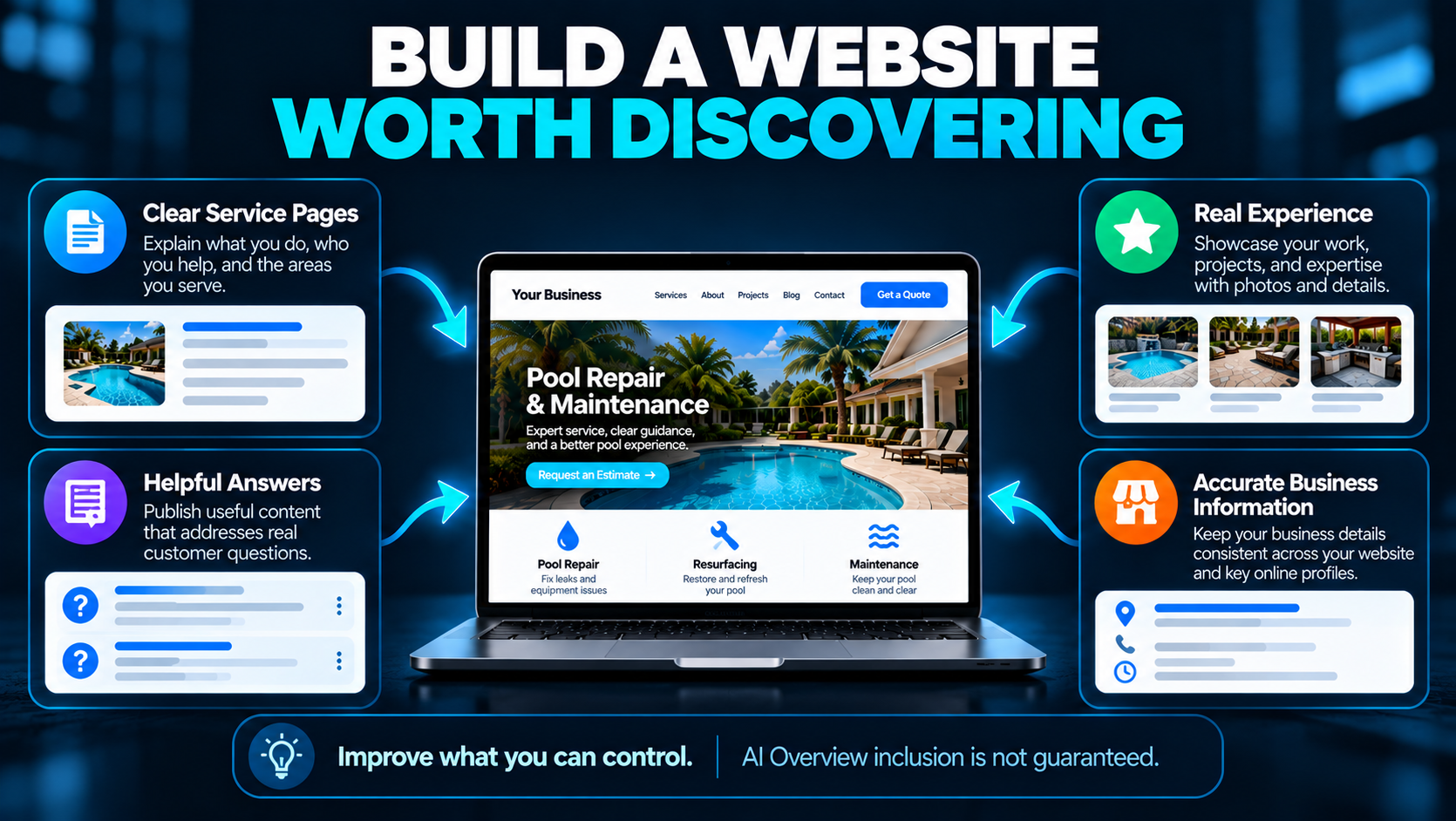
There is a lot of legitimate work you can do to make it a better resource.
7 ways to improve your business's chances of appearing in Google AI Overviews
1. Make sure Google can access and understand your website
Before worrying about AI visibility, make sure the fundamentals are working.
Can Google crawl the pages that matter? Are your service pages indexed? Can it access the actual content, or is important information hidden behind a script or interaction?
A beautiful website doesn't help much if Google can't reliably retrieve its content.
Start with:
- Google Search Console verification
- Indexing checks for important service and informational pages
- Clear page titles and headings
- Crawlable internal links
- A usable mobile experience
- No accidental
noindexsettings or blocking rules on pages you want discovered
Don't confuse a successful live URL test with a promise that Google will index or feature the page. It establishes that Google can access what you want it to inspect; inclusion remains Google's decision.
BLB perspective: An AI-powered website still needs sound website fundamentals. AI chat, automation, and interactive features are valuable when they serve visitors, but they shouldn't make the core business information difficult to access.
2. Answer the questions customers ask before they contact you
Many business websites explain what a company sells but leave the customer's real questions unanswered.
A pool builder may have a page saying “New Pool Construction,” yet offer little guidance about timelines, site access, permits, materials, or the decisions that affect a project.
A homeowner researching those issues needs more than a list of services.
Consider a page titled:
“What Affects the Cost of Building a Pool in Southwest Florida?”
A genuinely useful version might explain:
- How pool size and design affect the scope
- Why excavation and site conditions matter
- Which finish and decking decisions change the project
- Why permits and scheduling vary
- What a homeowner should prepare before requesting an estimate
The page doesn't need to reveal a universal price that doesn't exist. It needs to help the reader understand the decision.
That gives it a meaningful purpose whether the visitor arrives from an AI Overview, a traditional search result, or a link from another website.
3. Bring something to the answer that generic content cannot
This is where a local business has an advantage that many generic publishers don't.
A contractor who actually installs impact windows can explain what commonly complicates a replacement project.
A landscaping company can discuss the practical difference between maintaining an existing landscape and designing a new installation.
A pool remodeling company can explain what it evaluates before recommending resurfacing versus a larger renovation.
Those observations are useful because they come from the work itself.
You don't need to manufacture a proprietary framework or publish unsupported statistics to demonstrate expertise.
Use what you can substantiate:
- Your actual process
- Questions you hear from customers
- Project photos you have permission to share
- Real material and service comparisons
- Common misunderstandings you can explain
- Limitations and situations where a different solution may be appropriate
For example, a contractor might explain that a driveway's visible surface isn't the only factor in a paver installation; base preparation and drainage deserve attention too.
That is more useful than another article saying pavers are “durable, beautiful, and versatile.”
The goal isn't to sound like an expert. It's to publish information that helps someone make a better decision.
4. Give every important service a clear home on your website
If your business provides five distinct services, don't expect one generic homepage paragraph to explain them all.
A visitor looking for pool resurfacing needs different information from someone considering a new pool.
A business owner comparing AI-powered websites needs different guidance from someone looking for automated lead follow-up.
Create focused pages for meaningful services, then connect them to related articles that answer the next question.
A practical structure might look like this:
Pool resurfacing service page
→ What are the signs a pool needs resurfacing?
→ Pool resurfacing versus remodeling
→ What affects resurfacing costs?
→ Questions to ask before choosing a finish
The service page explains what the company offers. The supporting articles help customers understand when, why, and how to choose it.
This isn't a reason to publish dozens of near-identical articles with different city names.
If two pages answer essentially the same question for the same audience, improve the stronger page instead of creating another one.
5. Keep your local business information accurate
For businesses that serve a geographic area, local relevance matters.
Your website should make it easy to understand:
- What your business does
- Which services you actually provide
- Where you operate
- How customers can contact you
- Whether you have a customer-facing location or serve customers at their properties
Your Google Business Profile should accurately reflect the same business.
Keep categories, services, hours, and other relevant details current. Use real business photos and maintain an appropriate process for requesting and responding to customer reviews.
Google says local rankings are primarily based on relevance, distance, and prominence. That is guidance for local search—not a published formula for AI Overview citations—but it reinforces why accurate business information matters.
See Google's guidance on improving local ranking.
One important caution: do not add cities, services, locations, or business claims just because you want to appear for more searches. Accuracy is part of making the business understandable.
6. Make the website useful after someone clicks
Imagine Google includes a link to your article about choosing a roofing contractor.
The homeowner clicks.
What happens next?
If the page loads slowly, is difficult to read on a phone, or makes it hard to find your actual roofing services, the visibility has done only part of its job.
A useful page should help the visitor move naturally from research to the next step.
That might mean:
- A relevant link to the service being discussed
- A clear explanation of the company's service area
- Real project examples
- A simple way to ask a question
- A well-placed consultation or estimate request
- A mobile-friendly contact experience
Not every reader is ready to book. Some are still learning.
Give them a helpful next step without forcing a sales pitch into every paragraph.
This is also where a connected business system matters. A website can generate an inquiry, but the business still needs a reliable way to receive it, respond, follow up when appropriate, and move the conversation forward.
Getting found is the beginning of that journey—not the finish line.
7. Build a connected library of useful content
One isolated article can answer one question. A well-organized collection can help readers work through an entire decision.
Think about the questions a customer asks in sequence:
What's wrong? → What are my options? → What does it cost? → How do I choose a provider? → What happens next?
Your website doesn't need an article for every imaginable variation. It needs strong coverage of the questions that matter to your customers and your actual services.
Link related articles where the next page genuinely helps the reader.
For a local service business, that could mean connecting a repair guide to a replacement comparison, a cost explainer, and the relevant service page.
For BLB, it means connecting articles about AI-powered websites, visibility, lead conversion, and follow-up where those subjects naturally overlap.
Internal links help people navigate the information. They also give search engines clearer paths through the site.
Do you need special AI schema, an llms.txt file, or an “AI SEO” plugin?
Not to meet Google's documented eligibility requirements for AI Overviews.
Google says there are no additional technical requirements or special optimizations necessary beyond the relevant Search requirements.
Structured data can still be useful when it accurately describes a page and follows Google's supported guidelines. But adding schema is not a guarantee of an AI Overview citation.
Likewise, publishing an llms.txt file should not be treated as a substitute for accessible pages, useful content, and established SEO work.
Be cautious of anyone selling a checklist of secret files, special markup, or guaranteed AI placements.
If the proposal can't explain how the work improves your actual website, content, business information, or customer experience, ask harder questions.
How do you measure Google AI Overview visibility?
This is an area where the available tools have changed.
Google announced dedicated Search Console performance reporting for generative AI features in June 2026 and said the rollout reached websites worldwide by August 31, 2026.
That means businesses should check their current Search Console reporting rather than rely on older advice claiming AI-search visibility cannot be separated from general search performance.
Start with three questions:
1. Is your site being surfaced?
Review the available generative AI performance data and identify the pages and search topics receiving visibility.
2. Is that visibility producing useful visits?
Look at relevant landing pages, search traffic, and engagement. Don't assume an impression is a website visit.
3. Are those visits creating business opportunities?
Use your analytics and lead-tracking systems to understand whether visitors take meaningful next steps, such as contacting the business, requesting an assessment, or booking a consultation.
A monthly report that celebrates AI mentions but cannot connect them to anything meaningful for the business is incomplete.
Also remember that manually searching Google is only a spot check. Results can vary by query, location, timing, and search experience. A screenshot of one AI Overview isn't a reliable measurement strategy by itself.
For the official reporting announcement, see Google's Search Generative AI performance reports update.
What should a local business do first?
You don't need to launch a massive AI-search campaign tomorrow.
Start with a focused review of the business you already have online.
| Priority | Action | What you're trying to establish |
|---|---|---|
| 1 | Check indexing and technical access | Google can retrieve important pages |
| 2 | Review your core service pages | Customers can understand what you do |
| 3 | Update your Google Business Profile | Your local business information is accurate |
| 4 | Identify five important customer questions | You know what useful content is missing |
| 5 | Improve or publish the strongest answers | Your site helps customers make decisions |
| 6 | Connect related pages and next steps | Readers can continue their journey |
| 7 | Review AI visibility and conversion data | You can assess what the work is producing |
The order matters.
Publishing ten new articles won't fix a website that doesn't explain the services clearly. Buying an AI visibility tool won't solve unanswered customer questions. And more traffic won't automatically fix a slow response process.
Getting featured is not the whole strategy
There's nothing wrong with wanting your business to appear in Google AI Overviews.
It's a reasonable visibility goal. But it should sit inside a bigger business strategy.
The business needs to be discoverable. Its website needs to explain what it does. Its content needs to help people make decisions. And when someone reaches out, there needs to be a dependable path from inquiry to conversation.
That's how we think about AI-powered websites at Boost Local Biz.
Not simply websites built with AI, or pages designed to chase the newest search feature.
Websites that help people find the business, understand the offer, take the next step, and get a timely response.
The goal isn't just to be included in an AI answer. It's to build a business that can make something useful of the attention.
Is your website ready for the way customers search now?
If you're unsure whether your website clearly communicates your services, answers the right questions, and turns interested visitors into real opportunities, start with a Free Website Assessment from Boost Local Biz.
We'll look at the website as a business tool—not just a collection of pages.
Editorial note: This article reflects Google's published guidance available in September 2026. AI-search features, reporting, and documentation may change.