People aren't only searching Google anymore.
They're asking ChatGPT which companies to consider. They're getting answers directly inside Google's AI-powered search experiences. They're researching products and services with Gemini and Perplexity.
That creates a question businesses increasingly need to ask:
When someone asks AI about a company, service, or solution like mine, does my business show up?
That's the basic idea behind AI visibility.
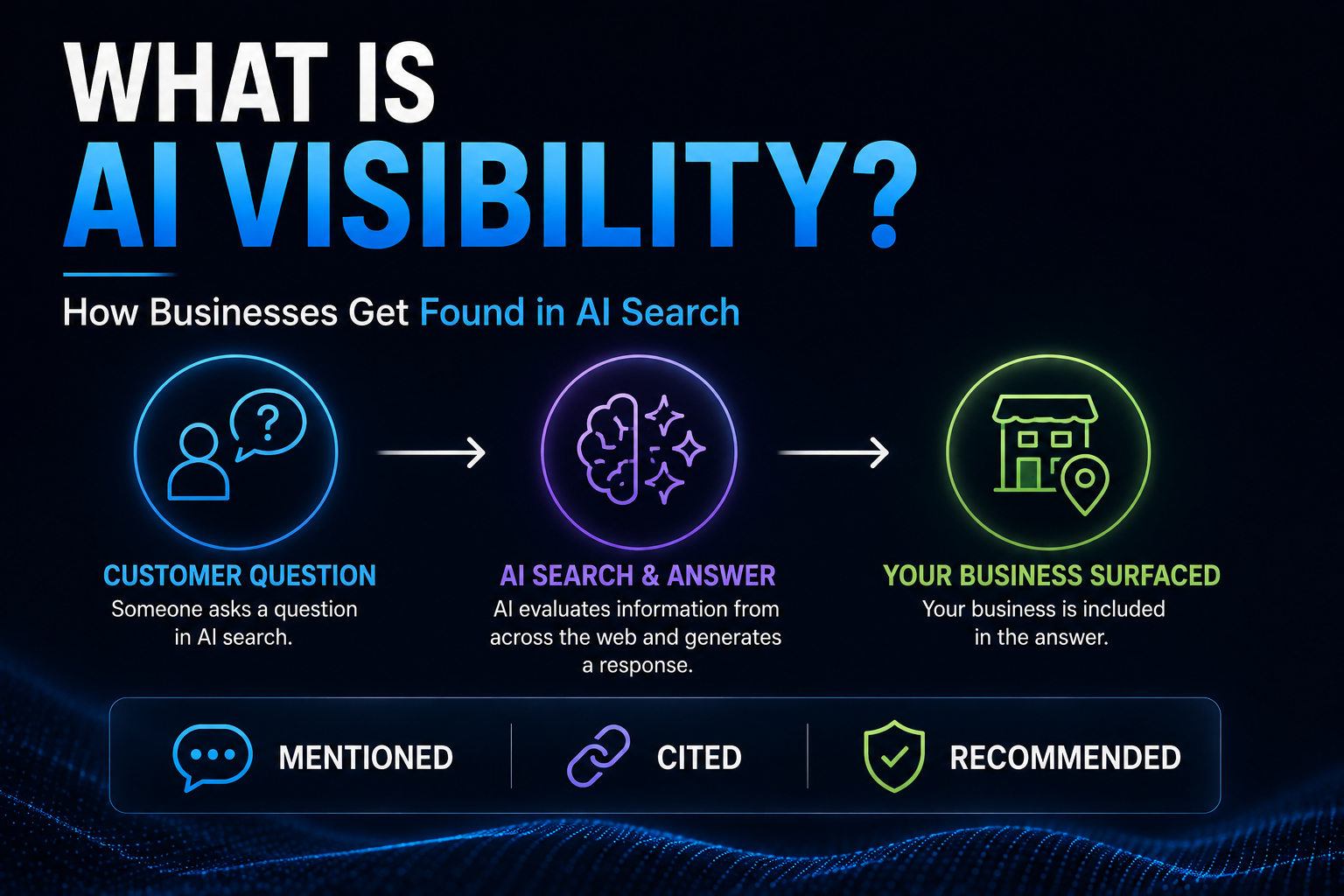
AI visibility is how easily a business or brand can be found, understood, mentioned, cited, linked to, or recommended in AI-powered search and answer experiences.
It doesn't replace traditional search visibility.
It expands it.
And as AI becomes another way people research businesses and make decisions, understanding that difference is becoming increasingly important.
What Does AI Visibility Actually Mean?
Imagine someone asks an AI system:
“Who installs impact windows in Broward County?”
Or:
“What are some commercial contractors that handle multi-state tenant build-outs?”
Or:
“Who can automate lead follow-up for a service business?”
The AI generates an answer.
The question for your business is simple:
Are you part of it?
That can happen in several different ways.
Your Business Is Mentioned
The AI includes your company by name in its answer.
Your Website Is Cited
A page from your website is used as a supporting source.
Your Website Is Linked
The user receives a direct path from the AI-generated answer to your website.
Your Business Is Recommended
Your company appears among businesses, products, services, or solutions the AI suggests considering.
Your Business Is Accurately Understood
Even when your company isn't explicitly recommended, the AI has a reasonably accurate understanding of what you do, who you serve, where you operate, and what you're relevant for.
Those are related outcomes, but they aren't identical.
That's one reason measuring AI visibility is more complicated than checking whether your website ranks #3 for a keyword.
There isn't always one fixed ranking position to track.
Why Should Businesses Care About AI Visibility?
Because customer discovery is changing.
Traditional search still matters enormously. People continue to use search engines, maps, directories, websites, social platforms, referrals, and plenty of other channels.
AI doesn't erase any of that.
It adds another discovery layer.
A potential customer may now begin research by asking an AI assistant to:
- explain a problem
- compare possible solutions
- recommend providers
- research a company
- summarize reviews or reputation
- identify businesses in a category
- compare vendors
- answer questions before contacting anyone
If AI systems become part of that research process, businesses have a new visibility question to solve.
Not just:
Can Google find my website?
But also:
Can AI-powered systems find and understand enough reliable information about my business to use it in an answer?
AI Visibility Isn't a Replacement for SEO
This distinction matters because AI search has already attracted a fresh collection of acronyms and bold predictions.
SEO.
GEO.
AEO.
AI SEO.
ChatGPT SEO.
And, inevitably, claims that traditional search optimization is dead.
It isn't.
Google's own guidance says the same foundational SEO practices remain relevant to its AI-powered search experiences.
According to Google's guidance for AI features in Search, pages generally need to meet the normal technical requirements for Google Search before they can appear as supporting links in AI Overviews or AI Mode.
That makes sense.
If a system can't reliably access or understand your content, making that content useful in an AI-generated answer becomes considerably harder.
A better way to think about the relationship is:
AI visibility isn't a replacement for SEO. It's an expansion of digital visibility.
Traditional SEO helps search engines discover, understand, rank, and display your pages.
AI visibility asks an additional question:
Can AI-powered systems find enough relevant, trustworthy, and understandable information about your business to use it when constructing an answer?
There's substantial overlap between the two.
What Are GEO, AEO and AI SEO?
The terminology around AI search is still developing, and different marketers use these terms differently.
Generally:
GEO — Generative Engine Optimization
GEO usually refers to improving content and digital signals so a business, brand, or source has a better chance of being represented in generative AI answers.
AEO — Answer Engine Optimization
AEO generally focuses on making information easier for search and answer systems to understand and use when directly answering questions.
The term existed before the current generative-AI boom and has often been associated with featured snippets, voice search, structured answers, and similar experiences.
AI SEO
AI SEO is increasingly used as an umbrella term for applying search optimization principles to AI-powered discovery.
There is plenty of overlap between all three.
That's why we prefer AI visibility when talking to business owners.
The owner usually doesn't care which acronym wins.
They care whether prospective customers can find them.
Do You Need Special GEO Optimization to Appear in AI?
Not necessarily.
This is where the conversation can get unnecessarily complicated.
Google explicitly says there are no additional technical requirements for appearing in AI Overviews or AI Mode beyond the normal requirements for appearing in Search.
Google also says businesses do not need special AI schema or new machine-readable files just to appear in these experiences.
You can read that directly in Google's documentation about AI features and websites.
That doesn't mean businesses should ignore how AI-powered discovery is changing search.
It means there isn't one secret GEO switch.
If someone tells you they discovered a magic schema tag that guarantees ChatGPT or Google AI visibility, keep one hand on your wallet.
The more useful question is:
What can a business realistically improve that makes its digital presence easier to access, understand, verify, and use?
That's where the real work begins.
Six Foundations of AI Visibility
Nobody outside these platforms has a complete formula for determining exactly why every business or source appears in every AI-generated answer.
Different systems work differently.
Their technology changes.
The answer can also change depending on the question, context, location, available sources, and other factors.
So rather than pretending there is a universal AI-ranking checklist, focus on the parts businesses can actually influence.
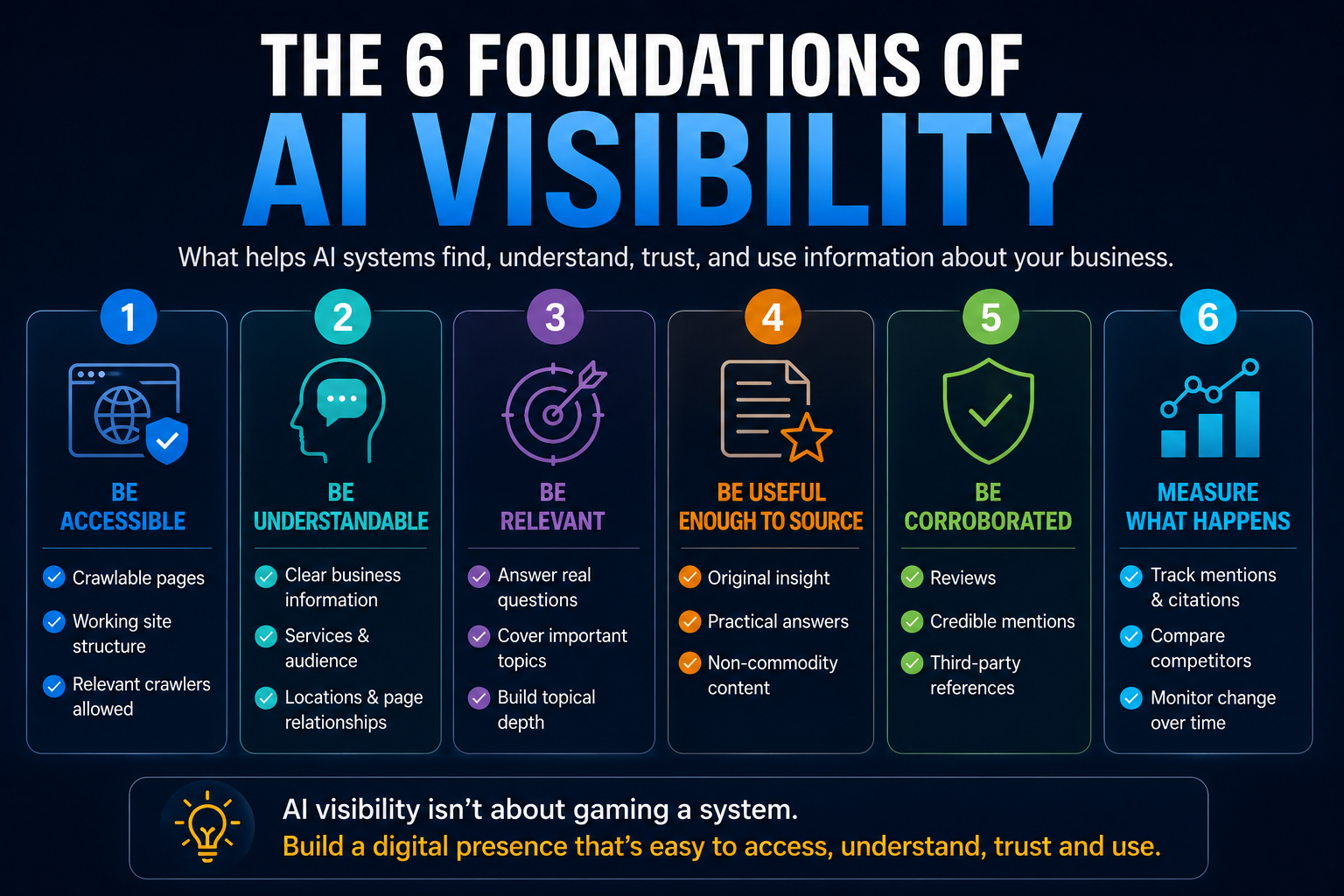
1. Be Accessible
Before your information can be useful, systems need to be able to access it.
That starts with familiar technical fundamentals:
- crawlable pages
- sensible site architecture
- working internal links
- accessible content
- appropriate indexing controls
- functioning pages
- useful text that isn't hidden behind unnecessary technical barriers
The specifics also vary by platform.
For example, OpenAI says public websites can potentially appear in ChatGPT Search and recommends allowing OAI-SearchBot if publishers want their content to be discoverable and surfaced in ChatGPT Search.
OpenAI also notes that placement is not guaranteed.
You can review the details in OpenAI's publisher and developer guidance.
Perplexity similarly publishes information about its crawlers and how they interact with robots.txt. Its official crawler guidance is a useful reference for site owners.
This doesn't mean every business owner needs to become an expert in AI crawlers.
It means technical accessibility still matters.
2. Be Understandable
Being accessible isn't enough.
Your digital presence should make it relatively easy to understand:
- who your business is
- what you do
- what products or services you provide
- who you serve
- where you operate
- what topics you're knowledgeable about
- how the different parts of your website relate to each other
A vague website makes this harder.
Imagine a homepage that says:
Transforming Tomorrow Through Innovative Solutions
Cool.
What does the company actually do?
Clear language matters.
Site architecture matters.
Consistent business information matters.
Structured data can be useful when appropriate.
Internal links help establish relationships between pages and topics.
And substantive content can provide considerably more context than a five-page brochure site repeating the same marketing copy.
This is one reason an AI-powered website shouldn't simply mean a website built with AI.
The useful question is what the website actually does for the business and customer.
3. Be Relevant
You can't expect your business to consistently appear for topics your website barely discusses.
Suppose a contractor wants to be considered for:
commercial tenant build-outs
but the website only says:
“We handle all types of construction.”
That's not much information.
The same principle applies to almost any business.
If you want to become visible around meaningful customer questions, your digital presence needs enough useful information to establish genuine relevance to those subjects.
That's where content strategy matters.
Not because businesses need to publish hundreds of blog posts.
They don't.
The goal is to build meaningful coverage around the problems, services, questions, decisions, and expertise that actually matter to the people you're trying to reach.
A strong content ecosystem compounds.
A pile of thin pages doesn't.
4. Be Useful Enough to Source
This may be one of the most important parts of the conversation.
If every article on your website says essentially the same thing already available on 500 other websites, why would anyone—or any system—need yours?
Google's current guidance for generative AI search optimization emphasizes creating non-commodity content and providing unique value rather than mass-producing pages around variations of search queries.
That's the right standard whether you're thinking about traditional search or AI discovery.
Useful content can include:
- clear definitions
- original analysis
- firsthand experience
- practical examples
- useful comparisons
- frameworks
- checklists
- original visuals
- specific answers
- credible evidence
- explanations that make complicated subjects easier to understand
The point isn't to write for an AI.
It's to create something worth using.
That's also why dumping hundreds of generic AI-written articles onto a website isn't much of an AI visibility strategy.
You're competing for attention by creating more of the exact commodity content everyone else can create.
5. Be Corroborated
Your website is an important source of information about your business.
But it's also your website.
Naturally, you're going to say nice things about yourself.
Other credible information around the web can provide additional context.
Depending on the business, that may include legitimate:
- customer reviews
- business profiles
- local citations
- industry directories
- professional associations
- media coverage
- third-party mentions
- authoritative references
- partnerships
- relevant community or industry presence
For local businesses, accurate business information and a strong local presence can be particularly important parts of the broader picture.
But we need to be careful here.
There is no defensible universal formula that says:
Get 50 directory listings + 100 reviews + five backlinks = ChatGPT recommends you.
AI systems don't work according to a public equation like that.
The practical principle is simpler:
Information becomes easier to trust when useful signals about a business aren't coming exclusively from the business itself.
That's not a secret AI hack.
It's basic credibility.
6. Measure What Happens
You can't improve AI visibility intelligently if you never look at the results.
But measuring it requires a slightly different mindset from traditional rank tracking.
Useful questions include:
- Does the business appear at all?
- Which AI platforms mention it?
- Which questions trigger a mention?
- Which competitors appear instead?
- Is the business described accurately?
- Is its website cited?
- Which pages are being cited?
- Are competitors being cited?
- What sources appear to influence the answer?
- Where are obvious content or authority gaps?
- Does visibility change over time?
Even traditional search measurement is beginning to adapt.
In June 2026, Google announced testing of Generative AI performance reporting in Search Console, designed to provide more visibility into impressions from AI Overviews and AI Mode.
Measurement across the broader AI ecosystem is still evolving.
That's another reason businesses should be skeptical of anyone presenting AI visibility as a perfectly measurable ranking system.
It isn't.
At least not yet.
Why AI Visibility Can Change Even When You Haven't Changed Anything
One frustrating characteristic of AI visibility is that results aren't necessarily static.
You might ask the same general question:
- on another platform
- with slightly different wording
- from another location
- at another time
- with different context
and receive a different answer.
That's partly because these aren't simply traditional search-result pages with ten fixed blue links.
Google itself explains that AI Overviews and AI Mode can use different models and techniques, and the responses and supporting links may vary.
OpenAI similarly makes clear in its ChatGPT Search documentation that inclusion and placement aren't guaranteed.
This is why businesses shouldn't build their entire strategy around exploiting one perceived AI ranking factor.
The systems will change.
The models will change.
The interfaces will change.
The sources they use may change.
The better long-term strategy is to build a digital presence that remains genuinely useful and understandable across those changes.
Does AI Visibility Matter for Local Businesses?
Yes—but the strategy shouldn't become “local SEO with AI sprinkled on top.”
Consider the types of questions people may ask:
“Who are some reputable pool remodeling companies near me?”
“What contractors handle commercial tenant improvements in Naples?”
“Who installs hurricane-impact windows in Broward County?”
Those questions contain local and commercial intent.
A strong local digital presence may help establish useful context around:
- business identity
- services
- location
- service areas
- reputation
- customer experience
- expertise
- relevance
That can include your website, Google Business Profile, reviews, business listings, locally relevant pages, third-party mentions, and other legitimate sources.
But don't assume optimizing your Google Business Profile automatically makes you visible in every AI platform.
The broader objective is consistency and clarity across the information ecosystem surrounding the business.
Does Your Website Matter for AI Visibility?
Absolutely.
It's one of the few digital assets your business actually controls.
Your website gives you space to clearly explain:
- what you do
- how you do it
- who you help
- where you operate
- what makes your approach different
- what customers should know
- what questions they commonly ask
- what expertise you actually possess
It also gives search engines and other systems structured relationships between pages, services, topics, and business information.
But there's another side to this.
Getting discovered doesn't accomplish much if the person eventually reaches your website and doesn't take action.
That's why AI visibility and website conversion shouldn't be treated as unrelated disciplines.
Once someone arrives, the website still has to turn visitors into legitimate opportunities.
Visibility gets you considered.
The customer journey still has to work after that.
Can You Pay Someone to Improve AI Visibility?
Yes.
But this is where businesses need to ask better questions.
There are legitimate areas an AI visibility strategy can work on:
- technical accessibility
- traditional SEO foundations
- business and entity clarity
- website architecture
- content gaps
- content quality
- structured information
- local visibility
- credible third-party signals
- source opportunities
- competitor visibility
- AI-answer monitoring
- measurement and ongoing improvement
Those are real areas of work.
What nobody can legitimately promise is:
“We'll guarantee you the #1 spot in ChatGPT.”
There isn't a universal #1 ChatGPT ranking to guarantee.
OpenAI itself states that inclusion and placement in ChatGPT Search aren't guaranteed.
So be skeptical of anyone selling certainty where the platforms themselves don't provide it.
A better AI visibility service should focus on improving the conditions that make a business easier to find, understand, verify, and potentially surface—and then measuring what actually happens.
What Is an AI Visibility Audit?
An AI Visibility Audit is a structured assessment of how a business currently appears across AI-powered discovery experiences and the digital signals surrounding that visibility.
A useful audit shouldn't simply ask ChatGPT one question and take a screenshot.
It should examine multiple realistic questions prospective customers might ask.
Depending on the business, that could include:
- category searches
- service questions
- local searches
- comparison questions
- recommendation queries
- problem-based searches
- brand-specific questions
The audit can then investigate:
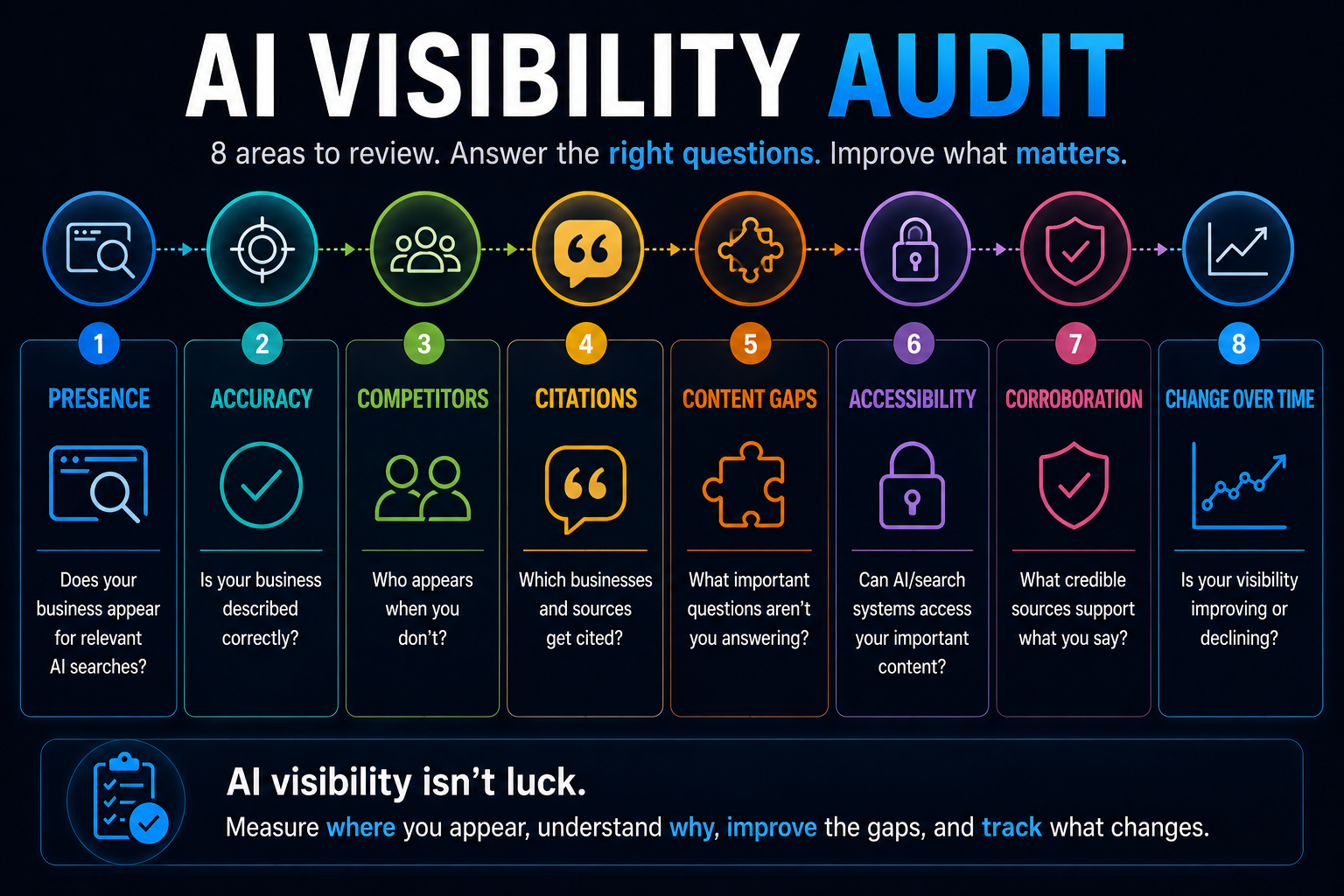
Presence
Does the business appear?
Accuracy
Is the business described correctly?
Competitors
Which companies appear when yours doesn't?
Citations
Which websites and pages are being used as sources?
Content gaps
Are competitors answering important questions your website doesn't?
Technical accessibility
Can relevant systems access important content?
Business clarity
Is it obvious what the company does and where it operates?
Corroboration
Is useful information about the business available beyond its own website?
Change over time
Does visibility improve, decline, or fluctuate as the digital presence changes?
The purpose isn't to manufacture a fake “AI score.”
It's to identify where the business currently stands and what can reasonably be improved.
What Should Businesses Do About AI Visibility Right Now?
You don't need to panic and rebuild your entire marketing strategy around ChatGPT.
Start with fundamentals.
Make Sure Your Website Can Be Accessed
Check crawling, indexing, robots directives, important pages, internal links, and other technical barriers.
Make Your Business Easy to Understand
Clearly explain your services, customers, locations, expertise, and business information.
Strengthen the Content You Already Have
Before publishing 100 new articles, make sure your important pages actually answer the questions customers care about.
Build Real Topical Depth
Cover meaningful subjects comprehensively rather than producing thin variations of the same article.
Strengthen Legitimate Authority Signals
Earn reviews, mentions, citations, links, partnerships, and third-party references because they're valuable—not because somebody promised they were a secret ChatGPT ranking factor.
Test Real Customer Questions
Ask the major AI platforms the types of questions prospective customers might realistically ask.
See what appears.
Then investigate why.
Keep Measuring
AI visibility isn't a one-time checkbox.
The ecosystem is changing too quickly for that.
AI Search Changes the Destination, Not the Need to Be Useful
The internet has changed before.
Desktop search became mobile.
Ten blue links gained maps, featured snippets, shopping results, knowledge panels, videos, and direct answers.
Now generative AI is becoming another interface between businesses and the people trying to find them.
The mechanics will continue evolving.
But the fundamental challenge isn't especially mysterious.
Businesses still need to be:
findable
understandable
credible
relevant
useful
And once somebody finds them, they still need a customer journey capable of turning attention into an opportunity.
That's why we don't view AI visibility as a replacement for SEO, websites, local search, content, or conversion strategy.
It's another layer connecting them.
Want to Know How Visible Your Business Is in AI Search?
A useful first step isn't buying a mysterious “GEO package.”
It's understanding what AI systems currently see.
An AI Visibility Audit can examine how your business appears across relevant AI-powered search experiences, which competitors are being surfaced, whether your business information is represented accurately, what sources are being used, and where meaningful gaps may exist.
From there, you can decide what actually deserves attention.
If you want to explore how AI visibility fits into your broader website, search, and digital-marketing strategy, contact Boost Local Biz to start the conversation.