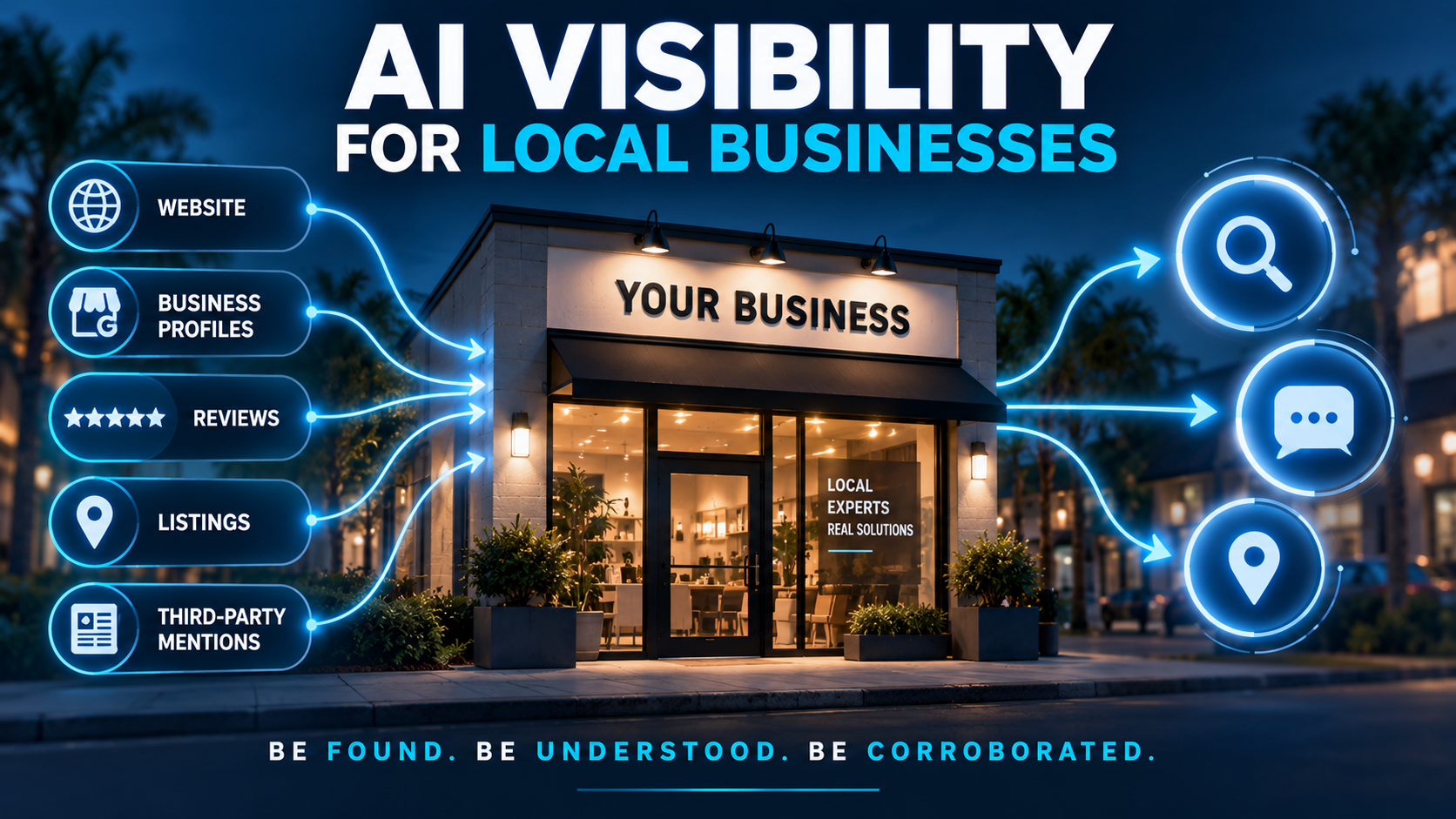
Someone needs a roofer, landscaper, dentist, remodeler, attorney, or HVAC company.
A few years ago, you could reasonably assume that person would open Google and search.
Now they might ask:
“Who are the best pool contractors near me?”
“Find a highly rated HVAC company in Naples that handles emergency repairs.”
“Which local remodelers specialize in high-end kitchen renovations?”
The answer may come from ChatGPT, Google's AI-powered search experiences, Perplexity, Gemini, or another AI-assisted discovery tool.
That creates a new question for local businesses:
What makes one company show up in an AI-generated answer while another company gets left out?
There isn't one universal ranking formula, and nobody can guarantee that an AI platform will recommend your business.
But there is plenty a local business can do to become easier to find, understand, verify, and potentially include.
That is the practical side of AI visibility.
What Is AI Visibility for a Local Business?
AI visibility is how accurately and consistently your business appears across AI-assisted discovery experiences when people ask questions relevant to what you offer.
For a local business, that might mean being:
- mentioned as a relevant option
- included in a list of local businesses
- cited as a source
- accurately described
- associated with the services you actually provide
- connected with the locations you actually serve
That last part matters.
It doesn't help much if an AI system knows your business exists but gets your services, location, hours, or other important facts wrong.
Visibility without accuracy isn't much of a win.
Local AI Visibility Is an Information-Confidence Problem
It is tempting to think there must be a new set of “AI ranking factors” you can install on a website.
Add some schema.
Create an llms.txt file.
Write 200 FAQs.
Mention ChatGPT seventeen times.
Congratulations, the robots love you.
Except that's not how this works.
Google's current guidance for generative AI features says traditional SEO best practices remain relevant and explicitly warns against chasing supposed AEO/GEO tricks or producing large amounts of commodity content.
For local businesses, a more useful way to think about AI visibility is information confidence.
Can a discovery system find enough reliable information to understand:
Who are you?
What do you do?
Where do you operate?
What are you known for?
Do other sources support those facts?
Your website contributes part of that picture.
But it isn't the entire picture.
Your Website Is Still the Foundation
AI search did not make websites irrelevant.
If anything, your website has become one of the places where you have the most control over explaining your business clearly.
A strong local-business website should make important facts easy to find in normal text:
- business name
- primary services
- meaningful service details
- geographic coverage
- contact information
- relevant experience or expertise
- legitimate credentials when applicable
- answers to questions customers actually ask
The goal isn't to write for a machine.
The goal is to remove ambiguity.
If your homepage says you provide “innovative solutions for modern lifestyles,” a human may not know what you actually do either.
Say what you do.
Explain it well.
Show where you do it.
Then build useful supporting content around the questions customers ask before choosing a company.
Our guide to what a service business website should include covers that foundation in more detail.
Make Sure Search and AI Crawlers Can Access the Site
Great information isn't particularly useful for discovery if systems can't access it.
For Google's AI features, Google says pages need to meet the normal technical requirements for Search. There is no separate AI-indexing requirement.
That means familiar fundamentals still matter:
- pages can be crawled
- important pages can be indexed
- important information exists as readable text
- internal links help systems discover related pages
- canonical signals make sense
- structured data accurately reflects visible content
- the site works properly across devices
Google also says there is no special AI schema or new machine-readable AI file required to appear in AI Overviews or AI Mode.
ChatGPT has its own discovery controls.
OpenAI's current publisher and developer guidance says public websites can appear in ChatGPT search and recommends allowing OAI-SearchBot if you want site content available for discovery, summaries, snippets, citations, and links.
Different platforms have different systems.
So don't assume that being accessible to Google automatically means every other AI search experience sees your site the same way.
Your Google Business Profile Still Matters
For a local business, your website isn't the only major source of information.
Your Google Business Profile can establish basic facts such as:
- business category
- location
- service area
- hours
- phone number
- website
- reviews
- photos
- other business details
Google's own local ranking guidance says local results are primarily influenced by relevance, distance, and prominence and recommends keeping Business Profile information complete and accurate.
That guidance predates some of the AI-search conversation, but the principle translates well:
Make it easy for Google to understand exactly what the business is and where it belongs.
Don't stuff categories.
Don't create fake locations.
Don't invent service areas where you don't operate.
Accuracy beats trying to manufacture relevance.
Reviews Do More Than Improve a Star Rating
Reviews are another source of information about a business.
They can help prospective customers understand things your website can't credibly say about itself.
A company can claim:
We provide excellent service.
Customers can independently describe:
They replaced our impact windows, communicated throughout the installation, and cleaned everything up when they finished.
Those are very different signals.
Reviews can reinforce associations between your business and:
- specific services
- customer experiences
- locations
- types of projects
- recurring strengths or weaknesses
That doesn't mean you should coach customers to stuff keywords into reviews.
Ask for legitimate feedback.
Let customers describe their actual experience.
Then respond to reviews like a business owner, not an SEO script.
Keep Your Business Information Consistent Across the Web
Local-business information rarely lives in one place.
Depending on the company and industry, it may appear on:
- Yelp
- Bing
- Apple Maps
- Better Business Bureau
- industry directories
- professional associations
- chambers of commerce
- local publications
- marketplaces
- supplier or manufacturer websites
- other relevant platforms
That creates an obvious problem.
What happens when your website has one phone number, an old directory has another, your hours differ across platforms, and three different versions of your business name are floating around?
Now a system has conflicting evidence.
Recent BrightLocal research into local AI citations reinforces why this broader footprint matters. Its 2026 analysis examined 1.9 million citations across 116,670 domains and found local AI results drawing from a mixture of Google Business Profiles, major directories, industry-specific sources, and business websites.
The lesson isn't:
“Get listed on every directory on the internet.”
It's:
Know which sources actually matter in your market and keep important business information accurate across them.
Third-Party Corroboration Matters
Your website is a first-party source.
Naturally, it says nice things about you.
Third-party sources can provide independent evidence that your business exists and is associated with a particular place, service, specialty, or reputation.
Depending on the business, useful corroboration might come from:
- legitimate directories
- professional associations
- local news coverage
- industry publications
- manufacturer or dealer directories
- community organizations
- awards that were actually earned
- interviews
- relevant partnerships
- other authoritative websites
This is one reason traditional authority-building isn't suddenly obsolete.
It simply has another potential benefit.
A local business with a clear website and a consistent footprint across credible independent sources gives discovery systems more information to work with than a business whose entire online existence is one thin homepage.
You Don't Need to Be Everywhere
This is where AI visibility can become another marketing hamster wheel.
Someone discovers that an AI platform cited Yelp.
Suddenly every business is told it needs Yelp.
Then Reddit gets cited.
Now everybody needs a Reddit strategy.
Then another directory appears.
And off we go.
Don't optimize your business around one screenshot of one AI answer.
Different platforms can use different sources, and the sources used can vary by query, industry, location, and time.
A better strategy is to build a credible digital footprint around the places that genuinely make sense for your business.
For a contractor, that footprint may look different from a restaurant.
A medical practice may have relevant sources that mean nothing to a landscaper.
A hotel and an attorney shouldn't have identical citation strategies.
Relevance matters more than collecting profiles.
Create Content That Answers Real Local Buying Questions
Local content can contribute to AI visibility when it genuinely helps people make decisions.
That does not mean publishing 300 pages that swap one city name for another.
Useful content might answer questions such as:
- How much does this service typically cost?
- What affects the price?
- How long does the process take?
- What should a customer compare before hiring?
- What permits or requirements may apply locally?
- Which option is appropriate for different situations?
- What should happen before an estimate?
- What common mistakes should customers avoid?
- How does the local climate affect the service or product?
This is where firsthand business expertise becomes difficult to commoditize.
A company that actually performs the work can explain nuances that a generic SEO article can't.
Google's 2026 generative-AI guidance specifically emphasizes unique, non-commodity content and warns against creating pages simply to capture every possible search variation.
That is good advice beyond Google.
Create fewer pages worth learning from.
Make Your Expertise Specific
There is a big difference between:
“We are experienced professionals committed to quality.”
and:
“We install impact windows and doors for residential and commercial properties throughout Broward and Miami-Dade counties.”
The second statement establishes entities and relationships.
Business → service.
Business → customer type.
Business → geography.
That clarity should exist throughout your digital presence where appropriate.
The same principle applies to people associated with the company.
If a founder, specialist, contractor, attorney, physician, designer, or other professional legitimately contributes expertise, make that relationship clear.
Don't manufacture authority.
Document the authority that actually exists.
Structured Data Helps With Clarity — But It Isn't an AI Cheat Code
Structured data can give search systems machine-readable information about a page and its entities.
Use it when appropriate.
But don't confuse helpful structure with a guaranteed AI-visibility switch.
Google specifically says there is no special schema required for its generative AI features.
Your structured data should also match what people can actually see on the page.
If the page doesn't establish that your business provides a service, hiding the claim inside schema isn't a clever workaround.
Fix the page.
Then make the markup accurately describe it.
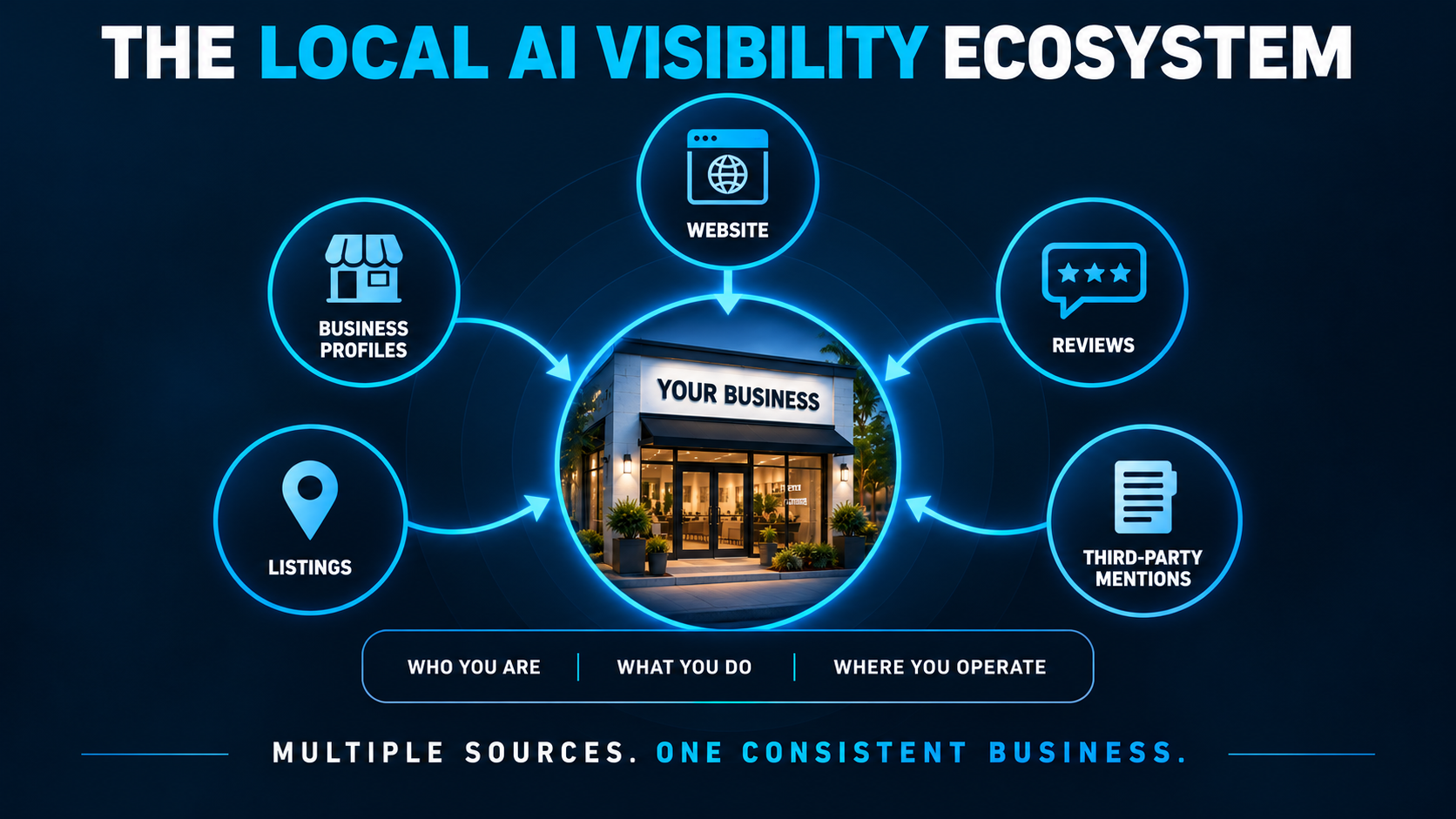
Think in Terms of a Connected Local Entity
The strongest local digital presence isn't a collection of disconnected marketing assets.
It's a connected picture of the same real business.
Your:
Website
says who you are and what you do.
Your:
Business profiles
establish important location and operational facts.
Your:
Reviews
provide customer-generated evidence.
Your:
Listings
reinforce business information across relevant platforms.
Your:
Third-party mentions
provide outside corroboration and authority.
When those sources consistently describe the same company, the business becomes easier to understand.
That benefits humans too.
This isn't about feeding an AI.
It's about eliminating ambiguity from your digital presence.
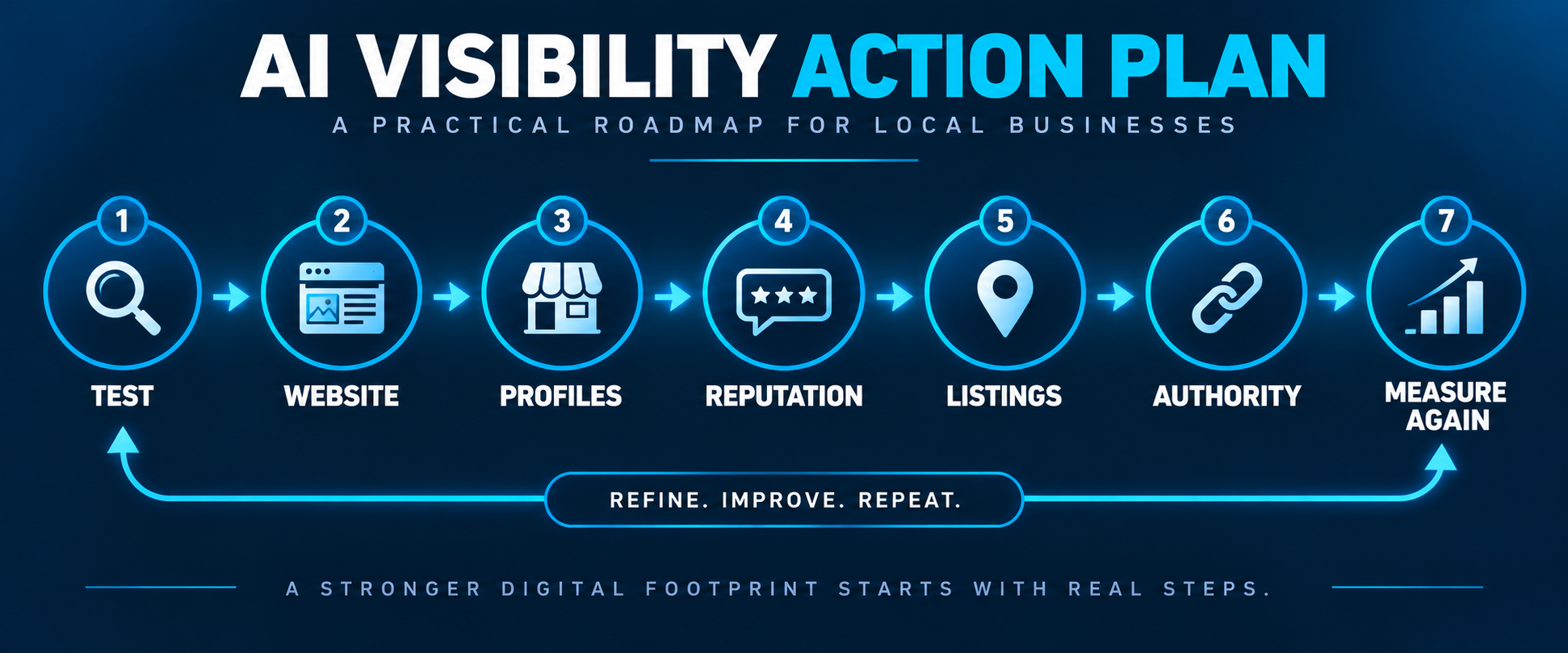
A Practical Local AI Visibility Action Plan
If you want to improve your local AI visibility, don't start by buying an “AI ranking” package.
Start with the fundamentals.
1. Test what AI systems currently say about you
Run realistic searches related to your services and market.
Don't only search your business name.
Try prompts a prospective customer might actually use.
Record:
- whether you're mentioned
- which competitors appear
- whether the information is accurate
- which sources are cited
- which questions produce different results
Our guide to measuring AI visibility explains this process in more detail.
2. Audit your website
Can someone quickly determine:
- what you do?
- where you operate?
- who you serve?
- why you're qualified?
- how to contact you?
Then check whether search crawlers can actually access and index the important pages.
3. Audit your business profiles
Correct inaccurate categories, contact information, hours, URLs, services, locations, and other factual details.
Prioritize profiles that actually matter to your customers and industry.
4. Review your reputation footprint
Look beyond the average star rating.
What do customers consistently say about you?
Are there enough recent, legitimate reviews to give prospective customers meaningful information?
Are you responding appropriately?
5. Check important listings and citations
Search your business name, address, phone number, and variations.
Find stale or conflicting information.
Correct the sources that matter.
6. Look at what AI systems cite in your actual market
Ask relevant questions.
Inspect the sources.
If competitors repeatedly appear through certain legitimate industry directories, publications, associations, or local resources, investigate why.
Don't blindly copy them.
Look for patterns.
7. Strengthen weak content
Create or improve pages where your site doesn't adequately explain important services, expertise, locations, processes, or customer questions.
8. Build legitimate third-party authority
Earn relevant mentions because the business is actually worth mentioning.
That might involve PR, partnerships, associations, community involvement, useful research, expert contributions, local coverage, or industry relationships.
9. Measure again
AI answers can change.
Visibility isn't a one-time certification.
Repeat meaningful queries over time and watch whether your business's presence, accuracy, citations, and competitive position change.
What Should Local Businesses Prioritize First?
If everything above sounds like a lot, use this order:
| Priority | What to work on | Why it matters |
|---|---|---|
| 1 | Accurate, useful website | Establishes your first-party source of truth |
| 2 | Google Business Profile | Critical local-business information and Google visibility |
| 3 | Reviews and reputation | Adds customer-generated evidence and trust |
| 4 | Important listings | Reinforces accurate business information |
| 5 | Useful local/service content | Builds depth around what you actually know |
| 6 | Third-party authority | Provides independent corroboration |
| 7 | AI visibility monitoring | Shows where you're appearing and what sources matter |
Notice what isn't at the top:
“Install an AI SEO plugin.”
There is no substitute for getting the underlying digital presence right.
Is AI Visibility Replacing Local SEO?
No.
The relationship is closer than the marketing around GEO sometimes suggests.
Traditional local SEO already involves:
- crawlability
- useful website content
- Google Business Profile optimization
- reviews
- citations
- links
- local relevance
- authority
Those things don't stop mattering because the answer is generated by AI.
What changes is the surface where discovery happens and the way information may be assembled and presented.
That's why we view AI visibility and SEO as overlapping disciplines rather than competing strategies.
A business shouldn't destroy a sound local SEO strategy to chase AI visibility.
It should expand its visibility strategy to account for how people are now discovering businesses.
Can You Guarantee That ChatGPT Will Recommend Your Business?
No.
Neither can anyone else.
AI-generated answers can vary by platform, query wording, location, available sources, personalization, system changes, and other factors outside a business's control.
You can improve the inputs.
You can make your business easier to understand.
You can strengthen the evidence available across the web.
You can test what happens.
You cannot legitimately promise the output.
For ChatGPT specifically, see our deeper guide to getting your business recommended by ChatGPT.
The Goal Isn't to Convince AI That You're Important
There is a strange way to approach AI visibility:
Try to figure out what the machine wants and manufacture signals for it.
We prefer the opposite approach.
Build a business presence that is clear, accurate, useful, consistent, and corroborated.
Make your website worth using.
Keep your business information correct.
Earn real customer feedback.
Be present on platforms that matter in your industry.
Publish expertise worth referencing.
Earn legitimate third-party recognition.
Then make sure search and AI-assisted discovery systems can actually access that information.
You aren't trying to create an artificial version of your business that looks good to an algorithm.
You're making the real business easier to understand across the web.
That is a much better foundation for local SEO, AI visibility, and whatever form discovery takes next.