AI visibility has created a measurement problem.
With traditional SEO, businesses became accustomed to familiar numbers:
Rankings.
Impressions.
Clicks.
Traffic.
Conversions.
AI-assisted discovery changes the experience.
Someone can ask ChatGPT for recommendations and see your business without visiting your website.
Google can surface one of your pages inside an AI-generated experience.
An AI assistant might mention your company but cite somebody else's website.
Your article might be cited without your company being the recommended provider.
And two people can ask similar questions and receive different answers.
So how exactly do you measure this stuff?
The answer isn't another magic dashboard number.
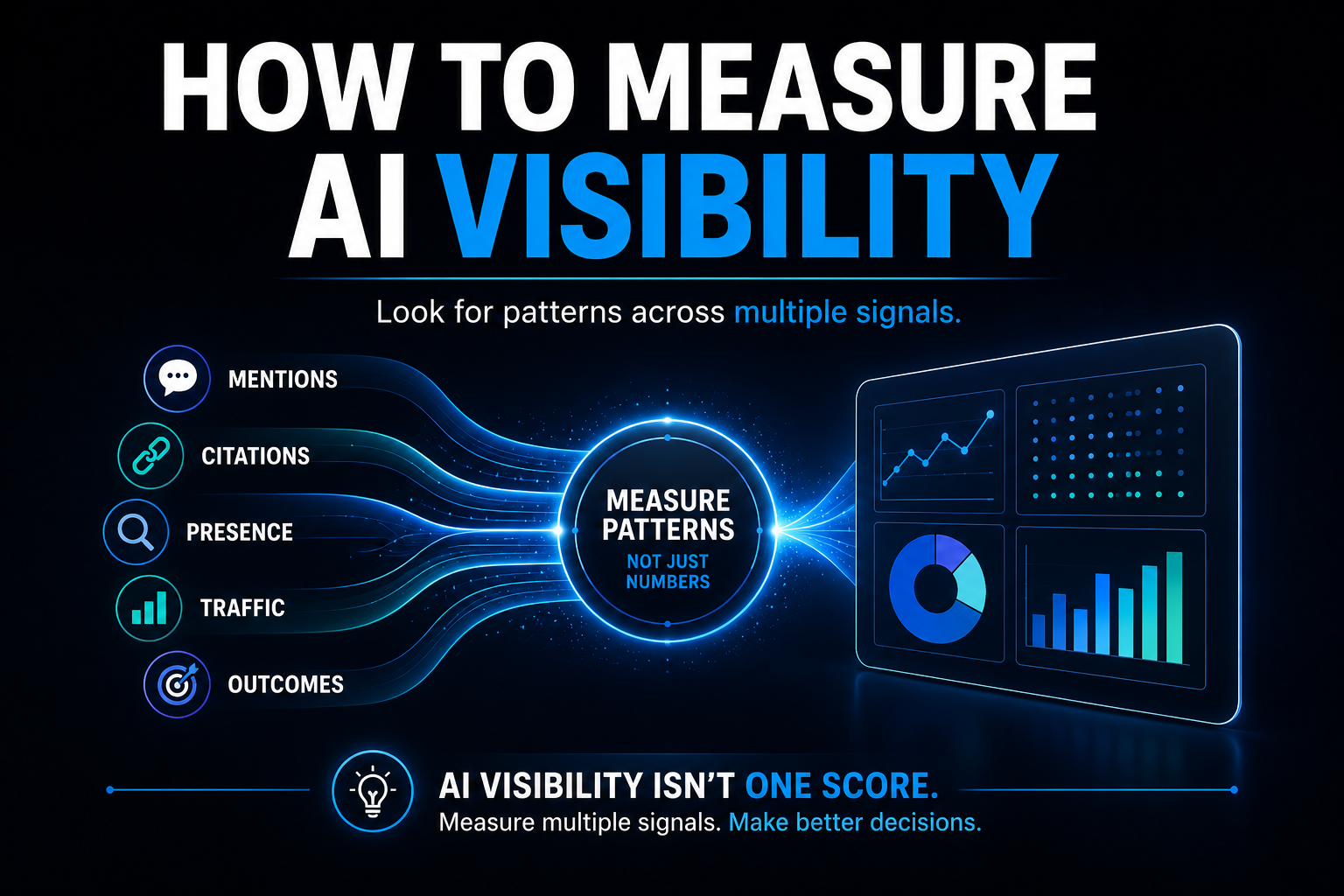
AI visibility needs to be measured as a collection of signals—not one universal score.
What Does It Mean to Measure AI Visibility?
As we defined in What Is AI Visibility?, AI visibility is about how easily a business or brand can be found, understood, mentioned, cited, linked, or recommended within AI-assisted discovery experiences.
Measuring it means looking for evidence that those things are actually happening.
That evidence can come from several places:
- AI responses themselves
- citations and source links
- competitor comparisons
- website analytics
- Google Search Console
- leads and customer conversations
- business outcomes
The important part is keeping those signals separate.
A mention is not automatically a citation.
A citation is not automatically a recommendation.
A recommendation does not necessarily create a click.
And a click isn't automatically a customer.
Once you understand that, AI visibility measurement gets much less mysterious.
Why One “AI Visibility Score” Isn't Enough
There are now platforms that attempt to summarize AI visibility into a single score.
Those scores can be useful.
But they aren't the equivalent of an official measurement standard.
Different tools may monitor different:
- prompts
- platforms
- models
- locations
- competitors
- response types
- sampling frequencies
- scoring formulas
That means two legitimate tools can look at the same company and report different visibility scores.
Neither number necessarily represents the entire market.
Think of an AI visibility score as a measurement produced by a particular methodology, not a universal grade handed down by ChatGPT, Google, Gemini, or Perplexity.
Google itself cautions website owners to be wary of third-party tools that claim access to internal Google metrics or promise ranking success.
Use tools when they make measurement easier.
Just understand what they're actually measuring.
The AI Visibility Measurement Stack
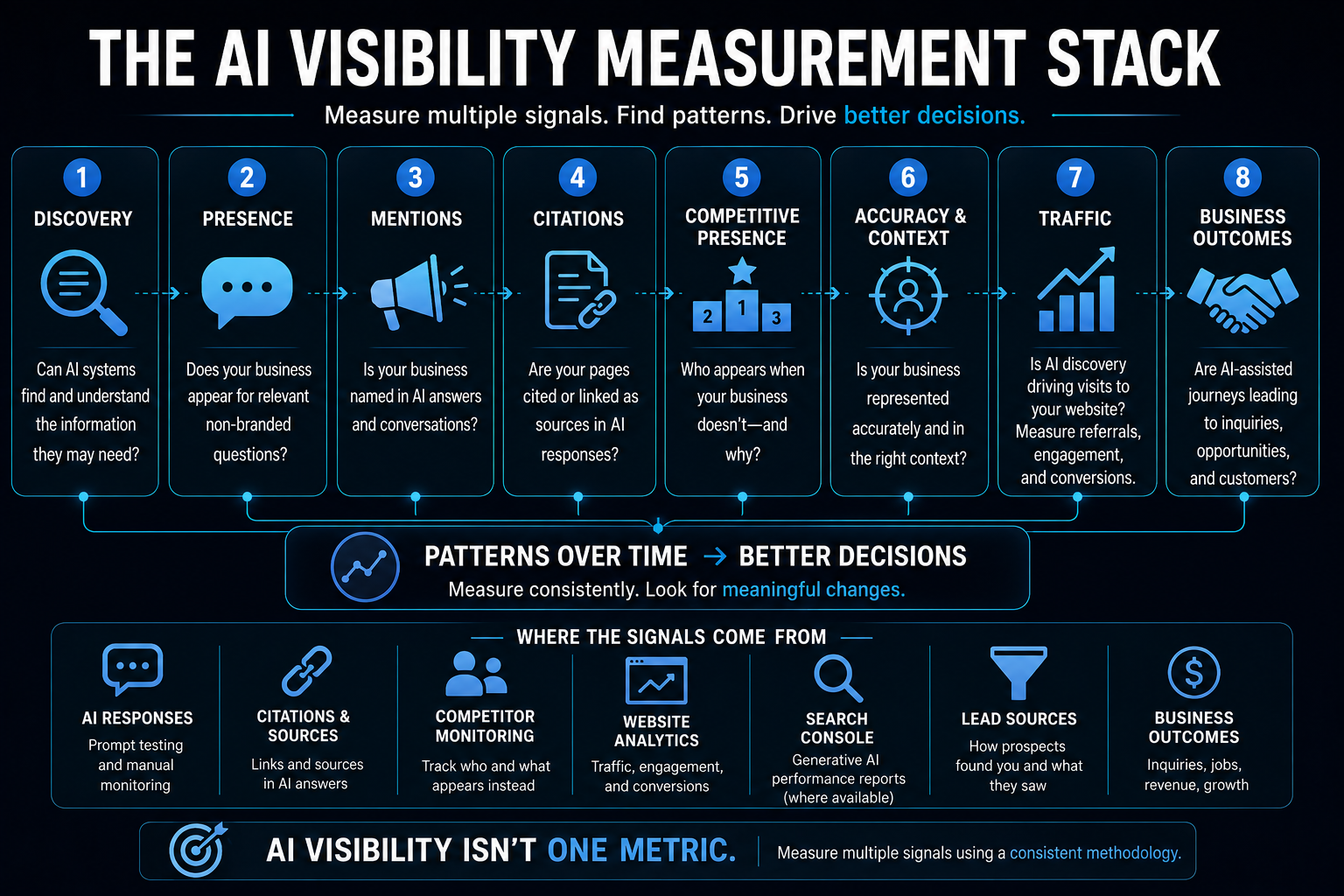
Instead of looking for one number, I prefer to think about AI visibility in layers.
1. Discovery
Can AI systems find and understand the information they may need?
This is the foundation.
That includes whether important pages are publicly accessible, crawlable where appropriate, clearly structured, and understandable.
Discovery isn't proof that you'll be mentioned.
It's the prerequisite for having a reasonable chance of being considered when a system retrieves information from the web.
2. Presence
Does your business appear when people ask relevant questions?
This is where prompt testing becomes useful.
For example, a hypothetical Naples remodeling company might monitor questions such as:
Who are some luxury home remodeling contractors in Naples, Florida?
What companies handle high-end kitchen remodeling in Naples?
Who should I consider for a major home renovation in Southwest Florida?
The question isn't simply:
Did we appear once?
It's:
Across a useful set of relevant questions, how often are we appearing and in what context?
3. Mentions
A mention occurs when the AI response names the business or brand.
That's useful because the company may be part of the answer even when its website isn't cited.
Track:
- whether you're mentioned
- which topics trigger mentions
- which platforms mention you
- how you're described
- which competitors appear alongside you
4. Citations
A citation is different.
This is where a page, website, or other source is actually referenced as supporting material.
Your company can be mentioned without your website being cited.
Your website can also be cited in an educational answer without your company being recommended.
That's why mentions and citations should be tracked separately.
5. Competitive Presence
AI discovery rarely happens in a vacuum.
If a prospective customer asks:
What are the best options for X?
the useful question isn't only whether you appeared.
It's also:
Who appeared instead?
Track recurring competitors and sources.
You may discover that:
- one competitor appears repeatedly
- directories dominate certain prompts
- review platforms are frequently referenced
- your company appears for educational questions but not commercial ones
- your website gets cited while another company gets recommended
Those patterns can reveal much more than a single visibility score.
6. Accuracy and Context
Being visible isn't automatically good.
Suppose an AI assistant mentions your company but says you provide a service you stopped offering three years ago.
Technically, you were visible.
Commercially, that's not particularly helpful.
Monitor whether important information is represented accurately:
- services
- locations
- business category
- expertise
- differentiators
- current offerings
- basic company facts
This is especially important because AI-generated answers can synthesize information from multiple sources.
7. Traffic
Some AI discovery produces clicks.
Some doesn't.
When it does, track it.
OpenAI's publisher guidance says publishers that allow OAI-SearchBot can measure referral traffic from ChatGPT through analytics platforms such as Google Analytics, and ChatGPT referral URLs include the utm_source=chatgpt.com parameter.
That makes ChatGPT referral traffic one of the more concrete signals available.
But don't make the opposite mistake and assume:
No referral traffic = no AI visibility.
Someone may encounter your business inside an answer and never click.
Google Is Starting to Give Us Better First-Party AI Data
This is one of the most important measurement developments of 2026.
In June, Google announced dedicated Google's Generative AI performance reporting in Search Console.
According to Google, these reports can show information including:
- impressions in generative AI features
- pages that appeared
- countries
- devices where applicable
- performance over time
That's a meaningful step forward because businesses can begin seeing first-party information about their visibility within Google's own generative AI search experiences.
There is an important caveat:
Google says these reports are currently being rolled out to a subset of websites.
So don't panic if you open Search Console and don't see one.
Google's broader Search Console reporting also continues to incorporate AI search activity according to its reporting methodology.
The measurement landscape is still developing.
What About ChatGPT, Perplexity, Gemini, and Other AI Platforms?
This is where things become less standardized.
There isn't currently one universal Search Console equivalent that gives every business complete impression data across every major AI assistant.
That means measurement often combines:
first-party data where available + analytics + repeatable prompt monitoring.
This is also why claims such as:
Your AI visibility is exactly 63%.
should immediately trigger the follow-up question:
63% of what?
Which platforms?
Which prompts?
Which locations?
Which competitors?
Which models?
Which time period?
Measurement without methodology isn't very useful.
How to Build a Repeatable AI Prompt Baseline
Randomly asking ChatGPT about your company every Tuesday isn't a measurement strategy.
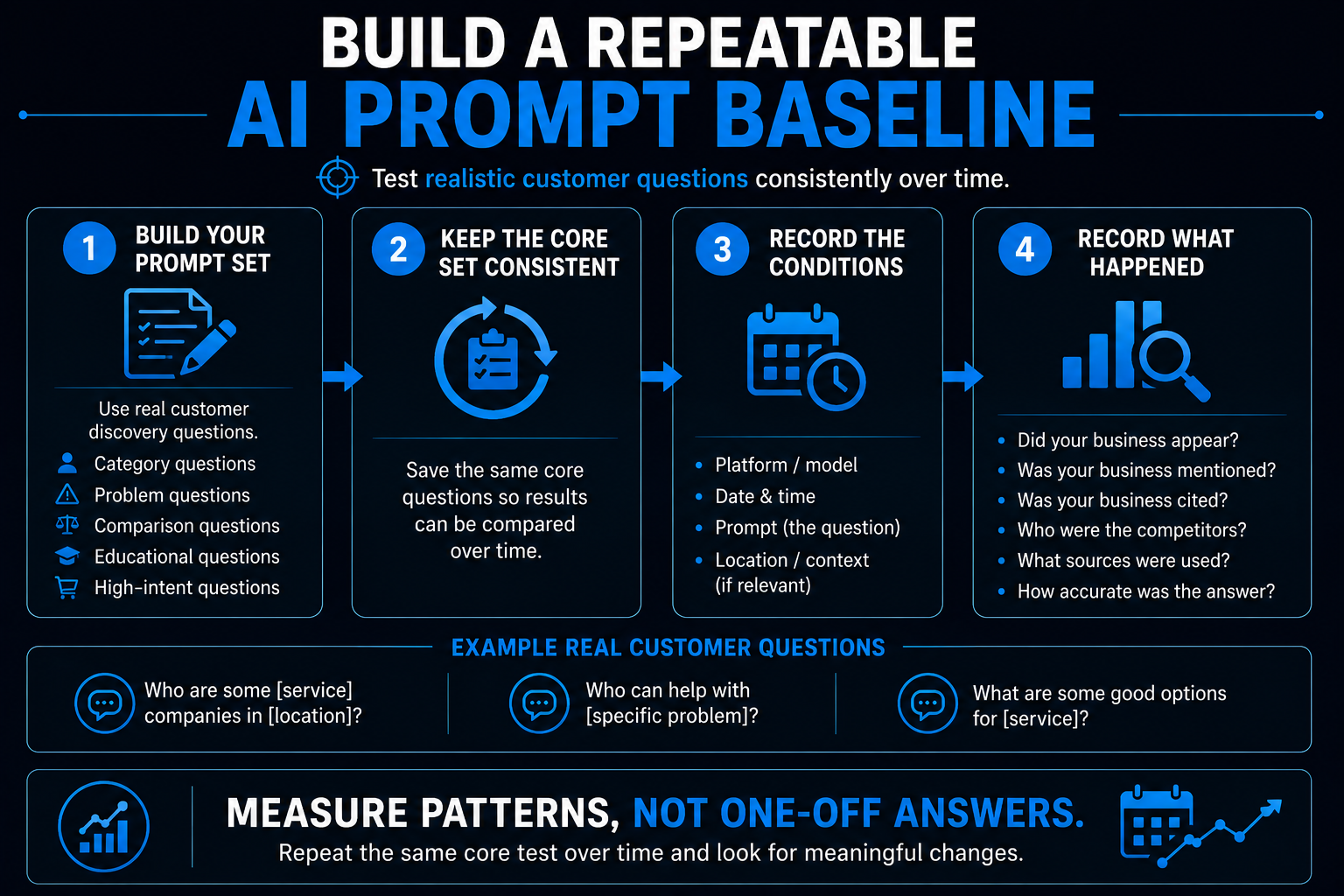
Build a baseline.
Start With Customer Questions, Not Your Brand Name
If you ask:
Tell me about Boost Local Biz.
and the system tells you about Boost Local Biz, you've learned very little about discovery.
The more useful questions are non-branded.
For BLB, hypothetical examples might include:
What companies help service businesses automate lead follow-up?
Who offers AI-powered websites for service businesses?
What type of system can help a contractor respond to and book leads faster?
These are closer to discovery situations where the person doesn't already know which company they want.
Group Prompts by Intent
Don't throw 100 unrelated questions into a spreadsheet.
Create useful groups.
For a local service business, that might include:
Category discovery
Who are some [service] companies in [location]?
Problem-based discovery
Who can help with [specific problem]?
Comparison
What are some good options for [service]?
Educational
What should I look for when hiring a [provider]?
High-intent
Who can I contact for [service] in [location]?
The exact prompts should reflect how real customers evaluate the business.
Keep a Consistent Core Set
AI responses can vary.
That's precisely why consistency matters.
Keep a core set of prompts you can repeat over time.
You can add new questions as you learn more, but don't replace the entire test every month and then pretend the numbers are directly comparable.
Record the Conditions
When practical, note:
- platform
- model or experience
- date
- prompt
- location/context
- whether the business appeared
- whether it was cited
- competitors mentioned
- sources cited
- accuracy
- relevant notes
You don't need a laboratory.
You need enough consistency to identify patterns.
Don't Treat AI Prompt Tracking Like Keyword Rankings
This distinction matters.
Traditional rank tracking encourages a mental model like:
Keyword → position #4.
AI answers don't behave that neatly.
Responses can vary based on:
- platform
- model
- location
- conversation context
- personalization
- freshness
- wording
- available sources
- other system behavior
So avoid reporting:
We rank #2 in ChatGPT.
as though there is one permanent results page where your business occupies position two.
A more defensible statement is:
Across our monitored prompt set, the business appeared in 12 of 20 relevant responses during this test period.
Now we know what was actually measured.
Track Mentions and Citations Separately
This deserves repeating because it's easy to combine them.
Imagine an AI answer says:
Three companies to consider are Company A, Company B, and Company C.
Your business is Company B.
But the sources cited underneath the answer are:
- an industry publication
- a directory
- Company A's website
You earned a mention.
You did not necessarily earn a citation.
Now imagine one of your educational articles is cited in an answer explaining how to evaluate contractors, but your company isn't included in the provider recommendations.
You earned a citation.
You did not necessarily earn a recommendation.
Those are different forms of visibility.
Track them that way.
Measure Competitor Presence Too
Your own visibility becomes more useful when it has context.
Suppose your business appears in 30% of your monitored prompts.
Is that good?
Maybe.
If the strongest competitor appears in 8%, your presence looks significant.
If five competitors appear in 70%, you probably have work to do.
Competitor monitoring can also reveal where their visibility comes from.
Are their websites being cited?
Their Google Business Profiles?
Directories?
Industry publications?
Review sites?
Local news?
Educational content?
You're not trying to copy every source.
You're trying to understand the information ecosystem surrounding the topic.
Watch What Sources AI Systems Keep Using
This is one of the more useful exercises.
For each important prompt, record the sources being cited.
Over time, patterns may emerge.
Perhaps AI systems repeatedly reference:
- authoritative industry websites
- government resources
- original research
- local directories
- review platforms
- detailed business websites
- educational articles
- forums or community discussions
The mix will vary by topic and platform.
Don't turn this into:
Get listed on these seven websites and ChatGPT will recommend you.
That's exactly the kind of GEO shortcut thinking we're trying to avoid.
Instead ask:
What information does this discovery environment appear to rely on, and where does our business have legitimate gaps?
That's a much better question.
Measure AI Referral Traffic
Website analytics still matter.
Create reporting that isolates identifiable AI referral traffic where possible.
Look at:
- sessions
- landing pages
- engagement
- conversions
- lead quality
- assisted conversions where your analytics setup supports them
You may discover that AI referrals are small but highly relevant.
Or that they land disproportionately on educational content.
Or that they rarely convert.
All of those are useful findings.
Don't assume the answer before looking at the data.
Connect Visibility to Business Outcomes
Eventually, marketing has to leave the dashboard.
The strongest measurement question isn't:
Did ChatGPT mention us?
It's:
Is AI-assisted discovery contributing to meaningful business opportunities?
That can be difficult to attribute perfectly.
A prospect may:
- encounter your company in an AI answer
- search your brand later
- visit through Google
- call the business
- become a customer
Analytics might credit Google.
The actual discovery journey began somewhere else.
This is why businesses should also consider qualitative attribution.
Ask new prospects:
How did you first hear about us?
If appropriate, include options for AI tools or AI search in lead-source tracking.
Over time, those answers can reveal behavior your analytics can't.
A Practical AI Visibility Scorecard
You don't need to invent a mysterious 0–100 score.
A straightforward scorecard is often more useful.
| Measurement | Question |
|---|---|
| Discovery | Can important content be accessed and understood? |
| Prompt presence | Do we appear for relevant non-branded questions? |
| Mentions | Is the business named in AI answers? |
| Citations | Are our pages used as sources? |
| Competitors | Who appears when we don't? |
| Accuracy | Is the business represented correctly? |
| Google AI visibility | What does available Search Console AI reporting show? |
| Referral traffic | Are identifiable AI visits reaching the website? |
| Outcomes | Are AI-assisted journeys contributing to inquiries or customers? |
That won't fit into one sexy dashboard number.
Good.
Reality doesn't always fit into one number.
How Often Should You Measure AI Visibility?
Frequent enough to detect patterns.
Not so frequently that you start reacting to noise.
For many businesses, a monthly baseline can be perfectly reasonable.
Businesses in highly competitive or rapidly changing categories may monitor more frequently.
The important thing is consistency.
Running 50 prompts today, 12 unrelated prompts next Thursday, and three screenshots six weeks later doesn't create a useful trend.
What Should You Do With the Data?
Measurement is pointless if it doesn't lead to better decisions.
Suppose you discover:
Your business is rarely mentioned.
Look at whether your website and broader digital presence clearly establish who you are, what you do, where you operate, and why you're relevant.
Competitors are mentioned but your business isn't.
Compare the information ecosystem around them—not merely their page titles.
Your articles are cited but the business isn't recommended.
Your informational authority may be stronger than your commercial/entity signals.
Your business is mentioned inaccurately.
Look for outdated or conflicting information across your website and other legitimate sources.
AI referral traffic lands on articles but doesn't reach commercial pages.
Improve the reader's next step.
The goal isn't to manipulate an AI system.
It's to use the evidence to strengthen the underlying digital presence.
AI Visibility Measurement Is Still Evolving
We should be careful about pretending this field is more mature than it is.
Google is adding first-party reporting.
Analytics platforms are adapting.
AI visibility tools are getting better.
AI assistants themselves continue to change.
Measurement methods that look reasonable today will almost certainly become more sophisticated.
That's okay.
You don't need perfect measurement to start.
You need consistent measurement with clearly defined limitations.
Measure Patterns, Not Screenshots
A screenshot showing ChatGPT recommending your company feels great.
It is not an AI visibility strategy.
Neither is panicking because one prompt didn't mention you.
The useful question is what happens across relevant discovery scenarios, across platforms, and over time.
Are you appearing more often?
Are your pages being cited?
Are AI systems describing the business accurately?
Which competitors and sources keep showing up?
Is identifiable AI traffic reaching the website?
Are those discovery experiences contributing to real opportunities?
Those questions don't produce one magical score.
They produce something better:
A clearer picture of whether your business is becoming easier to find, understand, trust, and choose wherever people increasingly go looking for answers.
For the foundation behind this measurement framework, read What Is AI Visibility?. To understand how it differs from traditional search measurement, see AI Visibility vs. SEO. And for the ChatGPT-specific side of the equation, read How to Get Your Business Recommended by ChatGPT.