
When someone asks ChatGPT for the best contractor, marketing company, dentist, accountant, restaurant, or other business for a particular need, only a handful of companies may make it into the answer.
Naturally, businesses want to know:
How do we become one of them?
There isn't a button you can press to submit your business for ChatGPT recommendations. There also isn't a checklist that guarantees you'll appear.
What you can do is make your business easier to discover, understand, verify, and confidently include in an answer.
That means making sure your website is accessible, clearly explaining what you do and where you operate, publishing genuinely useful information, keeping important business information consistent across the web, earning legitimate third-party signals, and giving AI systems better information to work with.
That's the practical side of AI visibility.
And it's becoming another reason businesses need to think beyond traditional Google rankings.
Can You Make ChatGPT Recommend Your Business?
Not directly.
OpenAI says that any public website can appear in ChatGPT search. It also explains that websites should allow its search crawler, OAI-SearchBot, if they want their content available for discovery, summaries, snippets, citations, and links.
But OpenAI also makes something equally important clear:
Placement is not guaranteed.
That distinction matters.
Allowing ChatGPT to access your website makes discovery possible. It does not make your business the automatic answer when someone asks for a recommendation.
There is no known RecommendMyBusiness=true setting hiding in your website code.
If only it were that easy.
The real work is improving the information ChatGPT can find and the signals available when it tries to determine which businesses or sources are relevant to a user's question.
1. Make Sure ChatGPT Can Access Your Website
Before worrying about content strategy, citations, reviews, or anything else, start with something less exciting:
Can the relevant crawler actually access the site?
OpenAI identifies OAI-SearchBot as the crawler used for search-related discovery.
If your robots.txt file blocks it—or your hosting provider, firewall, CDN, or bot-protection system prevents it from reaching your pages—you may be making it harder for your website content to appear in ChatGPT search.
This is also where an important distinction gets lost in a lot of AI visibility advice.
OAI-SearchBot and GPTBot are not the same thing.
OAI-SearchBot relates to search discovery.
GPTBot relates to controls around whether content may be crawled for potential use in improving OpenAI's generative AI models.
A business can make different decisions about those two things.
OpenAI also notes that allowing OAI-SearchBot doesn't guarantee placement. It simply helps make the content available for search-related discovery.
OpenAI provides current information about making websites available in ChatGPT search here.
Technical accessibility is the starting line.
It isn't the finish line.
2. Make It Obvious What Your Business Does
Imagine landing on a contractor's website and seeing this:
Building dreams. Creating possibilities. Delivering excellence.
Great.
What do they actually build?
Humans get frustrated by vague websites. Machines have the same underlying problem for a different reason: there isn't much concrete information to work with.
A business website should clearly communicate things like:
- what the company does
- which services it provides
- who those services are for
- where the business operates
- what makes particular services or capabilities relevant
- who the company is
This doesn't mean stuffing every city and keyword imaginable into the page.
It means eliminating unnecessary ambiguity.
A page titled Commercial Tenant Build-Outs that clearly explains the work, project types, process, capabilities, and geographic coverage provides substantially more usable information than a page filled with generic statements about "quality and excellence."
The goal isn't to write for robots.
It's to be specific enough that both people and machines can understand the business.
3. Build Pages Around What Customers Actually Need to Know
Your service pages explain what you sell.
Your informational content can explain what you know.
That's an important distinction.
Suppose someone asks ChatGPT:
How long does it usually take to replace impact windows in a three-bedroom home?
A window company's homepage may establish that it installs impact windows.
But a genuinely useful article explaining the variables that affect installation time could provide much better source material for that specific question.
This is one reason a real content library can matter for AI visibility.
Not because "AI likes blogs."
Because useful pages create more opportunities for a business to provide relevant information when people ask specific questions.
Google's current guidance for its own generative AI search features makes a similar point. It recommends creating unique, valuable, non-commodity content rather than manufacturing pages purely to manipulate AI search.
Google's current generative AI optimization guidance also makes clear that traditional SEO fundamentals continue to matter.
That's a useful principle well beyond Google:
Give the web something better than another generic summary of information that already exists everywhere else.
4. Give AI Something Worth Citing
A lot of content technically answers a question without adding much value.
Consider this:
Choosing the right roofing contractor is an important decision. Homeowners should consider experience, quality, and customer service.
True?
Sure.
Useful?
Barely.
Now compare it with a roofing company publishing a detailed explanation of:
- what homeowners should inspect after a major storm
- which damage requires immediate attention
- what can safely wait
- how different roofing materials tend to fail
- what happens during an inspection
- which factors affect repair versus replacement decisions
That content contains actual information.
It can help a prospective customer before that customer is ready to call.
It can support traditional search visibility.
And it creates material that an AI system could potentially retrieve or reference when answering a related question.
This is one of the biggest opportunities businesses miss when they start chasing "GEO."
They optimize the packaging without improving what's inside the package.
AI visibility isn't just a technical problem. It's also an information-quality problem.
5. Build Evidence Beyond Your Own Website
Your website is naturally going to say nice things about your business.
The rest of the web can provide additional context.
Depending on the business and query, that could include legitimate information from:
- business directories and listings
- customer reviews
- professional or industry organizations
- local publications
- news coverage
- community websites
- partners
- social or business profiles
- other credible third-party sources
This does not mean going out and manufacturing hundreds of junk citations because somebody sold you an "AI citation package."
Recent independent research gives us an interesting glimpse into this area.
Insites analyzed ChatGPT citations while auditing 10,000 U.S. local businesses and reported that businesses' own websites and directory/listing platforms were prominent source categories in the responses they studied.
You can review the Insites methodology and findings here.
That's useful observational evidence.
It is not proof that getting listed in a certain number of directories will cause ChatGPT to recommend a business.
Those are two very different claims.
The practical takeaway is simpler:
Don't think of your website as the only place where your business exists online.
A stronger digital footprint gives search and AI systems more information with which to understand the business.
6. Keep Important Business Information Consistent
Let's say one website describes a company as a residential remodeler.
Its business listings primarily describe it as a general contractor.
An old directory shows an outdated address.
A social profile uses an old company name.
Several pages describe completely different service areas.
None of those inconsistencies automatically disqualify the business from AI recommendations.
But why create unnecessary ambiguity?
Important information should be reasonably consistent across the digital ecosystem:
Business name.
Location or service area.
Core services.
Website.
Business identity.
Contact information where applicable.
For local businesses especially, this is already good digital marketing practice.
AI-assisted discovery gives businesses another reason to take it seriously.
7. Earn Real Reviews and Reputation Signals
Reviews matter to customers long before we start talking about AI.
They provide firsthand evidence that real people have interacted with a business.
They can also contribute to the broader body of information available about a company across the web.
But we need to be careful here.
It would be easy to turn this into:
"Get 50 Google reviews and ChatGPT will rank you."
There is no defensible basis for that claim.
Different AI experiences can use different information sources, recommendation mechanisms, search partners, and query context.
The better business strategy is the boring one:
Do good work. Ask legitimate customers for reviews. Respond appropriately. Keep building a real reputation.
That's valuable whether the next customer discovers you through Google, ChatGPT, a referral, or somewhere we haven't started obsessing over yet.
8. Make Your Business Easy to Understand as an Entity
Here's where AI visibility starts sounding more complicated than it needs to be.
An entity is essentially a recognizable person, organization, place, product, or concept.
Your business is an entity.
Your founder may be an entity.
Your services, locations, industry relationships, and content help provide context around that entity.
You don't need to become an expert in knowledge graphs to apply the basic principle.
Your website should make questions like these easy to answer:
Who is this company?
What does it do?
Where does it operate?
Who does it serve?
Who is behind it?
What subjects does it demonstrate expertise in?
What other credible sources corroborate some of this information?
An About page helps.
Clear service pages help.
Consistent business information helps.
Useful content helps.
Legitimate third-party references help.
Structured data can also help search engines understand certain information on a website, but it should be treated as part of sound technical SEO—not as a secret AI recommendation switch.
9. Don't Fall for Every New GEO Hack
Whenever a new discovery channel becomes valuable, an industry quickly appears to sell shortcuts into it.
AI search is no exception.
You'll encounter advice telling you that you must:
- create an llms.txt file
- add special "AI schema"
- break every article into tiny AI-friendly chunks
- rewrite everything specifically for language models
- manufacture mentions across the web
- publish huge amounts of AI-generated content
Treat claims like these carefully.
Google's 2026 guidance is unusually direct about several of them.
For Google's generative AI search experiences, Google says there is no special schema required, no requirement to break content into tiny chunks, no need to rewrite content specifically for AI, and no AI visibility benefit from creating llms.txt for Google Search.
Google's generative AI search guide addresses these misconceptions directly.
That guidance is specifically about Google Search, not every AI platform on the internet.
That's another distinction worth keeping.
Something being unnecessary for Google does not automatically prove that no other service can use it.
The larger principle is:
Don't confuse a new file, tag, tool, or acronym with a visibility strategy.
Technical improvements matter when they solve an actual discovery or understanding problem.
Magic files don't replace authority.
10. Test the Questions That Matter
There's another mistake businesses make when checking their AI visibility.
They ask:
"What is [Company Name]?"
Then ChatGPT describes the company and everybody celebrates.
That's branded discovery.
The more valuable test is often what happens before the customer knows the company's name.
For example:
Who are some good commercial contractors for retail build-outs in Florida?
What companies install impact windows in Fort Lauderdale?
Who can automate lead follow-up for a service business?
What should I look for when choosing a pool remodeling company?
Those questions reveal a different type of visibility.
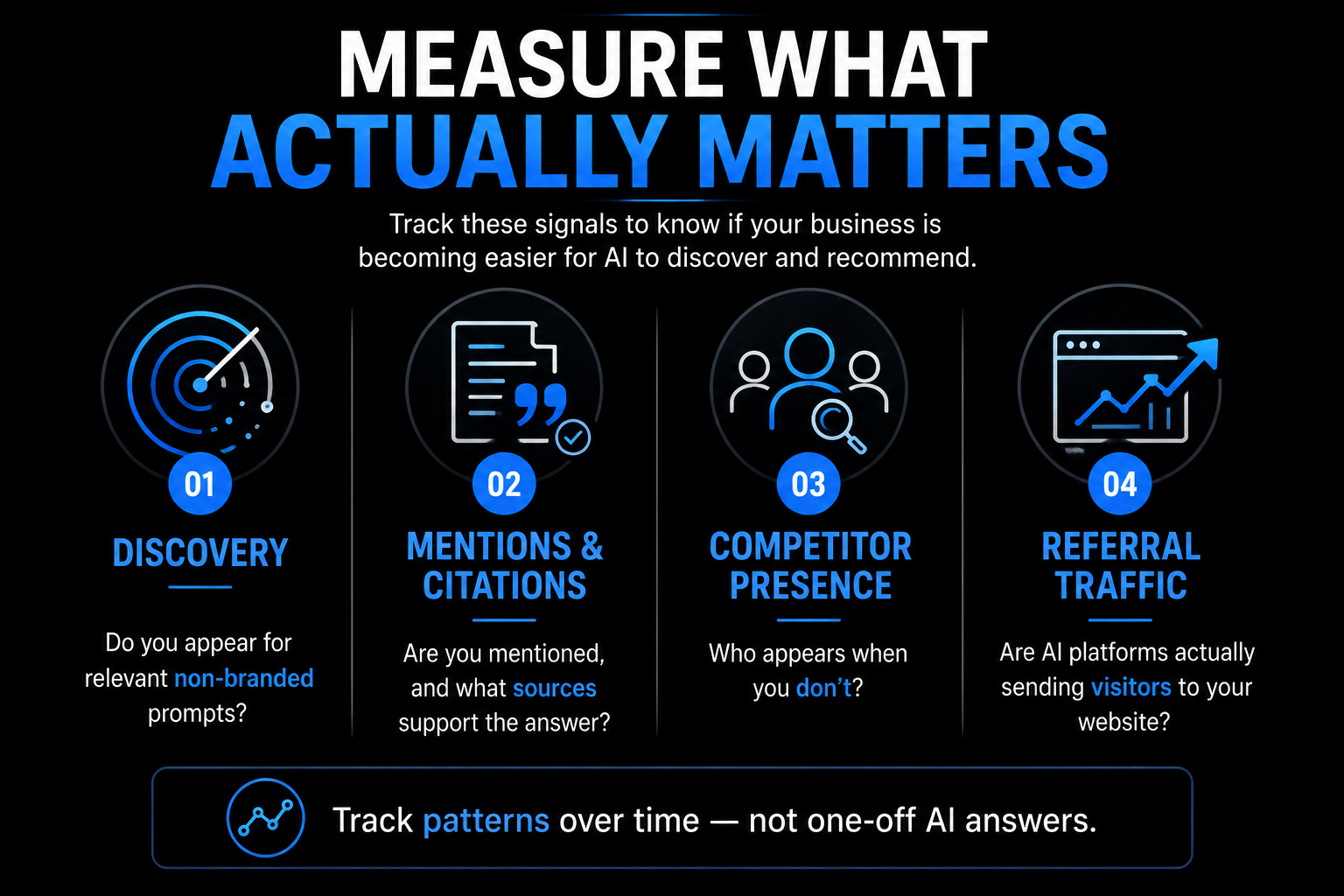
You can build a simple benchmark around representative prompts and periodically record:
- whether the business appears
- how it is described
- whether its website is cited
- which other sources are cited
- which competitors appear
- whether results change over time
Don't treat one ChatGPT answer as a permanent ranking report.
AI answers can vary.
Think in patterns, not screenshots.
11. Measure Traffic From ChatGPT Too
Recommendations and mentions are useful.
Website visits are even more interesting.
OpenAI says referral URLs from ChatGPT search include utm_source=chatgpt.com, which can help publishers identify referral traffic coming from ChatGPT.
OpenAI documents that referral behavior in its publisher guidance.
That means analytics can become part of the picture.
You may eventually want to track:
- ChatGPT referral sessions
- landing pages receiving AI referral traffic
- conversions from those visits
- branded versus non-branded AI discovery
- pages most frequently appearing as cited sources
- changes after meaningful website or content improvements
AI visibility shouldn't become another vanity metric.
A business ultimately cares about whether visibility creates qualified discovery and business opportunities.
So, What Actually Helps a Business Get Recommended by ChatGPT?
There is no publicly documented formula that guarantees a ChatGPT recommendation.
That's the answer businesses need to hear before somebody sells them one.
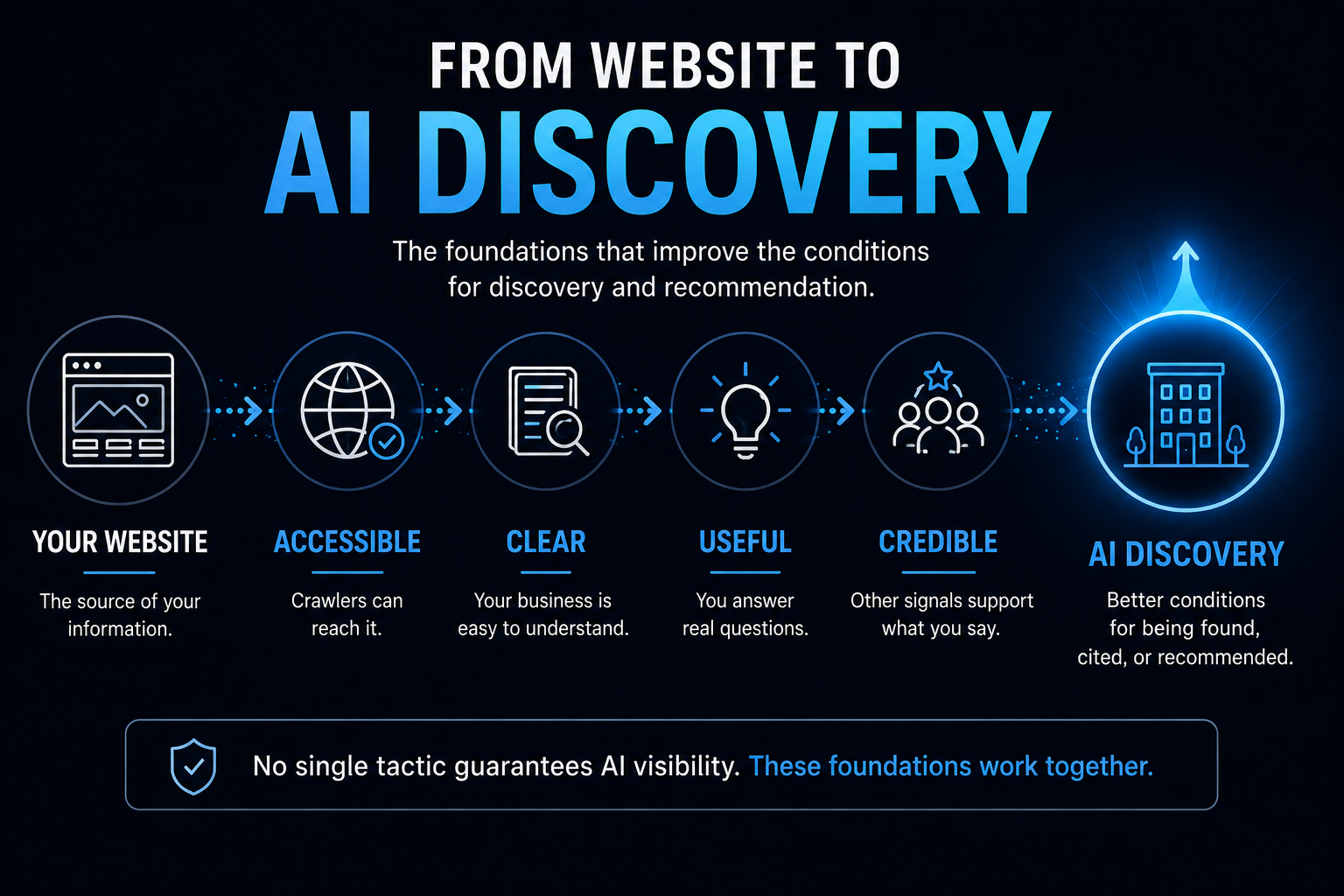
The practical strategy is to improve the conditions that make discovery and recommendation possible:
Be accessible.
Make sure relevant search crawlers can reach your website.
Be clear.
Explain exactly who you are, what you do, who you serve, and where you operate.
Be useful.
Publish information that genuinely answers the questions customers ask.
Be credible.
Build a real reputation and legitimate presence beyond your own website.
Be consistent.
Reduce conflicting information about your business across the web.
Be measurable.
Test meaningful discovery prompts and track actual AI referral traffic where possible.
None of these guarantees that ChatGPT will recommend you.
Together, they create a much stronger digital foundation than chasing whatever "GEO hack" happens to be trending this week.