For years, getting found online mostly meant one thing:
Show up in Google.
That hasn't stopped mattering.
But the way people search for businesses, products, services, and answers is expanding. Someone might search Google, encounter an AI Overview, ask ChatGPT for recommendations, research options with Perplexity, or use another AI assistant to narrow down a decision.
That has created a new question for businesses:
Do we still need SEO, or should we be focusing on AI visibility instead?
The short answer is both—but not because you need two completely separate marketing strategies.
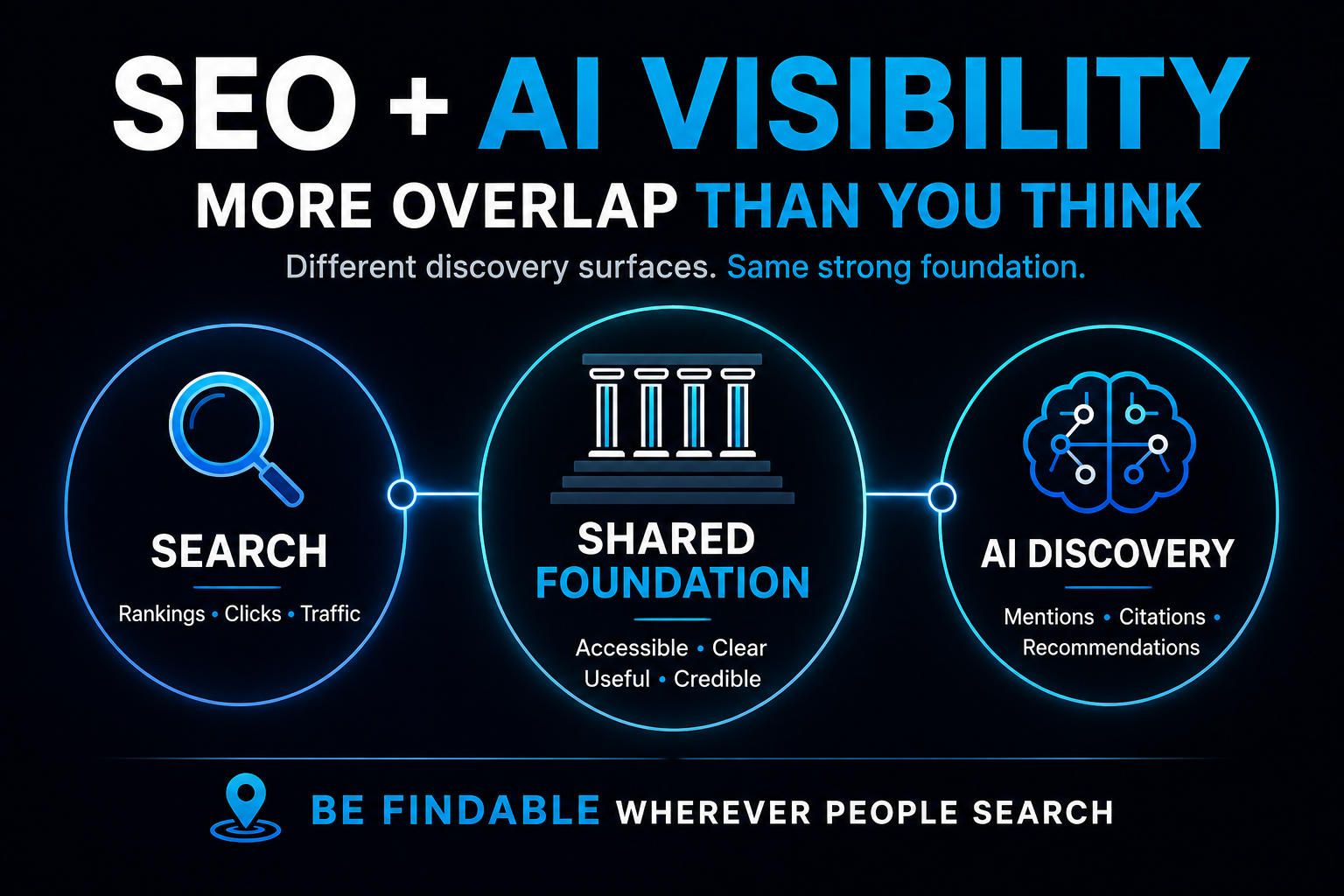
SEO and AI visibility share many of the same foundations: accessible websites, clear information, useful content, authority, relevance, strong business signals, and a trustworthy presence across the web.
The difference is largely where discovery happens and what success looks like.
SEO has traditionally focused on earning visibility in search results and attracting clicks.
AI visibility looks more broadly at whether a business or its content is found, understood, mentioned, cited, or recommended inside AI-assisted discovery experiences.
Those outcomes overlap.
They aren't identical.
SEO Isn't Dead. The Search Experience Is Changing.
Every few years, something supposedly kills SEO.
Social media was going to kill it.
Voice search was going to kill it.
Zero-click searches were going to kill it.
Now AI is apparently standing over the body.
Except SEO is still very much alive.
Google itself reinforced this in its 2026 guidance for generative AI features in Search. Its position is straightforward: many of the SEO practices that help Google crawl, understand, and evaluate content remain relevant to AI Overviews and AI Mode.
Google did not announce that everyone needs to throw away SEO and start practicing a completely unrelated discipline called GEO.
Quite the opposite.
Google's guidance on optimizing for generative AI features emphasizes established SEO fundamentals while also encouraging businesses and publishers to create original, useful, non-commodity content.
So the better question isn't:
Will AI visibility replace SEO?
It's:
How does SEO fit into a world where traditional search results are no longer the only place discovery happens?
What Is SEO?
Search engine optimization is the process of improving a website and its content so search engines can discover, understand, index, and surface relevant pages for searches people perform.
That can include work involving:
- website crawlability and indexability
- site architecture
- keyword and search-intent research
- service and location pages
- useful informational content
- page titles and metadata
- internal linking
- website performance
- structured data where appropriate
- backlinks and authority
- local SEO
- Google Business Profile optimization
- content quality and relevance
The exact strategy depends on the business.
A local HVAC contractor doesn't need the same SEO program as a national software company.
But the basic objective is familiar:
Become a strong result when someone searches for something relevant to your business.
Traditionally, we measure that through things such as rankings, impressions, clicks, organic traffic, calls, leads, and conversions.
What Is AI Visibility?
AI visibility looks at a related but broader question:
When someone uses an AI-assisted discovery experience to research a problem, service, product, company, or recommendation, does your business show up in the answer?
That could mean being:
- mentioned
- cited as a source
- linked
- described accurately
- included in a comparison
- recommended
- surfaced as part of an AI-generated response
That may happen in ChatGPT, Google's AI experiences, Perplexity, Gemini, or other systems.
We've covered the broader concept in What Is AI Visibility? How Businesses Get Found in AI Search.
The important distinction here is that AI visibility isn't simply another ranking position.
An AI response may synthesize information from multiple sources.
It may mention a business without linking to it.
It may cite an article from your website.
It may use third-party information when discussing your company.
It may recommend several businesses instead of presenting ten blue links.
That changes what businesses need to observe.
Where SEO and AI Visibility Overlap
This is where a lot of the conversation gets unnecessarily complicated.
Businesses are being told they need SEO.
Then AEO.
Then GEO.
Then LLMO.
Then AI SEO.
Eventually we're going to run out of letters.
The reality is less dramatic.
A large amount of the work that makes a website stronger for traditional search also makes the business easier for other discovery systems to access and understand.
Crawlability Still Matters
If important content cannot be accessed, discovery becomes harder.
Google needs to crawl pages for Search.
OpenAI separately tells publishers that allowing OAI-SearchBot helps make public website content available for discovery, summaries, snippets, citations, and links in ChatGPT search.
Those are different systems and different crawlers.
But the underlying lesson is familiar:
Important information needs to be technically accessible.
OpenAI's publisher guidance explains how website discovery works for ChatGPT search.
Clear Website Structure Still Matters
A well-organized website makes it easier to understand:
- what the business does
- which services it offers
- which topics pages cover
- where the company operates
- how pages relate to one another
That's useful for customers.
It's useful for search engines.
And it's useful when machines are trying to retrieve and interpret information about the business.
Useful Content Still Matters
Thin content doesn't suddenly become brilliant because somebody labels it "GEO optimized."
If a page provides the clearest, most useful explanation of a question customers actually ask, that page has more potential value across multiple discovery experiences.
Google's current AI-search guidance specifically emphasizes creating unique, valuable, non-commodity content rather than producing more generic material simply because generative search exists.
That's good SEO advice.
It's also good AI visibility advice.
Authority and Credibility Still Matter
Your website doesn't exist in isolation.
Links, legitimate mentions, reviews, business listings, publications, professional associations, community sources, and other third-party references can all contribute to the broader digital footprint surrounding a business.
Exactly how individual AI platforms use those sources varies.
But building a legitimate reputation across the web was useful before ChatGPT existed.
It's still useful now.
So What's Actually Different?
If so much overlaps, why talk about AI visibility separately at all?
Because the interface and the outcome have changed.
Traditional search often looks something like this:
Search → Results → Click → Website
AI-assisted discovery can look more like:
Question → Generated Answer → Mention / Citation / Recommendation → Possible Click
That changes several things.
You Can Gain Visibility Without Winning a Traditional Ranking Position
A business or source can potentially appear within an AI-generated answer even when the experience doesn't resemble a traditional numbered search result.
That means businesses need to monitor more than rankings.
You Can Be Mentioned Without Receiving a Click
This is one of the biggest differences.
If an AI assistant names your company as one of several options, you've gained visibility even if the user doesn't immediately visit your website.
That visibility could influence a later search, phone call, branded query, or decision.
Traditional web analytics may not capture the entire journey.
The Source and the Business Can Be Different
An AI answer could potentially learn about or reference your business through information that doesn't live on your website.
That makes the broader information environment surrounding the company more important to observe.
The Answer Can Synthesize Multiple Sources
Traditional SEO often focuses heavily on which individual URL ranks for a query.
AI-generated responses may combine information from multiple sources into one answer.
That makes being part of the information used to construct the answer another visibility outcome worth monitoring.
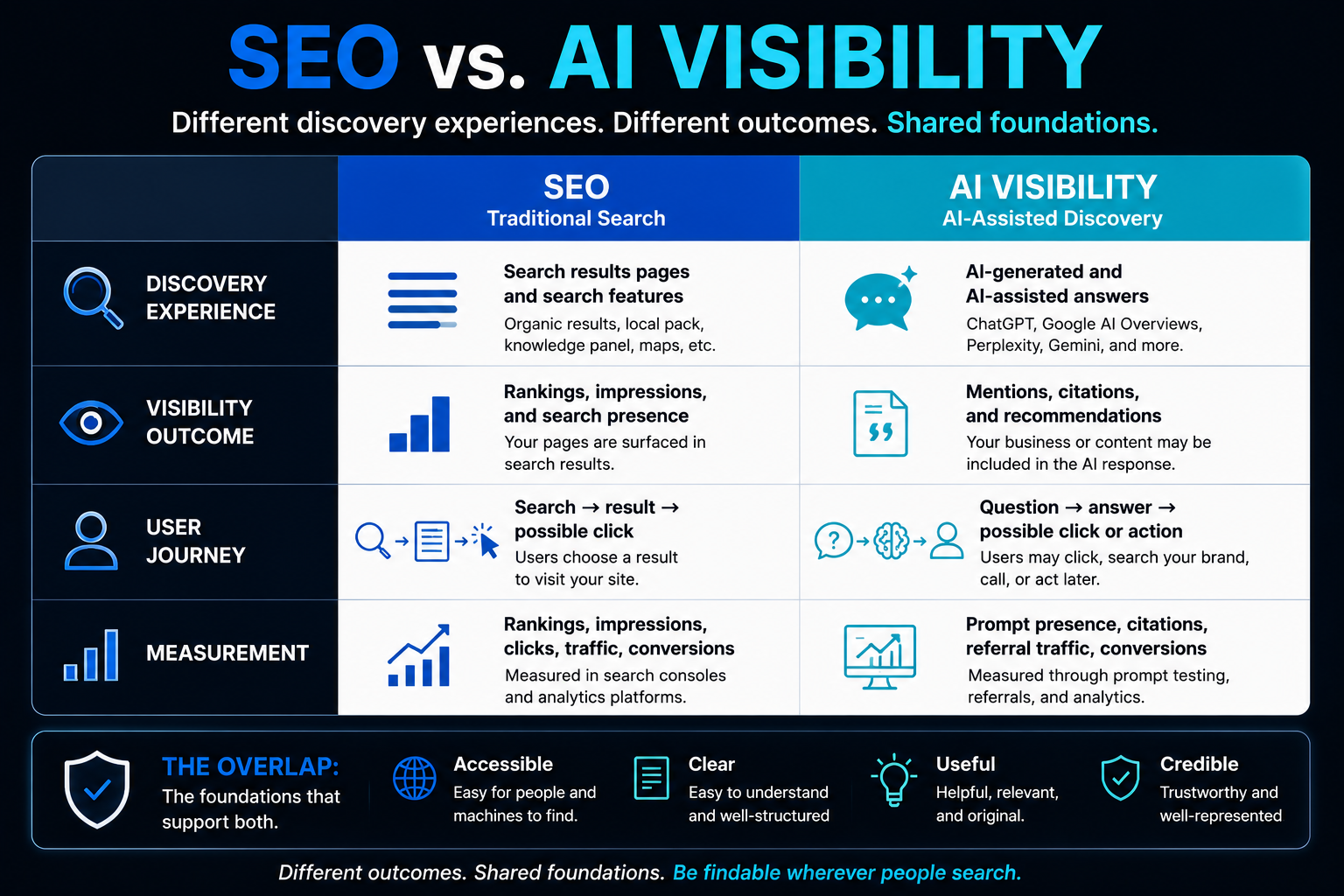
SEO vs. AI Visibility at a Glance
| SEO | AI Visibility | |
|---|---|---|
| Primary goal | Earn visibility in search results | Earn presence in AI-assisted answers and discovery |
| Common outcomes | Rankings, impressions, clicks | Mentions, citations, links, descriptions, recommendations |
| Typical interface | Search-results page | Generated or AI-assisted answer |
| Website importance | Extremely important | Extremely important, but third-party information may also contribute |
| Content quality | Important | Important |
| Technical accessibility | Important | Important |
| Authority/reputation | Important | Important |
| Measurement | Rankings, impressions, clicks, traffic, conversions | Prompt visibility, mentions, citations, recommendation presence, referral traffic, conversions |
| Guaranteed placement? | No | No |
Notice how much of the middle of that table looks the same.
That's the point.
The foundations overlap more than the acronyms suggest.
What About GEO and AEO?
This is where terminology gets messy.
GEO usually means Generative Engine Optimization.
AEO usually means Answer Engine Optimization.
You'll also encounter terms such as LLMO, AI SEO, AI search optimization, and others.
There is no universally agreed industry taxonomy separating all of these into perfectly distinct disciplines.
Some marketers use GEO to describe optimizing for generative AI citations and recommendations.
Some use AEO more broadly for direct-answer experiences.
Some use the terms almost interchangeably.
And some use AI visibility as the umbrella term for the actual outcome businesses care about.
At Boost Local Biz, that's largely why we prefer the phrase AI visibility.
Most business owners don't care which acronym wins the naming war.
They care about a simpler question:
Can customers find us when they use AI to research what we do?
The terminology should help explain the problem.
It shouldn't become the product.
Do You Need SEO and AI Visibility?
For most businesses that depend on being discovered online, yes.
But that doesn't necessarily mean paying for two completely independent campaigns with duplicate work.
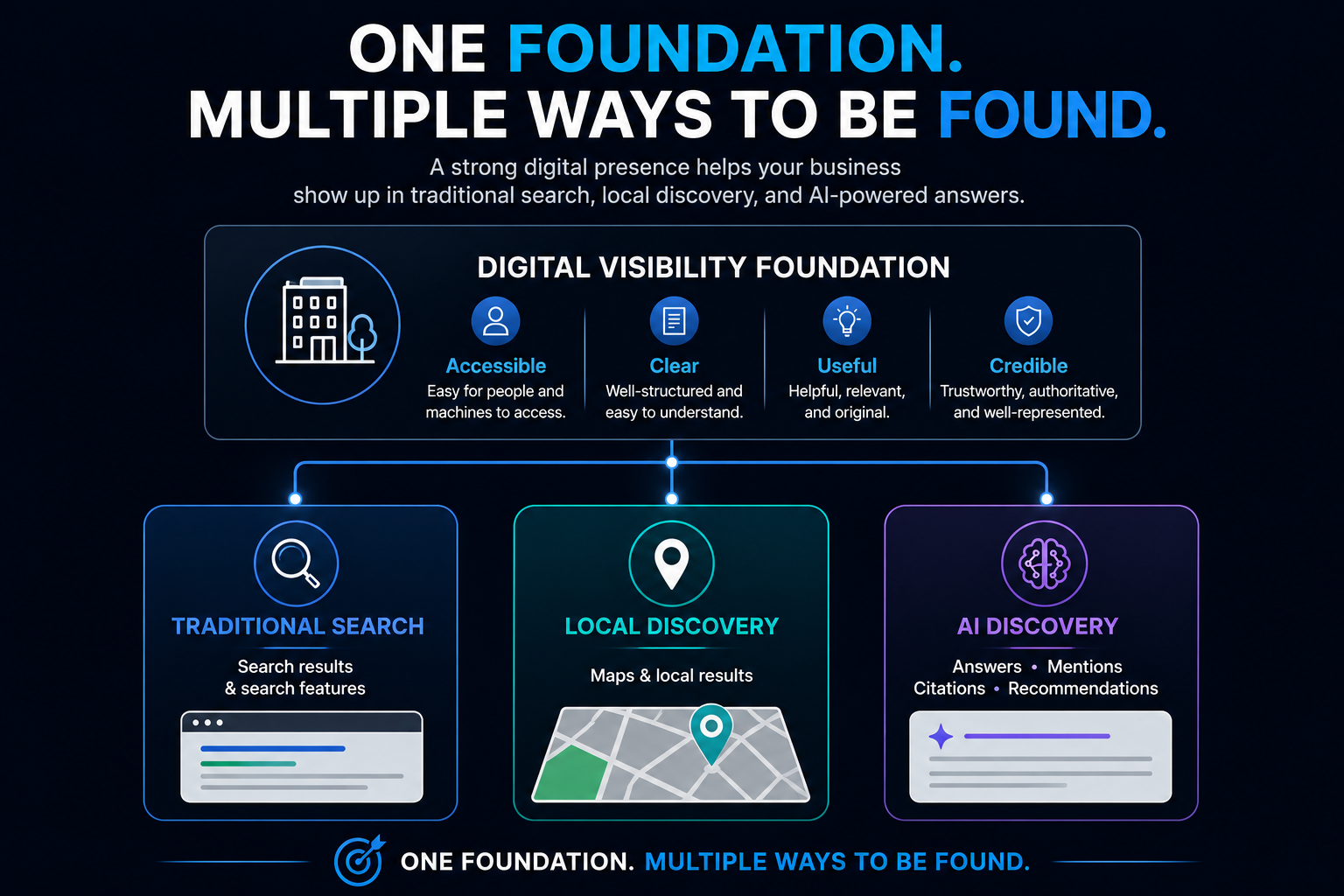
A better approach is to build a strong digital visibility foundation and then account for the different places discovery occurs.
That means continuing to care about:
Google Search.
Google Maps and local visibility where relevant.
Your website.
Useful content.
Technical SEO.
Authority and reputation.
And adding visibility questions such as:
Does ChatGPT mention us for relevant non-branded prompts?
Does our website appear as a cited source?
Which competitors appear when we don't?
How are AI systems describing our company?
Which third-party sources seem to influence those answers?
Are AI platforms sending referral traffic to our website?
That's an expansion of visibility strategy.
Not a funeral for SEO.
Can Strong SEO Improve AI Visibility?
It can create a much stronger foundation for it.
A technically sound website with clear architecture, useful pages, strong internal linking, legitimate authority, and relevant content already solves many of the problems involved in being discovered and understood online.
But you shouldn't assume:
"We rank well on Google, therefore ChatGPT will recommend us."
Those are different outcomes produced by different systems.
OpenAI has its own search discovery mechanisms and crawler controls. Other AI platforms operate differently again.
Likewise, a company appearing in an AI answer doesn't necessarily mean it dominates traditional organic search.
The relationship is better described as overlapping rather than identical.
Our guide to getting a business recommended by ChatGPT goes deeper into the practical factors businesses can work on without pretending there is a guaranteed ChatGPT ranking formula.
Should You Stop Investing in SEO and Move the Budget to GEO?
Usually, no.
That would be an overreaction.
If SEO is generating qualified discovery, traffic, calls, leads, or revenue, abandoning it because AI search is growing would make little sense.
The smarter move is to ask:
What parts of our existing SEO and digital marketing already support AI visibility?
Then:
Where are the genuine gaps?
Maybe your website is technically strong but your company is nearly invisible for relevant AI recommendation prompts.
Maybe you rank for important searches but AI systems misunderstand your services.
Maybe your business has excellent reputation signals but weak informational content.
Maybe you've produced years of content but most of it is generic enough that nobody—human or machine—has much reason to cite it.
Maybe your AI visibility is already stronger than you expected.
You don't know until you look.
What Should a Business Prioritize First?
Don't start by buying every service with an AI acronym attached to it.
Start with the foundation.
1. Make Sure Your Website Is Technically Accessible
Search engines and relevant AI search crawlers need to be able to access the information you want discovered.
2. Make Your Business Easy to Understand
Clearly communicate your services, locations, expertise, identity, and who you help.
3. Strengthen Your Core SEO
Fix genuine technical problems.
Build useful service pages.
Improve internal linking.
Match pages to real search intent.
Strengthen local search fundamentals where appropriate.
4. Publish Information Worth Finding
Answer real customer questions.
Provide original explanations.
Use firsthand expertise where you have it.
Create resources that are better than another generic rewrite of what's already ranking.
5. Build a Legitimate Digital Footprint
Maintain accurate business information.
Earn real reviews.
Build genuine authority.
Seek legitimate mentions and relationships rather than manufactured "AI citations."
6. Measure AI Discovery Separately
Test relevant non-branded prompts.
Track mentions and citations.
Observe competitors.
Monitor referral traffic.
Look for patterns over time.
That's where AI visibility adds something genuinely new to the traditional SEO playbook.
Google Itself Is Blurring the Line
There's an interesting wrinkle in the whole SEO-versus-AI debate:
Google Search itself is becoming more AI-driven.
Google's AI Overviews and AI Mode are part of Google Search.
In May 2026, Google published dedicated guidance about optimizing for generative AI features and explicitly reinforced that SEO best practices remain relevant.
Then in June, Google clarified another increasingly common claim: llms.txt is not required for Google Search and does not positively or negatively affect Google Search visibility or rankings.
That doesn't mean an llms.txt file can never be useful to another service.
It means businesses should stop treating every new AI optimization tactic as universally required.
Google documents these AI-search updates through Search Central.
This is likely where the industry is headed:
Less separation between "search" and "AI search."
More emphasis on whether a business has a strong, accessible, useful, trustworthy information presence wherever discovery happens.
The Better Strategy Is Search Visibility + AI Visibility
SEO still matters.
AI visibility matters too.
And increasingly, trying to draw a giant wall between them isn't particularly useful.
A better model is:
Build a digital presence strong enough to be discovered across multiple surfaces.
Traditional search.
Local search.
AI-generated answers.
Recommendation experiences.
Research assistants.
Whatever comes next.
The tactics won't be identical across every platform.
The measurement certainly won't be identical.
But the foundation remains remarkably familiar:
Be accessible.
Be understandable.
Be useful.
Be credible.
Be relevant.
Then measure whether you're actually being found.
That's a much stronger strategy than abandoning twenty years of search fundamentals because somebody invented another acronym.