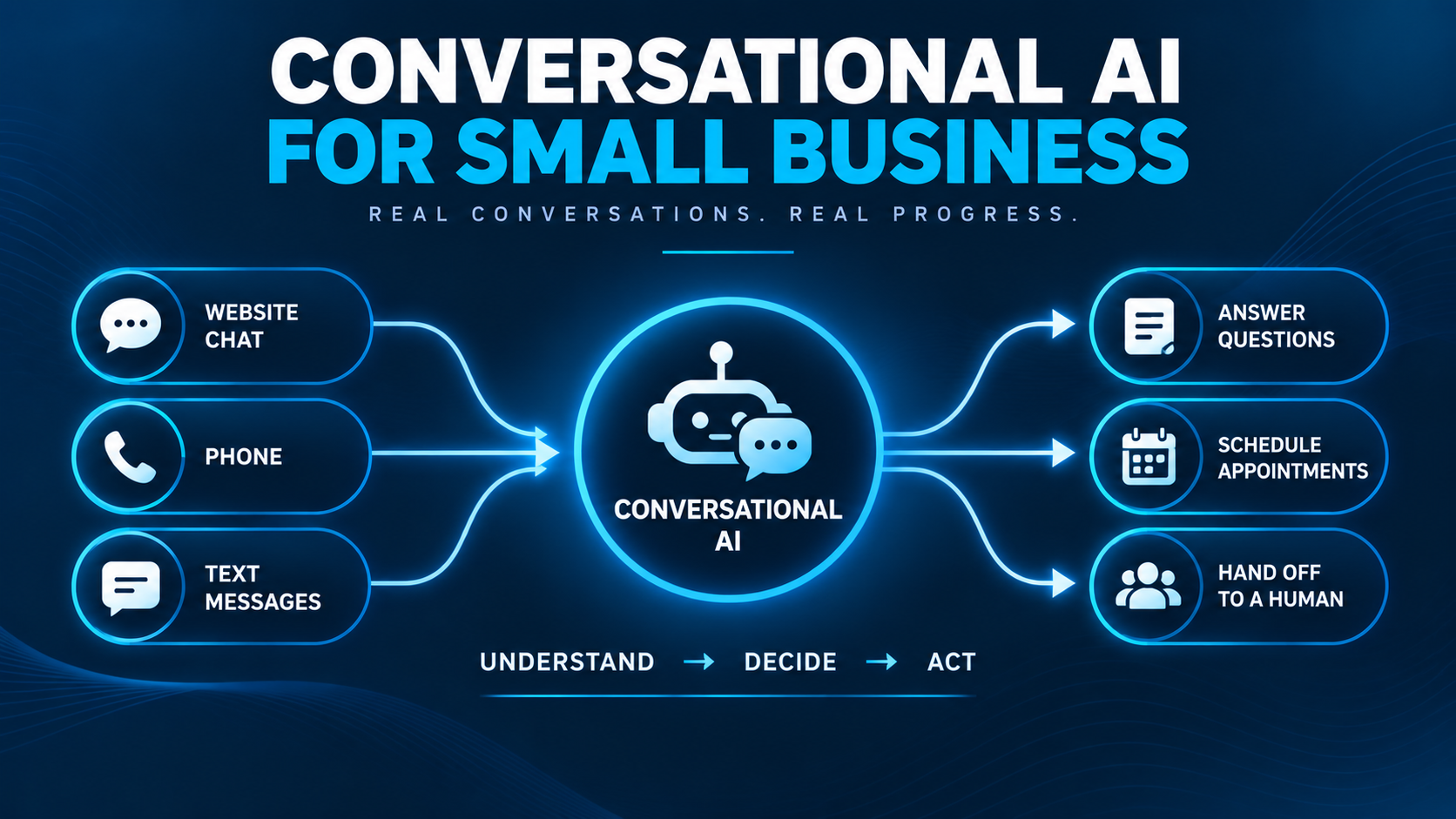
A potential customer visits your website at 9:30 at night and asks whether you service their area.
Another person calls while your team is already on the phone.
Someone else replies to a text asking whether you have an appointment available Friday.
These are three different channels, but the business problem is essentially the same:
Someone wants to have a conversation with your business, and they expect the conversation to go somewhere.
That's where conversational AI can become useful.
For a small business, conversational AI is technology that can understand and respond to customers using natural language through channels such as website chat, phone calls, and text messaging. More capable systems can also use information about the business, recognize what the customer is trying to accomplish, and take approved actions such as capturing information, qualifying an inquiry, scheduling an appointment, or handing the conversation to a person.
The important part isn't that the AI can talk.
It's whether the conversation can produce the right next action.
What Is Conversational AI?
Google Cloud defines conversational AI as artificial intelligence that can simulate human conversation, using technologies such as natural language processing, foundation models, and machine learning.
For a small business owner, however, the technical definition only tells part of the story.
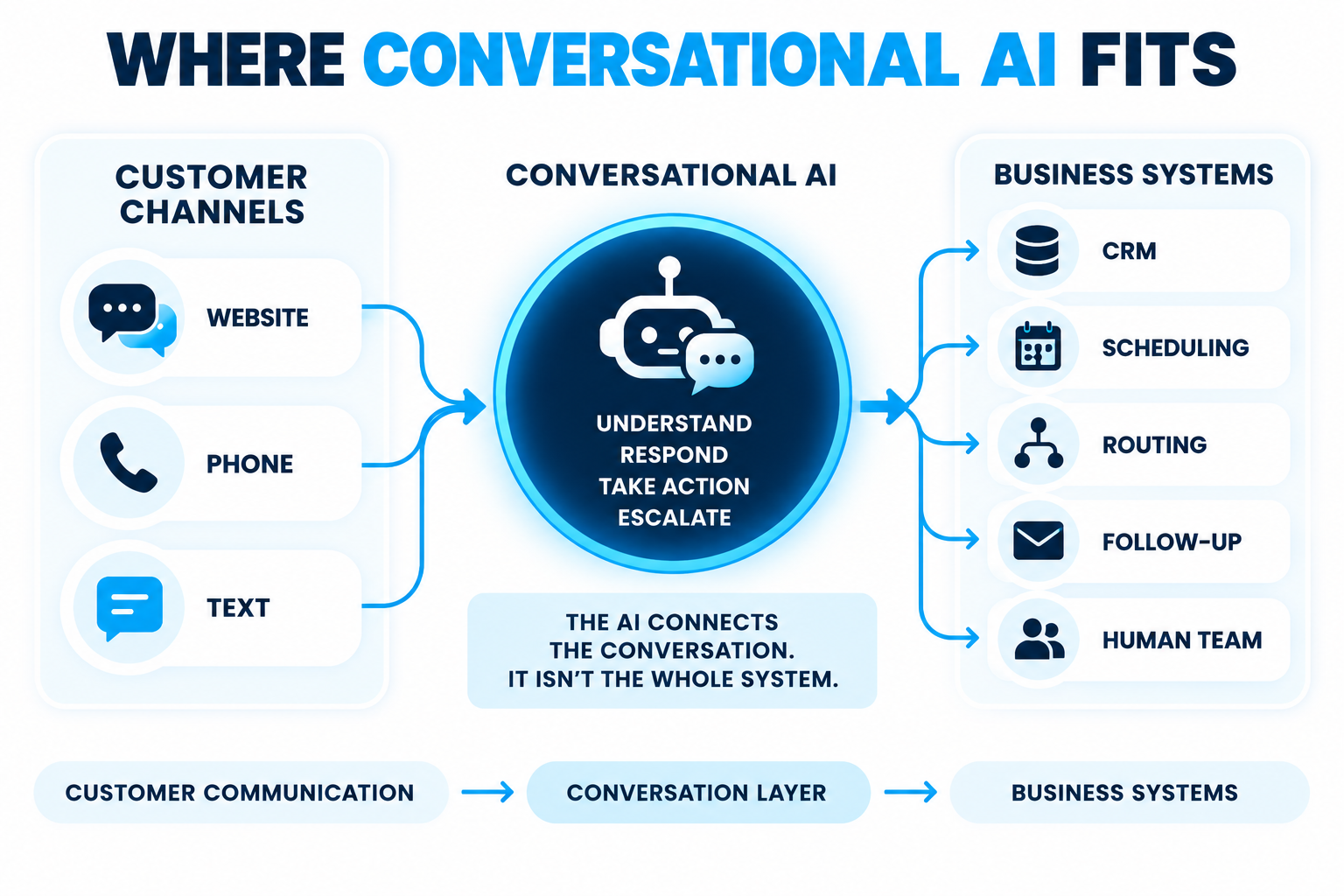
Think of conversational AI as a layer between customer communication and business action.
A traditional contact form collects information.
A basic chatbot may follow a predetermined decision tree.
Conversational AI can potentially interpret what someone is saying, respond based on the context of the conversation, and determine what should happen next.
For example:
Customer: “Do you guys repair pool heaters in Naples?”
A useful system shouldn't simply reply:
Yes, we provide pool services. How may I help you?
It should understand that the person is asking about:
- a specific service,
- in a specific location,
- with likely service intent.
Depending on how the business has configured the system, the next step might be asking a qualifying question, collecting contact information, offering an appointment, or transferring the conversation to a team member.
That's substantially more useful than merely producing a human-sounding sentence.
Conversational AI Is More Than a Chatbot
The terms chatbot and conversational AI are often used interchangeably, but they aren't always the same thing.
A chatbot describes an interface or communication method. Conversational AI describes the intelligence that can power a conversation.
Some chatbots use simple rules:
Choose one:
- Request a quote
- Schedule service
- Ask a question
There is nothing inherently wrong with that. For some businesses, a simple menu is exactly what's needed.
A conversational AI system can go further by allowing someone to type or say something naturally:
“My AC stopped cooling this afternoon and I have a newborn in the house. Can somebody come tonight?”
Instead of forcing that person through a rigid menu, the system can potentially recognize the problem, urgency, location, and desired outcome from the conversation itself.
If you want a deeper look specifically at website chat, see What Is an AI Website Chatbot?
Where Can a Small Business Use Conversational AI?
Conversational AI isn't limited to a chat bubble in the corner of a website.
It can be used anywhere customers and leads are already trying to communicate.
Website chat
A website visitor can ask questions about services, locations, availability, pricing policies, or next steps without searching through multiple pages.
The conversation can also move toward lead capture, qualification, or scheduling when appropriate.
Phone calls
Voice AI can hold spoken conversations with callers.
For a service business, that might include answering common questions, identifying why someone is calling, collecting information, routing the call, or scheduling an appointment.
An AI receptionist is one practical application of conversational AI.
Text messaging
Conversational AI can continue a conversation through SMS rather than sending only fixed automated messages.
That can be useful when a prospect replies to a missed-call text, asks a follow-up question after submitting a form, or needs help finding an appointment time.
Lead follow-up
Follow-up doesn't always need to be a one-way sequence of predetermined messages.
If someone replies, conversational AI can potentially interpret the response and adjust what happens next.
That distinction matters because good automated lead follow-up should respond to what has actually happened rather than blindly continuing a sequence.
Appointment scheduling
If the system has access to the appropriate scheduling rules and calendar availability, a conversation can move directly into booking.
Instead of:
“Someone from our office will contact you to schedule.”
the customer may be able to choose an appropriate appointment while they're already engaged.
Existing-customer questions
Conversational AI can also handle certain repetitive questions from current customers when it has reliable information and appropriate boundaries.
That doesn't mean every support issue should be automated.
Some conversations require judgment, empathy, account access, technical expertise, or human discretion.
Good implementation includes knowing the difference.
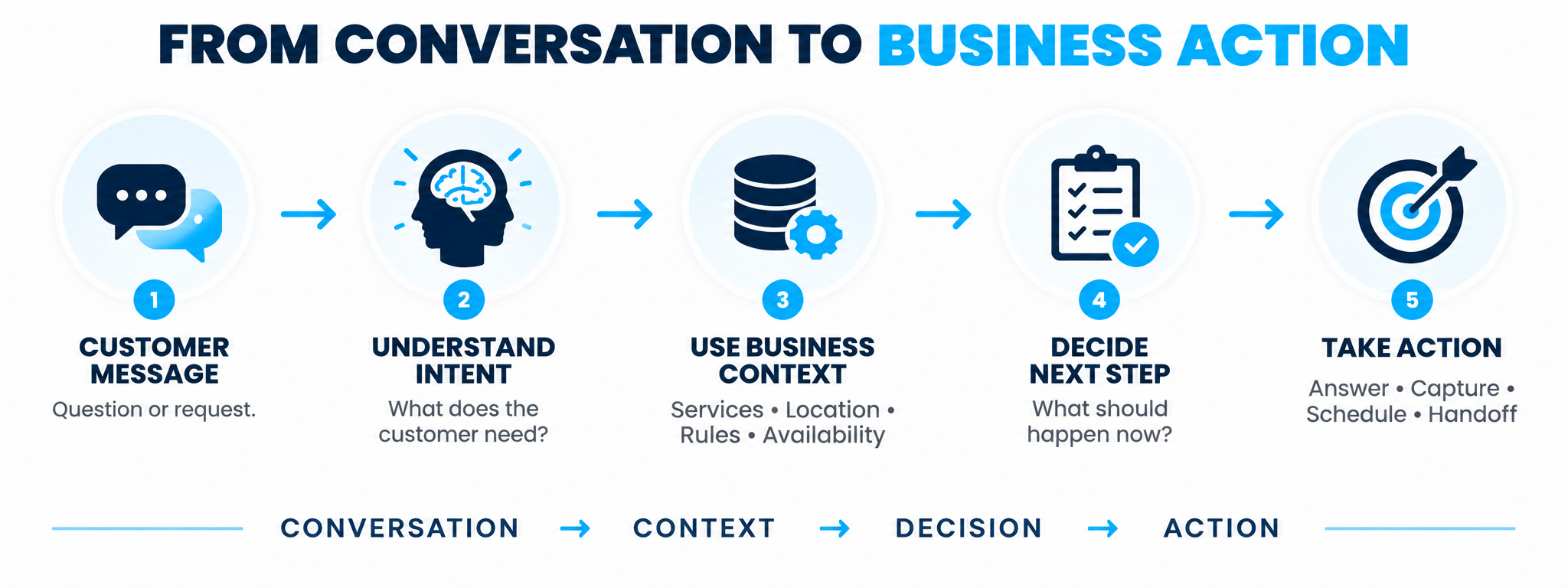
The Real Difference: Conversation vs. Action
This is where many discussions about conversational AI get too focused on the AI itself.
A system that produces impressive responses but cannot do anything useful may still create more work for the business.
Imagine a prospect tells an AI assistant:
“Yes, Thursday afternoon works.”
What happens next?
Does the system:
- know which calendar applies?
- know what type of appointment the person needs?
- know the business's service area?
- know whether Thursday afternoon is actually available?
- collect the required information?
- create or update the contact record?
- schedule the appointment?
- send the appropriate confirmation?
- stop unnecessary follow-up?
Those connections determine whether conversational AI is simply an interesting interface or part of an actual business system.
For BLB, this is the more useful way to evaluate the technology:
Conversation → Context → Decision → Action
The quality of the words matters.
But the quality of the next action matters more.
What Does Conversational AI Need to Know About Your Business?
Conversational AI becomes more useful when it has reliable context.
That may include:
- services offered,
- service areas,
- business hours,
- common customer questions,
- scheduling rules,
- pricing policies,
- qualification criteria,
- escalation rules,
- staff or department routing,
- information the AI should never provide,
- situations requiring human involvement.
This is one reason installing a generic AI widget and telling it to “answer customer questions” isn't much of an implementation strategy.
The system needs boundaries.
It needs to know what it is allowed to say and do.
And just as importantly, it needs to know what it doesn't know.
Conversational AI Should Not Pretend to Know Everything
A useful business AI does not need to win every conversation by itself.
Sometimes the correct response is:
“I want to make sure you get the right answer. Let me have someone from our team help with that.”
That's not a failure.
That's good system design.
Problems arise when an AI confidently invents information about pricing, availability, policies, technical issues, or services because nobody established appropriate boundaries.
The goal isn't maximum automation.
The goal is appropriate automation.
Routine, predictable conversations are usually better candidates.
Sensitive, unusual, high-value, disputed, or judgment-heavy situations may deserve human involvement.
Conversational AI vs. Live Chat vs. Traditional Chatbots
These technologies can overlap, but the distinction is useful.
| Technology | What it generally does | Main limitation |
|---|---|---|
| Traditional chatbot | Uses rules, menus, or predetermined responses | Can struggle outside defined paths |
| Live chat | Connects the customer with a human through messaging | Requires someone available to respond |
| Conversational AI | Interprets natural-language conversations and can potentially use context and take approved actions | Requires good information, integrations, boundaries, and oversight |
| AI receptionist | Applies conversational AI primarily to front-desk communication, often including voice | Not every call or situation should be automated |
None is automatically “best.”
The right choice depends on what customers need to accomplish and what the business needs to happen after the conversation.
Where Conversational AI Fits in a Lead Conversion System
Conversational AI becomes especially interesting when it connects to the rest of the customer journey.
A prospect might:
Visit website → Ask question → Provide information → Get qualified → Schedule → Receive confirmation → Enter follow-up
Or:
Call business → AI answers → Identify need → Collect details → Route to employee
Or:
Submit form → Receive immediate response → Reply by text → Continue conversation → Schedule appointment
The AI is not the entire system.
It's the conversation layer connecting the customer to the appropriate next step.
That's why conversational AI fits naturally inside a broader lead conversion system.
What Are the Benefits for a Small Business?
The strongest potential benefits are practical rather than futuristic.
Faster responses
Customers can receive an initial response when employees are busy or unavailable.
That matters because the opportunity often exists at the moment someone reaches out—not several hours later.
Coverage outside normal hours
A website, phone line, or messaging channel doesn't necessarily have to become completely unresponsive when the office closes.
Conversational AI can handle appropriate conversations after hours while reserving others for the team.
Less repetitive work
Businesses answer many of the same questions repeatedly.
Hours. Service areas. Appointment availability. Basic service questions. What happens next.
Automating appropriate repetitive conversations can give employees more time for work requiring actual judgment.
Better transitions from question to action
Someone asking a question is often doing more than gathering trivia.
They may be deciding whether to call, request an estimate, schedule, visit, or buy.
A useful conversational system can help move that person toward the appropriate next step while their interest is active.
More consistent information
When properly configured, the system can use the same approved business information across repeated conversations rather than relying on whoever happens to answer.
But consistency only helps when the underlying information is accurate.
Bad information delivered consistently is still bad information.
What Can Go Wrong?
Conversational AI can also create a terrible customer experience.
Common problems include:
- giving inaccurate answers,
- pretending to understand when it doesn't,
- forcing customers to keep talking to AI when they want a person,
- asking unnecessary questions,
- repeating information the customer already provided,
- failing to recognize urgency,
- booking incorrectly,
- continuing follow-up after someone has already taken action,
- using awkward or overly enthusiastic language,
- trying to automate situations that require human judgment.
This is why the demo isn't the implementation.
A polished five-minute demonstration can show that AI is capable of conversation.
It does not prove that the system understands your business, your workflows, your exceptions, and your customers.
Should Conversational AI Replace Employees?
Usually, that's the wrong question.
A better question is:
Which conversations require a person, and which ones mainly require a fast, accurate, repeatable process?
A customer with an unusual complaint may need a human.
A homeowner asking whether you service their ZIP code probably doesn't need to wait three hours for someone to answer.
A complicated estimate may require expertise.
An appointment request may simply need availability and scheduling rules.
The practical opportunity is to divide the work intelligently rather than treating AI as either useless or a replacement for everyone.
How to Decide Whether Your Business Needs Conversational AI
Start with the communication problems—not the technology.
Look at what happens today when customers:
- call and nobody answers,
- visit your website after hours,
- submit a form,
- reply to a text,
- ask common questions,
- want to schedule,
- need to reach the correct person.
Then identify where conversations regularly stall.
Maybe calls reach voicemail.
Maybe web leads wait until the next morning.
Maybe employees repeatedly answer the same five questions.
Maybe prospects exchange six text messages just to find an appointment time.
Maybe the business already responds quickly and conversational AI would add very little.
That's useful information too.
Don't buy conversational AI because conversational AI exists.
Use it where a conversation currently creates friction, delay, repetitive work, or lost context.
A Simple Conversational AI Evaluation Checklist
Before implementing a system, a small business should be able to answer:
Business knowledge
- What information can the AI reliably use?
- Who keeps that information current?
Channels
- Where should conversations happen—website, phone, SMS, or some combination?
Actions
- What is the AI allowed to do?
- Can it capture leads, qualify, schedule, route, or update records?
Boundaries
- What should it never answer or do?
- When must a human take over?
Integrations
- Does it need access to a CRM, calendar, phone system, or other software?
Conversation design
- Does it ask only for information that's actually needed?
- Does it remember what the customer already said?
Measurement
- How will you know whether it is helping?
That last question gets overlooked.
“People talked to our AI” isn't much of a business metric.
Look at outcomes such as whether inquiries were captured correctly, conversations reached the appropriate next step, appointments were scheduled accurately, handoffs worked, and employees spent less time on repetitive communication.
Conversational AI Is a Layer, Not the Whole Business System
It's tempting to make conversational AI the centerpiece because it's the part customers can see and hear.
But a great conversation sitting on top of a broken process is still a broken process.
If the AI captures an inquiry but nobody follows up, the problem remains.
If it schedules appointments into the wrong calendar, faster automation made things worse.
If it qualifies a lead but the CRM never records the information, context disappears.
If it answers a missed call beautifully but has nowhere useful to send the caller, the conversation accomplished very little.
The strongest implementations connect conversational AI to the systems already responsible for moving opportunities forward.
That may include the website, phone system, CRM, pipeline, calendar, notifications, follow-up, and human team.
The AI handles the conversation. The system handles what happens because of it.
The Conversation Isn't the Outcome
Conversational AI has become much better at sounding natural.
That's impressive technology.
But small businesses don't ultimately need software that can merely hold impressive conversations.
They need customers to get useful answers.
They need inquiries captured.
They need the right opportunities routed correctly.
They need appointments scheduled when appropriate.
And they need people brought into the conversation when human judgment matters.
That's the standard worth using when evaluating conversational AI:
Don't ask only, “Can it talk?”
Ask:
“What happens because of the conversation?”