Give me five minutes with a local business website and I can usually tell whether we have a problem.
Not whether I like the colors.
Not whether the logo could be a little bigger.
And definitely not whether some automated website grader gives it an 87 instead of a 92.
I want to know something much more important:
Is this website making it easier for someone to become a customer — or is it getting in the way?
Because a website can look perfectly respectable and still do a terrible job of helping the business.
So forget the 50-point audit for a minute.
Here’s the five-minute test I’d use.
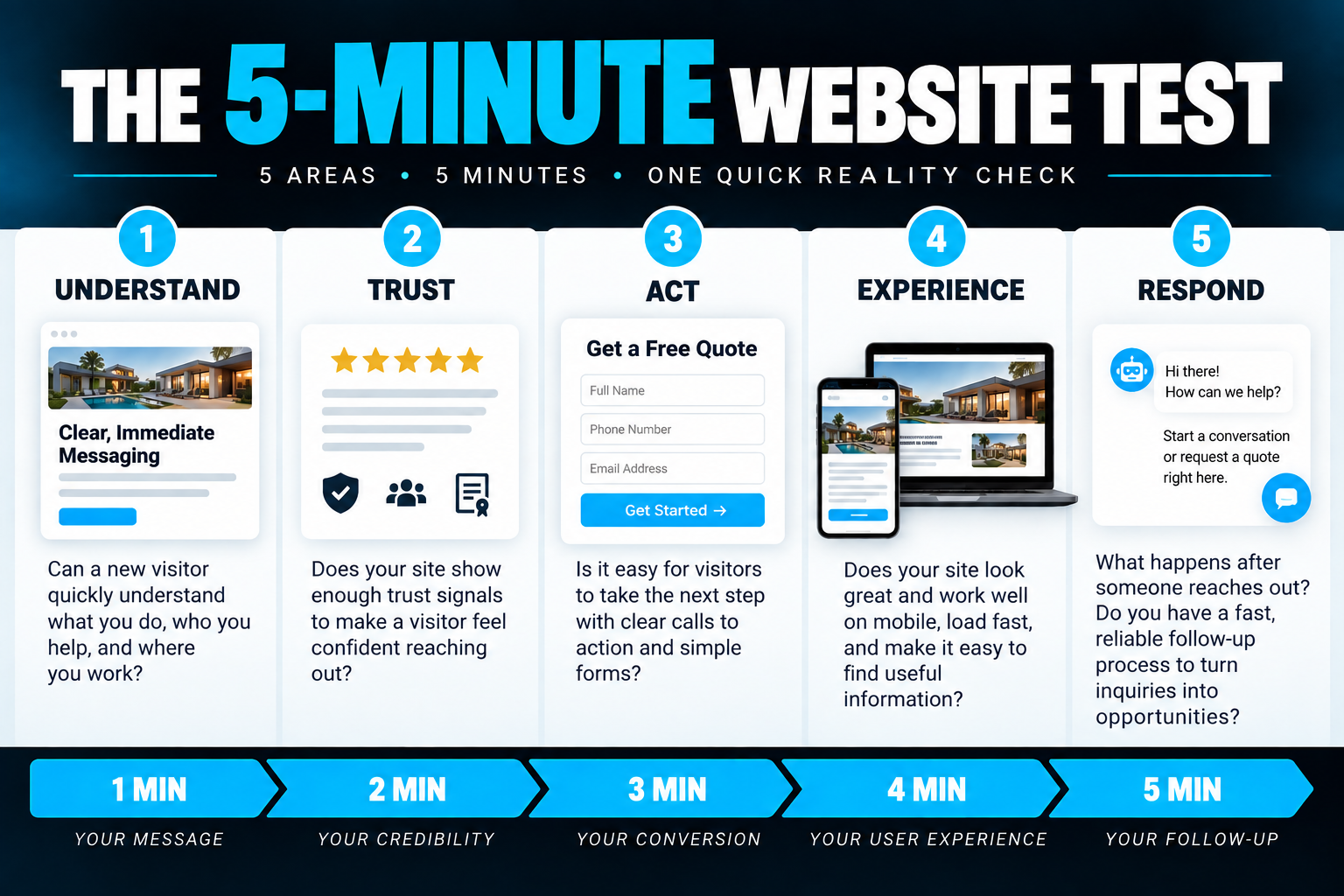
Minute 1: Do I immediately understand what you do?
Start on the homepage and pretend you know nothing about the company.
Don’t scroll yet.
Within a few seconds, can you answer the only question that matters at this stage: What does this business actually do?
That sounds ridiculously basic, but you’d be surprised how many websites make visitors work for the answer.
“Quality. Integrity. Excellence.”
Great.
Quality what?
If you’re a pool builder, say you build pools. If you’re a roofer, tell me you repair and replace roofs. If you remodel kitchens in Naples, Florida, I shouldn’t have to click through three pages to figure that out.
Who do you serve? Where do you work when geography matters?
A visitor should not have to investigate your business to understand why they’re there.
Clever marketing language is fine, until it starts obscuring the actual offer.
Clarity beats cleverness.
Minute 2: Do I have a reason to trust you?
Now I start looking for reasons to believe the business behind the website is legitimate.
Reviews.
Real project photos.
Before-and-after examples.
Licensing or credentials when they’re relevant.
Years in business, if that’s meaningful.
Clear information about the company.
Actual evidence of the work you do.
Notice what I’m not looking for:
A giant paragraph telling me you’re the “premier provider of best-in-class, industry-leading solutions.”
Anybody can write that. It means almost nothing.
Don’t just tell me you’re good. Show me something.
A good local business website should reduce uncertainty as I move through it.
Minute 3: Is the next step obvious and easy?
Let’s say I’m interested. Now what?
Call?
Request an estimate?
Schedule something?
Send a message?
Start a chat?
Whatever the appropriate next step is, I shouldn’t have to hunt for it.
Is the phone number easy to find?
Can I actually use it?
Can I request an estimate, or book a time when that makes sense, or message someone without filling out a form that asks for my life story before we’ve even spoken?
Every bit of friction needs to earn its place. You need enough information to have a useful conversation. You don’t need a visitor’s entire biography to reply to a simple question.
And this doesn’t mean putting seventeen flashing “GET A QUOTE” buttons on the page. Hitting a visitor with too many competing calls to action is its own kind of confusion.
The website should guide me toward a sensible next step — the one that feels like the natural continuation of the conversation, not a flashing collection of buttons.
Minute 4: Does the website work like a customer expects it to?
Now pull out your phone.
That’s where little problems become big problems fast.
Can I read everything comfortably?
Can I tap the buttons?
Does anything overlap?
Do huge images push the useful information halfway down the page?
Does a popup cover everything the moment I arrive?
Can I find the phone number or contact option without fighting the website — or does it quietly disappear on mobile?
Don’t just shrink the desktop version and call it mobile-friendly. Don’t obsess over some technical speed score, either. Use the site like a customer would.
Then ask whether the site actually answers the questions a customer is trying to answer before they pick up the phone.
How does the process work?
What are my options?
Is this even for someone like me?
What affects the price?
How long does it usually take?
What should I consider before choosing a provider?
You don’t need to answer every question anyone has ever asked. But if your customers keep asking the same things, your website probably shouldn’t pretend those questions don’t exist. Useful content helps people make progress toward a decision — which is a big part of what a service business website should include.
Minute 5: What happens when I actually raise my hand?
This is the one most website audits skip.
I actually submit the form. Or start the chat. Or follow whatever path the website is asking a prospective customer to take.
Then I look at what happens next.
Do I get confirmation that my message went through?
Do I know what to expect?
Does the inquiry actually reach the business?
Do I get an acknowledgment — and how quickly does a real, meaningful response come?
If I call and nobody answers, is that opportunity simply gone? Or is there a recovery path for the missed call?
Because from the customer’s perspective, the website experience didn’t end when they clicked Submit.
They raised their hand. What the business does next matters.
A beautiful website connected to a terrible follow-up process can still lose a very interested customer. No follow-up, slow follow-up, or a missed call that nobody recovers — any of those can quietly erase the lead the website just worked to create.
This is where I stop looking at the website as a standalone thing and start looking at it as the front door to a larger system.
Would I actually take the next step?
This is the question that ties the whole test together.
After five minutes on the website:
Do I understand what this business does?
Do I believe they can help me?
Have they given me a reason to trust them?
Is contacting them easy?
Do I know what happens next?
If the answer is yes, the website is doing its job.
If the answer is no, I want to figure out where the hesitation began.
Sometimes the problem is traffic.
But often it isn’t.
Sometimes the people are already arriving — the website just isn’t giving enough of them a reason, or an easy enough path, to continue.
Sometimes the business doesn’t need more marketing. It needs better systems behind the website that’s already getting traffic.
Your website doesn’t have to win design awards
I like a great-looking website.
But that’s not the standard I care about most.
A website doesn’t have to win design awards.
It doesn’t have to use every new AI feature.
It doesn’t have to impress another web designer.
It needs to help the right potential customer understand, trust, act, and move into a real conversation.
Traffic matters.
SEO matters.
Design matters.
AI visibility matters.
Advertising matters.
But ultimately, somebody has to become a customer.
That’s the job all of this is supposed to support.
Let Me Give Your Website the 5-Minute Test
It can be hard to evaluate a website you’ve looked at hundreds of times with fresh eyes. We’ll look at how clearly your site communicates what you do, how easy it is for potential customers to take the next step, and where you may be losing opportunities.
- Clear messaging
- Trust & credibility
- An easy next step
- Where leads slip away